
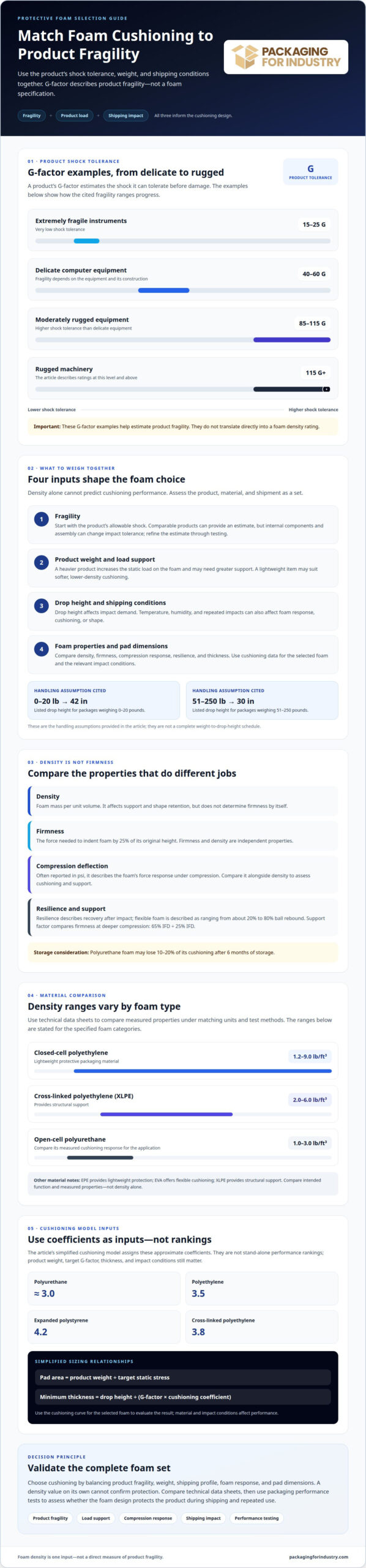
A higher foam density doesn’t automatically mean better protection. The right choice depends on how much shock the product can tolerate, its weight, and the shipping conditions. Understanding how to select foam density for the fragility G-factor starts with treating the G-factor as a measure of product fragility, not a foam specification. Extremely fragile items may have a fragility range of 15-25 G’s, while rugged machinery may be rated at 115 G’s and up.
Density and firmness are easy to confuse, but they describe different properties. Density affects support and shape retention; firmness describes how the foam responds under compression. Both matter when choosing cushioning that protects a product without adding unnecessary weight or creating a rigid impact point.
This article explains how density affects cushioning, how to use a product’s fragility and shipping profile to guide foam selection, and how to validate the foam set through packaging performance tests. It also covers common density ranges and quality categories, so you can make a more informed packaging decision and reduce the risk of shipping damage.
Key Takeaways
- Separate foam density from firmness so you can compare cushioning materials on the properties that affect your product.
- Use product fragility, weight, and shipping conditions together to guide foam selection instead of choosing density by itself.
- Compare material data sheets to understand how EPE, EVA, and XLPE may suit different protective packaging needs.
- Use performance testing to assess whether a foam design protects the product during shipping and repeated use.
- Explore custom foam packaging and inventory options that can support reliable supply and help reduce shipping damage.
Common Mistakes When Designing Cushioning Foam Packaging
Cushioning performance depends on more than density. Firmness, compression response, and resilience matter too. Treating these properties as interchangeable can leave a product under-supported or exposed to damaging impacts.
Density, Firmness, and Compressibility
Density is foam mass per unit volume; firmness is the force needed to indent foam by 25% of its original height. These independent properties affect cushioning differently, so a density rating alone cannot predict firmness. Compression deflection, commonly reported in psi, describes a foam’s force response under compression. Compare both measures to balance gentle cushioning with support for the product’s weight. Resilience describes recovery after impact, with flexible foam ranging from about 20% to 80% ball rebound. Polyurethane foam may lose 10-20% of its cushioning after 6 months of storage.
Support Factor and Compression Modulus
Support factor compares foam firmness at deeper compression with its initial firmness: divide 65% IFD by 25% IFD. Compression modulus describes how resistance changes as foam compresses further. These measures help assess whether cushioning can support a product without bottoming out during shipping. Temperature and humidity can affect foam response, while repeated impacts can reduce cushioning or change its shape. Consider the full shipping environment, not just a single impact.
Cushioning Curves and Pad Dimensions
A cushioning curve relates static stress and foam thickness to the G-factor transmitted during impact. To estimate pad area, divide product weight by the target static stress; then estimate minimum thickness by dividing drop height by the product of G-factor and cushioning coefficient. For example, the simplified model assigns polyurethane foam a coefficient of approximately 3.0. Use the curve for the selected foam to evaluate the result, since material and impact conditions affect cushioning performance.
What G-Factor Should I Use for My Product?
A product’s G-factor estimates the shock level it can tolerate before damage. Use its fragility, weight, and shipping conditions together to guide cushioning selection.
Estimating Product Fragility
Fragility is the maximum shock a product can withstand, expressed as a G-factor. Similar products provide a starting estimate, but internal components and assembly can change impact tolerance. Extremely fragile instruments may fall within 15-25 G’s; delicate computer equipment may fall within 40-60 G’s. Moderately rugged equipment may range from 85-115 G’s. Use the closest comparable product, then refine the estimate through testing.
Choosing Foam for Fragile Products
Foam selection means matching cushioning response to the product’s fragility and load. A product with a low allowable G-factor needs cushioning that absorbs impact without transmitting excessive shock. Softer, lower-density foam may suit a lightweight electronic item, while a heavier product may need greater load support and higher-density foam. G-factor does not map directly to a density rating, so assess material, firmness, pad thickness, and product weight together. That is how to select foam density for a product’s fragility G-factor.
Drop Height and Foam Selection
Drop height and package weight help define the impact the cushioning must manage. The listed handling assumptions assign a 42-inch drop height to packages weighing 0-20 pounds, and a 30-inch drop height to 51-250-pound packages. A higher drop height increases impact demand; greater product weight increases static load on the foam. Both affect the required thickness and support. For help specifying cushioning around a product and its shipping profile, request a packaging quote.
How Does Foam Density Impact Its Performance?
Density helps describe foam, but material properties show how it cushions an actual load. Compare technical data sheets by material and test measure, not density alone.
Finding Properties in Technical Data Sheets
A technical data sheet summarizes measurable properties for comparing foam grades under specified test conditions. Start with density and compression deflection, then review resilience and support data where provided. Make sure units and test methods match before comparing values. For example, a polyethylene foam sheet may list density in pounds per cubic foot, while compression deflection describes its response to force. Together, these figures help assess whether the foam can cushion and support the product’s load.
Comparing Foam Types and Density Ranges
Material type affects cushioning behavior, so compare EPE, EVA, and XLPE by intended function and measured properties. EPE provides lightweight protection, EVA offers flexible cushioning, and XLPE provides structural support. Polyethylene foam for protective packaging spans 1.2-9.0 pounds per cubic foot for closed-cell material; cross-linked polyethylene ranges from 2.0-6.0 pounds per cubic foot. Open-cell polyurethane ranges from 1.0-3.0 pounds per cubic foot.
For a broader cushioning comparison, the calculator assigns polyurethane a coefficient of approximately 3.0, polyethylene 3.5, expanded polystyrene 4.2, and cross-linked polyethylene 3.8. Treat these as model inputs, not stand-alone rankings: the product’s weight, target G-factor, and required thickness still matter. A heavier industrial component may need stronger load support, while lightweight electronics may need a different balance of cushioning and resilience. Compare the data sheet’s density and compression response for the exact material grade under consideration.
Validating Foam Sets with Packaging Performance Tests
Performance testing checks whether a protective packaging design limits product movement and impact during distribution. Measured results can show whether foam thickness, placement, and structural support work together.
Start with the actual product, foam set, and shipping container. Record the product’s condition before testing, then evaluate the packaged unit after each test sequence. ASTM D4169 and ATA 300 are used to determine drop-test height and frequency based on package size and weight. This makes the test profile more relevant to the package being assessed.
Drop tests show how a custom foam design performs during impacts. Check the product and foam after each drop for movement, damage, compression, or loss of support. ASTM D1596-14 covers dynamic shock cushioning characteristics of packaging material. Results can inform changes to foam thickness, contact points, and cavity fit.
Vibration testing evaluates how packaging responds to repeated motion rather than a single drop. Standards and procedures used for vibration testing include ASTM D4169, MILSTD-810, ATA 300, FedEx, ISTA 1A, and FED-STD-101. Select conditions that reflect the intended shipping and handling environment, then inspect for shifting or wear.
Reusable packaging needs evaluation across repeated use, not just its first shipment. Recheck foam shape, compression, and product fit after repeated handling. Foam that loses resilience may no longer position the product consistently. Use test results to guide design decisions: keep the structure if it meets protection needs, or revise the foam geometry and test again.
Foam Density Ranges and Quality Categories
Foam density ratings organize materials by mass relative to volume, commonly expressed in pounds per cubic foot. They provide an initial screening point, not a universal packaging grade. A “high quality” label alone cannot show whether foam will cushion a particular load. Performance also depends on material, firmness, thickness, and impact conditions.
Some classification schemes call 0.8LB-1.5LB fair quality, 1.6LB-2.4LB good quality and medium-density, and 2.5LB-3.5LB high quality. These ranges describe categories, not a pass-or-fail protection rating. The bands overlap the broader 1LB-3LB range common to conventional open-cell foams, showing why category names need material context.
Use the ranges as an initial comparison, then match the foam’s technical data to the application. Compare material type and compression behavior alongside density. Density alone cannot show how a foam set performs under the product’s load or during impacts. Evaluate the design through packaging performance tests before using it for routine shipments.
For purchasing decisions, record each candidate’s density range, material, and intended use. Compare these details with the product’s weight, cushioning design, and expected handling. This ties “quality” to measurable properties rather than a label. Density categories narrow the options, but the right grade is the one that meets the package’s protection needs in testing.
Products
Protective foam packaging helps limit product movement and absorb shipping impacts. The right format depends on the item’s shape, fragility, weight, and shipping route. A foam pad may suit simple separation, while shaped cushioning can support products with delicate edges or protruding components. A foam packaging supplier can help match the format to the application.
For parts that need a repeatable fit, custom foam inserts create dedicated cavities around each item. Their layout can separate components, support contact points, and keep parts organized during handling. The design should account for the outer carton or crate too, since foam and container work as one protective system.
Material selection affects foam response. Polyethylene and polyurethane foam differ in density, firmness, and compression behavior. Compare their properties with the product’s load and packaging requirements instead of choosing by material name alone. Testing the assembled package helps assess whether the foam thickness and fit perform as intended.
Packaging For Industry offers foam packaging and custom packaging design services for industrial shipping needs. A protective foam packaging design can be tailored to product geometry and handling requirements. Manufacturers shipping precision parts, electronics, or equipment can request a custom packaging quote based on their specific application.
To prepare for a foam packaging quote, gather product dimensions and weight, identify fragile areas, and describe shipping conditions and the outer package. Note whether the packaging will be reused. These details help define the foam format and design requirements, while helping a packaging supplier assess repeat-order needs.
Industries Served
Foam packaging requirements vary across manufacturing, aerospace, electronics, medical, food, and construction operations. Product fragility, shipment weight, handling points, and package reuse all influence the protective design. Match cushioning to the actual shipping workflow rather than relying on one foam specification for every product.
Manufacturers ship components, finished assemblies, and replacement parts with different support needs. A machined part may need cushioning that prevents surface contact, while a fragile assembly needs stable positioning during handling. Packaging for manufacturers should reflect product geometry and shipping route, not just material or density category.
Aerospace companies move equipment and components where fit and protection are central packaging concerns. Electronics businesses may ship products with delicate components, while medical companies package devices that need organized, secure placement. In each case, a tailored foam layout can separate items and support vulnerable areas. Manufacturing packaging solutions can be designed around these operational requirements.
Food companies and construction suppliers also face distinct shipping demands. Food-related shipments may need to balance product protection with efficient packing workflows, while construction components can vary in shape, size, and weight. A packaging design should account for the item, its outer container, and how teams handle it during storage and distribution.
Warehouses, distributors, and fulfillment centers need packaging that fits repeatable picking and packing processes. Consistent placement and fit can help limit movement in transit and simplify handling at pack stations. Reviewing the product mix and shipping conditions helps operations teams specify practical foam packaging for each application.
Benefits of Working with a Packaging Supplier
A packaging supplier can connect material selection with purchasing and shipping needs. For foam cushioning, consider product dimensions, weight, fragile areas, and the outer package together. Custom-sized foam can help match packaging to the item and workflow. A coordinated design can reduce avoidable movement in transit and help teams identify opportunities to lower packaging costs.
Custom packaging design brings product fit and packing workflow into the same conversation. A custom foam insert can locate components, separate parts, and support vulnerable areas. Sharing product details and shipping conditions gives the supplier a basis for developing a design around handling needs. Teams can then compare packaging pricing against the requirements of the complete package.
Working with one packaging partner can simplify sourcing for related supplies. Teams can coordinate foam with corrugated boxes, stretch film, or other protective materials instead of managing disconnected specifications. This makes it easier to review bulk packaging needs and decide whether combined purchasing suits recurring demand.
Inventory programs can support continuity for businesses with repeat packaging needs. Vendor Managed Inventory for packaging aligns replenishment with usage and stock requirements, while Just-In-Time inventory can coordinate supply with production schedules. For operations in Orange County, Los Angeles, and San Diego, planning local delivery around usage can help manage supply without tying up unnecessary warehouse space.
For manufacturers, warehouses, and distribution centers, the practical goal is to align protection, purchasing, and daily operations. Product specifications and shipment patterns give PFI a basis for discussing foam packaging and related recommendations.
Why Choose Packaging For Industry (PFI) for Foam Packaging?
Packaging For Industry (PFI) supports businesses that need foam packaging suited to their products and shipping workflows. Its custom packaging design services connect product dimensions, fragile areas, weight, and package format to a practical cushioning plan. This is a useful next step when a standard insert does not fit or an existing package needs redesign.
Share product details and explain how the item moves through storage and shipping. This helps shape a design around fit and handling, not density alone. Foam packaging can be designed alongside the outer package, and testing can help assess how the assembled design protects the product during distribution.
Packaging needs may extend beyond cushioning. PFI supplies stretch film to stabilize loads, complementing foam protection as products move through warehouse and distribution operations. Considering both materials together can align product protection with how teams prepare shipments.
For recurring packaging needs, Vendor Managed Inventory (VMI) for Packaging and Just-In-Time (JIT) Inventory Management for Packaging support replenishment planning. These programs can help coordinate purchasing and supply for operations that use packaging consistently. PFI also provides packaging kitting and assembly for teams that need components organized for repeatable packing workflows.
PFI connects product protection with the practical requirements of purchasing, packing, and supply. Start with product dimensions, weight, fragile points, shipping conditions, and current packaging concerns. These details provide a useful basis for discussing foam packaging and related materials.
Contact PFI about your foam packaging needs.
Put Your Foam Design Into Practice
A practical next step is to match the cushioning design to how your operation packs and ships products. Share the product dimensions, weight, vulnerable areas, outer package, and shipping conditions. Include whether the packaging will be reused. These details help turn a density decision into a design suited to your product and workflow.
Knowing how to select foam density for a product’s fragility G-factor gives your team a strong starting point. Then align the proposed foam set with your packaging process and evaluate the complete package. This keeps material selection connected to product protection, packing consistency, and supply planning.
Packaging For Industry (PFI) offers Foam Packaging, Stretch Film, and Vendor Managed Inventory (VMI) for Packaging. These services can support cushioning, load preparation, and replenishment as you plan your packaging approach.
Clear product and shipping requirements make the next packaging conversation more productive.
Frequently Asked Questions
Are Firmness and Density Correlated?
Density and firmness are separate foam properties, so one does not reliably predict the other. Density describes mass per unit volume; firmness describes resistance to indentation. Two foams with similar density can feel different under load, depending on material and construction. Compare both values on technical data sheets using matching units and test methods. This helps prevent choosing foam by density label alone.
Does More Density Necessarily Mean Greater Protection?
No. Higher density may improve support and resistance to compression, but it does not automatically reduce the shock transmitted to a product. Rigid foam may not suit a lightweight, delicate item if it does not compress appropriately. Protection depends on how the foam responds to the product’s load and impact conditions. Compare candidate materials by cushioning behavior and package design, then assess the complete system under relevant shipping conditions.
Does foam thickness scale linearly with drop height?
In a simplified minimum-thickness model, thickness increases with drop height when the G-factor and cushioning coefficient remain fixed. That relationship alone does not describe actual cushioning performance. Foam response changes with static stress, material, and impact conditions, so cushioning curves provide a more practical comparison. A higher drop may call for a revised design, but increasing thickness alone does not establish adequate product protection.
How is Firmness Measured?
Flexible foam firmness is commonly measured by the force needed to indent a sample by 25% of its original height. The result is reported as indentation force deflection, or IFD. In the described test setup, a 1-inch-diameter sample is compressed between plates; thickness measurements are taken at five locations. Compare IFD results only when the test conditions and sample details are consistent.
Need Help Choosing the Right Foam Density?
Packaging For Industry (PFI) can help connect foam packaging choices with product and shipping requirements. For a useful starting point, provide the product’s dimensions, weight, vulnerable areas, outer package, and handling conditions. PFI offers foam packaging, stretch film, and Vendor Managed Inventory for Packaging. Businesses in Orange County, Los Angeles, and San Diego can contact PFI to discuss packaging needs and request a quote.
What Material Firmness is Right for my Application?
The right firmness supports the product while allowing enough compression to cushion impacts. A delicate component may need a different response than a heavy industrial part, even when both use the same foam material. Consider product weight, contact points, and package layout together. If firmness is uncertain, medium-firm foam can be an initial candidate for evaluation, followed by performance testing.
What Should Shippers Look for in Terms of Foam Density?
Compare density alongside firmness, compression response, and fit within the package. Check whether density is stated by volume, such as pounds per cubic foot, and whether the data sheet identifies the material. Then consider the packaged product’s weight, shipping route, and expected handling. These details help distinguish a useful cushioning specification from a density figure that cannot describe performance on its own.
How is product fragility G-factor measured or estimated?
A product’s fragility G-factor represents the shock level it can tolerate before damage. Estimate it using product documentation or information about comparable equipment, then refine the estimate by testing the packaged product. Similarity matters: internal components, assembly, and mounting can change shock tolerance. If the product has no established rating, treat a comparable product as a starting point, not a substitute for evaluating the actual item and package.