
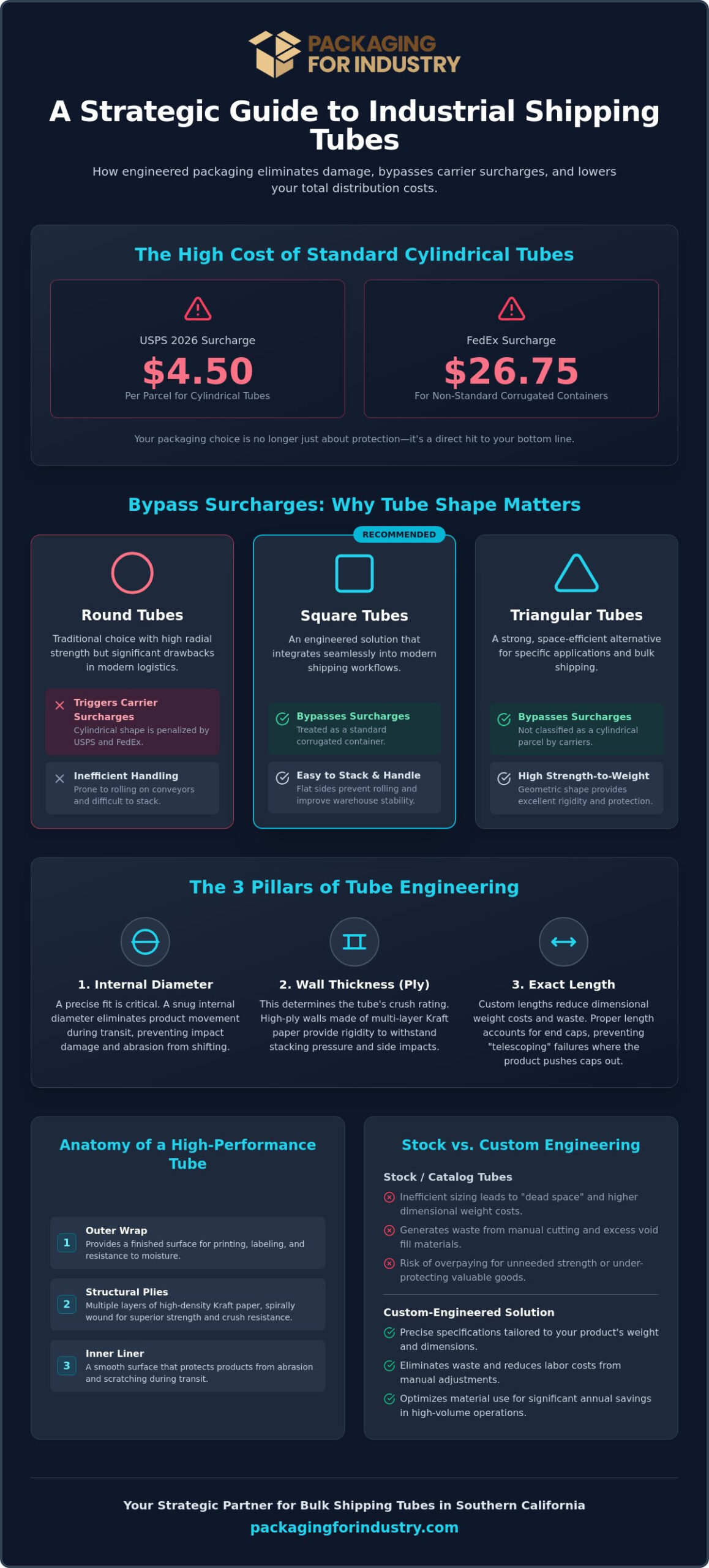
With the 2026 USPS surcharge for cylindrical tubes now at $4.50 per parcel and FedEx charging $26.75 for items not encased in standard corrugated containers, your choice of packaging is no longer just about protection; it’s a direct hit to your bottom line. Many Los Angeles manufacturers find that standard catalog options fail under pressure, leading to crushed products and expensive returns. You likely already know that a tube collapse isn’t just a loss of inventory; it’s a blow to your reputation and operational efficiency. Choosing the right spiral wound tube for shipping requires a balance between wall thickness and structural integrity to withstand the rigors of the supply chain without triggering unnecessary freight penalties.
We understand that you need a reliable way to protect your goods while maintaining fiscal responsibility. This article will teach you how to engineer precise tube specifications that eliminate shipping damage and bypass the latest carrier surcharges. We will examine the technical requirements for industrial applications and explain how a local Southern California packaging supplier can provide custom solutions that outperform generic alternatives. You will gain a clear roadmap to optimize your logistics and lower your overall distribution costs.
Key Takeaways
- Understand how multi-layer Kraft paper construction and engineered wall thickness prevent tube collapse and protect high-value industrial goods during transit.
- Discover why choosing the right spiral wound tube for shipping involves selecting specific shapes to bypass significant 2026 carrier surcharges for cylindrical packaging.
- Learn the critical engineering differences between standard mailing tubes and high-ply industrial cores required for aerospace and manufacturing applications.
- Identify how to balance internal diameter and length to eliminate product movement and reduce dimensional weight costs in your supply chain.
- Explore the benefits of sourcing bulk shipping tubes from a local Southern California supplier to access custom prototyping and lower freight expenses.
Understanding Industrial Spiral Wound Tubes: More Than Just Cardboard
Industrial spiral wound tubes are engineered for structural integrity, not just simple containment. Unlike standard retail mailing tubes that often buckle under the weight of palletized shipments, industrial versions utilize multiple plies of high-density Kraft paper. These layers are spirally wrapped around a mandrel and bonded with specialized industrial adhesives. This manufacturing process creates a composite structure with superior longitudinal strength. Choosing the right spiral wound tube for shipping involves understanding that the “crush rating” is a function of both ply count and the specific adhesive used to fuse the layers. For Los Angeles manufacturers shipping heavy metal rods, textiles, or sensitive electronic components, this structural rigidity is the primary defense against transit damage. It’s the difference between a successful delivery and a costly insurance claim.
The Anatomy of a High-Performance Paper Tube
The history of composite paper tubes shows a steady evolution from simple paper rolls to complex, multi-material containers. A high-performance tube consists of three main components: the inner liner, the structural plies, and the outer wrap. The inner liner provides a smooth surface to prevent product abrasion. The structural plies provide the necessary wall thickness to resist side-impact crushing. Many Southern California businesses now prioritize tubes with high recycled content to meet corporate sustainability goals. However, the engineering team must ensure that recycled fibers don’t compromise the tube’s ability to withstand vertical compression in a stacked warehouse environment. The spiral winding technique ensures that the grain of the paper runs at an angle. This provides uniform strength across the entire length of the tube and prevents the seams from splitting under pressure.
Stock vs. Custom Engineering: When to Make the Switch
Relying on off-the-shelf sizes from large catalog suppliers often leads to operational inefficiencies. If you find your warehouse team manually cutting tubes to fit specific products, you’re losing money on labor and creating unnecessary waste. Switching to custom-engineered tubes and cores allows for precise lengths and wall thicknesses tailored to your specific payload. Choosing the right spiral wound tube for shipping means right-sizing your packaging to eliminate “dead space” inside the tube. This reduces the total volume of your shipment, which is critical given the 2026 carrier focus on dimensional weight and non-standard package fees. Custom engineering also allows you to specify the exact ply count required for your item’s weight. This ensures you aren’t overpaying for excess material or under-protecting high-value goods. For high-volume distributors in Orange County or San Diego, these marginal gains in material efficiency translate into significant annual savings.
The Three Pillars of Tube Engineering: Diameter, Wall Thickness, and Length
Engineering a protective shipping solution requires more than selecting a container from a catalog. Choosing the right spiral wound tube for shipping depends on three critical variables: internal diameter, wall thickness, and total length. If any of these specifications are miscalculated, you risk product damage or excessive freight costs. For heavy industrial goods like metal extrusions or rolled textiles, ply strength is the foundation of reliability. High-ply tubes provide the necessary rigidity to prevent the tube from bending or failing when stacked under heavier loads in a warehouse environment. This structural stability is essential for maintaining the integrity of the supply chain from the manufacturing floor to the end user.
Length is often overlooked, but it requires a strategic safety buffer. You must account for the depth of the end caps to ensure they don’t press against the product itself. This buffer prevents “telescoping” failure, where the weight of the item forces the end cap out during transit. A properly engineered length also ensures that the item doesn’t shift internally, which can lead to momentum-based damage during sudden stops. If you are unsure of the exact dimensions needed for your specific application, you can request a packaging quote to have our engineering team review your requirements and provide a tailored recommendation.
Calculating the Ideal Wall Thickness
Wall thickness is the primary defense against side-impact crushing. While standard-duty tubes often use a 0.060-inch wall, heavy-duty industrial applications typically require 0.125 inches or more to maintain structural integrity. Matching the wall thickness to the weight of your contents is essential for preventing structural failure. If the wall is too thin, the tube will buckle under the vertical pressure of stacked pallets. For businesses in Orange County or San Diego shipping dense materials, a thicker wall ensures that the tube remains circular and intact throughout the entire logistics cycle, even when subjected to the rigors of cross-country freight.
Managing Curvature Stress and Internal Diameter
Internal diameter (ID) affects both product safety and shipping economics. Sensitive items, such as high-gloss architectural blueprints or specialized composite materials, are subject to the “ink cracking” rule. Rolling these items too tightly in a 1-inch or 2-inch ID tube can cause permanent surface damage or material fatigue. We generally recommend a 3-inch or 4-inch ID for these applications to minimize curvature stress. However, as the diameter increases, so does the dimensional volume of the package. Choosing the right spiral wound tube for shipping requires you to remain compliant with USPS parcel standards and other carrier regulations to avoid non-standard package fees. Utilizing custom tubes and cores allows you to find the exact midpoint between maximum protection and minimum shipping volume.
Round vs. Square vs. Triangular: Navigating Carrier Surcharges
The geometry of your packaging has a direct impact on your freight invoice. While round tubes are the traditional choice for their inherent crush resistance, they now carry significant financial penalties from major carriers. Choosing the right spiral wound tube for shipping in 2026 requires a calculated comparison between the structural benefits of a cylinder and the cost-saving advantages of flat-sided alternatives. Carriers like UPS and FedEx prioritize packages that stay stationary on automated sorting belts. Because cylindrical items roll, they often require manual intervention, which triggers “Additional Handling” surcharges that can quickly erode your profit margins.
Beyond the surcharges, shape dictates stacking efficiency in your warehouse and on the pallet. Round tubes create “chimney” gaps when palletized, wasting valuable cubic space and reducing the overall stability of the load. In contrast, square and triangular tubes fit together flush. This eliminates the need for excessive stretch film and reduces the risk of the load shifting during transit. For many Los Angeles distributors, the move to flat-sided packaging is a pragmatic step toward optimizing warehouse floor space and improving the safety of their logistics operations. However, for extremely heavy industrial goods, the uniform wall strength of a round tube may still be necessary, making the carrier surcharge a secondary concern to product protection.
The Hidden Costs of Cylindrical Shipping
Recent 2026 carrier updates have made cylindrical shipping more expensive than ever. The USPS now applies a $4.50 surcharge to all cylindrical tubes or rolls. FedEx has increased its additional handling surcharge for packaging to approximately $26.75 per package for items not fully encased in standard corrugated containers. These fees are assessed on top of the base shipping rate and dimensional weight calculations. To mitigate these costs, many businesses are switching to square tubes and utilizing custom-cut foam packaging to secure the product inside. This combination provides the impact resistance of a heavy-duty tube while maintaining the “flat-sided” profile that carriers prefer.
Triangular and Square Tube Applications
Triangular and square tubes are becoming the standard for e-commerce fulfillment centers because they are compatible with high-speed sorting belts. These designs often feature “self-locking” ends, which significantly reduce the labor time and material costs associated with heavy taping. Choosing the right spiral wound tube for shipping also provides a unique branding advantage; flat sides offer a clean surface for high-visibility labeling or custom-printed logos. This is particularly valuable for Southern California manufacturers who want their brand to stand out the moment a package arrives at a customer’s facility. By selecting a non-roll shape, you improve your operational throughput while simultaneously lowering your total packaging spend.
Industry-Specific Selection Criteria for Shipping Tubes
Generic packaging solutions often fail to meet the rigorous demands of specialized industrial sectors. Choosing the right spiral wound tube for shipping requires an understanding of your industry’s specific environmental stressors and regulatory requirements. A tube designed for simple documents will not support the high-speed tension of textile winding or the archival needs of aerospace engineering. For Southern California manufacturers, selecting a tube with the correct liners and ply strength is essential for maintaining supply reliability and reducing the high cost of product returns. Whether you are shipping sensitive medical instruments or heavy metal rods, your packaging must be engineered for the specific challenges of your vertical.
Medical device manufacturers and construction firms also have unique requirements. Medical packaging often necessitates cleanroom-compatible materials and secure, tamper-evident end-cap closures to maintain sterility. In the construction sector, tubes must feature moisture-resistant outer wraps to protect site plans and blueprints from the humidity and dust common on active job sites. By tailoring the tube’s material composition to these environments, you ensure that critical information and high-value components arrive in pristine condition. If your current supplier provides one-size-fits-all options, it’s time to request a packaging quote for a solution designed for your specific industry.
Aerospace Blueprint and Component Protection
The aerospace sector in Los Angeles and Orange County demands high-precision aerospace packaging to protect sensitive thin-film materials and large-scale blueprints. These tubes often require archival-safe liners to prevent acid migration, which can degrade technical drawings over time. Engineering the tube to prevent edge damage is critical for composite materials that are sensitive to even minor structural compromises. Mil-Spec compliance is often required for defense-related tube shipments to ensure materials withstand extreme environmental stressors during global deployment. This level of protection prevents the loss of proprietary data and ensures that expensive components remain flight-ready upon arrival.
Industrial Roll Goods and Textiles
For manufacturers of textiles and plastic films, the internal core strength of the tube is the most important factor. These tubes serve as the foundation for high-speed machine winding; any core collapse during this process can lead to significant machine downtime and material waste. Choosing the right spiral wound tube for shipping industrial roll goods involves selecting a high-ply construction that can withstand the inward “crush” pressure of tightly wound fabrics. To further secure these heavy loads during transit, many distributors use corner and edge protection in conjunction with large-diameter tubes. This integrated approach stabilizes the pallet and protects the ends of the rolls from impact damage during forklift handling and long-haul shipping.
Why PFI is the Strategic Choice for Bulk Shipping Tubes in Southern California
Selecting a packaging partner is as critical as the engineering of the package itself. For manufacturers and distributors across Southern California, Packaging For Industry (PFI) provides a localized, engineering-driven approach to distribution. Choosing the right spiral wound tube for shipping is often a complex decision involving structural requirements and carrier fee structures. We simplify this process by offering direct-from-manufacturer bulk pricing and free prototyping. Our team conducts hands-on fit-testing to ensure your specific products are secured against the transit vibrations and stacking pressures identified in previous sections. By eliminating the middleman markups found at large catalog suppliers, we help you lower your total packaging spend while improving the durability of your shipments.
Logistical speed is a primary advantage of working with a regional supplier. We provide next-day local delivery across Los Angeles, Orange County, and the Inland Empire. This proximity allows our clients to maintain leaner operations without the risk of long-distance supply chain disruptions. Whether you require heavy-duty cores for industrial textiles or specialized tubes for aerospace components, our local presence ensures that your production lines never stall due to a lack of supplies. Our focus is on providing a stable, reliable flow of materials that supports your operational goals and fiscal responsibility.
Solving Lead-Time Issues with VMI and JIT
Custom-engineered tubes often come with extended lead times from national distributors, but our Vendor Managed Inventory (VMI) program in Anaheim eliminates this bottleneck. We monitor your usage levels and maintain stock in our facility, preventing stockouts of your specific custom specifications. This proactive management allows you to utilize just-in-time delivery for high-volume manufacturing lines, which frees up valuable warehouse floor space for your core operations. By shifting the inventory burden to PFI, you improve your logistical flow and ensure that your shipping department always has the exact materials needed to meet daily fulfillment targets.
Integrated Solutions: Beyond the Tube
Industrial shipping often requires more than a single tube to ensure total product protection. We specialize in integrated solutions, such as combining high-ply tubes with custom corrugated boxes for master shipping. This multi-layered approach is particularly effective for e-commerce and medical device sectors where secondary containment is necessary. When you request a packaging quote, our engineers conduct a comprehensive cost-reduction analysis. We examine your entire packaging workflow to identify opportunities for material consolidation and damage reduction. Choosing the right spiral wound tube for shipping is just the first step in a broader strategy to optimize your supply chain and protect your bottom line with local Southern California expertise.
Optimize Your Supply Chain with Engineered Shipping Tubes
Securing your high-value inventory against transit damage requires a methodical approach to packaging engineering. By balancing internal diameter with precise wall thickness and selecting shapes that bypass 2026 carrier surcharges, you can significantly lower your total distribution costs. Choosing the right spiral wound tube for shipping is no longer just a procurement task; it’s a strategic decision that impacts both your bottom line and your brand’s reliability in the field.
As specialists in aerospace and industrial manufacturing solutions, PFI is ready to help you refine your specifications. We offer free prototyping to ensure a perfect product fit and provide next-day delivery across Southern California to keep your operations moving at peak efficiency. Our team understands the unique pressures of the Los Angeles logistics landscape and is committed to being your proactive problem-solver. Request a custom packaging quote for bulk shipping tubes today and take the first step toward a more resilient supply chain. We look forward to helping you eliminate shipping damage and improve your operational flow.
Frequently Asked Questions
How do I determine the correct wall thickness for heavy items?
You should determine wall thickness by analyzing the total weight of your product and the expected stacking height during transit. For heavy industrial goods, we recommend a minimum wall thickness of 0.125 inches to prevent telescoping or side-impact failure. Choosing the right spiral wound tube for shipping requires matching the ply count to the density of your load to ensure the core doesn’t collapse under the pressure of palletized stacking.
Do round shipping tubes always incur a carrier surcharge?
Most major carriers now apply significant financial penalties for cylindrical packaging because they roll on automated sorting belts. In 2026, USPS assesses a $4.50 fee for rolls and tubes, while FedEx applies a surcharge of approximately $26.75 for items not fully enclosed in standard corrugated containers. Switching to square or triangular tubes is a pragmatic way to avoid these non-standard package fees while maintaining high levels of product protection.
What is the difference between a shipping tube and a mailing tube?
The primary difference lies in the ply count and the resulting structural rigidity. Mailing tubes are typically thin-walled and designed for lightweight documents or posters. Industrial shipping tubes feature multiple layers of bonded Kraft paper, providing the “crush rating” necessary for heavy items like metal rods, textiles, or aerospace components that require protection from forklift handling and long-haul freight vibrations.
Can I get custom-printed spiral wound tubes for my brand?
Yes, custom-printed outer wraps are available to display your company logo, handling warnings, or specific part numbers. This improves brand visibility and ensures that warehouse teams in Los Angeles or Orange County can identify contents quickly without opening the packaging. Utilizing custom-printed tubes also allows you to include essential compliance information directly on the container, reducing the need for additional external labeling.
What are the best end-cap options for industrial tubes?
Industrial tubes typically utilize plastic friction-fit plugs, heavy-duty metal ends, or self-locking crimped ends. Plastic plugs are the industry standard for most fulfillment needs, but metal end caps provide superior security for heavy-duty manufacturing goods that might shift during transit. For high-security shipments, we often recommend stapled or taped end caps to prevent the product from forcing its way out of the tube during sudden stops.
How does wall thickness affect the crush strength of a paper tube?
Wall thickness is the primary determinant of a tube’s resistance to side-impact crushing and vertical compression. Each additional ply of Kraft paper increases the overall density and rigidity of the core. Choosing the right spiral wound tube for shipping involves selecting a thickness that withstands the specific PSI requirements of your stacked warehouse environment in the Inland Empire or other high-volume distribution hubs.
Are spiral wound tubes recyclable or sustainable?
Most spiral wound tubes are highly sustainable because they are manufactured from recycled Kraft paper and are fully recyclable after use. The adhesives used in industrial-grade tubes are typically biodegradable, making them an eco-friendly alternative to plastic-based protective packaging. This allows Southern California manufacturers to meet corporate sustainability goals without sacrificing the durability or reliability of their supply chain.
What is the maximum length available for custom industrial tubes?
Custom industrial tubes can be manufactured in lengths exceeding 20 feet, though carrier regulations often dictate the practical shipping limit. For example, USPS assessed a $200 fee in 2026 for packages larger than 130 inches in combined length and girth. Our Anaheim facility can cut tubes to your exact specifications to eliminate waste and ensure your shipments remain compliant with the latest carrier dimension and weight standards.