
If you’re using the heaviest foam available just to “be safe,” you’re likely wasting thousands of dollars on material while still risking product damage through improper shock absorption. In the high-stakes world of aerospace and electronics manufacturing in Los Angeles and Orange County, over-packaging is often a sign of poor engineering rather than superior protection. It’s a common frustration to see expensive industrial components arrive damaged despite being wrapped in thick layers of high-density material. You need a solution that balances physical protection with fiscal responsibility.
We understand that inconsistent foam performance and rising overhead are major pain points for your operation. In this article, you’ll learn how to choose the right foam density to eliminate shipping damage and significantly reduce your material costs. We’ll explore the technical differences between polyethylene and polyurethane, discuss how California’s SB 54 regulations affect your material choices as of 2026, and provide a clear framework for creating a repeatable specification for your production line. By the end of this guide, you’ll have the data-driven insights needed to optimize your packaging for maximum reliability and minimum waste.
Key Takeaways
- Learn the technical process for how to choose the right foam density by calculating your product’s G-factor and static loading requirements to prevent damage.
- Understand the critical distinction between foam density, which dictates durability and weight support, and firmness (ILD), which controls surface pressure and “give.”
- Identify the optimal applications for Polyethylene (PE) and Polyurethane (PU) to ensure your industrial components are neither under-protected nor unnecessarily bulky.
- Discover how custom-engineered foam inserts can lower your total cost of ownership by reducing dimensional weight and eliminating expensive over-packaging.
- Align your packaging strategy with California’s SB 54 regulations by selecting material densities that minimize Extended Producer Responsibility (EPR) fees and meet recycling targets.
What is Foam Density and Why Does it Matter for Industrial Protection?
Foam density is the primary metric that determines how well your packaging will withstand the rigors of transit. In the industrial sector, we measure this in pounds per cubic foot (PCF). To understand What is Foam Density at a technical level, you should view it as the ratio of polymer to air within the foam structure. A 2.0 PCF foam contains more physical material and less air than a 1.2 PCF foam; this distinction is the foundation of structural integrity in shipping.
When you’re evaluating how to choose the right foam density, you’re essentially deciding how much weight the material can support before it fails. In a warehouse environment, density dictates whether a foam insert will retain its shape after multiple uses or collapse under the pressure of a heavy industrial component. For manufacturers in Los Angeles or Orange County shipping high-value parts, selecting the correct density is the difference between a successful delivery and a costly insurance claim.
The Role of Density in Shock Absorption
Density directly influences the deceleration of a product during an accidental drop or sudden shift in a delivery vehicle. When a package hits the ground, the foam must compress at a controlled rate to dissipate energy. If the density is too low for the weight of the item, the foam compresses completely. This is known as “bottoming out.” When this happens, the shock is transferred directly to your product, often resulting in catastrophic damage to sensitive electronics or calibrated medical instruments.
The cell structure of the foam acts as a series of tiny shock absorbers. Higher density materials have more cell walls to resist impact, which provides a more gradual deceleration. By understanding how to choose the right foam density based on your product’s specific weight and surface area, you ensure the energy is dissipated through the foam rather than the component itself.
Density vs. Material Cost
It’s a fundamental rule of packaging economics that you pay for the polymer, not the air. Because higher density foams require more raw material to manufacture, they carry a higher unit price. However, over-specifying density can lead to unnecessary expenses and increased shipping surcharges due to the added weight of the packaging. You must find the precise point where protection meets profitability.
Optimizing this selection is a key driver for packaging cost savings. By using an engineering-minded approach to find the minimum density required for safety, you reduce material waste and lower your total cost of ownership. We help Southern California distributors balance these protection levels against logistical costs, ensuring your shipping budget is spent on performance rather than excess material.
Density vs. Firmness (ILD): Understanding the Difference
Density and firmness are frequently used interchangeably, yet they represent entirely different physical properties. Density measures the mass of the foam per unit of volume, while firmness, or Indentation Load Deflection (ILD), measures the surface’s resistance to pressure. It’s a common mistake for buyers to assume that a higher density foam is automatically firmer. In reality, you can have a high-density foam that is incredibly soft or a low-density foam that is rigid. This distinction is critical when requesting custom foam packaging because selecting based on the wrong metric can lead to surface damage or insufficient support.
Industrial buyers often struggle with how to choose the right foam density because they focus on how the material “feels” rather than its technical performance. While density dictates the longevity and weight-bearing capacity of the foam, firmness determines how the foam interacts with the product’s surface. Misunderstanding this can lead to abrasion or marring on sensitive finishes. Understanding the relationship between density and ILD is the first step in learning how to choose the right foam density for your specific payload.
What is ILD (Indentation Load Deflection)?
ILD is the technical standard used to quantify the firmness of a foam sample. The measurement process involves calculating the force required to compress a 50-square-inch circular plate into a foam sample to a depth of 25% of its original thickness. This value tells us how much “give” the foam has. A higher ILD number indicates a firmer foam that requires more force to compress.
For lightweight, fragile items, a low ILD is often necessary to provide a soft cushioning effect that prevents the item from bouncing or shifting. Aerospace components often require specific ILD ratings to ensure the foam doesn’t exert too much pressure on delicate coatings or thin-walled structures. Adhering to standards like 4 Steps to Choosing the Right Foam Density ensures that the shock-absorbing capabilities of your packaging are verified through rigorous testing rather than guesswork.
Finding the Sweet Spot for Your Product
The engineering challenge lies in matching your product’s weight to the correct density-firmness combination. Consider a 50lb industrial motor versus a 2lb circuit board. The motor requires high-density foam to support the weight with a high ILD to prevent it from sinking too deep. Conversely, the circuit board needs a low ILD to provide soft deceleration, but the density might still be moderate to ensure the insert remains durable over several shipping cycles.
Our team at Packaging For Industry (PFI) uses these precise metrics to design custom foam inserts that protect your bottom line. If you’re unsure which specifications your components require, you can request a packaging quote to consult with our engineering experts. We focus on finding the exact intersection of protection and material efficiency for every project, ensuring your logistics flow remains uninterrupted and cost-effective.
Common Industrial Foam Materials and Their Density Profiles
Selecting the proper polymer is the technical foundation for any successful shipping strategy. At Packaging For Industry (PFI), we help manufacturers navigate a vast array of protective materials to find the exact density profile required for their specific application. While previous sections explained the physics of shock absorption, this section focuses on the specific material families and the sectors they serve. Understanding these profiles is essential for any San Diego packaging supplier or procurement manager looking to lower packaging costs while maintaining high performance.
Industries Served: Matching Materials to Specialized Sectors
Every industry has a unique fragility profile that dictates material choice. As a leading Orange County packaging supplier, we tailor density specifications to meet the rigorous demands of the following sectors:
- Aerospace and Defense: These sectors primarily utilize high-density Polyethylene (PE) foam (ranging from 2.2 to 9.0 PCF) for custom tool kitting and heavy component protection. The closed-cell structure ensures chemical resistance and durability for multi-trip use.
- Electronics and Semiconductors: High-value electronics require specialized Anti-Static (ESD) Polyurethane (PU) or Polyethylene. These materials, typically in the 1.2 to 1.7 PCF range, provide the soft cushioning needed to reduce shipping damage while dissipating static charges.
- Medical and Healthcare: Cleanroom-compatible Cross-linked Polyethylene (XLPE) is the standard for medical devices. Its high-purity, low-sloughing surface is ideal for high-purity environments where density must be balanced with surface cleanliness.
- Construction and Industrial Equipment: For heavy-duty pumps or cast components, Expanded Polystyrene (EPS) and high-density PE provide the rigidity necessary to support thousands of pounds without collapsing.
The Benefits of Precision Material Selection
Optimizing your material density isn’t just about protection; it is about operational efficiency. When you align your product requirements with the correct foam profile, your business realizes three primary benefits. First, you significantly reduce shipping damage by ensuring the foam never “bottoms out” under load. Second, you achieve lower packaging costs by eliminating the “over-packaging” trap, where businesses pay for high-density materials when a lighter, more efficient option would suffice. Finally, precision specs improve supply reliability by creating a repeatable standard that ensures consistent performance across every production run.
Whether you require a soft 1.0 PCF Polyurethane for delicate optics or a rigid 6.0 PCF Polyethylene for automotive engines, Packaging For Industry (PFI) provides the technical expertise to guide your selection. By focusing on these industrial-grade solutions rather than generic consumer options, we help you secure bulk packaging pricing that reflects your actual volume and performance needs. If you are ready to move beyond “one-size-fits-all” foam, you can request a custom packaging quote to begin your material optimization process.
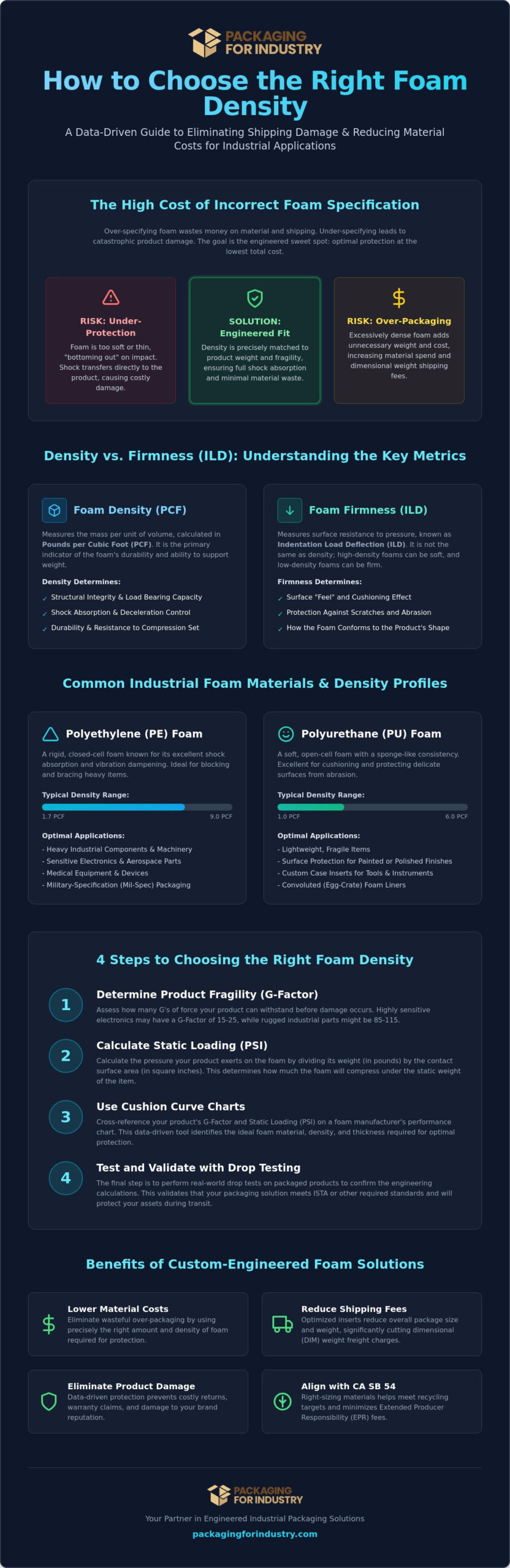
4 Steps to Choosing the Right Foam Density for Your Product
Moving from material selection to technical application requires a methodical approach. For manufacturers in San Diego or Los Angeles, the goal is to create a packaging specification that is both repeatable and cost-effective. If you’re wondering how to choose the right foam density for a new production line, you must look beyond the physical feel of the material. You need to follow a structured engineering process to ensure your industrial components survive the “last mile” of delivery without incurring unnecessary material costs.
- Determine the G-Factor: Identify the fragility of your product to set a baseline for protection.
- Calculate Static Loading: Determine the weight distribution to ensure the foam isn’t over or under-engineered.
- Match Environmental Needs: Select a material that accounts for moisture, ESD requirements, or chemical exposure.
- Validate with Prototyping: Use drop tests to confirm that your density choice performs under real-world stress.
Understanding the G-Factor
Fragility is quantified by a G-factor, which represents the maximum deceleration a product can withstand before it breaks. When learning how to choose the right foam density, you must know your product’s limit. Delicate electronics typically fall into the 15 to 40G range, requiring softer, energy-dissipating foams. In contrast, rugged industrial pumps or cast iron components can often handle 80 to 100G. Your density selection directly dictates how much of that G-force is transmitted to the product. A foam that is too dense for a fragile circuit board won’t compress enough, passing the shock directly to the sensitive internal components.
Calculating Static Loading
Static loading is the amount of weight placed on a specific area of foam. This calculation is vital because it prevents the “trampoline effect.” If you use too much foam surface area for a lightweight product, the foam won’t compress upon impact. Instead, it acts like a spring, bouncing the product and potentially causing internal damage. To find your static load, divide product weight by the square inches of foam contact. This number tells you if the foam is properly loaded to its “sweet spot” for energy absorption.
By balancing the static load with the correct density, you ensure the foam compresses just enough to cradle the part without bottoming out. This precision is what allows our engineers to reduce shipping damage while simultaneously lowering material volume. Whether you’re shipping heavy automotive parts from Orange County or medical devices nationwide, getting this calculation right is the foundation of a professional packaging strategy.
Custom Foam Engineering: Why Specialized Density Saves Money
Custom engineering is where technical specifications meet logistics economics. As a premier custom box manufacturer and Los Angeles packaging supplier, Packaging For Industry (PFI) understands that learning how to choose the right foam density is the first step in reducing your total cost of ownership. By selecting a higher density foam with superior shock absorption, you can often reduce the overall thickness of the protective buffer. This optimization allows for a smaller outer carton footprint, which significantly lowers dimensional weight (DIM) surcharges and improves your palletization density for national distribution.
Eliminating the “over-packaging” trap requires a partner who looks at the intersection of material science and freight costs. When you use optimized foam-to-box ratios, you stop paying for excess air and start paying for performance. Our Southern California facility is equipped to integrate these custom foam inserts directly with our corrugated solutions, providing a total protection system that reduces shipping damage while keeping your freight budget under control.
Prototyping and CAD/CAM Support
Precision density management requires physical validation to ensure your components are adequately protected without waste. We offer CAD/CAM design and free prototyping so you can verify the fit and performance of your insert before requesting a custom packaging quote for full production. Whether your project requires high-precision CNC routing or high-volume die-cutting, we ensure your density specifications are maintained to the millimeter, preventing the hidden costs of material over-specification that often inflate bulk packaging pricing.
Why Choose Packaging For Industry (PFI) as Your Southern California Packaging Partner?
Manufacturers looking for a reliable packaging supplier near me choose Packaging For Industry (PFI) for our integrated service model. Beyond custom foam, we offer Vendor Managed Inventory (VMI) and just-in-time (JIT) packaging solutions to streamline your warehouse operations in Anaheim, Irvine, or San Diego. Our local presence allows us to provide next-day delivery and proactive supply reliability that large national catalog distributors simply cannot match.
Our expertise translates into professional peace of mind for your operations team. We don’t just sell protective materials; we provide a repeatable specification that ensures your production line remains efficient and your damage rates remain near zero. From initial design to final delivery, we manage the entire protection system so you can focus on your core manufacturing goals.
Optimize Your Industrial Protection Strategy
Mastering the intersection of engineering and economics is the key to a resilient supply chain. You’ve learned that understanding how to choose the right foam density involves more than just a surface-level assessment; it requires a calculated analysis of G-factors, static loading, and material durability. By transitioning to custom-engineered inserts, you don’t just reduce shipping damage; you also eliminate the hidden costs of over-packaging and excessive dimensional weight surcharges.
Packaging For Industry (PFI) is your steady partner for specialized protection, offering expertise in aerospace and medical-grade foam solutions. We support your operations with free prototyping and CAD design, ensuring every specification is validated before production begins. Our local Southern California next-day delivery ensures your warehouse in Irvine or Los Angeles stays stocked with the high-performance materials you need to maintain a smooth operational flow.
We’re ready to help you refine your packaging specifications and achieve the perfect balance of protection and fiscal efficiency.
Frequently Asked Questions
Is higher foam density always better for protecting heavy items?
No, higher density is not always superior for protection. The effectiveness of foam depends on the static loading of your product. If you use a high-density foam for a lightweight item, the material will not compress during a drop. This causes the kinetic energy to pass through the foam and directly into your component, potentially causing damage. The ideal solution is finding the specific density that compresses just enough to decelerate the item safely.
What is the most common foam density for shipping electronics?
Most electronics manufacturers in Southern California utilize 1.2 lb to 1.7 lb density foams. When learning how to choose the right foam density for sensitive PCBs or medical devices, you must also prioritize anti-static (ESD) properties. These lower densities provide the soft cushioning required for fragile components while the ESD additives protect against latent electrical damage during handling in your warehouse or fulfillment center.
How do I know if my foam is ‘bottoming out’ during shipping?
You can identify bottoming out by inspecting the foam after a drop test or a transit cycle. If the foam is permanently deformed or crushed to a thin layer at the contact points, it failed to support the weight. This means the product struck the outer corrugated box wall. To prevent this, you should increase the foam density or the surface area of the foam inserts to better distribute the load across the material.
What is the difference between open-cell and closed-cell foam density?
The primary difference lies in the cell structure and weight-bearing capacity. Open-cell foam, like polyurethane, is breathable and typically ranges from 0.5 to 2.0 PCF. It is best for light cushioning. Closed-cell foam, like polyethylene, has sealed cells that trap air. This makes it more dense, ranging from 1.2 to 9.0 PCF, and offers better moisture resistance and structural support for heavy industrial motors or aerospace parts.
Can I use low-density foam for multiple shipments?
Low-density foams are generally unsuitable for multiple shipments because they lose their resiliency quickly. Open-cell polyurethane often takes a “set” after the first few impacts, which significantly reduces its protective capabilities. If you are designing returnable packaging for a production line in Los Angeles, we recommend using a closed-cell polyethylene with a density of 2.2 lb or higher to ensure the inserts maintain their shape over many use cycles.
Does foam density affect the price of custom inserts?
Foam density is a major factor in the total cost of custom inserts. Since density represents the amount of polymer used per cubic foot, higher density materials require more raw ingredients and cost more to produce. By working with a specialist to determine how to choose the right foam density, you can avoid the “over-packaging” trap. This ensures you only pay for the material volume necessary to keep your damage rates at zero while optimizing your budget.
How do I calculate the density of the foam I am currently using?
To calculate density, you need the weight and the volume of the material. First, find the cubic feet by multiplying the length, width, and height in inches and dividing by 1,728. Then, divide the weight of the foam block in pounds by that cubic foot value. This gives you the pounds per cubic foot (PCF). Understanding this baseline helps you compare your current performance against more efficient or durable material options for your shipping lanes.
What density is required for mil-spec foam packaging?
Military specifications typically require specific densities based on the fragility and weight of the payload. Common standards like MIL-P-26514 often call for 1.7 lb or 2.2 lb polyethylene foam. These densities are proven to withstand extreme temperature fluctuations and repeated shocks in the field. If you are shipping aerospace or defense components from Orange County, following these density requirements is essential for contract compliance and long-term equipment reliability.