
Your high-value equipment deserves better than a generic, hand-plucked foam insert that screams “afterthought” to your prospective clients. You likely already realize that standard catalog foam often fails to protect sensitive components during transit and looks unprofessional during a high-stakes demo. When you invest in CNC routed foam inserts for presentation cases, you aren’t just buying protection; you’re investing in a strategic sales tool that reflects the precision of your own engineering.
We understand that long lead times and high freight costs for bulky foam orders from out-of-state vendors can stall your operations. This guide will show you how to engineer high-precision inserts that reduce shipping damage and create a branded, professional look for your sales kits. You’ll learn how to choose the right materials to protect fragile aerospace or medical instruments while leveraging a local Southern California supplier to lower packaging costs. We’ll preview the prototyping process and explain how to compare packaging pricing to ensure your project stays on budget. By the end, you’ll know exactly how to request a packaging quote that meets your specific industrial requirements for fast, local delivery in Los Angeles, Orange County, or San Diego.
Key Takeaways
- Choose between Polyethylene and Polyurethane foam to optimize protection based on your product weight and surface sensitivity.
- Compare CNC routing and die-cutting to find the most cost-effective method for your specific production volume and design complexity.
- Utilize a professional CAD design and prototyping process to ensure your CNC routed foam inserts for presentation cases provide a precision fit.
- Reduce shipping damage and improve supply reliability by engineering custom inserts that offer superior shock absorption for sensitive instruments.
- Request a packaging quote from a local Southern California supplier to access next-day delivery and avoid the high freight costs of bulky foam shipments.
Why Precision CNC Routed Foam is Essential for Industrial Presentation
CNC routed foam is a specialized manufacturing process where a CNC router uses computer-aided design (CAD) files to mill exact, multi-level cavities into a foam block. Unlike manual cutting, this method ensures precise product nesting for every component in your kit. In the world of industrial sales, your packaging serves a dual purpose. It must provide reliable foam packaging protection during transit while acting as a high-end display for your hardware. Standard foam might keep a part from breaking, but it won’t impress a procurement officer during a high-stakes meeting.
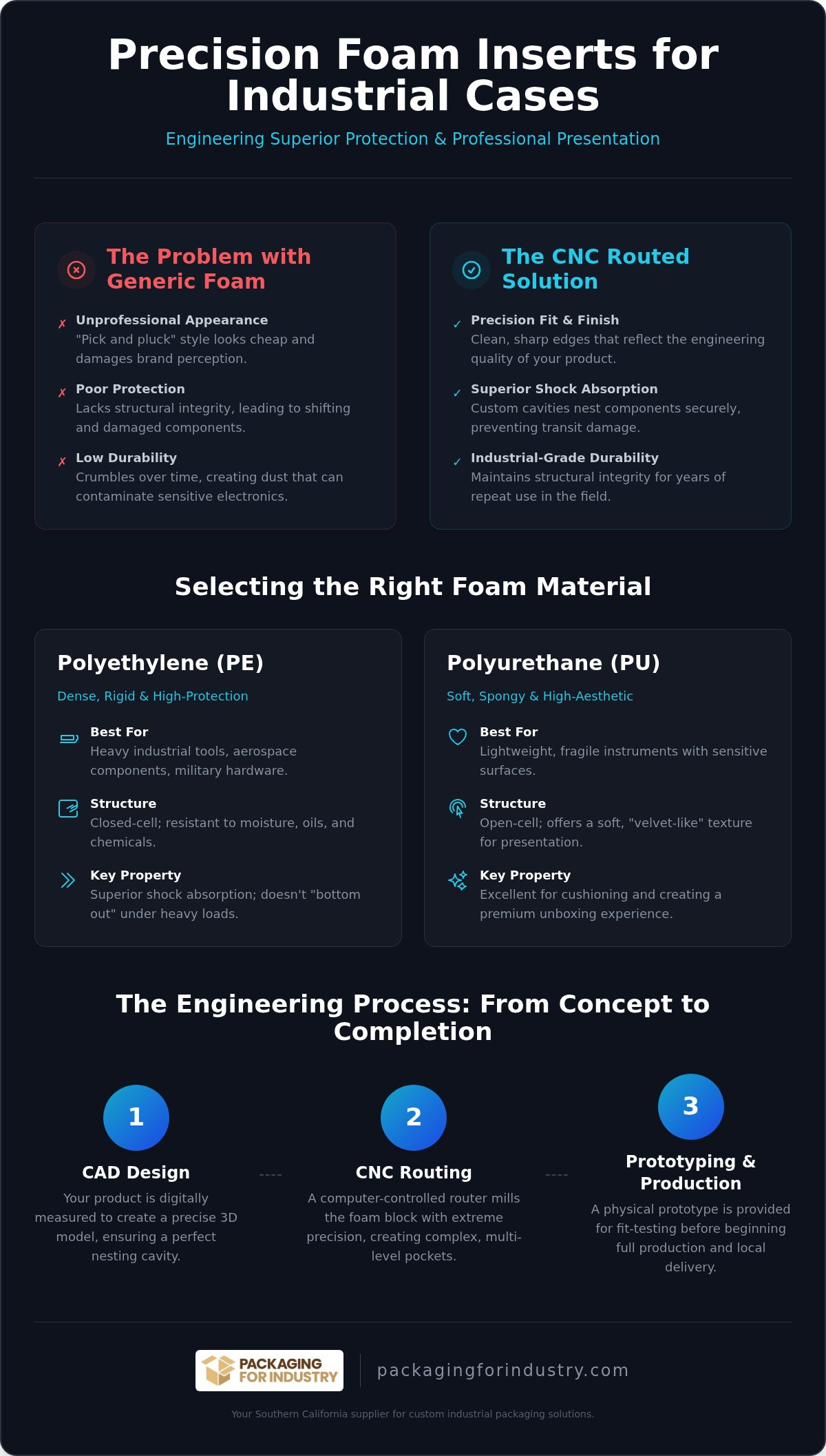
Off-the-shelf “pick and pluck” foam often fails in professional aerospace and medical environments. These pre-scored cubes lack the structural integrity to hold heavy or sharp industrial gear securely. Over time, the cubes detach, which leads to shifting equipment and a cluttered, cheap appearance. You should request a packaging quote to see how professional routing eliminates these failures and elevates your brand. Custom engineering allows for varying depths and complex geometries that generic foam simply cannot accommodate.
The Aesthetic Advantage for Sales and Demo Kits
Industrial presentation is about building trust through visual precision. CNC routed foam inserts for presentation cases offer clean, sharp edges that reflect the engineering quality of the product inside. You can choose multi-layered colors or color-coded inserts to help organize complex kits, making it easier for sales reps to verify that every component is present after a demo. A well-organized case significantly improves the unboxing experience for potential B2B clients. It signals that your company values precision and detail, which is essential when selling high-value instruments or specialized electronics.
Industrial Durability for Repeat Use
Sales kits and technician tools endure constant handling and harsh field environments. Low-grade foams used by catalog suppliers often crumble, creating “foam dust” that can contaminate sensitive electronic or medical instruments. CNC routing maintains the material’s internal cell structure better than manual cutting, ensuring the insert retains its shape for years of service. This longevity directly contributes to lower packaging costs by reducing the need for frequent replacements. When you use high-density polyethylene or polyurethane, your manufacturing packaging solutions remain functional and professional despite heavy use. Reliable protection and a professional look shouldn’t be mutually exclusive; custom routing provides both.
Selecting the Right Foam Material: Polyethylene vs. Polyurethane
Selecting the correct material for your CNC routed foam inserts for presentation cases is a decision that balances protection with aesthetics. I’ve seen many buyers focus solely on the “feel” of the foam, but industrial applications require a more technical approach. You must evaluate the weight of your equipment, the sensitivity of its surfaces, and the environmental conditions it will face. The two primary options in the industry are Polyethylene (PE) and Polyurethane (PU), each serving distinct operational needs.
When to Choose Closed-Cell Polyethylene
Polyethylene is a dense, closed-cell foam that offers high rigidity and superior shock absorption for heavier items. It’s the standard for aerospace components, heavy industrial tools, and military hardware because it doesn’t bottom out under pressure. If your parts have sharp edges or significant weight, PE foam provides the structural support needed to prevent shifting. Its closed-cell nature makes it resistant to moisture, oils, and chemicals, which is critical for equipment stored in warehouses or shipped internationally. For high-durability needs, custom foam inserts made from PE are the most reliable choice for long-term field use.
The Benefits of Open-Cell Polyurethane for Presentation
Polyurethane is a softer, open-cell foam that excels in aesthetics and cushioning for fragile instruments. It has a “velvet-like” texture that creates a premium unboxing experience, making it ideal for medical device demos or high-end electronics. While it’s less rigid than PE, it provides excellent surface protection against scratches. We often pair PU base inserts with convoluted (egg-crate) lid foam. This combination ensures a secure fit by applying gentle pressure to the top of the item, preventing any movement when the case is closed. It’s the preferred material when presentation quality is just as important as impact protection.
Beyond the basic material type, you must also consider specialized requirements like ESD (electrostatic dissipative) foam. This is essential for semiconductor and electronics manufacturing to prevent static discharge from damaging sensitive circuits. Evaluating material density is the final step; a higher density foam offers better protection for heavy loads but adds weight to the overall kit. If you’re unsure which density fits your application, you can request a packaging quote and our team will help you compare packaging pricing for different foam grades. We provide free prototyping to ensure your chosen material performs exactly as expected before you commit to a bulk order.
CNC Routing vs. Die-Cutting: Choosing the Best Method
When you evaluate manufacturing methods for your foam project, the choice usually comes down to geometry and production volume. Die-cutting is a high-speed process that uses steel-rule dies to stamp shapes out of foam sheets. It works well for simple 2D silhouettes in high volumes, but it requires a significant upfront investment in tooling. Conversely, CNC routing uses a computer-controlled cutting bit to mill material away from a solid block. This process eliminates tooling fees and allows for varying depths within a single piece of foam. For CNC routed foam inserts for presentation cases, this multi-depth capability is often the deciding factor in creating a professional, tiered layout.
Complexity and Depth Control
CNC routing allows for “blind holes” and tiered cavities that die-cutting cannot achieve. If your sales kit includes a handheld medical device, a charging cable, and a spare battery, each item likely has a different height. Routing enables us to create precise pockets for each component so they sit flush with the top surface of the foam. We use CAD/CAM software to translate your product’s dimensions into digital blueprints, maintaining tolerances as tight as 0.01mm. This level of precision is vital for sensitive aerospace gear where even minor shifting during transit could cause calibration issues. You can’t get this level of three-dimensional nesting from a flat die-cut sheet without gluing multiple layers together, which often looks messy and unprofessional.
Cost-Effectiveness for Custom Runs
One of the biggest advantages of routing is how it helps lower packaging costs for small-to-mid volume orders. Because there are no physical dies to manufacture, you don’t face the expensive upfront tooling charges typical of die-cutting. This flexibility is invaluable for manufacturers who frequently update their product designs. Instead of scrapping expensive hardware when a part dimension changes, we simply update the CAD file and run a new batch. Our custom design packaging team works with you to optimize these layouts, ensuring maximum material yield and reduced waste. By eliminating initial tooling fees, you can compare packaging pricing more favorably for custom sizes and short-run promotional kits. This approach ensures your capital is spent on the quality of the protection rather than the cost of the setup.
The Engineering Process: From CAD Design to Free Prototyping
Turning a complex industrial instrument into a high-precision sales kit requires a methodical engineering workflow. We follow a structured five-step process to ensure your CNC routed foam inserts for presentation cases provide a perfect fit every time. This journey begins with a technical consultation to identify your case dimensions and the fragility of your equipment. We analyze the weight distribution and identify sensitive contact points that require extra cushioning. Our strategic location in Anaheim allows us to provide faster turnaround times for Southern California manufacturers compared to out-of-state catalog suppliers. While competitors might take weeks to finalize a design, our local presence enables rapid prototyping for firms across Los Angeles and Orange County.
- Step 1: Consultation; We define the case specs and product fragility.
- Step 2: CAD/CAM Design; Our engineers create a digital blueprint of the insert.
- Step 3: Free Prototyping; We produce a physical sample for your approval.
- Step 4: Production; We scale the design using industrial-grade CNC routers.
- Step 5: Kitting and Assembly; We assemble the foam into cases for a turnkey solution.
Free Prototyping: Reducing Risk for Manufacturers
Testing a physical sample is critical when you’re protecting high-value industrial equipment. A digital file cannot tell you how a 10-pound aerospace component feels when a technician tries to remove it from the case. Our free prototyping service allows you to verify the ergonomics of finger-pull cutouts and ensure they’re placed for easy access. We simplify your purchasing process by handling the entire design-to-delivery workflow. This proactive approach eliminates the risk of a full production run failing to meet your operational standards. Rapid prototyping is essential for R&D teams working on tight deadlines for medical or electronics product launches where every day of delay impacts the bottom line.
Kitting and Inventory Management
Precision foam is only one part of the logistical puzzle. We often integrate CNC routed foam inserts for presentation cases into custom corrugated boxes or wooden crates to provide multiple layers of protection. To help you lower packaging costs and reduce warehouse clutter, we offer Vendor Managed Inventory (VMI). This service allows us to stock your custom inserts and deliver them only as you need them for current shipping cycles. It ensures your production line never stalls due to a stock-out while keeping your floor space clear for manufacturing. By stocking only what you need, you improve your cash flow and maintain a leaner warehouse operation.
Custom Foam Solutions in Southern California: Why Choose PFI
Shipping foam across the country is an expensive logistical mistake that many procurement managers realize too late. Because foam is essentially trapped air, you’re paying high freight costs on volume rather than weight. Choosing a local Southern California supplier eliminates these unnecessary expenses while providing a level of engineering oversight that out-of-state catalog vendors can’t match. At PFI, we provide local next-day delivery across Orange County, Los Angeles, and San Diego, ensuring your production line stays active without the delays of nationwide shipping.
Our strategic location in Anaheim positions us at the center of the region’s industrial hubs. This proximity allows us to conduct on-site reviews of your equipment, which is a critical step in engineering CNC routed foam inserts for presentation cases that actually perform. When we can physically see your product and its case, we can identify potential failure points that a digital photo might miss. This localized expertise is how we help manufacturers reduce shipping damage and improve the reliability of their supply chain.
Serving Anaheim, Irvine, and Los Angeles
We provide direct support for Anaheim packaging needs, offering fast turnaround times for companies in the North Orange County industrial corridor. We also serve Irvine manufacturers and Los Angeles logistics hubs with the same commitment to speed and precision. Our team doesn’t just ship boxes; we act as industrial consultants who help you lower packaging costs through better material selection and optimized nesting designs. If you’re currently using a one-size-fits-all solution from a large catalog, a quick on-site review from our team can often reveal significant opportunities for cost savings and improved product protection.
The PFI Difference: Reliability and Expertise
The PFI team brings deep expertise in aerospace packaging and medical device protection. We understand that your requirements aren’t just about aesthetics; they’re about meeting strict industrial standards for durability and cleanliness. We position ourselves as a pragmatic, cost-saving alternative to large catalog suppliers. Instead of navigating a generic call center, you work with packaging experts who understand purchasing, operations, and warehouse needs. This professional partnership ensures a dependable supply, so you never have to deal with the shortages or long lead times that disrupt your shipping cycles. Whether you need bulk packaging pricing for a major rollout or custom sizes for a specialized prototype, we have the industrial capacity to deliver. You can request a packaging quote today to compare our pricing and see the difference that local, expert engineering makes for your bottom line.
Elevating Your Industrial Product Presentation
High-precision foam is more than just cushioning; it’s an extension of your brand’s commitment to quality. By selecting the right density of polyethylene or polyurethane and utilizing the multi-depth capabilities of CNC routing, you ensure your equipment arrives safely and presents professionally. This approach helps you lower packaging costs by avoiding expensive steel-rule dies and reducing shipping damage. Investing in CNC routed foam inserts for presentation cases is a strategic decision that balances engineering precision with fiscal responsibility.
As a local Southern California packaging supplier, PFI offers free prototyping to ensure a perfect fit for your industrial instruments. Our expertise in aerospace and medical packaging allows us to provide a reliable supply without the high freight costs or long lead times of out-of-state catalog vendors. We’re ready to help you optimize your logistics and improve your product presentation.
We look forward to engineering a solution that protects your high-value equipment and streamlines your shipping operations.
Frequently Asked Questions
What is the best foam for CNC routed presentation case inserts?
The ideal material depends on your equipment’s weight and surface sensitivity. High-density polyethylene (PE) is the best choice for heavy or sharp industrial components because it provides rigid, closed-cell support. For lightweight electronics or medical instruments requiring a premium look, open-cell polyurethane (PU) offers superior cushioning and a soft texture. We often combine these materials with convoluted lid foam to ensure a secure, professional fit for every part in your kit.
How much does a custom CNC routed foam insert cost?
Project costs are determined by the material type, design complexity, and production volume. Unlike die-cutting, CNC routing eliminates expensive upfront tooling fees, which makes it a cost-effective choice for custom sizes and mid-volume runs. We recommend that you request a packaging quote to compare packaging pricing for your specific project. This allows our engineers to optimize the material yield and provide an accurate estimate based on your industrial requirements.
Can you create foam inserts for existing Pelican or Nanuk cases?
Yes, we specialize in engineering custom inserts designed to fit specific case brands like Pelican, Nanuk, or Storm. Our team uses CAD/CAM design to create a digital blueprint that matches the interior dimensions of your existing case perfectly. This ensures that your CNC routed foam inserts for presentation cases provide a snug, professional nesting environment for your gear, regardless of the case manufacturer or model you currently use.
What is the lead time for custom foam prototyping in Southern California?
We provide rapid turnaround times for prototyping because our manufacturing facility is centrally located in Anaheim. While out-of-state catalog suppliers might take weeks to deliver a sample, our local presence allows us to move from initial consultation to a physical prototype quickly. This speed is essential for manufacturers in Orange County and Los Angeles who need to verify product fit before committing to a full production rollout for new product launches.
Do you offer anti-static foam for electronics presentation cases?
We provide both anti-static and ESD (electrostatic dissipative) foam options for sensitive electronics and semiconductor components. These specialized materials prevent static discharge from damaging your hardware during transit or during sales demos. You can choose between pink anti-static or black ESD-safe versions in both polyethylene and polyurethane grades. These options ensure your presentation kit meets the rigorous safety standards required by the electronics and aerospace industries.
Is there a minimum order quantity for CNC routed foam inserts?
We focus on serving the recurring needs of industrial manufacturers and warehouses, but CNC routing is inherently flexible for various order sizes. Because there are no physical dies to manufacture, we can produce small-to-mid volume custom runs without the high setup costs associated with other methods. Most of our clients utilize our bulk packaging pricing for production lines, but we also handle specialized short-run projects for high-value aerospace or medical device kits.
How do I provide the dimensions for my custom foam project?
You can provide dimensions by sending us your product’s CAD files or by providing a physical sample of the equipment. For complex kits in Southern California, we can also perform an on-site review at your facility in Irvine, Anaheim, or Los Angeles. This hands-on approach ensures that your CNC routed foam inserts for presentation cases are engineered with precise tolerances. We identify sensitive contact points and ergonomic needs before beginning the digital design phase.
Do you offer local next-day delivery in Orange County and Los Angeles?
Yes, we provide local next-day delivery for stock items and scheduled replenishment orders throughout Southern California. Our delivery area includes Orange County, Los Angeles, San Diego, Riverside, and the Inland Empire. This local service helps you lower packaging costs by eliminating the high freight fees associated with shipping bulky foam products from out-of-state. It also supports our VMI programs, ensuring you have the right packaging available exactly when your production line needs it.