
What if your multi-million dollar ASRS is being held hostage by a commodity pallet? In a high-speed automated warehouse, the pallet is no longer just a platform; it’s a critical component of the machinery itself. You’ve likely invested heavily to maximize efficiency, only to find that standard pallets are the primary cause of system jams and sensor errors. We understand that specialized facilities require custom pallets for automated warehousing systems that meet exact tolerances to maintain uptime and protect expensive equipment.
Whether you are looking to compare bulk packaging pricing for high-volume operations or need custom sizes available for unique shuttle specifications, finding a reliable partner is essential. We provide local packaging delivery across Southern California to ensure your production lines never stop. In this 2026 guide, you’ll learn how precision-engineered custom pallets prevent ASRS downtime, reduce equipment wear, and lower total operational costs. We will preview the engineering specs, material comparisons, and procurement strategies that top distribution centers use to optimize their automation investment.
Key Takeaways
- Learn how precision-engineered pallets eliminate sensor errors and mechanical jams in high-density automated storage and retrieval systems.
- Understand why controlling pallet deflection is critical for protecting automated shuttles and reducing long-term equipment wear.
- Compare the weight-to-strength ratios of various materials to optimize shuttle battery life and lower your total operational costs.
- Discover how custom pallets for automated warehousing systems can be prototyped for free to ensure 100% compatibility with your racking.
- Streamline your supply chain with local next-day delivery and VMI programs across Southern California, including Los Angeles and Orange County.
The Critical Link Between Custom Pallets and ASRS Efficiency
In modern logistics, an Automated Storage and Retrieval System (ASRS) operates as a single, integrated machine. For this machine to function at peak capacity, every component must meet strict engineering tolerances. While a standard forklift operator can adjust for a warped board or a slightly undersized deck, a robotic shuttle cannot. This makes custom pallets for automated warehousing systems the most critical physical link in your supply chain. Without precision-engineered carriers, your high-bay racking becomes a liability rather than an asset.
Standard commodity pallets are designed for manual handling where human intuition compensates for material flaws. In contrast, automated environments demand absolute consistency across thousands of units. A single out-of-spec pallet can trigger a system-wide shutdown. When a sensor fails to detect a pallet edge or a gripper misses its contact point, the cost isn’t just the price of the pallet; it’s the cost of manual intervention in a high-density “dark” warehouse. You also face the risk of damaged products and lost throughput during peak fulfillment hours. At PFI, we help warehouses and distribution centers avoid these bottlenecks by designing pallets that interface perfectly with robotic hardware.
Why Automation Demands Precision Engineering
Robotic interfaces rely on predictable geometry. Our custom designs ensure that every deck board and stringer is placed with CAD/CAM accuracy. This uniformity prevents vertical height sensor errors that occur when board thickness varies by even a few millimeters. By maintaining exact contact points, we help your shuttles move faster and more reliably. We provide custom design packaging services to match your pallet specs to your specific ASRS manufacturer requirements, ensuring 100% compatibility before the first load hits the rack.
The Hidden Costs of Using Commodity Pallets
Choosing a generic pallet often leads to mechanical failure. A broken fragment from a low-grade pallet can jam a conveyor line or damage a shuttle motor. Over time, inconsistent pallet weights also increase wear on rollers and drive systems. For facilities in Los Angeles, Anaheim, or Orange County, these repairs are expensive and avoidable. We focus on custom pallets that reduce shipping damage and lower total operational costs by preventing these mechanical headaches. By investing in a precision-engineered base, you’re protecting the millions of dollars you’ve spent on automation technology.
Engineering Specifications: Why Standard Pallets Fail in Automation
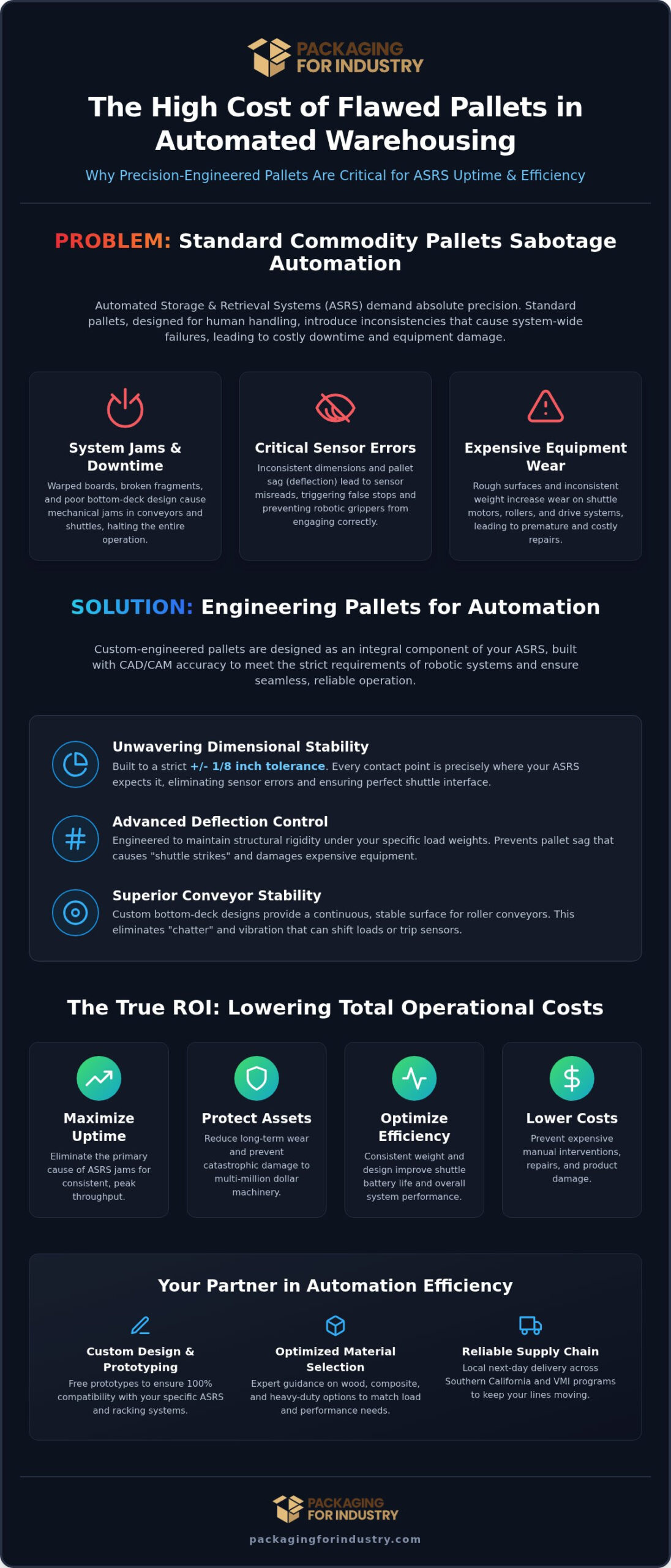
Standard pallets fail in automation because they’re built for humans, not sensors. In a manual warehouse, a forklift operator can tilt their forks to compensate for a warped board or an off-center stringer. Robotic systems don’t have that luxury. An automated shuttle expects a perfectly flat, predictable surface every time. If the pallet doesn’t meet these rigid specs, the system stops, and your throughput drops. We’ve identified that the vast majority of ASRS jams stem from three issues: excessive deflection, sensor interference from fasteners, and conveyor instability caused by poor bottom-deck design.
Deflection is the primary enemy of automated shuttles. This refers to the amount a pallet sags when it’s sitting on a rack or being carried by a shuttle. High deflection rates change the vertical clearance of the pallet, which often leads to “shuttle strikes” or sensor misreads. For custom pallets for automated warehousing systems, we use CAD/CAM engineering to ensure the pallet maintains structural rigidity under your specific load weights. This prevents the pallet from bowing and ensures the robotic grippers always have a clean, level contact point.
Bottom-deck coverage also plays a vital role in roller conveyor stability. Standard pallets often have large gaps between bottom boards, which causes the pallet to “chatter” or jump as it moves across rollers. This vibration can trip sensitive vibration sensors or shift the load. Our custom designs ensure a continuous, stable surface for smooth transit through your entire facility.
Tolerance and Dimensional Stability
We design custom pallets for automated warehousing systems with a strict +/- 1/8 inch tolerance on all dimensions. A pallet that’s even slightly out of square, a condition known as “racking,” will jam in the tight confines of a high-bay rack. Moisture content is another critical factor we manage. If the wood is too wet, it’ll warp as it dries in your temperature-controlled facility, throwing off your system’s calibration. We monitor these levels to ensure your pallets remain square and stable for years of service.
Fastener Integrity and Surface Quality
Fastener placement is often overlooked but can be a major source of downtime. Every nail must be countersunk to prevent metal-on-metal contact with shuttle components or interference with magnetic sensors. Protruding “shiners” or splinters can snag on high-speed conveyor belts, causing expensive damage. We also engineer specific surface friction levels to ensure your loads don’t slip during rapid acceleration or deceleration. If your current supply is causing frequent sensor trips, you can request a packaging quote to see how precision-built units can stabilize your operation. Our team provides these high-tolerance solutions with local next-day delivery to facilities in Los Angeles, Anaheim, and the Inland Empire.
Material Selection: Comparing Wood, Composite, and Heavy-Duty Options
Selecting the right material for custom pallets for automated warehousing systems involves balancing weight, strength, and regulatory compliance. While some competitors suggest that plastic is the only viable option for automation, we’ve found that precision-engineered wood remains the most cost-effective and adaptable choice for heavy industrial loads. The weight-to-strength ratio is particularly critical in high-bay racking where every pound of pallet weight impacts the battery life of your automated shuttles. Wood provides the structural rigidity needed to minimize deflection without the high upfront cost of specialized composites.
Fire regulations also play a significant role in material selection for ASRS environments. In many high-density facilities, insurance providers and local fire codes favor wood because it chars rather than melts. Certain plastic pallets can melt and pool during a fire, potentially creating a “flowing” fire hazard that’s difficult for overhead sprinklers to suppress. By choosing high-quality custom wood pallets and crates, you can often meet safety standards more easily while maintaining the tight tolerances required by your robotic sensors.
Custom Wood Pallets: The Versatile Industrial Choice
For most manufacturing and warehouse applications, hardwood species like oak or maple are preferred for their density and resistance to wear. We match the wood species to your specific load requirements to ensure the pallet doesn’t bow under pressure. If your operation involves international aerospace logistics, we provide heat-treated (ISPM-15) options to ensure full export compliance. Wood’s natural repairability also makes it a sustainable choice for a circular supply chain. Unlike plastic, a single broken board on a wood pallet can be replaced, extending the unit’s lifespan and lowering your long-term procurement costs.
When to Consider Composite or Engineered Wood
In environments where dust and debris must be minimized, such as medical or electronics manufacturing, engineered wood like plywood or OSB deck boards is an excellent alternative. These materials offer superior dimensional stability because they don’t have a natural grain that warps or shrinks with moisture changes. Precision is key when building custom pallets for automated warehousing systems to ensure they don’t jam in the rack. While the initial investment for composite materials is higher than standard lumber, the reduction in sensor errors and “cleaner” operation often justifies the cost for specialized cleanroom facilities. We help you compare packaging pricing across these material types to find the best fit for your budget and ASRS specs.
Lowering Operational Costs Through Precision Pallet Design
Precision design isn’t just about engineering; it’s about fiscal responsibility. When you use custom pallets for automated warehousing systems, you eliminate the waste associated with one-size-fits-all solutions. Over-packaging often occurs when standard pallets don’t fit the product footprint, leading to excessive use of stretch film or corrugated fillers to stabilize the load. By matching the pallet to the product and the machinery, you achieve significant packaging cost savings through reduced material usage and lower damage rates. This approach ensures you aren’t paying for empty space or unnecessary protection.
Weight management is another critical factor for your bottom line. Every extra pound on a pallet requires more energy from your automated shuttles. Over a year of thousands of cycles, heavier pallets degrade battery life and increase the frequency of charging downtime. We engineer pallets to the exact strength required for your specific load weights and high-bay racking. This ensures you aren’t paying for “over-engineered” weight that slows down your system and increases your utility costs. Our goal is to provide a base that is as light as possible while maintaining the rigid tolerances your sensors require.
Reducing Product Damage and Freight Surcharges
Product overhang is a major cause of sensor trips and physical damage in ASRS. If a box hangs over the edge of a standard pallet, it can strike rack uprights or misalign with robotic grippers. Our custom footprints ensure your product sits flush with the pallet edge, maximizing cube utilization in your high-bay racks. This precision also helps you avoid dimensional weight surcharges from carriers. When your pallet is right-sized for the load, you stop paying for the shipping of “air” and reduce the risk of side-impact damage during transit.
Streamlining Procurement with VMI and JIT
Maintaining a steady supply of custom pallets for automated warehousing systems is a challenge for many high-volume facilities. Our Vendor Managed Inventory (VMI) program solves this by tracking your usage and stocking your custom designs off-site. This frees up valuable floor space in your Anaheim or Los Angeles warehouse for production rather than pallet storage. We provide local next-day delivery across Orange County and the Inland Empire, ensuring your manufacturing lines never stop due to a pallet shortage. This just-in-time approach reduces your on-hand inventory costs and simplifies your procurement process.
Request a Custom Pallet Quote from Packaging For Industry (PFI)
Choosing the right partner for your ASRS implementation determines whether your facility hits its ROI targets or struggles with constant mechanical downtime. Packaging For Industry (PFI) specializes in engineering custom pallets for automated warehousing systems that meet the rigorous demands of robotic storage and high-speed retrieval. We move beyond commodity sales to offer technical consulting; we ensure your pallets are a seamless extension of your machinery. If you’ve been searching for a reliable packaging supplier near me that understands the intersection of robotic hardware and industrial engineering, PFI provides the infrastructure and expertise to stabilize your operation.
We’ve positioned ourselves as a proactive problem solver for manufacturers who are tired of sensor errors and system jams. By focusing on the intersection of engineering and economics, we help you lower packaging costs while maintaining the tight tolerances your robotic sensors require. Our approach eliminates the professional stress of unpredictable warehouse stoppages, giving you peace of mind that your logistics flow will remain steady. Whether you are launching a new automated line or troubleshooting an existing one, we provide the stability your facility requires to thrive in a high-demand market.
PFI’s Custom Design and Prototyping Capabilities
Our process begins with technical CAD/CAM design support to align pallet dimensions with your specific ASRS grippers and shuttle tolerances. We offer on-site packaging reviews to identify current failure points in your automated line, helping you reduce shipping damage and mechanical wear. Whether you need a custom packaging quote for specialized pallets or want to compare packaging pricing for an integrated solution, we provide free prototyping for product fit before you commit to a bulk order. This ensures your investment is protected from the start, combining heavy-duty pallets with custom foam or corrugated inserts for total product protection.
Local Support for Southern California Manufacturers
Reliability is as important as precision in a high-volume supply chain. We provide local next-day delivery across Southern California, including Anaheim, Irvine, Los Angeles, and Riverside. PFI also offers fast nationwide shipping for manufacturers with distributed operations across the United States. Beyond pallets, our account managers can provide a corrugated box quote or a stretch film quote to consolidate your purchasing and simplify your warehouse inventory. This end-to-end oversight ensures you have the right supplies at the right time, allowing you to focus on production rather than managing packaging shortages.
Future-Proof Your Automation Strategy
High-density automation requires more than just a standard load carrier. By prioritizing precision engineering and strict dimensional tolerances, you protect your ASRS investment from mechanical failures and sensor errors. The right material choice reduces deflection and extends shuttle battery life; this directly impacts your bottom line. PFI provides the expertise needed to integrate custom pallets for automated warehousing systems into your specific workflow without the risk of system jams.
Our CAD/CAM design support and free prototyping allow you to verify compatibility before placing a bulk order. As specialists in aerospace and industrial logistics, we understand the high stakes of automated throughput. Manufacturers across Los Angeles, Anaheim, and the Inland Empire rely on our local next-day delivery to maintain a steady supply and lower operational costs.
We’re ready to help you eliminate professional stress and optimize your facility’s performance with a reliable, engineered solution.
Frequently Asked Questions
What are the most common pallet-related causes of ASRS downtime?
Pallet deflection and board breakage are the leading causes of ASRS downtime. When a board sags beyond the system’s tolerance, it can strike rack uprights or trigger height sensor errors. Fragments from poor-quality commodity pallets also jam conveyor rollers and damage shuttle motors. We design custom pallets for automated warehousing systems to eliminate these mechanical risks by using higher-density materials and precision fastener placement that prevents board separation during high-speed transit.
How do custom pallets differ from standard GMA pallets?
Custom pallets differ from standard GMA pallets by offering significantly tighter dimensional tolerances and specialized deck board configurations. A standard GMA pallet often varies in thickness or squareness, which causes robotic grippers to miss contact points. Our custom designs follow a strict +/- 1/8 inch tolerance rule. This ensures every pallet in your system is identical, preventing the out-of-square conditions that lead to catastrophic jams in high-bay racking systems.
Can wood pallets be used in fully automated robotic warehouses?
Yes, wood pallets are a reliable choice for fully automated warehouses when they’re engineered to the correct specifications. Many industrial facilities prefer precision wood over plastic because it offers better fire compliance and is easier to repair. At PFI, we use CAD/CAM support to ensure wood pallets maintain the rigid geometry required for robotic interfaces. This provides a cost-effective alternative to expensive composite materials while meeting the specific needs of aerospace and medical manufacturing.
What tolerances are required for pallets used with automated shuttles?
Automated shuttles typically require dimensional tolerances of +/- 1/8 inch or better to function without error. Consistency in height is especially critical to prevent vertical sensor trips. We use advanced manufacturing processes to ensure every board is placed with surgical accuracy. This precision allows your robotic hardware to move at maximum speed without the risk of shuttle strikes or misaligned loads, protecting your million-dollar automation investment from avoidable mechanical wear.
How does heat treatment (ISPM-15) affect pallet durability in ASRS?
Heat treatment is a regulatory requirement for international shipping under ISPM-15 standards, but it also helps stabilize wood by reducing moisture content. This process prevents the wood from warping or shrinking once it’s placed in your temperature-controlled warehouse. While it doesn’t change the wood’s load capacity, it ensures the pallet remains square and dimensionally stable. We provide heat-treated custom pallets for automated warehousing systems to keep your global aerospace logistics compliant and reliable.
How can I lower my pallet costs without sacrificing automation reliability?
You can lower your total operational costs by right-sizing your pallets to eliminate over-packaging and reducing shipping damage. Custom designs prevent product overhang, which stops side-impact damage and avoids freight surcharges from carriers like UPS or FedEx. Additionally, using a reliable local supplier helps you avoid the high cost of emergency rush orders. We help you compare packaging pricing and identify design improvements that reduce material waste without compromising your system’s uptime.
Do you provide local pallet delivery in Southern California?
We provide local next-day delivery for pallets and crates across Southern California. Our delivery network covers Anaheim, Los Angeles, Orange County, San Diego, and the Inland Empire. This proximity allows us to support high-volume manufacturing lines with just-in-time replenishment, reducing the amount of warehouse space you need to dedicate to pallet storage. Whether you’re in Huntington Beach or Riverside, we ensure your production stays moving with dependable, local supply.
How does a VMI program work for custom-sized industrial pallets?
A Vendor Managed Inventory (VMI) program for custom pallets involves PFI monitoring your actual usage and replenishing stock based on agreed-upon min/max levels. We store your custom-engineered pallets at our facility and deliver them as needed, which frees up valuable floor space in your warehouse. This proactive management eliminates the risk of shortages and simplifies the purchasing process for your procurement team, ensuring you always have the right packaging for your production schedule.