
Did you know that freight claims cost U.S. shippers over $50 billion annually as of April 2026? If you’re feeling the pressure to cut procurement costs, you aren’t alone. It’s common to focus on the unit price of a box, but that single metric often obscures the hidden costs of cheap packaging materials that erode your company’s profitability. Between rising freight surcharges and a 1.24% average damage rate for LTL shipments, the perceived savings from low-quality supplies frequently vanish before the product even reaches the customer.
We understand the challenge of justifying a higher upfront investment to a budget-conscious manager. This guide provides a clear, data-driven framework to help you build a professional business case for better materials. You’ll learn how to demonstrate the total cost of ownership (TCO) by accounting for the 139 dimensional weight divisor, excessive labor time, and the recent spike in containerboard pricing. We’ll show you how to pivot from being a simple purchaser to a strategic partner who delivers long-term operational stability and measurable ROI.
Key Takeaways
- Move beyond the unit price illusion by calculating the Total Cost of Ownership (TCO) for your entire shipping operation.
- Identify the hidden costs of cheap packaging materials, such as carrier DIM weight surcharges and the excessive labor required for make-shift protection.
- Learn why custom-engineered corrugated boxes and foam packaging often cost less than over-specifying with generic catalog items.
- Build a data-driven business case using a simple audit of your current damage rates and packing times to prove ROI to management.
- Leverage local Southern California delivery and Vendor Managed Inventory (VMI) programs to eliminate stockouts and lower total packaging costs.
The ‘Unit Price’ Illusion in Industrial Packaging
Procurement teams often fall into the trap of evaluating a corrugated box quote based solely on the invoice price. While a lower unit cost looks favorable on a quarterly spreadsheet, it rarely reflects the actual impact on your bottom line. This narrow focus ignores the hidden costs of cheap packaging materials that surface elsewhere in your operation. When you prioritize price over performance, you aren’t just buying a box; you’re often buying a liability that increases your total expenditure through higher damage rates and shipping inefficiencies.
The psychological lure of volume discounts on low-quality materials is another common pitfall. Buying in bulk to drive down the per-unit price often leads to overstocking substandard supplies that consume valuable warehouse floor space. These materials are also prone to supply chain volatility. Suppliers who compete only on price frequently lack the infrastructure to ensure reliable delivery, leading to packaging shortages that can stop a production line cold. For manufacturers and fulfillment centers, a single day of downtime due to missing supplies costs far more than any marginal savings gained from a cheap vendor.
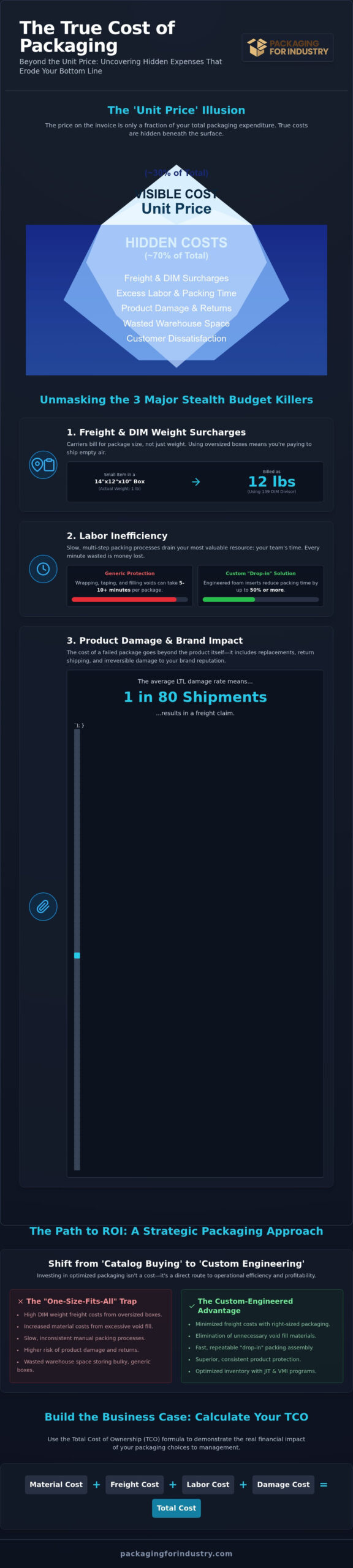
Why the Invoice Price is Only 30% of the Story
To understand the true financial impact of your supplies, you must look at the visible versus invisible costs. The visible cost is the dollar amount on the purchase order. The invisible costs include the warehouse labor spent handling oversized boxes, the capital tied up in inventory, and the freight penalties triggered by poor box sizing. Total Cost of Ownership (TCO) is the sum of material, labor, freight, and damage costs. When you lower packaging costs by looking at the TCO, you often find that a slightly more expensive, custom-engineered solution is actually the most economical choice for the business.
The Ripple Effect of Substandard Materials
Substandard materials create a chain reaction of operational failures. If you use thin-walled corrugated boxes with poor stacking strength, they often collapse under the weight of a pallet. This forces your warehouse team to spend hours re-boxing products before they can even leave the facility. Beyond the internal labor costs, these failures damage your brand trust. In 2026, the average LTL damage rate is 1.24%, meaning roughly 1 in every 80 shipments results in a claim. If your packaging fails to protect the product, the cost of returns, replacements, and lost customer loyalty will far outweigh the initial savings on material.
Identifying the Three Major Stealth Budget Killers
While unit price is visible on every invoice, stealth budget killers drain your profitability under the radar. Product loss in high-value sectors like aerospace or medical electronics is catastrophic. One damaged turbine component or sensitive circuit board can wipe out an entire year of packaging “savings.” Similarly, carrying excess stock from massive catalog suppliers ties up capital and warehouse floor space that could be used for revenue-generating production. These hidden costs of cheap packaging materials are often misclassified as “shipping errors” or “operational overhead” rather than what they truly are: packaging failures.
Freight and Dimensional (DIM) Weight Surcharges
Carriers now bill based on the space a package occupies, not just its actual weight. In 2026, the universal DIM weight divisor for UPS, FedEx, and USPS is 139. If you ship a 1 lb item in a standard 14x12x10 box, you aren’t paying for one pound; you’re billed for a 12 lb package. You’re effectively paying to ship air. New 2026 cubic volume triggers also apply “Additional Handling” surcharges to packages over 10,368 cubic inches. Using custom corrugated boxes tailored to your specific product dimensions eliminates these steep penalties. Optimized sizing also improves palletization, which can reduce the total number of truckloads required for bulk distribution.
Labor Inefficiency and Protective Packaging
Labor accounts for a massive portion of warehouse expenses. If your team spends ten minutes wrapping a single part in multiple layers of bubble wrap and tape, you’re losing money on every shipment. Professional foam packaging or custom polyethylene inserts allow for “drop-in” assembly. This cuts packing time by half or more while ensuring consistent protection. Low-quality stretch film that snaps or fails to cling during application leads to constant re-wrapping and wasted material. Reclaiming these hours through expert packaging kitting services allows your staff to focus on high-value fulfillment tasks instead of struggling with substandard supplies.
Inventory bloat is the final silent killer. Relying on generic catalog suppliers often requires you to buy standard quantities that don’t align with your actual production cycles. This ties up cash flow and creates clutter. Transitioning to a Vendor Managed Inventory (VMI) program ensures you have exactly what you need without the burden of excess stock. If you suspect your current materials are triggering these stealth costs, you can request a packaging quote to compare engineered solutions against your current spend.
Custom Engineering vs. Catalog Over-Specifying
Catalog buying is the default for many procurement departments. It’s easy to see a “heavy-duty” double-wall box and assume it’s the safest bet for your high-value parts. However, this often leads to over-specifying, which is the flip side of the hidden costs of cheap packaging materials. While a cheap box fails due to lack of strength, an over-specified catalog box drains your budget through excessive material weight and oversized dimensions that trigger DIM weight penalties. Custom engineering finds the “sweet spot” where protection meets economic efficiency, ensuring you don’t pay for more material than your application requires.
By moving away from one-size-fits-all catalog options, you can integrate multiple materials into a single, cohesive unit. For example, combining heavy-duty corrugated with precision-cut foam allows for a smaller overall footprint. This integrated approach reduces the total number of components your team has to manage and assemble. It streamlines your supply chain while providing a level of protection that generic catalog items simply cannot match.
The Power of Free Prototyping
The greatest risk in industrial logistics is an expensive failure during a full-scale rollout. If your packaging doesn’t fit the product perfectly, you’ll face shifting, abrasion, or structural collapse during transit. PFI eliminates this risk through custom design packaging services that include CAD/CAM support and free prototyping. This process allows your team to verify the fit and performance of a corrugated box or foam insert before you commit to bulk packaging pricing. Prototyping removes the guesswork that typically leads to over-ordering “just in case,” allowing you to lower packaging costs with confidence.
Material Science: Choosing Polyethylene vs. Polyurethane
Choosing the right material density is a science, not a guess. Polyethylene is durable and moisture-resistant, making it ideal for heavy industrial parts and aerospace components. Polyurethane is softer and better for fragile items that need high-performance cushioning. If you choose the wrong density, you’re either paying for more foam than you need or risking product damage. For electronics and semiconductor manufacturers, we offer specialized ESD foam to prevent static discharge. By consulting our protective foam packaging experts, you ensure your high-value items are secured with the exact material required for their specific fragility and weight. This precision prevents the waste associated with generic catalog foam that’s often either too stiff or too flimsy for specialized industrial needs.
Building the Business Case: Data Points Your Boss Needs
To convince management, you’ll need to move beyond the warehouse floor and into the profit and loss statement. A CFO cares about EBITDA and operational efficiency, not just the invoice price of a pallet of supplies. You must frame the hidden costs of cheap packaging materials as a direct drain on the company’s net income. This requires a shift from discussing material specs to presenting a data-backed ROI that highlights long-term profitability over short-term savings.
- Step 1: Audit your current damage rates and return shipping costs to find the true price of material failure.
- Step 2: Calculate labor time per package with current materials versus engineered, drop-in solutions.
- Step 3: Compare shipping invoices to identify “Additional Handling” or DIM weight penalties.
- Step 4: Present the total projected savings over a 12-month period rather than a simple per-unit comparison.
- Step 5: Request a packaging quote to obtain real-world numbers for a side-by-side financial comparison.
Quantifying the Cost of Shipping Damage
When a product breaks, the cost isn’t just the manufacturing price of the item. You must account for the original freight, the return shipping, and the administrative labor required to process the replacement. For high-value manufacturers in the aerospace or medical sectors, a 1% reduction in damage can save thousands of dollars in lost inventory every month. Use PFI’s packaging cost savings analysis to provide your boss with a comprehensive view of these operational leaks.
The Strategic Value of Reliability and Lead Times
Supply chain reliability is a financial asset. If a generic vendor fails to deliver on time, your production line stops. For businesses in Southern California, PFI provides local packaging delivery in Anaheim, Los Angeles, and the Inland Empire. This proximity eliminates the risk of stockouts that can paralyze a fulfillment center. Positioning a Vendor Managed Inventory (VMI) program to your boss shows you’re thinking about cash flow. VMI ensures you only pay for what you use, improving your balance sheet while reclaiming warehouse floor space for production.
Optimizing ROI with PFI’s Integrated Packaging Solutions
In Southern California, industrial real estate costs are among the highest in the country. If you’re filling expensive warehouse space in Irvine or Santa Fe Springs with pallets of “cheap” bulk boxes, you’re losing money on storage overhead alone. PFI helps you pivot from being a simple box buyer to having a strategic logistics partner. We look at your entire supply chain to eliminate the hidden costs of cheap packaging materials, such as port delay disruptions at Los Angeles or San Pedro and excessive inventory carrying costs. By optimizing your packaging footprint, we help you reclaim floor space for revenue-generating production. This transition ensures that your packaging becomes an asset that drives efficiency rather than a commodity that creates bottlenecks.
Vendor Managed Inventory (VMI) and Just-In-Time Supply
Stockouts are a silent killer of manufacturing productivity. If your line stops because a shipment of custom foam or corrugated boxes is delayed, the perceived savings from a low-cost vendor vanish instantly. Our Vendor Managed Inventory services remove this risk by letting PFI manage your stocking levels. We monitor your usage and ensure you have exactly what you need when you need it. With local next-day delivery across Orange County and the Inland Empire, we support lean manufacturing goals and free up your warehouse team to focus on fulfillment rather than manual inventory counts.
Why Industrial Leaders Choose PFI
Industrial leaders in the aerospace, medical, and electronics sectors require a level of precision that generic suppliers can’t provide. We combine nationwide shipping capabilities with deep local expertise in the Southern California logistics environment. Our team understands how to navigate the complex 2026 UPS and FedEx surcharge structures that often penalize industrial shippers for oversized or “Additional Handling” items. Whether you need heavy-duty double-wall boxes in Anaheim or specialized ESD foam in San Diego, we provide the engineering expertise to lower your total cost of ownership. We don’t just sell supplies; we build integrated systems that protect your products and your profitability. This comprehensive oversight ensures that your high-value components arrive safely without unnecessary freight penalties.
Secure Your Profitability Through Engineered Protection
Shift the high-level conversation from “how much does this box cost” to “how much is this box saving our operation.” By auditing damage rates, labor hours, and carrier surcharges, you can clearly demonstrate that the hidden costs of cheap packaging materials are a measurable drain on your company’s net income. Transitioning to custom-engineered solutions isn’t an expense; it’s a strategic move to lower the total cost of ownership and eliminate professional stress.
PFI provides the technical expertise and local infrastructure to make this transition seamless. We offer free prototyping and CAD/CAM design support to ensure a perfect fit for your aerospace, medical, or industrial components before you commit to bulk pricing. Our local next-day delivery across Southern California, including Orange County and Los Angeles, ensures your production lines stay active and your customers stay satisfied.
Taking control of your packaging strategy today creates a more resilient and profitable supply chain for the future. We’re ready to help you build a case that management cannot ignore.
Frequently Asked Questions
How do I calculate the Total Cost of Ownership (TCO) for my packaging?
Calculate TCO by combining the invoice price with secondary expenses like warehouse labor, freight surcharges, and the cost of product damage. You must track the time staff spends on assembly and the frequency of shipping claims. By looking at the 12-month total rather than the unit price, you reveal how the hidden costs of cheap packaging materials drain your budget. This holistic approach helps you identify where high-performance materials provide a better ROI.
Can custom-sized boxes really save me money on freight?
Custom-sized boxes significantly reduce freight costs by eliminating the “shipped air” that triggers dimensional (DIM) weight surcharges. Carriers use a 139 divisor to bill based on volume rather than actual weight. If your box is even two inches larger than necessary, you could pay for several extra pounds. Tailored corrugated boxes also improve palletization efficiency. This allows you to fit more products onto each truckload and reduce your total number of shipments.
What are the most common hidden costs in warehouse packaging operations?
The most frequent hidden costs include excessive labor time spent on complex assembly and freight penalties from oversized boxes. Using the wrong materials often leads to production stops or the need for “make-shift” protection like extra tape and bubble wrap. These inefficiencies are often buried in general overhead. By identifying these hidden costs of cheap packaging materials, you can pivot to engineered solutions that streamline your warehouse flow and protect high-value items more effectively.
How does Vendor Managed Inventory (VMI) help lower my packaging costs?
A Vendor Managed Inventory (VMI) program lowers costs by aligning your supply levels with actual production usage. This prevents expensive emergency orders and stockouts that can halt your shipping department. PFI manages the stocking levels for you, which frees up valuable warehouse floor space in high-cost areas like Orange County. You also improve cash flow by only paying for what you need, rather than tying up capital in massive catalog bulk orders.
Is it worth investing in custom foam inserts for industrial parts?
Investing in custom foam packaging is highly cost-effective for high-value industrial sectors like aerospace or medical devices. Standard cushioning often requires excessive labor to apply and provides inconsistent protection. Precision-cut polyethylene or polyurethane inserts allow for fast “drop-in” assembly and superior shock absorption. This reduces the risk of catastrophic shipping damage and reclaims hours of warehouse labor, providing a clear return on investment that far outweighs the initial material cost.
How can I reduce shipping damage without significantly increasing material spend?
You can reduce damage without a massive budget increase by switching from generic catalog items to engineered packaging. Over-specifying with “heavy-duty” materials you don’t need is a common waste of capital. Instead, use free prototyping and CAD/CAM design to find the exact material strength required for your product. Combining materials, such as custom foam end caps with a right-sized corrugated box, often provides better protection while using less total material.
What should I include in a packaging cost-reduction proposal for my boss?
Your proposal should include a 12-month audit of current damage rates, return shipping fees, and labor time per package. Compare these figures against the projected savings from an engineered solution. Highlight the reduction in UPS or FedEx surcharges and the space-saving benefits of a VMI program. Presenting a data-driven ROI case shows management that you’re focused on the total cost of ownership and long-term profitability rather than just the per-unit invoice price.
Why should I choose a local Southern California supplier over a large catalog company?
Choosing a local Southern California supplier like PFI provides logistical advantages that national catalog companies cannot match. We offer local next-day delivery across Anaheim, Los Angeles, and the Inland Empire, which eliminates the high shipping costs of receiving your own supplies. Proximity also allows for hands-on engineering support and VMI programs that respond to your production changes in real-time. This localized service ensures a more reliable supply chain and faster response for custom prototyping needs.