
Your product’s geometry shouldn’t be a logistical burden. It should be its own structural support system. If you’re shipping high-value industrial components, you’ve likely dealt with the high freight costs of poor packaging density and the headache of surface abrasion on interlocking joints. It’s frustrating to manage pallet instability that leads to crushed bottom-layer boxes during transit. We agree that standard catalog solutions often fail these complex shapes, leaving you with avoidable shipping claims and wasted warehouse space.
This article teaches you how to engineer custom packaging design for stackable, interlocking parts that leverages the product’s own shape to maximize pallet density. You’ll learn how to combine heavy-duty corrugated boxes with precision foam inserts to eliminate damage and lower packaging costs. We’ll preview how PFI’s CAD/CAM prototyping and local next-day delivery across Southern California can streamline your production-ready packaging. By the end, you’ll understand how to transform your logistical challenges into a repeatable, cost-effective shipping strategy that protects your bottom line.
Key Takeaways
- Isolate negative spaces and protrusions using custom foam or corrugated partitions to prevent surface abrasion and nesting failures during transit.
- Leverage packaging design for stackable, interlocking parts to maximize pallet density while ensuring high-value components remain structurally secure.
- Maintain the vertical compression strength of your heavy-duty boxes by utilizing column stacking instead of interlocking pallet patterns.
- Select specialized materials like triple-wall corrugated and weather-resistant coatings to protect heavy metal parts from oxidation and crushing.
- Lower packaging costs and reduce shipping damage through CAD/CAM prototyping and local next-day delivery across Southern California.
Why Interlocking Part Geometries Require Specialized Packaging Design
Industrial packaging for components with Interlocking Part Geometries is more than just a container; it’s a structural isolation system. This type of specialized packaging design for stackable, interlocking parts focuses on securing both the protrusions and the negative spaces that define the product’s shape. Unlike standard rectangular goods, these components often feature tabs, slots, or grooves that are highly vulnerable during high-vibration transit. Without a custom solution, your shipping damage rates will likely exceed the industry average LTL damage rate of 1.24%, leading to costly claims and operational delays.
Optimizing this design isn’t just about protection. It’s a direct method to lower packaging costs. By leveraging the geometry of the parts, we can increase pallet density and reduce the overall box volume. This helps manufacturers avoid expensive freight surcharges based on dimensional weight. When you compare bulk packaging pricing for custom-engineered systems versus off-the-shelf options, the long-term savings in reduced scrap and optimized freight are evident. If you’re shipping from Anaheim or Irvine, our team can help you review designs that maximize your freight efficiency and improve supply reliability.
The Risks of Surface Abrasion and Nesting
Micro-vibrations during freight transport act like sandpaper on interlocking joints. When parts are allowed to shift even a fraction of an inch, the friction can degrade surface finishes or damage critical tolerances. This is especially dangerous for aerospace or medical components where precision is mandatory. Beyond abrasion, there is the risk of nesting failures. Nesting is a structural failure where parts become permanently wedged together due to transit pressure and vibration, often requiring the components to be scrapped. To prevent this, we utilize protective foam or corrugated partitions to create a physical barrier between every interlocking feature.
Identifying Structural Stress Points in Stackable Assemblies
Interlocking parts often create uneven pressure points within a shipping container. Instead of the weight being distributed across the entire surface of a box, it’s concentrated on small, specific contact points. Standard corrugated boxes often fail under these conditions because they aren’t engineered for non-uniform load distribution. Through our custom design packaging services, we use CAD/CAM support to identify these stress points before you ever start a production run. We can then specify heavy-duty double or triple-wall RSCs to ensure your stackable assemblies don’t crush the bottom-layer boxes. This proactive approach is essential for maintaining pallet stability in high-volume warehouse environments across Southern California.
Engineering Custom Inserts for Secure Interlocking Assemblies
Engineering a high-performance packaging design for stackable, interlocking parts requires internal architecture that mirrors the complexity of the product. By utilizing custom-engineered inserts, we transform the empty space inside a corrugated box into a rigid support structure that prevents shifting. This level of precision is critical for meeting performance standards, such as those found in Optimizing Pallet Stability through rigorous distribution testing. With custom sizes available for every insert and partition, we ensure that every protrusion and negative space is accounted for, providing the structural isolation necessary to maintain product integrity during long-haul transit.
For high-value aerospace and electronics components, we often integrate multiple materials to provide a balance of shock absorption and structural integrity. Combining heavy-duty corrugated partitions with foam cushioning allows us to create a hybrid system that handles both vertical compression and lateral vibration. This approach helps manufacturers lower packaging costs by maximizing the number of parts per container without increasing the risk of transit damage. You can request a packaging quote to see how these bespoke engineered inserts can be tailored to your specific production requirements and warehouse needs.
Precision Die-Cut Foam for Complex Part Profiles
Precision is the priority when protecting intricate interlocking joints from the stresses of the supply chain. We frequently recommend custom foam packaging to isolate these sensitive features. Polyethylene (PE) foam is our standard choice for industrial applications because its closed-cell structure provides the rigidity needed for heavy components while resisting moisture and chemicals. For lighter, more delicate finishes, Polyurethane (PU) foam offers superior cushioning against impact. We engineer foam end caps to lock parts into place, holding them in suspension within a larger crate or box. This prevents any contact with the outer walls and ensures the interlocking features remain pristine throughout the supply chain.
Corrugated Dividers and Partitions for High-Density Loads
For high-density loads, corrugated partitions are the most efficient way to create an organized grid within a master shipper. Specifying heavy-duty double-wall partitions is necessary when stacking heavy industrial components, as it prevents the internal grid from buckling under the weight of upper layers. We design notched dividers that mirror the interlocking nature of your product, allowing parts to be seated securely without touching one another. For manufacturers in Anaheim, Irvine, or the Inland Empire, we provide custom design packaging that integrates seamlessly with your assembly line. Our local next-day delivery ensures that these production-ready designs are available exactly when your warehouse needs them, maintaining your supply reliability.
Optimizing Pallet Stability: Interlock vs. Column Stacking Patterns
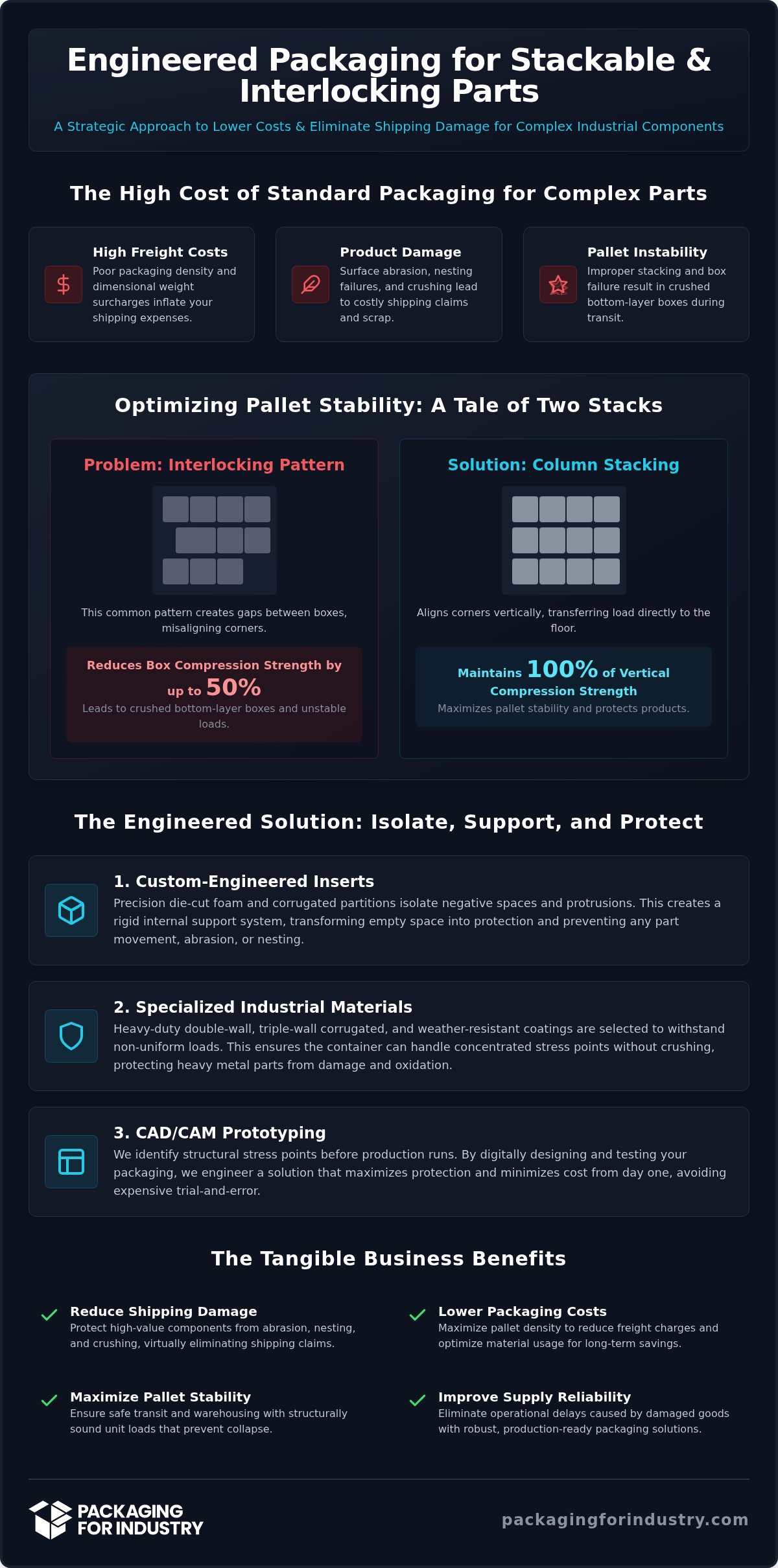
Many operations managers confuse the geometry of their product with the pattern of their pallet. When implementing packaging design for stackable, interlocking parts, you must distinguish between the parts that fit together and how those boxes are arranged on a pallet. The choice of stacking pattern can either support your engineering or lead to a structural collapse. We often see what we call the “Interlock Paradox.” While a brick-layer pallet pattern provides lateral stability, it can reduce the vertical compression strength of your corrugated boxes by up to 50%. This happens because the weight is shifted away from the corners, which are the strongest structural points of any box.
Column stacking is the gold standard for maintaining the compression strength of heavy-duty boxes. By aligning box corners vertically, you utilize 100% of the container’s rated strength. A unique advantage of shipping interlocking components is that the parts themselves can act as a secondary support system. If your custom inserts are engineered correctly, the stackable parts create an internal “pillar” that reinforces the outer corrugated walls. This prevents the bowing and crushing often seen in the bottom layer of pallets in high-volume warehouse environments. However, you must be wary of pallet overhang. Even a one-inch overhang can reduce a box’s top-to-bottom compression strength by over 30%, making precise pallet sizing essential for manufacturers in Anaheim and the Inland Empire.
When to Use Column Stacking for Maximum Compression
Precision alignment is the only way to ensure your bottom-layer boxes don’t fail under the weight of a full pallet. Corner-to-corner alignment is critical for heavy industrial loads because it ensures the weight is transferred through the most rigid part of the packaging. To prevent these columns from shifting during transit, we suggest using slip sheets between layers. These sheets increase friction and tie the load together without sacrificing vertical strength. It’s a simple way to lower packaging costs by reducing the need for excessively heavy-duty outer boxes while keeping your components secure.
Stabilizing Interlocking Box Designs for Transit
Because column-stacked pallets don’t have the natural “tie-in” of a brick pattern, they require professional-grade stabilization. We recommend using a high-performance stretch film with high containment force to keep the columns unified. Additionally, applying cardboard corner and edge protection is a mandatory step for load stability. These protectors distribute strap tension across the load, preventing the straps from crushing the edges of your packaging design for stackable, interlocking parts. This integrated approach ensures your high-value parts arrive without surface abrasion or structural failure, regardless of the vibration levels during LTL shipping.
Selecting Industrial Materials for Stackable Component Packaging
Your choice of outer material must compensate for the uneven load concentration inherent in interlocking assemblies. While we’ve addressed internal isolation, the primary shell is what prevents a total stack failure. Selecting the right materials for a packaging design for stackable, interlocking parts requires a balance between structural rigidity and cost efficiency. With North American containerboard prices seeing a third round of increases reaching up to $140 per ton in September 2026, over-specifying materials can be just as costly as under-specifying them. Our goal is to provide the exact level of protection needed to improve supply reliability without inflating your budget.
Interlocking metal parts often require chemical protection alongside structural support. These components are prone to oxidation if moisture is trapped within the packaging. We offer weather-resistant coatings and VCI (Vapor Corrosion Inhibitor) options that integrate with your custom boxes. This prevents rust from forming on critical joints during long-haul transit or warehouse storage in humid environments like Carson or San Pedro. By matching the material to the environmental risks of Southern California, we ensure your high-value parts arrive in production-ready condition.
Heavy-Duty Corrugated: Double-Wall and Triple-Wall Solutions
When you stack high-density components, the bottom box faces hundreds of pounds of constant pressure. We analyze the Edge Crush Test (ECT) requirements to determine if a double-wall or triple-wall corrugated boxes solution is necessary. Standard boxes fail because they can’t handle the localized stress points created by interlocking geometries. We often recommend double-wall RSCs for most industrial stackable parts because they provide a high strength-to-weight ratio. For heavy machinery modules or aerospace assemblies, triple-wall corrugated is often necessary to provide crate-like strength in a lighter format. Additionally, Gaylord boxes serve as the most efficient bulk packaging for small interlocking parts, allowing for maximum density within a single large container.
Custom Crates and Foam-Lined Wood Packaging
Custom wood crates provide the ultimate protection for heavy, stackable industrial modules that exceed the weight limits of corrugated. These are particularly effective for internal plant-to-plant transport where the packaging must be reusable and durable. For high-value aerospace components, we engineer foam-lined crates that secure sensitive interlocking joints against both shock and vibration. This hybrid approach ensures that even the most complex geometries remain pristine. PFI specializes in wooden crates that meet international shipping standards while lowering your long-term shipping damage rates. Whether you’re shipping locally in Anaheim or across the country, these bespoke solutions provide peace of mind for your most challenging freight.
Custom Packaging Solutions for Manufacturers in Southern California
Engineering a high-performance packaging design for stackable, interlocking parts is only the first step. For Southern California manufacturers, the challenge often lies in moving from a technical concept to a production-ready reality without disrupting the assembly line. PFI functions as a seasoned industrial consultant to bridge this gap. We provide a comprehensive approach that starts with an analysis of your part’s geometry and ends with local next-day delivery to your facility. By conducting rigorous packaging reviews and cost-reduction analysis, we help you eliminate the professional stress of shipping damage while ensuring your freight costs remain competitive.
Our operational footprint is designed for speed and reliability. We serve as a dedicated packaging supplier near me for businesses in Anaheim, Irvine, Los Angeles, San Diego, and the Inland Empire. Unlike catalog suppliers that offer generic sizes, we focus on custom-tailored responses that address specific pain points like surface abrasion and pallet instability. This local presence allows us to provide fast nationwide shipping and specialized support for aerospace, electronics, and industrial manufacturing sectors across the region.
Prototyping and CAD/CAM Design Services
Precision is mandatory when your product relies on complex interlocking joints. PFI utilizes advanced CAD/CAM support to design your packaging around the exact protrusions and negative spaces of your components. This ensures a perfect fit that standard boxes simply cannot provide. We believe in the “fixer” mentality; we identify potential failure points, such as nesting or load concentration, before they reach the shipping dock. We offer free prototyping so you can test the stability of your stackable assemblies in real-world conditions. You can request a quote for custom packaging design in Anaheim or Irvine to start this process. Testing a physical prototype is the most effective way to ensure your packaging design for stackable, interlocking parts meets the structural requirements of your supply chain.
Vendor Managed Inventory (VMI) for Recurring Production
One common gap in industrial logistics is managing the recurring supply of custom-engineered materials. Custom foam and heavy-duty corrugated often have longer lead times than stock items, which can create bottlenecks in your production line. Our VMI services solve this by allowing us to manage your stock levels for you. We monitor your usage and maintain a buffer of your custom packaging in our warehouse, delivering it exactly when you need it. This frees up valuable warehouse space for Southern California businesses and streamlines procurement for purchasing managers. By integrating our VMI and just-in-time inventory programs, you ensure that your production line never stops due to a packaging shortage, ultimately improving your overall supply reliability.
Secure Your Supply Chain with Engineered Packaging
Mastering packaging design for stackable, interlocking parts requires a strategic shift from generic boxing to custom engineering. By isolating sensitive joints with precision foam and utilizing column stacking for pallet stability, you directly reduce shipping damage while maximizing freight density. These optimizations don’t just protect your components; they lower your overall logistics costs and eliminate the professional stress of avoidable transit claims.
PFI provides the technical expertise and local support needed to solve these complex industrial challenges. We offer free prototyping and CAD/CAM support to ensure a perfect fit for your most intricate aerospace or manufacturing assemblies. Our local next-day delivery across Orange County, Los Angeles, and the Inland Empire ensures your warehouse always has the materials required to maintain production without interruption. We understand the pressure of managing purchasing and operations; our goal is to serve as your dependable partner in logistical optimization.
We’re ready to help you stabilize your shipping operations and improve your long-term supply reliability today.
Frequently Asked Questions
What is the best way to prevent surface damage on interlocking parts during shipping?
The most effective method is using custom foam inserts or corrugated partitions to isolate critical joints and protrusions. This physical barrier prevents micro-vibrations from causing abrasion between parts. For heavy industrial components, we typically recommend closed-cell polyethylene foam. This material provides the rigidity needed to keep parts suspended and secure, ensuring that sensitive interlocking features don’t touch during transit.
How does pallet stacking pattern affect the safety of stackable parts?
Pallet patterns dictate how weight is distributed throughout the load. While a brick-layer pattern offers lateral stability, it can reduce box compression strength by 50%. An optimized packaging design for stackable, interlocking parts often utilizes column stacking to align box corners vertically. This ensures the weight is carried by the strongest part of the corrugated material, preventing the bottom layer from crushing under heavy loads.
Can custom foam inserts really lower my overall packaging costs?
Yes, engineered foam inserts lower costs by reducing shipping damage rates and increasing part density. When you eliminate damage claims, you save on replacement and freight costs. Additionally, precision inserts allow you to fit more components into a smaller footprint. This helps manufacturers avoid expensive dimensional weight surcharges from carriers like UPS and FedEx while maximizing the efficiency of every pallet shipped.
What is the difference between column stacking and interlock stacking on a pallet?
Column stacking involves placing boxes directly on top of each other with corner-to-corner alignment. This method maintains 100% of the box’s rated compression strength. Interlock stacking, or brick stacking, overlaps boxes to tie the load together. While this prevents the pallet from shifting, it significantly weakens the stack. For heavy industrial parts, column stacking is usually preferred to prevent structural failure in the warehouse.
Why should manufacturers use custom boxes instead of standard catalog sizes?
Standard catalog boxes often result in excessive void fill or wasted space, which increases your shipping costs. Custom boxes are engineered to the exact dimensions of your stackable assemblies. This precision improves product protection and optimizes pallet density. By using custom-sized corrugated solutions, Southern California manufacturers can reduce material waste and avoid the high freight prices associated with oversized, poorly fitted packaging.
Does PFI provide free prototypes for custom packaging designs?
PFI provides free prototyping and CAD/CAM support for our industrial clients. This service allows you to verify the fit and structural integrity of your packaging design for stackable, interlocking parts before starting a full production run. Testing a physical sample ensures the packaging is production-ready and capable of withstanding real-world transit vibrations. This proactive step is essential for improving supply reliability and reducing damage.
What industries benefit most from custom packaging for stackable parts?
Aerospace, electronics, medical device manufacturing, and industrial machinery sectors benefit most from these specialized designs. These industries often deal with high-value components that feature complex geometries and sensitive joints. PFI specializes in creating integrated solutions for these sectors, combining heavy-duty corrugated with custom foam and crates. This approach ensures that intricate parts remain pristine throughout the supply chain, from the factory floor to the final delivery.
How does local delivery work for businesses in Orange County and Los Angeles?
PFI offers local next-day delivery for businesses throughout Southern California, including Anaheim, Irvine, Santa Fe Springs, and the Inland Empire. Our local fleet ensures that your warehouse receives packaging materials exactly when they are needed. This service is often part of a Vendor Managed Inventory (VMI) program. We monitor your stock levels and replenish your custom boxes and foam automatically, which prevents production line stops caused by packaging shortages.