
Could your heavy-duty internal bracing be the primary reason your freight costs are ballooning while your warehouse space disappears? Many operations managers accept bulky foam or wood bracing as a necessary evil to prevent transit damage for heavy industrial parts. It’s frustrating to watch shipping margins erode because the protective packaging takes up more room than the product itself. Integrating corrugated build-up blocks for internal bracing offers a precision-engineered alternative that bridges the gap between structural durability and fiscal efficiency.
We understand that you need reliable protection that doesn’t compromise your bottom line or sustainability mandates. This guide will show you how to specify, engineer, and procure these blocks to maximize product protection while reducing both shipping costs and environmental impact. We’ll examine the technical advantages of multi-layered corrugated structures, the benefits of ISPM-15 compliance for export, and how localized supply chains in Southern California can eliminate the lead time headaches common with large catalog suppliers.
Key Takeaways
- Understand how corrugated build-up blocks for internal bracing provide heavy-duty structural support while maintaining ISPM-15 compliance for international export.
- Discover how to specify board grades, from single-wall to triple-wall, and leverage CAD/CAM design to optimize bracing for complex product geometries.
- Compare the fiscal and environmental advantages of switching from polyethylene foam to sustainable, recyclable corrugated alternatives to lower per-unit packaging costs.
- Learn how Southern California manufacturers can reduce lead times and warehouse footprints by utilizing Vendor Managed Inventory (VMI) and local next-day delivery.
- Explore integrated protection strategies that combine corrugated blocks with foam or crates to secure sensitive aerospace and electronic components.
Understanding Corrugated Build-Up Blocks for Heavy-Duty Internal Bracing
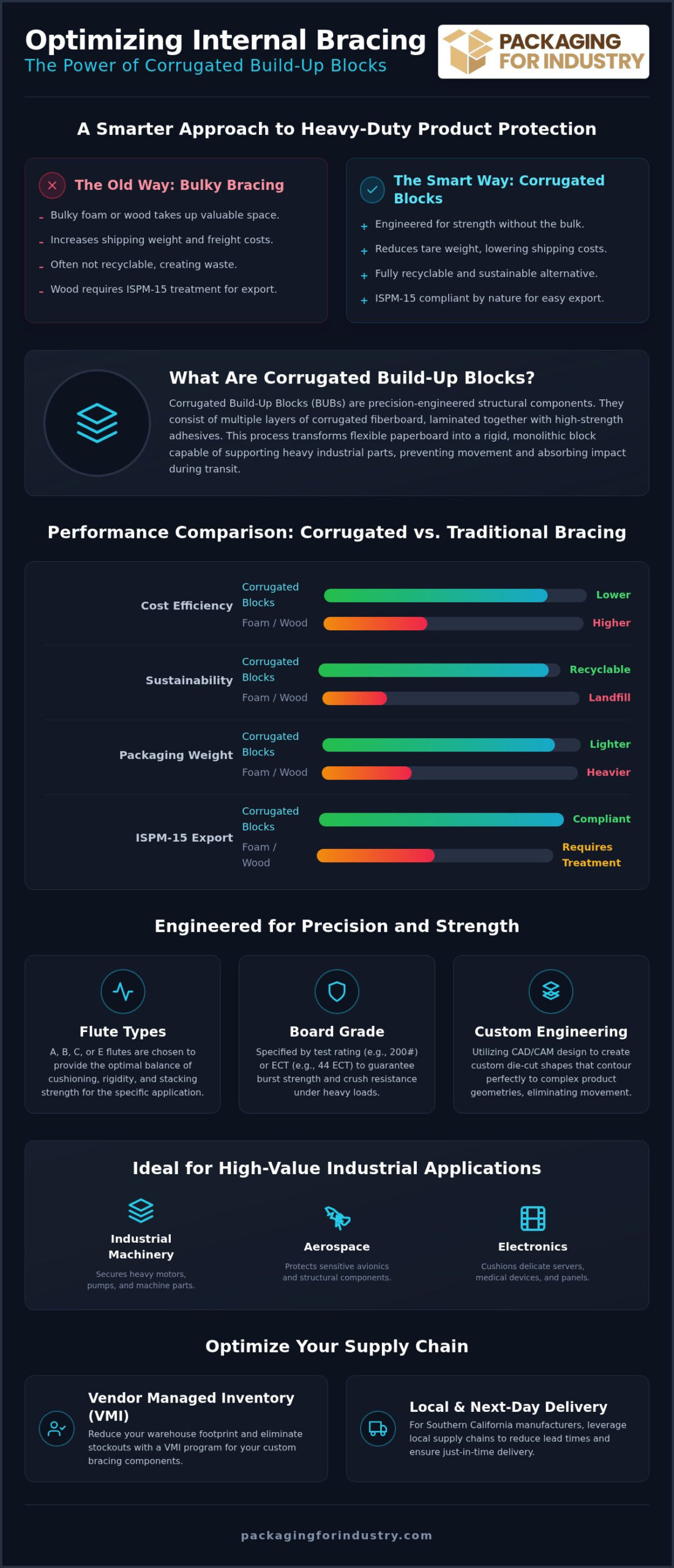
Corrugated build-up blocks (BUB) aren’t simply thick pads; they are precision-engineered structural components. These blocks consist of multiple layers of corrugated fiberboard laminated together with high-strength adhesives. This process transforms flexible paperboard into a rigid, monolithic brick capable of supporting hundreds of pounds. In heavy industrial shipping, these blocks serve as the primary defense against lateral and vertical product movement inside a crate or box.
For manufacturers shipping high-value equipment, loose-fill peanuts or thin single-wall pads are insufficient. Heavy components easily crush standard materials, creating voids that lead to impact damage. Using corrugated build-up blocks for internal bracing ensures that the product remains stationary even during the turbulent conditions of ocean freight or long-haul trucking. The lamination density allows these blocks to absorb energy and distribute weight across a larger surface area, preventing the localized stress points that often cause finish damage or structural failure.
The Mechanics of Crush Resistance and Stacking Strength
The strength of a build-up block originates from its flute orientation. When we design these components, we typically align the flutes vertically to act like tiny columns. This orientation resists downward pressure far more effectively than horizontal layers. The adhesive bonding between each liner prevents delamination under shear force. For high-precision equipment, calculating the correct thickness is a balance of weight distribution and transit force requirements. You can explore these options through our custom design packaging services to find the right fit for your load.
Common Internal Bracing Terminology for Buyers
Purchasing agents often encounter technical acronyms when sourcing protection. An RSC (Regular Slotted Container) is the outer shell, but the BUB provides the internal structure. These blocks are a specialized form of dunnage. Most industrial buyers prefer expendable corrugated bracing because it’s fully recyclable and eliminates return logistics. When you compare packaging pricing, verify these key specifications:
- Flute Type: A, B, C, or E flutes determine the cushioning and thickness.
- Board Grade: 200# test or 44 ECT impacts the overall burst strength.
- Lamination Density: The total number of layers required to fill the specific void.
Engineering Custom Build-Up Pads: Materials and Construction Specifications
Engineering effective corrugated build-up blocks for internal bracing requires a deep understanding of load dynamics and material science. These aren’t one-size-fits-all products. They’re calculated structural components designed to withstand the rigors of the global supply chain. By utilizing advanced Packaging Engineering Technology principles, we can determine the exact material specifications needed to protect your specific equipment without over-packaging.
Standard single-wall board works for light dunnage, but industrial parts usually require double or triple-wall construction. Triple-wall corrugated offers a superior weight-to-strength ratio, providing the rigidity of wood bracing with a fraction of the weight. This reduction in tare weight helps you lower packaging costs and freight expenses. These materials are often made from recycled fibers, helping you meet corporate sustainability mandates while maintaining high performance during long-distance transit.
Complex geometries in aerospace and electronics manufacturing demand more than simple squares. We use CAD/CAM design to create custom die-cut shapes that contour perfectly to your product. This precision fit eliminates the gaps where movement could occur. For sensitive surfaces, we can integrate non-abrasive liners such as wax coatings or tissue laminates. These layers prevent scuffing and marring on high-finish components during high-vibration transit, ensuring your parts arrive in pristine condition.
The Role of Prototyping in Bracing Design
Testing is the only way to guarantee performance. We offer free prototyping to ensure your custom fitments perform as expected under real-world conditions. This process includes analyzing shock absorption and vibration dampening to protect delicate internal circuitry or calibrated instruments. Our custom design services provide the engineering support necessary to move from a concept to a finished, high-performance solution. If you’re looking to optimize your current bracing, you can request a packaging quote to see how our engineered solutions compare to your existing setup.
Using corrugated build-up blocks for internal bracing allows for a level of customization that foam often can’t match at a similar price point. Whether you need a simple rectangular block or a complex multi-layered insert with specific cutouts, the engineering phase ensures every inch of the material serves a functional purpose. This methodical approach eliminates waste and focuses your packaging spend where it matters most: product security.
Corrugated vs. Foam Bracing: Comparing Protection, Cost, and Sustainability
Industrial buyers often default to polyethylene foam for interior protection, but corrugated build-up blocks for internal bracing frequently offer a more pragmatic balance of performance and fiscal responsibility. While foam provides excellent cushioning for lightweight electronics, heavy industrial components require the rigid stacking strength that only multi-layered paperboard can provide. When evaluating these materials, engineering teams should align their choices with ASTM transport packaging design standards to ensure that the chosen bracing can withstand specific compression and vibration hazards during transit.
Sustainability is a major differentiator in this comparison. Corrugated material is 100% recyclable and biodegradable, making it a “circular” packaging choice that supports corporate environmental mandates. Unlike many petroleum-based foams, corrugated blocks don’t require specialized disposal processes for your end-users. Additionally, corrugated solutions are exempt from ISPM-15 heat-treatment regulations. This makes them a superior choice for international export compared to traditional wood bracing, as they eliminate the risk of customs delays related to pest infestation certifications.
Storage efficiency also favors corrugated designs. While foam inserts are bulky and must be stored in their final shape, many corrugated build-up components can be engineered for flat-packing or nesting. This reduces the warehouse footprint required for your packaging inventory, allowing you to reallocate floor space to production. By optimizing the design, you can lower packaging costs through reduced inbound freight and storage overhead before the blocks are even deployed on the assembly line.
Economic Advantages for High-Volume Manufacturers
Switching from die-cut foam to corrugated build-up blocks often results in a significant reduction in per-unit material costs. For high-volume manufacturing runs, these savings scale quickly. Beyond the initial purchase price, the lightweight nature of corrugated board helps in “lightweighting” your overall shipment. This directly impacts your bottom line by reducing fuel surcharges and freight class ratings for heavy industrial parts. End-users also benefit from lower disposal costs, as they can simply bail the bracing with their standard cardboard waste.
When to Use Integrated Foam-Corrugated Solutions
There are scenarios where a hybrid approach is the most effective engineering choice. In these designs, we use corrugated build-up blocks for internal bracing to provide the primary structural support and “blocking” needed to keep a heavy part stationary. We then integrate thin layers of protective foam packaging at the contact points to prevent surface marring or to provide ESD protection for sensitive electronics. This hybrid strategy is common in aerospace and semiconductor logistics, where components are both exceptionally heavy and highly sensitive to surface friction.
Strategic Internal Bracing for Aerospace, Electronics, and Industrial Machinery
Industrial sectors like aerospace and heavy manufacturing don’t have room for error. A single shifted component can result in catastrophic financial loss or mechanical failure. Custom-engineered corrugated build-up blocks for internal bracing provide the specific structural support required to immobilize multi-ton equipment or delicate calibrated instruments. By tailoring the block density and shape to the specific industry application, we ensure that your product remains stationary regardless of the shipping method. This level of precision is essential for maintaining the integrity of high-value industrial goods during long-haul transit.
Aerospace and Defense: Meeting Mil-Spec Requirements
Aerospace logistics involves moving high-value turbine components and engine parts that must meet rigorous military packaging standards. These mil-spec requirements often dictate the exact durability and moisture-resistance levels needed for long-term storage or overseas deployment. Our build-up blocks are engineered to withstand these environmental stressors. During the design phase, we prototype fitments for high-precision turbine blades and electronic housings to ensure that every contact point is reinforced against the shocks of air and sea transport. This proactive engineering prevents the micro-vibrations that can knock sensitive aerospace instruments out of calibration.
Industrial Machinery: Void Fill and Blocking
Multi-ton machinery presents a unique challenge: preventing lateral movement inside custom wood crates. Traditional wood blocking can be heavy and labor-intensive to install. Corrugated build-up blocks offer a lightweight, high-strength alternative for blocking and bracing protruding parts or delicate external controls. These blocks are designed to fill large voids and distribute the weight of the machine across the crate floor, optimizing load stabilization for flatbed trailers and ocean containers. Using corrugated materials also helps you lower packaging costs by reducing the total tare weight of your industrial shipments.
Sensitive electronics and medical devices require more than just immobilization; they need high-frequency vibration damping. For circuit boards and semiconductor equipment, we combine corrugated build-up blocks for internal bracing with specialized anti-static liners to mitigate ESD risks. In the medical sector, we provide packaging solutions that are compatible with various sterilization methods. Our engineering team ensures the materials used don’t interfere with the integrity of the device or its sterile barrier. This precision-focused approach ensures that your packaging spend is optimized for the actual hazards your products will encounter in the field.
Optimizing Your Supply Chain with Custom Corrugated Bracing Solutions
Procurement efficiency is just as critical as structural integrity. Many manufacturers lose money not because of product damage, but through inefficient packaging logistics. Transitioning from generic catalog orders to integrated corrugated build-up blocks for internal bracing allows you to streamline your operations. When you consolidate your custom corrugated needs with a single expert provider, you eliminate the administrative burden of managing multiple vendors and inconsistent quality standards. This move ensures that your internal protection is as precisely engineered as the products you ship.
We recommend starting with a custom packaging review to identify where you can lower packaging costs. Our engineering team analyzes your current damage rates and freight expenses to determine if a shift in bracing material or design can improve your margins. This holistic approach ensures that your internal protection strategy supports your broader business goals of reliability and fiscal responsibility. By focusing on the intersection of engineering and economics, we help you eliminate the professional stress of transit failures and bloated packaging budgets.
Vendor Managed Inventory (VMI) for Bulky Bracing
One of the biggest challenges with heavy-duty bracing is its physical footprint. Large build-up blocks take up valuable warehouse floor space that should be dedicated to production. By leveraging our VMI services, you offload the burden of dunnage storage to us. We manage the inventory levels for you, providing scheduled replenishment based on your actual usage cycles. This just-in-time approach ensures you never face a packaging shortage that halts your assembly line while keeping your on-site inventory lean. It’s a pragmatic solution for manufacturers who need to maximize their operational square footage.
Local Support in Southern California and Nationwide
Proximity matters when you need fast turnaround times and reduced lead times. For manufacturers in Orange County, Los Angeles, and the Inland Empire, we offer local next-day delivery. This regional presence allows us to provide more responsive service and lower inbound freight costs for your operations. While we are a leader in Southern California, our nationwide shipping capabilities ensure that your multi-location facilities receive the same high-performance corrugated build-up blocks for internal bracing with consistent specifications. We act as a steady, dependable partner for your entire logistical network.
If you’re ready to improve your supply chain reliability and protect your high-value components more effectively, it’s time to request a packaging quote for custom build-up blocks. We’ll help you engineer a solution that maximizes protection while minimizing your total cost of ownership. Our team is ready to provide the CAD/CAM support and prototyping necessary to secure your most complex industrial loads.
Secure Your Industrial Shipments with Engineered Bracing
Implementing corrugated build-up blocks for internal bracing transforms your packaging from a simple expense into a strategic asset. By utilizing CAD/CAM design and free industrial prototyping, you ensure that even the most complex aerospace components or multi-ton machinery remain stationary during transit. This transition not only reduces shipping damage but also aligns with sustainability mandates through 100% recyclable materials. It’s a pragmatic shift that balances high-performance protection with long-term cost savings.
Manufacturers across Orange County and Los Angeles can leverage our local next-day delivery and Vendor Managed Inventory programs to eliminate warehouse congestion and packaging shortages. Our deep specialization in high-value machinery protection provides the peace of mind that your logistics chain is optimized for both safety and fiscal responsibility. We focus on the intersection of engineering and economics so you don’t have to worry about transit failures or supply delays.
We’re ready to help you streamline your operations and protect your critical assets with precision-engineered solutions that fit your specific industrial needs.
Frequently Asked Questions
What are corrugated build-up blocks used for in industrial shipping?
These blocks serve as high-strength structural dunnage designed to immobilize heavy or delicate products within a shipping container. They fill the voids between the product and the outer box or crate walls. By using corrugated build-up blocks for internal bracing, you prevent the lateral and vertical movement that causes transit damage. They’re common in the aerospace and machinery sectors where securing multi-ton parts is essential for safe delivery.
Are corrugated build-up pads as strong as foam blocks for bracing?
Corrugated build-up blocks offer superior stacking and compression strength compared to many foam types. While polyethylene foam excels at absorbing high-frequency vibrations for light electronics, corrugated blocks provide the rigid structural support needed for heavy industrial equipment. They resist bottoming out under heavy loads, ensuring the product remains stationary. Many engineers choose them over foam to achieve higher weight-bearing capacities without the bulk or cost of plastic-based materials.
Do corrugated build-up blocks require ISPM-15 certification for export?
No, corrugated materials are exempt from ISPM-15 heat-treatment requirements. Unlike raw wood blocking and bracing, the manufacturing process for corrugated fiberboard eliminates the risk of pest infestation. This exemption allows you to ship internationally without the risk of customs delays or the added expense of certified heat-treated lumber. It’s a pragmatic solution for global logistics, simplifying the documentation process for export crates and heavy-duty industrial packaging.
Can build-up blocks be custom-cut to fit complex product shapes?
Yes, we utilize CAD/CAM technology and precision die-cutting to contour blocks to the exact geometry of your product. Custom sizes available allow for a glove-like fit that standard catalog dunnage can’t match. This level of precision is critical for aerospace turbine blades or medical devices where even slight movement can lead to failure. We can engineer complex shapes with specific cutouts to protect protruding parts or delicate external controls during long-haul transit.
How do build-up blocks help reduce industrial packaging costs?
You can lower packaging costs by replacing expensive foam or heavy wood bracing with lightweight corrugated alternatives. Corrugated blocks reduce the total tare weight of your shipment, which directly impacts fuel surcharges and freight rates. Additionally, their 100% recyclability eliminates the disposal fees often associated with petroleum-based foams. When you compare packaging pricing, the per-unit cost of a multi-layer corrugated block is typically lower than an equivalent volume of engineered foam.
What is the difference between double-wall and triple-wall corrugated blocks?
The difference lies in the number of fluted layers and liners used in the construction. Double-wall blocks feature two fluted layers and provide excellent durability for standard industrial parts. Triple-wall blocks utilize three fluted layers, offering maximum impact protection and stacking strength for multi-ton machinery. Choosing triple-wall is essential when your load requires extreme crush resistance or when the bracing must support significant vertical pressure inside a custom wood crate.
Are these blocks recyclable at the end of their lifecycle?
Yes, corrugated build-up blocks are 100% recyclable and can be processed through standard commercial cardboard recycling streams. This makes them a more sustainable choice than polyethylene or polystyrene foams, which often end up in landfills. Using these blocks helps you meet corporate sustainability mandates while providing a convenient disposal solution for your customers. They’re biodegradable and made primarily from renewable wood fibers, supporting a circular economy in industrial logistics.
Does PFI offer free prototyping for custom internal bracing designs?
Yes, PFI provides free industrial prototyping to ensure your corrugated build-up blocks for internal bracing fit perfectly before you commit to a full production run. Our engineering team uses CAD/CAM support to develop samples based on your specific product dimensions and weight requirements. This process allows you to test the bracing for shock absorption and vibration dampening, ensuring your high-value components arrive in pristine condition without the risk of design errors.