
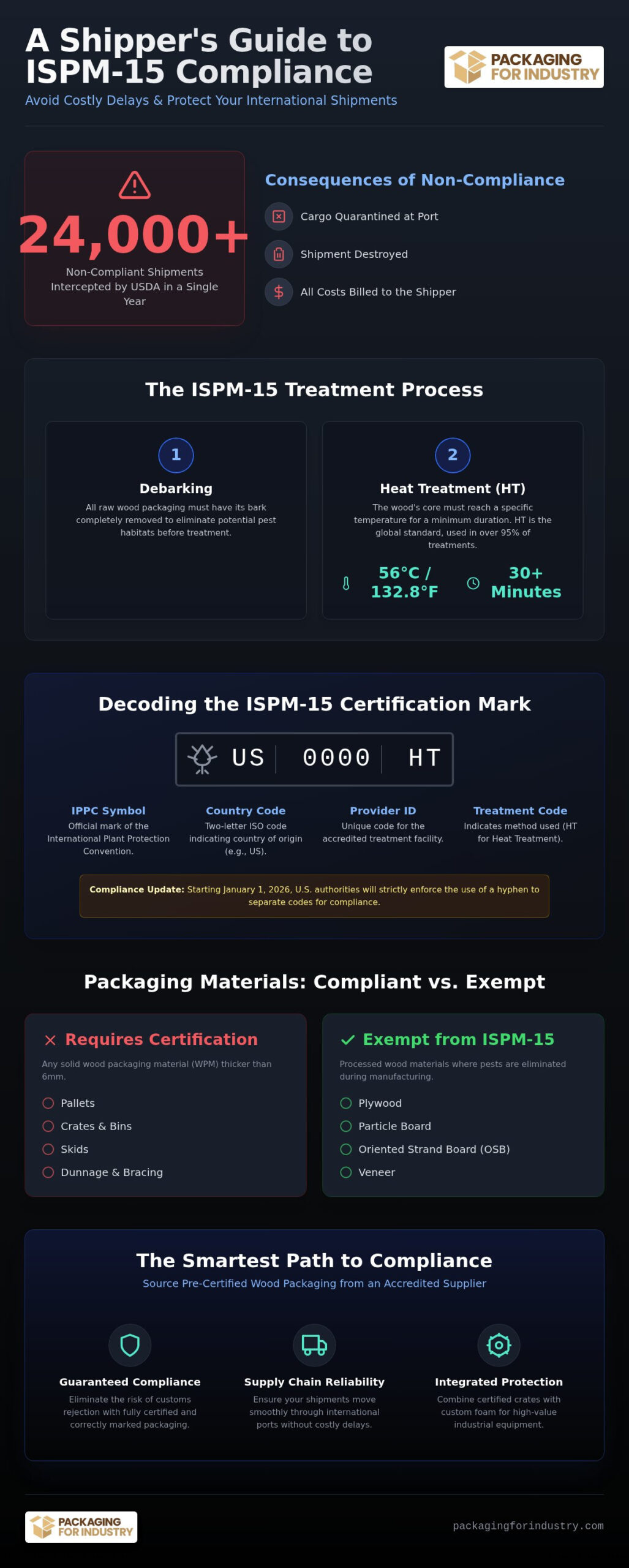
The USDA intercepted over 24,000 shipments with non-compliant wood packaging in 2025 alone, resulting in cargo being quarantined, treated, or destroyed at the shipper’s expense. When your high-value equipment reaches a foreign port, the last thing you want is a costly customs hold because of an incorrect mark on a crate. Learning how to secure ISPM-15 certification for wood packaging isn’t just about checking a regulatory box. It’s a vital procurement strategy that protects your bottom line and ensures your supply chain remains reliable.
We understand that the technical differences between Heat Treatment (HT) and fumigation can be confusing, especially with new enforcement rules regarding hyphenated marks. You’re likely looking for a way to eliminate the risk of international shipping surcharges without slowing down your operations. This guide provides a clear checklist for ISPM-15 compliance to remove the guesswork from your export logistics. We’ll cover the specific temperature requirements for heat-treated pallets, the latest APHIS marking standards, and the benefits of sourcing pre-certified export crates to streamline your shipping process.
Key Takeaways
- Understand the technical requirements of ISPM-15, which include the necessity of debarking wood and maintaining a core temperature of 56°C for at least 30 minutes.
- Discover how to secure ISPM-15 certification for wood packaging through accredited suppliers to bypass the administrative burden and high costs of in-house kiln management.
- Use the ACIR database to verify specific import regulations for your destination country and prevent costly customs rejections or cargo destruction.
- Optimize your supply chain reliability by choosing pre-certified export crates and pallets that integrate custom foam protection for high-value industrial components.
What is ISPM-15 and Why Does Your Export Strategy Depend on It?
The International Standards for Phytosanitary Measures No. 15, commonly known as ISPM 15, is a global regulation that governs wood packaging used in international trade. Its primary objective is to stop the spread of invasive pests, such as the Asian longhorned beetle, which can devastate local ecosystems and forests. For businesses shipping goods abroad, understanding how to secure ISPM-15 certification for wood packaging is a critical operational requirement rather than an optional safety measure. Non-compliant packaging can lead to your entire shipment being quarantined or destroyed at the port of entry, causing significant delays and unplanned expenses.
The standard applies to all Wood Packaging Material (WPM) thicker than 6mm. This category includes pallets, crates, skids, and dunnage. To meet the requirement, the wood must be debarked and undergo a specific treatment process to eliminate pests. In 2025 alone, the USDA intercepted over 24,000 shipments with non-compliant wood packaging. These incidents demonstrate that customs authorities are moving toward a zero-tolerance policy, making compliance a prerequisite for logistical flow.
The Role of the IPPC in Global Trade
This standard was developed by the International Plant Protection Convention (IPPC) to harmonize trade regulations across 186 signatory countries. Most major U.S. trading partners require ISPM-15 compliance for any imports involving solid wood. By standardizing these rules, the IPPC balances the needs of global logistics with environmental protection. For companies in manufacturing and aerospace, following these guidelines is the only way to ensure goods move through customs without friction.
Identifying Which Materials Require Certification
Not all packaging materials fall under these regulations. Raw, non-manufactured wood always requires certification. However, processed wood materials like plywood, particle board, and oriented strand board (OSB) are exempt. This is because the manufacturing process, which involves high heat and pressure, naturally eliminates pest risks. Procurement teams often ask how to secure ISPM-15 certification for wood packaging without investing in their own heat-treatment facilities.
When designing custom design packaging, engineers often combine certified solid wood frames with exempt plywood panels. This hybrid approach helps companies lower packaging costs while remaining fully compliant. WPM is defined as any wood used to support, protect, or carry a commodity, so even the small blocks used for bracing must meet the standard if they are made from raw lumber.
The Technical Requirements: Heat Treatment (HT) vs. Marking
The core of the ISPM-15 standard lies in the Heat Treatment (HT) process. For raw wood to be certified, it must be heated until its core reaches a minimum of 56°C (132.8°F) for at least 30 continuous minutes. This thermal profile is designed to kill larvae and insects that may be nesting deep within the wood grain. While Methyl Bromide (MB) fumigation is still an approved alternative, its use is rapidly declining. Heat Treatment now accounts for over 95% of all treated wood packaging globally. This shift is driven by environmental regulations and the European Union’s ban on Methyl Bromide for wood packaging. Using HT is the most reliable way to future-proof your export strategy and maintain consistent logistical flow.
When sourcing materials, you need to understand ISPM 15 & Export Treatment requirements to ensure your stamp is valid. Inspectors use these permanent, legible marks to trace the wood back to a specific, accredited facility. If the mark is missing or unreadable, the packaging is considered non-compliant. Learning how to secure ISPM-15 certification for wood packaging involves verifying that your supplier’s facility code is active and recognized by the relevant national authorities.
How to Read an ISPM-15 Stamp
The certification mark, often called the “wheat stamp,” contains three essential pieces of data. First is the two-letter ISO country code, such as “US” for the United States. Following this is a unique registration number assigned to the treatment provider. Finally, the stamp includes the treatment abbreviation, typically “HT” for Heat Treatment. Effective January 1, 2026, U.S. authorities will strictly enforce the use of a hyphen to separate these codes. Precise marking is now a technical necessity for avoiding border delays.
Debarking and Wood Quality Standards
Certification also requires that wood be debarked. The standard allows for small pieces of residual bark only if they’re less than 3 cm wide or have a total surface area of less than 50 square cm. Bark is restricted because it provides a habitat for pests to re-infest the wood after treatment. While surface mold or blue stains don’t disqualify the wood, any evidence of live pests will result in immediate rejection. High-quality, debarked lumber is the foundation for durable custom shipping crates. If you’re unsure if your current inventory meets these strict technical thresholds, you can request a packaging quote to secure pre-certified, compliant materials.
DIY Certification vs. Buying Pre-Certified Wood Packaging
Manufacturers often reach a crossroads when expanding their export operations: do they certify their wood packaging in-house or source it from a certified partner? While owning the process seems appealing, the reality involves significant capital and administrative hurdles. To certify wood internally, a facility must invest in specialized heat-treatment kilns and maintain strict compliance with National Plant Protection Organization (NPPO) standards. This includes paying for recurring monthly audits by accredited agencies and maintaining precise treatment logs for every batch of lumber processed.
When you’re evaluating how to secure ISPM-15 certification for wood packaging, you must account for the hidden costs of the DIY approach. Beyond the equipment, there’s the labor cost of manual stamping and the constant risk of stamp misuse or accidental non-compliance. Shifting this responsibility to a professional supplier eliminates these overheads. It also moves the liability for compliance onto the provider, ensuring that every crate or pallet is border-ready before it reaches your loading dock. This is especially true when custom design packaging is required, as the certification is engineered into the design from the start.
Operational Impact of Managing Certification
Maintaining an IPPC license requires a dedicated focus on regulatory updates and documentation. For many Southern California manufacturers, this administrative burden distracts from core production goals. For companies wondering how to secure ISPM-15 certification for wood packaging without the capital expense of a kiln, professional sourcing is the standard solution. By purchasing pre-certified materials, you bypass the need for internal audits and specialized training. Reliability is further strengthened when your supplier provides a certificate of compliance with every delivery, serving as an additional layer of protection during customs inspections.
Cost-Reduction Through Professional Sourcing
Outsourcing is often the most fiscally responsible path because it leverages the supplier’s economies of scale. When you compare packaging pricing between in-house production and professional supply, the total cost of ownership (TCO) for DIY certification often exceeds the price of pre-certified units. Bulk purchasing of certified wooden shipping pallets allows you to access lower per-unit pricing that isn’t available for small-scale in-house operations. It also prevents costly errors, such as confusing ‘kiln-dried’ lumber with ‘heat-treated’ lumber.
To further optimize your supply chain, you can utilize Vendor Managed Inventory (VMI). This program ensures you always have compliant stock on hand without tying up warehouse space or capital in excess inventory. By letting a professional manage the certification and stock levels, you reduce the risk of shipping delays and focus your resources on manufacturing and distribution.
Steps to Secure ISPM-15 Compliance for Your Exports
Securing a smooth export process requires a proactive approach to phytosanitary standards. The first operational step is to identify the destination country’s specific import requirements by searching the Agricultural Commodity Import Requirements (ACIR) database. While ISPM-15 is a global standard, some nations maintain stricter enforcement regarding bark size or specific documentation. Once you understand the destination’s rules, your primary task is sourcing lumber or finished packaging exclusively from accredited providers. Learning how to secure ISPM-15 certification for wood packaging essentially means verifying that your supplier is authorized to apply the IPPC mark through a recognized agency.
After your materials arrive, perform a physical inspection of every unit. Each piece of wood packaging must feature the official, legible IPPC stamp. Do not overlook the dunnage, blocks, and bracing used inside your crates. If you use loose wood for internal support, every individual piece must be stamped. A common reason for shipment rejection is the use of non-compliant dunnage within an otherwise certified crate. Finally, maintain a meticulous paper trail. Your invoices should explicitly state that the materials are ISPM-15 and HT compliant, providing a second line of defense if a customs inspector questions the validity of a stamp.
Sourcing Compliant Packaging in Southern California
For manufacturers operating in the industrial hubs of San Diego, Orange County, and Los Angeles, finding local expertise is essential for maintaining a just-in-time supply chain. When you evaluate a wood packaging manufacturer, verify their credentials through their accredited inspection agency. For the aerospace and medical device sectors, ‘HT’ stamped lumber is a non-negotiable requirement. These industries require the highest levels of precision and reliability to prevent the high costs of rejected loads at foreign ports of entry.
Internal Quality Control Checklists
Your warehouse teams are the final gatekeepers before goods leave the dock. Training staff to recognize valid versus invalid stamps is a low-cost way to prevent high-cost delays. A valid mark must include the ISO country code, the producer’s unique registration number, and the treatment code. If you discover unstamped wood in a critical export shipment, do not attempt to ship it. Instead, replace the non-compliant components with certified materials immediately. Documenting your WPM compliance for your freight forwarder or customs broker ensures that all parties are aligned. This internal oversight is a key part of how to secure ISPM-15 certification for wood packaging within your broader logistics strategy.
Certified Export Crates and Pallets from Packaging For Industry
Packaging For Industry (PFI) provides a proactive solution for businesses that want to eliminate the risk of shipping delays. We maintain a 100% commitment to ISPM-15 compliance for all international wood packaging. For companies in the aerospace and manufacturing sectors, we provide specialized mil-spec packaging that meets the most stringent defense and industrial requirements. Our packaging kitting services further streamline your assembly line by providing all necessary components, from certified wood frames to custom foam packaging, in a single, ready-to-use package.
When you’re determining how to secure ISPM-15 certification for wood packaging, the most efficient path is to partner with a supplier that handles the technical details on your behalf. We leverage our local Southern California expertise to serve clients in Los Angeles and Orange County with local next-day delivery where applicable, while our nationwide shipping capabilities support facilities across the country. Our team acts as a steady and dependable partner, ensuring your cargo is border-ready before it leaves your loading dock.
Custom Design and Prototyping Services
We offer free prototyping to ensure your custom crate fits your specific product dimensions perfectly before we begin a full production rollout. Our design process simplifies compliance by integrating the HT stamp directly into the initial engineering phase, with custom sizes available for any high-value industrial component. This engineering-first approach allows us to balance material durability with weight optimization. By refining the external dimensions of your crates, we help you lower packaging costs by avoiding common UPS and FedEx surcharges related to oversized packaging.
Streamlining Your Supply Chain with VMI and JIT
Efficient logistics depend on having the right materials available at the right time. We help you eliminate packaging shortages through Just-In-Time inventory management. Our stocking programs are designed to free up valuable warehouse floor space in cities like Anaheim and Irvine, where square footage is at a premium. Instead of storing bulky pallets and crates yourself, we manage the inventory and deliver it as you need it. This reduces your overhead and improves your overall supply reliability. Request a packaging quote today to see how our certified solutions can optimize your international supply chain.
Secure Your International Supply Chain with Compliant Wood Packaging
Navigating global phytosanitary standards is a technical requirement that directly impacts your logistics efficiency and fiscal responsibility. By understanding how to secure ISPM-15 certification for wood packaging, you eliminate the risk of cargo being quarantined or destroyed at foreign ports. Whether you’re sourcing heat-treated pallets or custom-engineered export crates, the focus must remain on precision and verified marking. These standards are non-negotiable for maintaining a reliable supply chain.
Relying on a certified partner shifts the liability away from your internal operations and ensures every piece of dunnage or bracing meets the latest IPPC mandates. Packaging For Industry brings deep expertise in aerospace and defense packaging to every project, providing the durability and precision required for high-value exports. We offer reliable local delivery throughout Southern California and comprehensive Vendor Managed Inventory (VMI) programs to ensure you never face a shortage of compliant materials. We’re ready to act as your steady partner in logistical optimization and supply chain stability.
We look forward to helping you streamline your international shipments and protect your bottom line with reliable, compliant solutions.
Frequently Asked Questions
Does ISPM-15 apply to plywood or particle board?
ISPM-15 does not apply to processed wood materials like plywood, particle board, or OSB. The manufacturing process for these materials involves high heat and pressure, which naturally eliminates pest risks. Solid wood packaging thicker than 6mm is the primary target of the regulation. You can often combine plywood panels with heat-treated solid wood frames to lower packaging costs while ensuring your custom export crates remain fully compliant with international standards.
Can I stamp my own wood packaging if I buy heat-treated lumber?
You cannot apply an IPPC mark yourself simply by purchasing heat-treated lumber. Only facilities accredited by a National Plant Protection Organization (NPPO) are authorized to apply the stamp. Learning how to secure ISPM-15 certification for wood packaging involves sourcing from a certified supplier like PFI. Attempting to self-certify or reuse stamps without proper authorization is a violation of international trade laws and will lead to immediate shipment rejection at the port.
How long is an ISPM-15 certification valid for a single crate?
The certification mark is valid for the entire lifespan of the wooden crate or pallet. There is no expiration date on the treatment itself. However, if the wood packaging is repaired or modified, the entire unit must be re-treated and re-stamped by an accredited facility. It’s essential to keep the mark legible on at least two opposite sides to ensure customs inspectors can verify compliance throughout the entire international transit process.
What happens if my shipment is found with non-compliant wood packaging?
If a shipment is found with non-compliant wood packaging, customs authorities will issue an Emergency Action Notification. The USDA intercepted over 24,000 shipments with non-compliant wood packaging in 2025 alone, demonstrating strict enforcement levels. The shipment may be quarantined, treated on-site at a high cost, or destroyed. In many cases, the entire cargo is re-exported to the country of origin at the shipper’s expense, leading to significant financial penalties.
Are there any countries that do not require ISPM-15 certification?
Currently, 186 countries are signatories to the IPPC and require ISPM-15 compliance. While some smaller nations or specific regions might have varying enforcement levels, it’s safer for your export strategy to assume compliance is mandatory for all international trade. Relying on a professional supplier helps you navigate how to secure ISPM-15 certification for wood packaging so you don’t have to track the shifting regulations of every individual destination country.
What is the difference between kiln-dried (KD) and heat-treated (HT) wood?
Kiln-dried (KD) wood is processed to reduce moisture content for structural stability, but it doesn’t always reach the temperatures required for pest sterilization. Heat-treated (HT) wood must reach a core temperature of 56°C for at least 30 continuous minutes. While some lumber is both KD and HT, only the HT mark is recognized for ISPM-15 compliance. Always verify the stamp specifically indicates HT to avoid border issues and ensure your cargo remains moving.
Does ISPM-15 apply to shipments between the U.S. and Canada?
Yes, ISPM-15 requirements apply to shipments moving between the United States and Canada. The long-standing exemption for wood packaging moving across this border was phased out years ago to prevent the spread of invasive species like the Emerald Ash Borer. All solid wood pallets and crates crossing the border must now be debarked and heat-treated. Using pre-certified materials is the most efficient way to ensure your cross-border logistics remain uninterrupted and reliable.
How much does ISPM-15 certification typically add to the cost of a crate?
The cost of certification is integrated into the price of the finished export crate or pallet. While certified wood may have a higher per-unit cost than untreated lumber, it’s a necessary investment to avoid the massive expenses of shipment rejection. When you request a packaging quote, you’ll find that sourcing pre-certified materials is far more economical than managing internal audits or risking the destruction of your high-value cargo at a foreign port.