
How much of your annual operational budget is literally ending up in a landfill? For manufacturers managing high-value components, the recurring expense of one-way corrugated and expendable foam isn’t just a line item; it’s a structural leak in your bottom line. You likely already know that disposal fees and rising material costs, such as the $50 to $70 per ton increase in containerboard projected for 2026, are making single-use systems harder to justify. Performing a rigorous cost-benefit analysis of returnable dunnage program options is no longer just a sustainability initiative. It’s a necessary financial audit for any facility facing the pressure of new Extended Producer Responsibility (EPR) regulations and mounting waste.
We understand that the high upfront capital required for a closed-loop system can be daunting for any purchasing manager. This guide will show you how to look past the initial price tag to see the long-term fiscal advantages of durable, custom-engineered protection. You’ll learn how to calculate the true ROI of returnable dunnage by factoring in reduced product damage, lower labor costs, and the elimination of recurring packaging spend. We provide a clear framework to help you determine if a returnable system is the right fit for your specific supply chain and how to leverage vendor-managed inventory to ensure your assets stay in circulation.
Key Takeaways
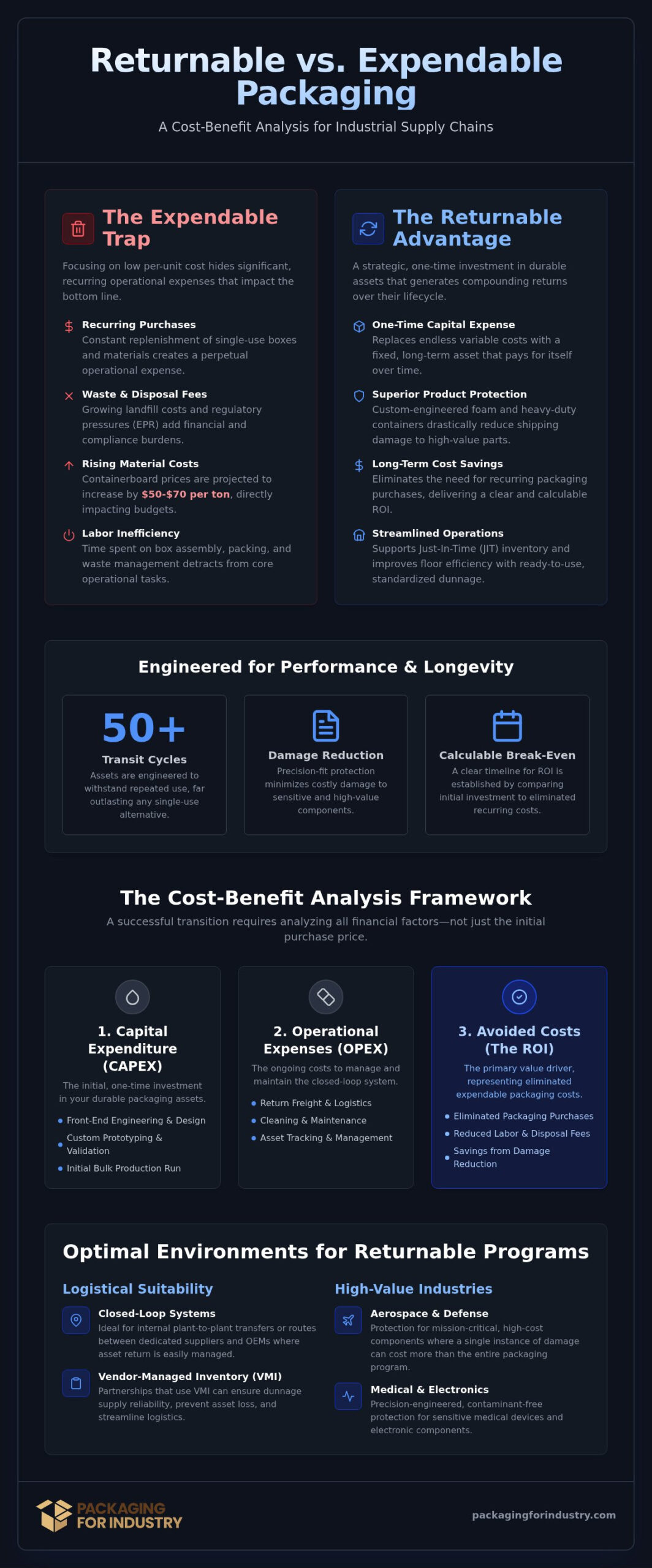
- Quantify the longevity of returnable assets, such as custom foam and heavy-duty crates, which are engineered to withstand 50 or more transit cycles.
- Utilize our detailed framework for a cost-benefit analysis of returnable dunnage program implementation to calculate your exact ROI and break-even timeline.
- Evaluate industry-specific advantages for high-value components in the aerospace and medical sectors where precision-engineered protection is critical.
- Master the logistics of a closed-loop system by using asset tracking and Vendor Managed Inventory (VMI) to prevent dunnage loss and ensure supply reliability.
- Leverage custom prototyping and engineering services to validate your packaging design and fit before committing to bulk production.
The Fundamentals of Returnable Dunnage in Industrial Logistics
Returnable dunnage refers to specialized containers, custom foam inserts, or heavy-duty corrugated boxes with custom sizes available for repeated use within a supply chain. Unlike single-use materials, these assets are engineered to survive 50 or more trips. Transitioning to this model requires a thorough cost-benefit analysis of returnable dunnage program feasibility, as the initial investment is significantly higher than buying standard RSC boxes. Choosing between custom foam assemblies and heavy-duty corrugated depends on the fragility of your components and the expected lifecycle of the program.
Many manufacturers fall into the “expendable trap” by focusing only on the per-unit price of one-way packaging. While a single box is cheap, the recurring costs of procurement, assembly labor, and disposal add up quickly. With containerboard prices expected to rise by $50 to $70 per ton in 2026, the financial burden of single-use systems is becoming a structural liability. Reusable packaging breaks this cycle. It helps lower packaging costs by replacing variable material costs with a one-time capital expenditure that pays for itself over multiple transit cycles.
Expendable vs. Returnable: A Strategic Shift
A standard RSC box is a consumable item that requires constant replenishment and takes up valuable warehouse space. In contrast, custom returnable crates and packaging kitting solutions support just-in-time inventory management by providing a predictable flow of ready-to-use protection. This shift reduces the labor spent breaking down boxes and managing waste streams. It also improves floor efficiency because dunnage is designed to fit specific workstations, which eliminates the need for packers to hunt for tape or bubble wrap. When you don’t have to manage a mountain of cardboard waste, your operational flow stays clean and focused.
Identifying Your Closed-Loop Potential
Not every route is suitable for returnables. A cost-benefit analysis of returnable dunnage program success depends on a closed-loop or tightly controlled open-loop system. The most effective applications include internal plant-to-plant transfers or shipping between Tier 1 suppliers and OEMs. Facilities in Southern California, specifically across Orange County, Los Angeles, and the Inland Empire, are particularly well-positioned for these programs due to the high density of manufacturing hubs. If your components move frequently between fixed locations, the logistical cost of returning empty dunnage isn’t just a loss; it’s easily offset by the elimination of new packaging purchases.
Key Components of a Cost-Benefit Analysis (CBA)
A successful cost-benefit analysis of returnable dunnage program implementation begins with a clear distinction between Capital Expenditure (CAPEX) and Operational Expenses (OPEX). CAPEX includes the front-end engineering, custom prototyping, and the initial production run of your assets. While these figures are higher than a single purchase order for standard corrugated boxes, they represent a long-term investment in supply chain stability. OPEX, on the other hand, covers the lifecycle costs such as return freight, cleaning, and asset tracking. A detailed comparative analysis of a returnable/reusable packaging system shows that while OPEX exists, it’s frequently dwarfed by the “Avoided Cost” of recurring expendable purchases and disposal labor.
When you calculate the value of eliminated waste, don’t overlook the impact of damage reduction. Precision-engineered foam inserts provide a level of security that standard bubble wrap or loose-fill cannot match. For industries like aerospace, preventing damage to a single six-figure component can instantly justify the entire program’s cost. If you’re ready to see how these numbers apply to your specific facility, you can request a packaging quote to compare custom returnable options against your current spend.
Calculating the Break-Even Point
The break-even point is defined by the number of “turns” or trips a container makes before the cumulative cost of expendables would’ve exceeded the returnable investment. Choosing the right material is vital here. High-density Polyethylene (PE) foam offers superior durability for 50 or more trips, whereas softer Polyurethane might fail earlier, extending your break-even timeline. By integrating these projections into your packaging cost savings strategy, you can secure CFO approval based on verified durability data rather than speculation.
Hidden Costs and Soft Savings
A realistic cost-benefit analysis of returnable dunnage program must account for “shrinkage,” which refers to dunnage that is lost or damaged in transit. Most successful programs factor in a small annual replacement rate to maintain the fleet. However, these costs are often offset by significant soft savings. Labor efficiency increases when workers use kitting solutions that don’t require taping or complex box assembly. Additionally, as state-level Extended Producer Responsibility (EPR) laws take effect in 2026 across states like California and Colorado, avoiding single-use waste helps you bypass new regulatory fees modulated by material weight.
Industry-Specific ROI: When Returnable Dunnage Wins
While the basic math of a cost-benefit analysis of returnable dunnage program applies to any facility, the ROI accelerates in sectors handling sensitive or high-value inventory. Recent research on costs and benefits of returnable packaging highlights that specialized protection systems provide more than just material savings; they act as a risk mitigation strategy for your most critical assets. In industries where a single failure can lead to six-figure losses, the durability of returnable assets becomes a form of supply chain insurance.
Automotive logistics, for example, thrives on high-volume, repeatable part shipments where dunnage can be used hundreds of times. By optimizing packaging kitting and improving shipping density, manufacturers can fit more components into every trailer. This directly lowers the total cost per part delivered while eliminating the constant need to procure and dispose of one-way corrugated materials. When parts move on a predictable schedule between fixed locations, the logistical return of empty containers is a minor operational step that yields major fiscal rewards.
Aerospace Packaging: High Stakes ROI
In the aerospace and defense sector, the cost of a single damaged turbine blade or avionics unit can exceed the annual budget for an entire packaging department. Utilizing Aerospace Packaging Solutions involving custom-engineered crates and mil-spec foam is a financial necessity. If a $50,000 damage claim is avoided even once over the lifecycle of a returnable crate, the program has achieved an immediate and massive ROI. These assets provide consistent, repeatable protection that standard RSC boxes simply can’t offer for flight-critical hardware. You aren’t just buying a box; you’re securing a high-value asset over dozens of transit cycles.
Medical and Electronics: Precision and Protection
Medical device manufacturers must maintain sterile environments and ensure a precision fit for delicate surgical instruments. Returnable systems often incorporate cleanroom-compatible poly bags within standardized foam packaging to ensure safety without creating excessive waste. For the electronics industry, implementing ESD (Electrostatic Discharge) and anti-static foam is critical for sensitive PCB transfers. These specialized materials prevent latent defects that occur during transit. Such defects are often the most expensive type of failure because they aren’t discovered until the product is in the field, leading to costly recalls and brand damage.
Operational Logistics: Managing Your Returnable Program
Managing a fleet of returnable assets requires a different logistical approach than ordering one-way boxes. The “management overhead” of tracking these assets is a common concern in any cost-benefit analysis of returnable dunnage program, but it’s a hurdle that can be cleared with the right systems. Efficient tracking ensures your custom crates and foam inserts aren’t lost at customer sites or supplier facilities. By treating dunnage as a capital asset rather than a consumable, you shift the focus from procurement to asset management. This transition requires a dedicated partner who understands the rhythm of your supply chain.
This is where Vendor Managed Inventory (VMI) becomes a critical component of your operational strategy. At PFI, we take on the responsibility of monitoring your dunnage levels and ensuring that replenishment happens seamlessly. This removes the administrative burden from your purchasing team and prevents production bottlenecks caused by missing packaging. We provide custom sizes available for any returnable container to ensure that even as your product lines evolve, your program remains optimized for space and protection.
Integrating VMI and JIT for Returnables
Our VMI programs are designed to support just-in-time inventory management by synchronizing dunnage availability with your production schedule. We perform scheduled reviews to identify worn or damaged dunnage before it fails on the line. This proactive maintenance extends the life of your investment and ensures that every part shipped receives the same high-level protection. By automating replenishment, your facility can maintain a leaner footprint without the risk of stockouts. It’s a pragmatic solution for manufacturers who want the benefits of returnables without the headache of daily tracking.
The Logistics of the “Return” Trip
The cost of the “return” trip is a primary factor in the cost-benefit analysis of returnable dunnage program success. To maximize truck space, we engineer nesting and collapsible designs that allow empty containers to be stacked efficiently. For manufacturers in Orange County, Los Angeles, and the Inland Empire, our local delivery networks facilitate faster turns and lower freight costs. Utilizing local next-day delivery for dunnage returns allows you to maintain a smaller total fleet while keeping your supply chain moving at peak efficiency. This local advantage significantly shortens the payback period for your investment.
Implementing Your Program with Packaging For Industry (PFI)
Moving from a theoretical cost-benefit analysis of returnable dunnage program to a live operational system requires a partner who understands the intersection of engineering and economics. At PFI, we don’t just sell containers; we engineer systems of protection designed for long-term durability. The foundation of your ROI lies in the design phase. A poorly engineered insert leads to premature material failure or product damage, which can quickly erase the projected savings of a returnable program. By selecting the right materials, such as high-density polyethylene foam or heavy-duty triple-wall corrugated, we ensure your assets survive the 50-plus trips required to maximize your investment.
We invite you to request a packaging review to identify specific areas where your current expendable spend can be converted into a high-performance returnable system. Our team analyzes your transit cycles and component fragility to recommend a solution that will lower packaging costs over the life of your program. With custom sizes available for every application, we eliminate the inefficiencies of one-size-fits-all catalog options.
The PFI Design and Prototyping Process
Our engineering team utilizes advanced CAD/CAM support to create custom design packaging tailored to your exact specifications. We offer free prototyping because we believe you shouldn’t commit to bulk production until you’ve verified the fit and function of the solution. During this phase, we test the durability of the dunnage across simulated transit cycles to ensure it maintains its structural integrity. We often combine materials, such as foam-lined plastic corrugated or custom crates with kitting inserts, to provide integrated, heavy-duty protection for high-value components.
Scaling Your Solution Nationwide
PFI is uniquely positioned to support manufacturers with complex supply chains. We leverage our Southern California hubs in Orange County and Los Angeles to provide rapid turns for local routes, while our nationwide shipping capabilities ensure your returnable program remains consistent across all facilities. Our competitive pricing allows you to compare packaging pricing against major catalog suppliers who often lack the custom engineering depth required for returnable systems. When you partner with us, you gain a steady, dependable guide focused on tangible, real-world outcomes for your bottom line.
Optimizing Your Supply Chain for Long-Term ROI
Transitioning to a closed-loop system is a strategic investment in your facility’s fiscal health. While the initial capital requirement is higher than purchasing standard corrugated boxes, the long-term reduction in recurring spend and disposal fees is substantial. A rigorous cost-benefit analysis of returnable dunnage program feasibility often reveals that the avoided cost of one-way packaging quickly offsets the engineering and production expenses.
PFI provides the technical expertise needed to ensure your transition is successful. We specialize in high-stakes sectors like aerospace and medical packaging, where precision and reliability are non-negotiable. Our engineering team offers free prototyping for a guaranteed fit before you commit to bulk production. With local Southern California next-day delivery and VMI services, we help you manage your assets without the operational burden of manual tracking. You don’t have to navigate these logistical shifts alone.
Take the first step toward a more efficient and cost-effective supply chain today.
Frequently Asked Questions
How many trips are needed to make returnable dunnage cost-effective?
Most industrial programs reach a break-even point between 15 and 25 trips. This calculation varies based on the price difference between standard RSC boxes and the initial investment for custom foam or plastic crates. A comprehensive cost-benefit analysis of returnable dunnage program variables should also include labor savings from reduced assembly time. If you manage high-frequency routes, you’ll likely see a way to lower packaging costs within the first year of implementation.
What is the typical lifespan of foam dunnage inserts?
High-density polyethylene (PE) foam inserts typically last for 50 to 100 trips before showing functional wear. Polyurethane foam is softer and usually has a shorter lifespan of 20 to 30 trips. Actual longevity depends on the handling environment and the weight of your components. Selecting the right material during the engineering phase is essential. We offer custom sizes available in various densities to ensure your dunnage survives long enough to maximize your total savings.
How do I prevent returnable dunnage from being lost in the supply chain?
Implementing a structured asset tracking system is the most effective way to prevent dunnage loss. This often includes barcoding, RFID tags, or simple serialized labeling on every custom crate. You should also establish clear accountability protocols with your Tier 1 suppliers or OEM partners. Using a vendor-managed inventory (VMI) program allows a partner to monitor inventory levels and flag missing assets before they impact your production schedule or budget.
Can returnable dunnage be used for international shipping?
Returnable systems are technically possible for international shipping but are often less cost-effective due to high return freight expenses. They work best for overseas routes when you have a high-value product and a balanced flow of goods between two fixed points. Most international manufacturers prefer heavy-duty triple-wall corrugated or heat-treated pallets for one-way export to avoid the logistical complexity and cost of backhauling empty containers across oceans.
What industries benefit most from returnable packaging programs?
Aerospace, medical device manufacturing, and automotive sectors see the highest ROI from these programs. These industries handle expensive, sensitive components that require precision-engineered protection. In a cost-benefit analysis of returnable dunnage program success, these sectors benefit from the massive reduction in product damage claims. Electronics manufacturers also benefit by using ESD-safe foam inserts to protect sensitive PCBs during frequent plant-to-plant transfers within Southern California and beyond.
How does VMI help in managing returnable dunnage assets?
VMI shifts the burden of asset management from your purchasing team to your packaging supplier. We monitor your dunnage counts at various points in the loop to ensure you always have enough kitted sets for production. This proactive oversight identifies bottlenecks where dunnage might be sitting idle. It ensures your returnable fleet is sized correctly. This allows you to compare packaging pricing against the hidden costs of emergency one-way backup packaging.
Is returnable dunnage more expensive to ship due to weight?
While returnable assets are heavier than thin-walled corrugated boxes, the impact on shipping costs is often minimal compared to the material savings. We use lightweight, high-strength materials like plastic corrugated and specialized foam to keep tare weight low. Furthermore, custom-designed dunnage often improves pallet density, allowing you to ship more parts per trailer. This increased efficiency frequently offsets the slight increase in weight for the outbound leg of the trip.
What are the cleaning and maintenance requirements for returnable inserts?
Requirements vary by industry but usually involve periodic inspections and basic cleaning. Medical and electronics sectors may require dunnage to be wiped down with isopropyl alcohol or air-blown to remove dust. For automotive applications, a simple visual check for structural integrity during the kitting process is often sufficient. We engineer our custom foam and plastic solutions to be moisture-resistant, making them easy to sanitize without degrading the material over time.