
Could a minor oversight in your corrugated box specifications be the hidden catalyst for a million-dollar production halt? For procurement and operations managers, the true cost of a packaging vendor isn’t found on a line-item quote; it’s found in the reliability of the supply chain and the integrity of the product upon arrival. If you’ve dealt with production stops due to inventory shortages or seen high-value components arrive damaged, you know that unit price is secondary to operational performance. This guide provides a comprehensive checklist for evaluating a new packaging supplier to ensure your next partner can handle the rigors of industrial logistics.
We understand that your primary objectives are to lower total packaging costs and maintain a reliable just-in-time (JIT) or vendor-managed inventory (VMI) program. You need a partner who understands that inefficient box sizing leads to astronomical freight costs and wasted warehouse space. This article outlines a professional framework for vetting technical capabilities, from custom-engineered foam inserts to heavy-duty crates. We’ll examine the critical metrics that separate a simple vendor from a strategic partner capable of optimizing your entire distribution workflow.
Key Takeaways
- Identify hidden expenses beyond unit pricing by calculating the Total Cost of Ownership, including freight surcharges and transit damage rates.
- Vet a vendor’s technical expertise by reviewing their CAD/CAM design support and requesting free prototyping for complex industrial components.
- Use our professional checklist for evaluating a new packaging supplier to verify their ability to prevent production stops through Vendor Managed Inventory (VMI) and stocking programs.
- Ensure long-term reliability by reviewing ISO certifications and establishing clear KPIs for delivery accuracy during an initial pilot program.
- Lower overall packaging costs by choosing a partner capable of combining corrugated, custom foam, and protective film into a single engineered solution.
Beyond the Quote: Evaluating Total Cost of Ownership
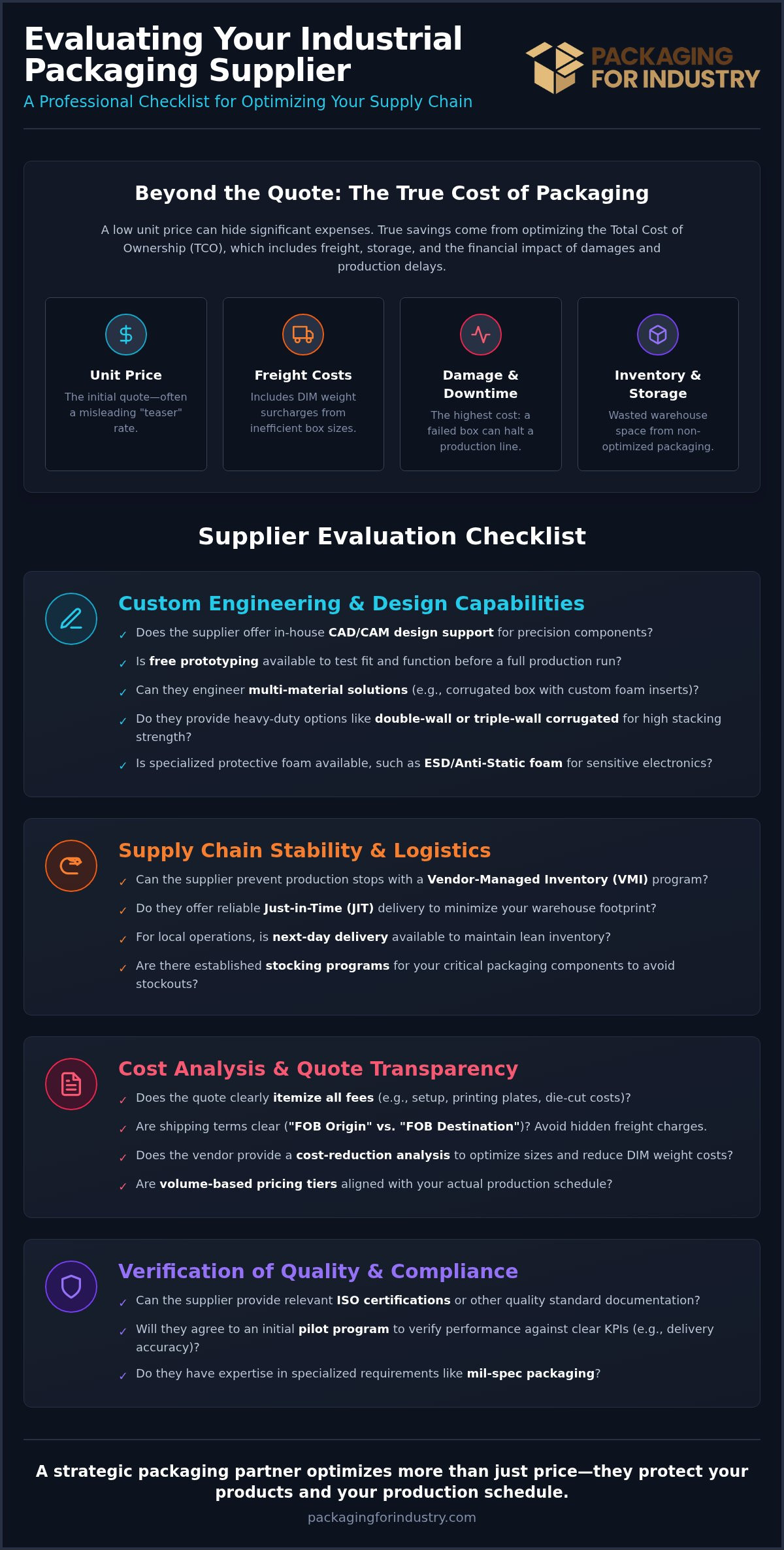
Total Cost of Ownership (TCO) in industrial packaging represents the sum of the unit price, freight expenses, storage requirements, and the financial impact of shipping damage. Procurement managers often encounter “teaser” pricing from large catalog vendors that seems attractive on a spreadsheet. However, these prices frequently mask inefficiencies that drive up the bottom line. A low-cost box that arrives late or fails during transit isn’t a bargain; it’s a liability. True packaging cost savings come from optimizing every touchpoint in the supply chain, from the warehouse floor to the customer’s dock.
Analyzing Quote Transparency
A transparent quote should leave no room for ambiguity. When you compare packaging pricing, look for itemized setup fees, printing plate charges, and die-cut costs. Some suppliers hide these behind a low per-unit rate, only to bill them separately later. Verify if the shipping terms are “FOB Origin” or “FOB Destination.” If a quote is listed as “plus freight,” your final cost is at the mercy of fluctuating carrier rates. Your checklist for evaluating a new packaging supplier must include a verification of volume-based pricing tiers. Ensure these tiers align with your actual production schedule so you don’t overpay for storage or under-order and risk a stockout.
Freight and Dimensional Weight Impact
Shipping air is one of the most common ways to waste money in industrial logistics. If your vendor only offers stock sizes, you’re likely paying dimensional (DIM) weight surcharges for empty space inside your boxes. A capable supplier will conduct a cost-reduction packaging analysis to determine if custom-engineered solutions can reduce your package footprint. For those with Southern California operations, proximity is a major factor in TCO. Local vendors can offer next-day delivery and reduced freight costs that national catalog companies can’t match. Choosing a partner near your Anaheim or Orange County facility minimizes transit time and helps you maintain a leaner warehouse footprint.
Assessing Custom Engineering and Design Capabilities
Industrial packaging isn’t just about boxes; it’s about precision engineering. A critical item on your checklist for evaluating a new packaging supplier is their internal CAD/CAM capability. Complex components, especially within aerospace and aviation packaging, require exact tolerances that generic catalog sizes cannot provide. You shouldn’t commit to a full production run based on a 2D drawing. Professional suppliers offer free prototyping, allowing you to test the physical assembly under real-world conditions. This step is vital for ensuring that custom foam inserts and corrugated structures work in unison to protect high-value assets during transit.
Many catalog vendors focus on high-volume, single-material sales. Industrial operations require a more sophisticated, multi-material approach. A single shipping solution might require a heavy-duty corrugated outer shell, custom polyethylene foam for shock absorption, and integrated corner protection. Vetting a supplier’s ability to engineer these hybrid solutions prevents the logistical headache of sourcing components from multiple vendors. It also ensures that the entire system is designed for maximum efficiency and durability, which naturally lowers your total cost of ownership.
Protective Foam and Interior Cushioning
Inquire about the technical specifications of their foam offerings. For sensitive electronics, verify if they can provide ESD and anti-static foam to prevent catastrophic static discharge. Evaluate the density options for polyethylene and polyurethane foam based on the fragility and static load of your components. A seasoned partner will explain the benefits of die-cut foam inserts for high-precision parts versus convoluted foam for generic cushioning. This technical expertise ensures you aren’t over-specifying material and inflating your costs.
Heavy-Duty Corrugated Specifications
Standard single-wall boxes often fail in industrial environments where stacking strength is paramount. Adding structural integrity to your checklist for evaluating a new packaging supplier ensures your inventory remains safe during vertical storage. Your operations likely require double-wall or triple-wall custom corrugated boxes to handle heavy mechanical parts. For international export, assess the availability of weather-resistant corrugated materials that maintain integrity in high-humidity transit. Confirm their capability to produce custom partitions or Gaylord bins that optimize your warehouse footprint. If you need a technical review of your current designs, you can request a packaging quote to see how an engineered approach improves product protection.
Evaluating Supply Chain Stability and Stocking Programs
Packaging reliability is the backbone of any manufacturing operation. A single stockout of a custom double-wall box can halt an entire assembly line, leading to costly downtime and missed delivery windows. When building your checklist for evaluating a new packaging supplier, you must move beyond simple lead times and investigate their inventory management philosophy. Most catalog vendors operate on a reactive model; they wait for your order and ship from a distant hub. An industrial partner, however, provides proactive stability through structured stocking programs designed around your specific usage rates.
The distinction between “just-in-time” (JIT) and “stocking programs” is critical for risk mitigation. JIT relies on precise timing and perfect logistics, which can be risky for custom-engineered items with long production lead times. A stocking program involves the supplier holding a dedicated safety stock of your specific corrugated boxes or foam inserts in their warehouse. This ensures that even if your production spikes unexpectedly, you have immediate access to the materials you need. Assessing a vendor’s warehouse capacity is essential to confirm they can actually house your recurring packaging needs without relying on third-party storage that adds cost and delay.
Vendor Managed Inventory (VMI) Criteria
A high-tier supplier should offer Vendor Managed Inventory to take the burden of tracking off your team. When vetting a partner, ask about their on-site review process. PFI conducts weekly or monthly reviews to ensure inventory levels match current production demands. This proactive approach allows the vendor to manage lead times for custom-engineered items that can’t be replaced off-the-shelf. It transforms the supplier from a mere vendor into a logistical partner that understands your operational rhythm and eliminates the stress of manual reordering.
Delivery and Logistical Reach
Logistics costs and reliability are often determined by proximity. Local Southern California suppliers provide a level of responsiveness that national catalog companies can’t match. If your facility is located in Carson or Irvine, you should prioritize vendors capable of local next-day delivery. This proximity allows for emergency rush orders that can save a production cycle from failure. While local expertise is vital, verify that the supplier also has nationwide shipping support if you manage multi-location manufacturing sites. This hybrid capability ensures consistent quality and pricing across your entire organization without sacrificing local agility.
Verification of Quality Standards and Compliance
Quality assurance in industrial packaging isn’t a “check-the-box” exercise. It’s a critical operational safeguard. When you add quality verification to your checklist for evaluating a new packaging supplier, you’re protecting your company from the cascading costs of transit damage. Inconsistent material quality, such as fluctuating corrugated flute strength or varying foam densities, compromises the integrity of your shipping system. A professional supplier maintains rigorous internal quality control protocols and ISO certifications to ensure that the thousandth box off the line performs exactly like the prototype you approved.
Damage reduction reviews are essential for high-value components. A supplier shouldn’t just sell you a box; they should analyze why a package failed and engineer a solution to prevent it from happening again. This level of accountability is what separates a strategic partner from a commodity vendor. If you’ve experienced high damage rates, your next supplier must demonstrate how their internal testing and material consistency will mitigate those risks during long-haul transit.
Industrial and Defense Compliance
Specialized sectors require specific regulatory expertise. If you’re in the defense industry, your checklist for evaluating a new packaging supplier must prioritize Military and Mil-Spec packaging capabilities. These requirements often involve specialized moisture barriers, greaseproof materials, and heavy-duty corrugated structures that meet strict government standards. For international shipping, verify that the supplier uses heat-treated (ISPM 15) wood for all export crates to avoid customs delays or rejections. Additionally, manufacturers in the semiconductor and electronics sectors should assess a vendor’s ability to provide ESD-safe materials and cleanroom-compatible packaging to prevent electrostatic damage to sensitive circuits.
Documentation and Reporting
Reliability is built on transparency and documentation. For critical aerospace or medical orders, ask if the supplier provides certificates of conformance (CoC). This document verifies that the materials used meet the exact specifications required by your contract. You should also evaluate their formal process for handling material defects. A partner who proactively manages returns and identifies root causes demonstrates a commitment to your long-term success. Before signing a contract, ask for references from established firms in the manufacturing and logistics sectors. Hearing how a vendor handled a quality crisis for another client is often more revealing than reviewing their sales brochure.
The Final Onboarding Checklist: Transitioning Suppliers
Transitioning to a new vendor is a critical operation that requires more than just a signed contract. It requires a structured alignment between your procurement team and the supplier’s production floor. The final phase of your checklist for evaluating a new packaging supplier should focus on a controlled onboarding process that validates every claim made during the bidding stage. By implementing a pilot program, you can identify potential logistical friction points before they impact your primary production schedule. This ensures that the transition from a standard catalog vendor to a specialized industrial partner is seamless and risk-averse.
Effective onboarding also involves establishing clear communication channels between your purchasing and operations departments. This internal alignment ensures that the technical requirements of the warehouse floor match the fiscal goals of procurement. When these departments work in silos, the result is often a mismatch in material specifications or inventory levels. A professional supplier facilitates this dialogue by acting as a consultant, helping both teams understand how engineered solutions impact the bottom line.
Structuring the Pilot Order
We recommend starting with a high-volume item rather than a non-critical one. This approach provides a realistic test of the supplier’s lead-time reliability and production capacity. During this phase, your operations team must conduct a “first-article” inspection for all custom-engineered items, such as die-cut foam inserts or heavy-duty double-wall boxes. If your workflow requires packaging kitting or assembly, use the pilot order to evaluate the accuracy and speed of these value-added services. Establishing clear Key Performance Indicators (KPIs) for material quality and delivery timing at this stage sets a professional standard for the entire long-term partnership.
Seamless Supply Chain Integration
Moving from reactive catalog purchasing to a managed supply model is a significant step toward operational efficiency. To ensure success, you must define specific minimum and maximum stocking levels for your Vendor Managed Inventory (VMI) program. This prevents the “bullwhip effect” where inventory levels fluctuate based on short-term demand spikes. Establish a firm communication schedule; PFI typically conducts weekly or biweekly reviews to monitor these levels and adjust production accordingly. This level of integration allows your purchasing department to focus on strategic goals while the supplier manages the granular details of warehouse replenishment. The final step in this process is to request a comprehensive packaging quote that reflects your specific volume requirements and logistical needs. A detailed quote from an expert like PFI will outline the path toward lower total costs and enhanced supply chain stability.
Secure Your Production with Strategic Packaging Partners
Selecting a packaging partner is a high-stakes decision that dictates your operational uptime and long-term fiscal health. By utilizing a professional checklist for evaluating a new packaging supplier, you transition from reactive purchasing to a strategic model that prioritizes total cost of ownership. This framework ensures that you vet for technical engineering capabilities and supply chain stability rather than just the lowest unit price on a spreadsheet.
We specialize in custom corrugated boxes and protective foam inserts tailored for the aerospace and medical sectors. Our proven VMI programs are designed to eliminate production shortages; while our local next-day delivery across Southern California provides the agility your warehouse needs. Whether you require mil-spec compliance or custom-engineered cushioning, the right partner acts as a proactive fixer for your most complex logistical challenges.
We’re committed to helping you lower total costs while improving your delivery reliability. Let’s build a more resilient supply chain together.
Frequently Asked Questions
What is the most important factor when evaluating a new packaging supplier?
Reliability and the total cost of ownership are the most critical factors. A low unit price doesn’t matter if the vendor can’t prevent stockouts or shipping damage. You should prioritize a supplier that offers engineered solutions and proactive inventory management. This ensures your production line remains active and your high-value components arrive intact. Use a comprehensive checklist for evaluating a new packaging supplier to verify these capabilities before signing a long-term agreement.
How can a new packaging vendor help reduce my shipping damage rates?
A specialized vendor reduces damage by performing a technical analysis of your current packaging failures. They use custom-engineered foam inserts and heavy-duty corrugated materials to address specific vulnerabilities. Instead of using generic stock boxes, they design a system that absorbs shock and prevents movement during transit. This engineering-led approach is vital for protecting sensitive aerospace parts or medical devices that can’t withstand the rigors of standard industrial shipping cycles.
What are the benefits of a Vendor Managed Inventory (VMI) program for packaging?
VMI programs eliminate the risk of production stops by shifting inventory tracking to the supplier. PFI conducts weekly or monthly on-site reviews to monitor your stock levels of corrugated boxes and stretch film. This proactive replenishment ensures you always have the necessary materials without tying up capital in warehouse space. It also removes the administrative burden of manual reordering; this allows your procurement team to focus on higher-level strategic supply chain goals.
Should I choose a local or national packaging supplier for my manufacturing plant?
Choosing a local supplier in Southern California often provides superior delivery reliability and lower freight costs. Local vendors can offer next-day delivery in areas like Orange County and Los Angeles, which is essential for managing emergency production spikes. However, ensure they also have nationwide shipping capabilities if you operate multi-location facilities. This hybrid approach combines the responsiveness of a local partner with the scalability needed for a growing and diverse industrial operation.
How do I know if a supplier is qualified for mil-spec or aerospace packaging?
Verification requires reviewing their history with defense contracts and specialized barrier materials. Qualified suppliers must provide mil-spec corrugated and heat-treated wood that meets ISPM 15 standards for international export. Ask for specific examples of their work with moisture-vapor barriers and greaseproof packaging. A seasoned consultant will also demonstrate knowledge of cleanroom standards and ESD protection; this ensures they can meet the rigid compliance requirements of the aerospace and semiconductor industries.
Can a custom packaging supplier help me avoid UPS and FedEx surcharges?
Yes, custom-engineered sizing directly reduces dimensional (DIM) weight surcharges. Large catalog vendors sell standard sizes that often result in shipping excess air, which triggers carrier penalties. A custom supplier designs boxes that fit your product precisely, minimizing the exterior footprint while maintaining protection. This optimization is a key part of your checklist for evaluating a new packaging supplier, as it can lead to substantial reductions in your annual freight expenditures.
What should I look for in a packaging supplier’s prototyping process?
Look for a supplier that offers free physical prototyping and internal CAD/CAM support. You shouldn’t rely solely on digital drawings for complex industrial components. A physical prototype allows your operations team to test the fit and structural integrity of foam inserts and corrugated partitions. This verification step prevents costly errors during full production runs and ensures the final design meets your specific protection and kitting requirements before any materials are ordered.
How often should I review my packaging supplier’s performance and pricing?
We recommend conducting a formal performance review at least twice a year. These reviews should evaluate delivery accuracy, material quality consistency, and current pricing compared to market trends. If you utilize a VMI program, the weekly or monthly inventory checks provide a continuous feedback loop. Regular reviews ensure your supplier’s capabilities still align with your production volume and that they continue to offer the technical support needed for your evolving requirements.