
The cheapest box on your procurement list is often the most expensive line item in your shipping budget. When comparing the cost of custom packaging vs stock, looking only at the unit price per box ignores the 5.9% carrier rate hikes and the rigid 139 dimensional weight divisor that UPS and FedEx are enforcing in 2026. If you’re paying to ship empty space filled with expensive air pillows, your “cheap” stock box is actually a fiscal liability. It’s a common frustration for logistics managers who see their margins eroded by shipping “air” and dealing with preventable product damage.
We’ll help you stop the bleed by showing you how to calculate the true total landed cost of your packaging. You’ll discover exactly when custom engineering saves your business more money than standard containers by eliminating unnecessary void fill and reducing DIM weight surcharges. This guide provides a pragmatic look at the math behind modern shipping. It offers a clear path to streamline warehouse kitting, eliminate transit damage, and improve supply reliability across your Southern California operations and beyond.
Key Takeaways
- Learn how current 2026 carrier rate increases and DIM weight divisors penalize oversized stock boxes, often making them more expensive than custom alternatives.
- Discover how to perform a total landed cost analysis of custom packaging vs stock to uncover hidden savings in freight, warehouse space, and assembly labor.
- Evaluate the protective benefits of engineered foam inserts and custom corrugated solutions in reducing high-value product damage and costly return cycles.
- Identify the specific product value and fragility benchmarks that determine when custom engineering becomes a mandatory requirement for fiscal responsibility.
- See how local Southern California manufacturers use Vendor Managed Inventory (VMI) to enjoy the benefits of custom packaging without the traditional lead-time delays.
Decoding the Cost: Stock vs. Custom Industrial Packaging
Industrial procurement often hinges on a single number: the unit price. However, when evaluating the cost of custom packaging vs stock, looking at the invoice price in isolation is a tactical error. Stock packaging refers to mass-produced, standardized containers manufactured in bulk and available for immediate purchase. These are the “off-the-shelf” options that seem convenient for general use. In contrast, custom packaging involves engineered solutions specifically designed around your product’s unique dimensions, weight, and fragility.
To make an informed decision, you must analyze the Total Landed Cost (TLC). This metric encompasses the unit price, freight charges, labor for assembly, potential product damage, and warehouse storage fees. While a stock box might have a lower upfront cost, it often creates inefficiencies that inflate the TLC. Understanding Packaging and labeling fundamentals helps buyers realize that a box’s primary job isn’t just to hold an item; it’s to protect it and optimize the logistical flow. If your packaging isn’t engineered for your specific supply chain, you’re likely overpaying in areas that don’t appear on a standard purchase order.
The Unit Price Myth in Procurement
Focusing solely on the price-per-box is a common mistake for industrial buyers. Stock boxes are rarely a perfect fit for specialized machinery, aerospace components, or sensitive electronics. This discrepancy forces your team to use excessive void fill, such as bubble wrap or packing peanuts, to prevent movement during transit. These extra materials add up quickly in both material cost and labor time. Additionally, oversized stock boxes take up more space on pallets and warehouse shelves. This reduces your storage density and increases the frequency of replenishment orders, which complicates your inventory management.
When Upfront Tooling Becomes an Investment
Custom solutions require an initial outlay for die-cutting tools and printing plates. While these are one-time costs, they often deter buyers who are focused on short-term budgets. You should view these as investments in long-term operational efficiency. The break-even point occurs when the savings from reduced shipping volume and eliminated product damage surpass the tooling fee. It’s about fiscal responsibility. PFI’s custom design packaging services minimize these initial hurdles by focusing on engineering that reduces material waste and labor from day one. By optimizing the design, we help you stabilize the long-term cost of custom packaging vs stock through superior performance.
The Hidden Expenses of Stock Boxes: DIM Weight and Surcharges
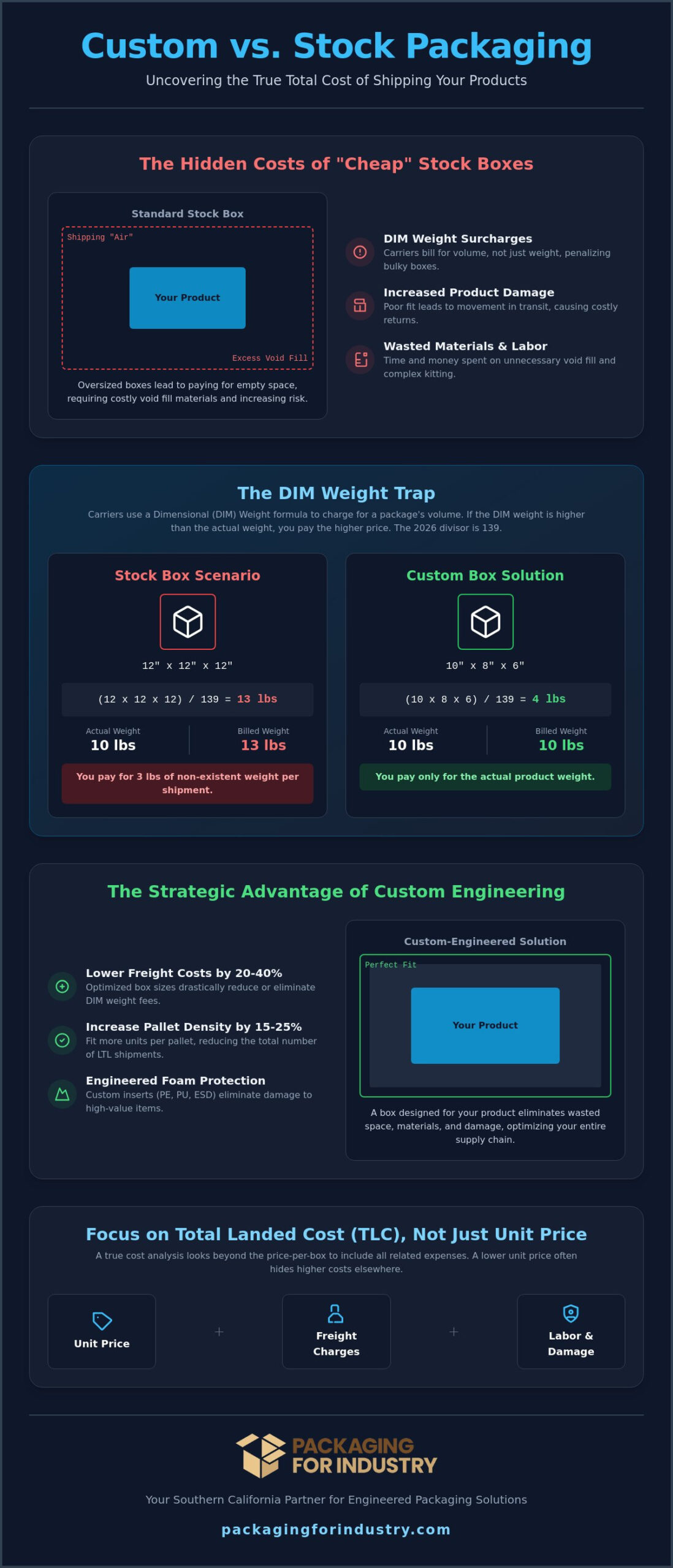
Carrier pricing shifted years ago from actual weight to Dimensional (DIM) weight, yet many procurement departments still overlook this in the cost of custom packaging vs stock debate. As of 2026, UPS and FedEx maintain a standard DIM divisor of 139. The formula is simple but punishing: (Length x Width x Height) / 139. If the resulting number is higher than the actual weight, you are billed for the volume. Stock boxes, which are rarely sized perfectly for industrial components, often force you to pay for “shipping air.” This inefficiency typically triggers 20% to 40% higher freight costs than necessary.
Consider a practical case study. Shipping a 10lb industrial component in a standard 12x12x12 stock box results in a DIM weight of 13 lbs (1,728 divided by 139, rounded up). You are paying for 3 lbs of non-existent weight. By switching to a custom 10x8x6 box, the DIM weight drops to 4 lbs. Since the actual weight of 10 lbs is now the higher number, you pay only for the 10 lbs of product. Over thousands of units, this difference represents a massive budgetary leak. Implementing a smart packaging strategy for supply chain efficiency is the only way to mitigate the 5.9% base rate increases carriers implemented this year.
Freight Optimization for Manufacturing
Custom sizing does more than just lower individual shipping rates. It directly impacts your pallet density. When boxes are engineered to fit the product exactly, you can often fit 15% to 25% more units on a single pallet. This reduces the total number of freight shipments required throughout the year. Furthermore, custom corrugated solutions can be designed with specific structural integrity, such as double-wall or triple-wall construction. This often eliminates the need for secondary outer-packaging or excessive corner and edge protection, further reducing the weight and volume of your outgoing freight.
Labor Costs: Kitting and Assembly Time
Labor is a significant component of your total landed cost. Stock boxes require your team to manually manage complex void-fill requirements, such as air pillows or paper dunnage, to bridge the gap between the product and the oversized container. This adds minutes to every pack-out. Engineered packaging kitting services allow your production line to move faster. When you use custom inserts, the product drops into place instantly, eliminating the guesswork of manual wrapping. These man-hour savings often offset the slightly higher unit price of a custom container. If you want to see how these numbers apply to your specific workflow, you can request a packaging quote to compare tailored solutions against your current stock inventory.
Engineering Protection: Custom Foam Inserts vs. Standard Void Fill
Relying on generic bubble wrap or crumpled paper dunnage creates a variable environment where your product’s safety depends entirely on the packer’s discretion. This inconsistency is a primary driver of transit damage. In contrast, custom foam packaging provides repeatable, engineered security that eliminates human error. While the unit price of loose-fill materials seems low, the cost of custom packaging vs stock is often justified the first time a high-value shipment arrives intact instead of in pieces. According to a 2024 study, even moving from loose paper to air pillows reduced breakage by 23% for mid-weight items; engineered foam inserts take this protection even further by immobilizing the product.
The true cost of product damage extends far beyond the replacement value of the item. You must also account for return shipping fees, the labor required to process claims, and the long-term erosion of your brand reputation. For aerospace and medical device manufacturers, these stakes are even higher. Sensitive instruments and flight-critical components cannot rely on the unpredictable compression rates of stock cushioning. These industries require the precision of closed-cell polyethylene for heavy, sharp-edged parts or the soft, open-cell structure of polyurethane for delicate surfaces that require maximum shock absorption.
Damage Reduction as a Profit Center
A 1% reduction in shipping damage isn’t just an operational metric; it’s a direct injection into your annual revenue. PFI’s foam engineering protects sensitive electronics from G-force impacts by neutralizing the specific vibration frequencies encountered during truck and air transit. For semiconductor firms and electronics manufacturers in Orange County and Los Angeles, anti-static (ESD) foam is a non-negotiable requirement. Using engineered ESD foam prevents the latent electrostatic discharge that can ruin a component without showing any visible exterior damage, saving your team from the nightmare of field failures.
Sustainability and Material Waste
Industrial B2B environments are increasingly sensitive to the “unboxing mess” created by excessive, non-recyclable void fill. Custom designs are inherently more sustainable because they use significantly less total material than “one-size-fits-most” stock solutions. By engineering a foam insert that fits the product exactly, you eliminate the need for layers of secondary wrap. This precision design makes the package smaller and lighter, which naturally reduces the environmental impact of your logistics chain. Transitioning to custom solutions demonstrates a commitment to fiscal and environmental responsibility that stock boxes simply can’t match.
Strategic Selection: When Does Custom Packaging Outperform Stock?
Determining the right time to transition from off-the-shelf containers to engineered solutions requires a clear understanding of your product’s value and the risks of the shipping environment. As a general rule in industrial procurement, any item with a replacement value exceeding $500 justifies the use of custom corrugated boxes. At this price point, a single damage claim doesn’t just erase your profit; it creates a logistical deficit that outweighs any marginal savings gained from a cheaper stock box. When you calculate the cost of custom packaging vs stock, the insurance provided by a precision fit becomes your most valuable asset.
Fragility and sensitivity are the next critical benchmarks. If your components are susceptible to shock, vibration, or electrostatic discharge, stock cushioning is a gamble you shouldn’t take. Shipping volume also dictates the strategy. While a small startup might survive on stock inventory, established manufacturers moving more than 500 units per month find that custom solutions pay for themselves through reduced labor and lower DIM weight charges. For Tier 1 suppliers, brand consistency is also a factor. Delivering a high-precision aerospace part in a generic, taped-up stock box sends the wrong message about your quality control standards.
Industry-Specific Benchmarks
Aerospace manufacturers face the most stringent requirements. In this sector, Mil-Spec packaging and custom-engineered crates are the industry standard because the cost of failure is catastrophic. In contrast, e-commerce fulfillment centers must balance shipping speed with a custom design that enhances the unboxing experience while remaining lightweight. Medical device companies require precision-fit kitting to ensure that every component of a surgical kit or diagnostic tool remains sterile and in its exact designated place during transit. These specialized needs make stock options practically obsolete for high-stakes industrial applications.
The Hybrid Approach
You don’t always have to choose one or the other. A highly effective strategy is the hybrid approach, where you utilize stock boxes paired with custom foam inserts. This allows you to benefit from the bulk pricing of standard outer containers while still enjoying the superior protection of engineered internals. For non-critical components like industrial rolls or long metal rods, using stock tubes and cores remains a cost-effective choice. Finding this middle ground requires a consultation with an experienced Southern California packaging supplier who understands both the engineering and the economics of your supply chain. To find the right balance for your specific inventory, you can request a packaging quote and receive a tailored analysis of your logistical needs.
Optimizing Your Bottom Line with PFI’s Custom Solutions
When businesses evaluate the cost of custom packaging vs stock, the most common objection isn’t the unit price; it’s the lead time. Stock boxes are available today, while custom runs typically require a production window. PFI eliminates this barrier through Vendor Managed Inventory (VMI). We manufacture and store your custom-engineered boxes and foam inserts in our warehouse, allowing you to pull inventory as needed. This system provides the protection and DIM weight savings of a custom solution with the immediate availability of a stock item. It’s a pragmatic approach that stabilizes your supply chain without bloating your on-site storage requirements.
Confidence in a new design is essential before a full production run. PFI offers free prototyping to ensure your components fit perfectly and meet all protection requirements. This “measure twice, cut once” philosophy prevents the costly mistake of ordering thousands of units that don’t perform in the field. By validating the engineering upfront, we remove the risk associated with moving away from familiar stock containers. Our goal is to function as a proactive fixer for your logistical challenges, ensuring every box that leaves your dock is a tool for profit rather than a liability.
Southern California Packaging Expertise
Partnering with an Anaheim-based manufacturer like PFI significantly reduces your freight lead times and carbon footprint. We provide local next-day delivery throughout Los Angeles, Orange County, and San Diego. Our fleet also services the Inland Empire and Riverside County warehouses daily, ensuring your production lines never stall. For Tier 1 aerospace and medical suppliers in the LA basin, our proximity allows for rapid on-site consultations. You can access specialized engineering expertise and resolve design issues in hours, not weeks.
Requesting a Packaging Audit
The path to lower packaging costs begins with a professional review of your current operations. PFI engineers analyze your current stock usage to find hidden savings in labor, material waste, and carrier surcharges. When we calculate the cost of custom packaging vs stock for our clients, we often find that the labor and freight savings provide an immediate ROI. This process moves your business from a passive catalog-buyer to a strategic partner focused on long-term fiscal health. If you’re ready to stabilize your logistics budget and eliminate transit damage, request a custom packaging quote today.
Future-Proofing Your Industrial Logistics for 2026
The transition from stock containers to engineered solutions is a strategic shift that pays dividends across your entire supply chain. By eliminating the “shipping air” problem and reducing DIM weight surcharges, you can stabilize your margins against rising carrier rates. Successfully managing the cost of custom packaging vs stock requires looking beyond the initial invoice to the total landed cost per unit. This calculation must include the labor saved during assembly and the revenue protected by eliminating transit damage.
PFI provides the technical expertise needed to optimize your operations. With our free prototyping and design support, you can validate your fit before committing to production. Our local next-day delivery in Southern California and specialized aerospace protection ensure your high-value goods move with precision and reliability. It’s time to move from generic solutions to a custom system that actively supports your bottom line.
Request a custom packaging quote to lower your total landed costs. We’re ready to help you build a more efficient, dependable shipping operation today.
Frequently Asked Questions
Is custom packaging significantly more expensive than stock boxes?
Custom packaging often has a higher unit price, but it isn’t necessarily more expensive when you calculate the total landed cost. The cost of custom packaging vs stock should be measured by evaluating freight savings, reduced labor, and the elimination of product damage. For high-value industrial goods, the upfront investment in custom engineering typically pays for itself by preventing a single damage claim or reducing dimensional weight charges on every shipment.
How does custom packaging reduce shipping costs for Southern California businesses?
Custom solutions reduce shipping costs by optimizing the exterior dimensions of every package to match the product exactly. For businesses in the Los Angeles and Orange County areas, working with a local supplier further reduces expenses by eliminating long-distance freight charges on the packaging materials themselves. By minimizing “shipped air,” you ensure that your carrier billing is based on actual weight rather than the punishing 139 dimensional weight divisor.
What is the typical minimum order quantity (MOQ) for custom corrugated boxes?
Minimum order quantities depend on the specific material and manufacturing process, such as die-cutting versus standard RSC construction. While custom runs generally require higher volumes to offset tooling costs, PFI’s Vendor Managed Inventory (VMI) programs allow manufacturers to commit to larger runs while pulling smaller quantities for just-in-time delivery. This strategy secures bulk pricing without overwhelming your warehouse space or tying up excessive capital in standing inventory.
Can custom foam inserts be used inside standard stock boxes?
Yes, utilizing custom foam inserts inside standard stock boxes is a highly effective hybrid strategy. This approach allows you to benefit from the lower unit price of mass-produced outer containers while providing the precision protection of engineered polyethylene or polyurethane foam. It is an ideal middle ground for businesses that need specialized shock and vibration protection but don’t yet have the volume to justify a fully custom corrugated exterior.
How does custom packaging help with UPS or FedEx surcharges in 2026?
Custom packaging is the most effective tool for mitigating the 2026 UPS and FedEx rate increases and surcharges. Carriers use a dimensional weight divisor of 139, which penalizes oversized boxes regardless of their actual weight. By engineering a container that fits your product with minimal void, you avoid these volume-based surcharges. This optimization can reduce your billable weight significantly, directly offsetting the 5.9% base rate hikes implemented this year.
What industries benefit most from custom-engineered packaging?
Industries shipping high-value, fragile, or sensitive components see the greatest return on investment from custom packaging. This includes aerospace firms requiring Mil-Spec compliance, medical device manufacturers needing precision kitting, and electronics companies that must protect against ESD. When the cost of a single damaged unit exceeds several hundred dollars, the engineering precision of custom solutions becomes a mandatory requirement for maintaining operational profitability and supply reliability.
How long does it take to design and manufacture a custom packaging solution?
The timeline for a custom solution involves an initial design phase, prototyping, and final production. While standard lead times vary based on material availability, PFI’s free prototyping service accelerates the validation process. Once a design is approved, our VMI and just-in-time programs ensure that your recurring orders are manufactured in advance and held in our local facility. This eliminates the lead-time delays typically associated with custom manufacturing for Southern California warehouses.
Does PFI offer local delivery for custom packaging orders in Los Angeles?
Yes, PFI provides local next-day delivery for custom packaging orders throughout the Los Angeles basin. Our dedicated fleet also services Orange County, San Diego, and the Inland Empire. By maintaining a local manufacturing presence in Anaheim, we offer Southern California manufacturers a level of supply reliability that national catalog suppliers cannot match. This proximity reduces your freight lead times and supports a more agile, responsive production environment.