
Shipping air is the most expensive mistake in modern industrial logistics. If your team is currently struggling with packaging for irregularly shaped products, you’ve likely seen the direct impact on your bottom line through rising UPS and FedEx dimensional weight surcharges. It’s frustrating to pay for oversized corrugated boxes simply because a component has a single protruding arm or an offset center of gravity. You already know that every inch of empty space is more than just a waste of material. It’s a liability that invites product shifting and leads to expensive transit damage during LTL shipping.
You don’t have to settle for inefficient packing methods that slow down your warehouse throughput and inflate your freight costs. This guide provides a pragmatic engineering perspective on how to protect non-standard components while aggressively reducing your billable shipping weight. We’ll examine how custom foam inserts and engineered corrugated geometries turn a logistical liability into a stable shipping unit. You’ll learn how to streamline your packing station workflow and ensure your products arrive at their destination exactly as they left your facility, whether you’re shipping from Orange County or across the country.
Key Takeaways
- Identify how optimized box sizing and custom geometries help you avoid the shipping air tax caused by aggressive carrier dimensional weight (DIM) surcharges.
- Discover why specialized packaging for irregularly shaped products outperforms generic void fill by providing superior structural bracing and surface protection for high-value components.
- Learn to streamline your warehouse operations by replacing time-consuming wrap-and-tape methods with engineered drop-in custom foam and corrugated inserts.
- Understand the specific packaging requirements for aerospace and automotive sectors where precision fit and material selection are critical for preventing transit damage.
- Gain insight into the PFI engineering process, including how free prototyping and local next-day delivery in Southern California ensure your supply chain remains reliable.
The Hidden Risks and Costs of Shipping Irregularly Shaped Products
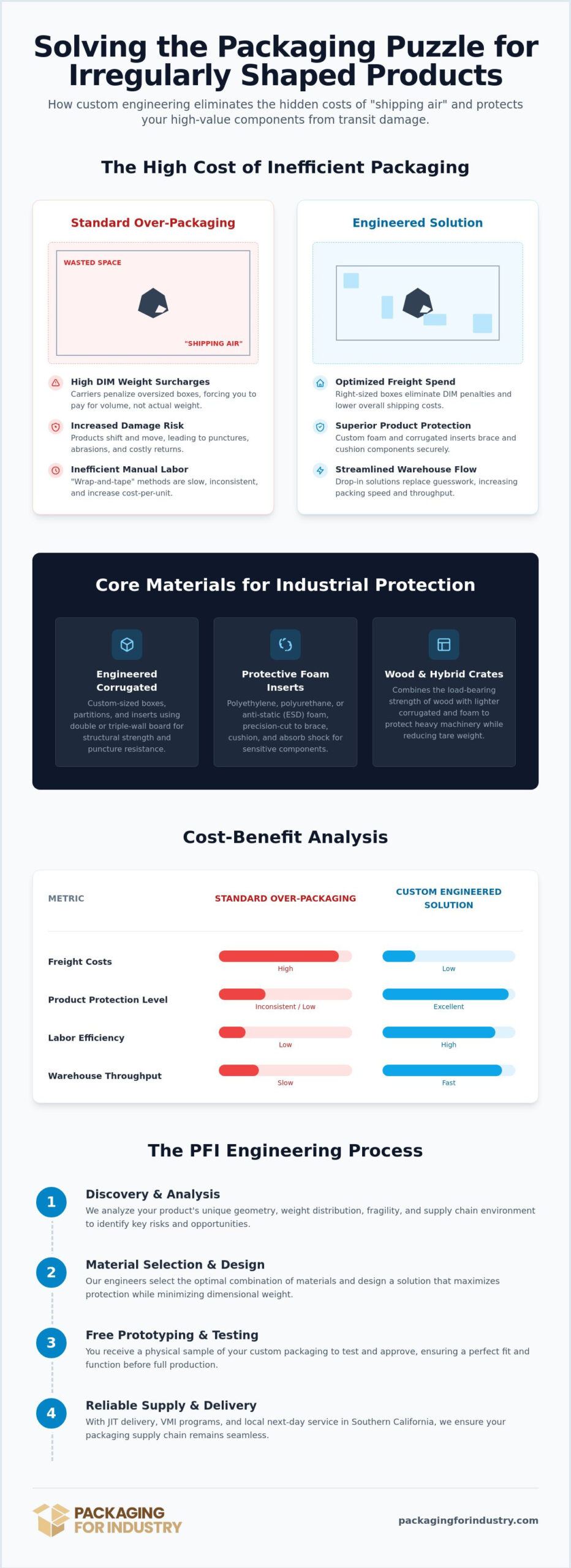
Irregular products are industrial components that lack the flat surfaces or uniform dimensions required for standard Regular Slotted Container (RSC) boxes. Think of turbine blades, hydraulic manifolds, or custom-machined castings with protruding brackets. These items present significant logistical challenges because they don’t fit snugly into a standard cubic footprint. In a fast-paced warehouse environment, trying to reconcile these shapes with standard boxes often leads to complex mathematical packing problems that floor staff aren’t equipped to solve on the fly. Without an engineered approach, your team likely defaults to over-packaging, which creates a cascade of hidden costs.
The manual labor required to hand-wrap complex geometries is a silent profit killer. When workers spend ten minutes wrapping a single part in bubble wrap and tape, your throughput drops and your labor costs per unit spike. This “wrap-and-tape” method is also inconsistent; it lacks the repeatable precision needed for high-stakes sectors like aerospace or automotive manufacturing. Moving toward specialized packaging for irregularly shaped products replaces this manual effort with efficient, drop-in solutions that protect your bottom line as much as the product itself.
Understanding Dimensional Weight (DIM) Surcharges
As of July 2026, shipping carriers have tightened the rules on how they bill for space. The USPS has lowered its dimensional weight divisor to 139, while major carriers like UPS and FedEx have implemented rate increases that average nearly 6%, though the real impact often hits double digits due to surcharges. Carriers now round up all fractional dimensions to the next whole inch, making every oversized box a financial liability. Dimensional weight is a billing technique that calculates freight costs based on the volume of a package rather than its actual weight, directly penalizing companies that ship excess air in standard boxes. If you’re using a large box to accommodate a single protrusion on a small part, you’re paying a “shipping air” tax that erodes your freight ROI.
Transit Damage: Beyond the Surface
Standard corrugated boxes aren’t designed to handle offset centers of gravity. In a Less Than Truckload (LTL) environment, your shipment will face constant vibration, sudden stops, and mechanical handling. Irregular items often have “heavy” spots that cause standard boxes to tip or collapse when stacked. This structural instability leads to tipped pallets and crushed corners that can compromise even the most durable industrial components.
Internal movement is equally dangerous. A protruding arm or sharp edge on a non-standard part can easily puncture a double-wall box if it isn’t properly braced. Once the box wall is breached, the product loses its primary defense against moisture and debris. The cost of returns, replacements, and damaged client relationships far outweighs the investment in custom-engineered protection.
Core Materials for Protecting Non-Standard Industrial Components
Effective packaging for irregularly shaped products requires a multi-material engineering strategy rather than a one-size-fits-all approach. While catalog giants might suggest simply using more void fill, industrial-grade protection often involves a hybrid of foam, corrugated, and wood. This approach maximizes structural integrity while minimizing the dimensional weight costs that inflate your freight spend. By selecting materials based on their specific physical properties, you can ensure that even the most awkward component remains secure throughout the supply chain.
Integrated solutions represent the highest level of industrial packaging engineering. For example, a heavy turbine component might require a custom wood pallet base for load-bearing strength, combined with polyethylene foam bracing to prevent shifting and a triple-wall corrugated sleeve for puncture resistance. This hybrid method provides the protection of a full wood crate but at a significantly lower tare weight. This balance of durability and weight optimization is essential for maintaining fiscal responsibility in modern logistics.
Custom Foam Packaging and Inserts
Polyethylene and polyurethane are the workhorses of protective packaging. Polyethylene is a high-density, closed-cell foam ideal for bracing heavy industrial parts and providing superior corner protection. In contrast, polyurethane is softer and better suited for cushioning sensitive surfaces or lightweight electronics. Die-cut foam end caps are particularly effective for cylindrical or protruding parts, as they suspend the item in the center of the box and away from impact zones. Explore our custom foam packaging options to see how engineered inserts eliminate the need for excessive hand-wrapping.
Heavy-Duty Corrugated and Triple-Wall Boxes
Standard boxes often fail when tasked with supporting an offset center of gravity or sharp protrusions. Using double-wall or triple-wall industrial corrugated boxes provides the stacking strength and puncture resistance needed for Less Than Truckload (LTL) environments. Custom-engineered partitions and dividers can also be integrated to stabilize multiple irregular parts within a single container, preventing them from colliding during transit. For manufacturers with specialized storage needs, we offer weather-resistant and mil-spec corrugated options that maintain their structural integrity in high-humidity or long-term storage conditions.
Choosing the right material combination depends on your product’s weight, fragility, and destination. If you’re currently dealing with high damage rates or oversized shipping fees, you can request a packaging quote to receive a custom-engineered solution tailored to your specific component geometry. Our team focuses on reducing material waste while ensuring your products arrive in factory-perfect condition.
Custom Engineering vs. Standard Over-Packaging: A Cost-Benefit Analysis
Many operations fall into the “void fill trap” when dealing with non-standard components. They rely on massive amounts of bubble wrap, air pillows, or packing peanuts to stabilize a part inside an oversized RSC box. This approach is fundamentally flawed for packaging for irregularly shaped products because these materials often compress or shift during LTL transit. When the filler settles, the product is free to move, leading to the exact damage you were trying to prevent. Relying on loose-fill also creates a messy unboxing experience that reflects poorly on your brand’s professional standards.
Switching to an engineered solution offers immediate labor and freight advantages. Consider the time a warehouse worker spends hand-wrapping a complex aerospace manifold; those minutes add up across a single shift. Custom-cut foam or corrugated inserts allow for a “drop-in” workflow that takes seconds, not minutes. This efficiency isn’t just about speed. It’s about consistency. Because the packaging is pre-engineered, every part is secured exactly the same way every time. Additionally, reducing the box size to fit the custom insert helps you capture significant packaging cost savings by lowering your billable dimensional weight.
The ROI of Custom-Designed Packaging
Pragmatic decision-makers look at the Total Cost of Ownership (TCO) rather than just the unit price of a box. Standard boxes might seem cheaper on a purchase order, but they hide costs in labor, excess shipping fees, and damage claims. Custom engineering streamlines the entire process. For businesses in Orange County or Los Angeles, PFI’s local next-day delivery means you don’t need to warehouse massive amounts of custom inventory, further improving your operational cash flow. Using a tailored approach also supports sustainability goals by eliminating the need for excessive plastic fillers that eventually end up in landfills.
Prototyping and Fit Verification
Precision engineering for complex shapes requires more than just a digital sketch. While CAD/CAM software allows us to design with millimeter accuracy, a physical prototype is essential for verifying the “real-world” fit of a part’s unique protrusions and center of gravity. PFI provides free prototyping for fit verification so you can test the solution before committing to a full production run. A physical prototype is superior to a digital model because it reveals how materials interact with the product’s weight and texture in a way a screen cannot. This hands-on verification process ensures your packaging for irregularly shaped products is functional and reliable from the first shipment.
Industry-Specific Strategies for Aerospace, Automotive, and Heavy Machinery
Industrial sectors face unique logistical challenges that generic catalog suppliers aren’t equipped to solve. While a consumer package might survive a few bumps, an aerospace component or an automotive engine block requires engineering that accounts for specific structural vulnerabilities. Effective packaging for irregularly shaped products in these high-stakes environments ensures that non-standard geometries don’t lead to catastrophic transit damage. We focus on the intersection of material science and logistical flow to keep your supply chain moving without interruption.
Heavy machinery and defense components often feature offset centers of gravity that make them prone to tipping. Standard pallets aren’t enough for these top-heavy units. We design custom wood skids and integrated crates that provide a wider, more stable footprint. For defense contractors, our engineering team ensures all packaging for irregularly shaped products meets strict mil-spec standards for odd-sized defense components. This level of precision is essential for maintaining compliance and protecting high-value government assets during global deployment.
Aerospace and Aviation Solutions
In the aerospace sector, the margin for error is non-existent. Turbine blades, landing gear, and composite panels often feature fragile, high-value protrusions that can be easily damaged by slight vibrations. We use precision-cut polyethylene foam end caps to suspend these items, ensuring no part of the component touches the outer box wall. For integrated avionics with complex, non-linear shapes, we provide ESD (Electrostatic Discharge) protection within the foam itself. This specialized approach to aerospace packaging solutions prevents both physical and electrical damage during global transit, ensuring mission-critical parts arrive flight-ready.
Automotive and Industrial Manufacturing
Automotive Tier 1 suppliers operate on tight Just-in-Time (JIT) schedules where a single damaged shipment can halt an entire assembly line. Irregular engine components and transmission parts require a strategic mix of returnable and expendable packaging that balances durability with cost-effectiveness. We often integrate heavy-duty corner and edge protection to stabilize top-heavy machinery and prevent pallet collapse in high-density warehouse environments. This ensures that your manufacturing packaging is as lean and efficient as the production line it supports, reducing both material waste and labor time at the packing station.
If your current provider is failing to meet these technical requirements or if you’re seeing high damage rates on specialized components, our team can help. You can request a packaging quote today for a solution engineered to your exact industry specifications. We provide the technical expertise needed to turn complex shipping challenges into predictable, cost-effective logistical wins.
How PFI Engineers Custom Solutions for Your Toughest Shapes
Solving the logistical challenges of packaging for irregularly shaped products requires a partner that understands the intersection of engineering and economics. PFI doesn’t just provide boxes; we deliver a comprehensive system of protection designed to stabilize your most complex components. Our process begins with a detailed operational assessment where we identify the specific vulnerabilities of your product, from offset centers of gravity to fragile protrusions. We then move into custom engineering and prototyping to ensure the final design meets your exact performance standards before a single unit is manufactured.
While we support multi-location manufacturers across the United States, our local expertise in Southern California provides a distinct advantage for regional industrial hubs. We understand the high-speed requirements of aerospace and automotive suppliers in Orange County, Los Angeles, and the Inland Empire. By leveraging our local warehouse space and logistics network, we help you maintain a lean inventory while ensuring your custom-engineered solutions are always available when your production line needs them.
Vendor Managed Inventory (VMI) for Custom Packaging
The primary headache with custom-engineered crates and inserts is managing lead times. Because these aren’t off-the-shelf items, a sudden spike in production can lead to a critical packaging stockout. Our VMI programs eliminate this risk by placing the responsibility of inventory management on our team. We track your actual production usage and manage stocking levels within our own facilities, ensuring that your packaging for irregularly shaped products is always ready for immediate release. This proactive approach turns a complex logistical variable into a predictable, fixed component of your supply chain.
Next-Day Delivery in Southern California
Reliability is the foundation of a successful manufacturing partnership. We provide local next-day delivery to industrial centers in Anaheim, Irvine, and San Bernardino, allowing you to reduce your on-site storage footprint. Instead of dedicating valuable warehouse floor space to stacks of empty boxes, you can use that square footage for production and assembly. Our fleet is optimized for the specialized handling requirements of industrial packaging, ensuring your custom foam and double-wall corrugated units arrive in factory-perfect condition.
If your current packaging isn’t providing the protection or the cost-efficiency your operations require, it’s time for an engineered upgrade. You can request a custom packaging quote for your irregularly shaped products today. Our team will work with you to design a solution that reduces transit damage, lowers your dimensional weight costs, and streamlines your packing station workflow.
Secure Your Supply Chain with Engineered Packaging Solutions
We’ve explored how transitioning from generic over-packaging to custom-engineered geometries directly reduces both transit damage and dimensional weight surcharges. By integrating specialized materials like high-density foam and triple-wall corrugated, your operation can eliminate the hidden “shipping air” tax while improving warehouse throughput. Effective packaging for irregularly shaped products is a strategic investment that pays for itself through lower freight spend and reduced return rates.
PFI provides the technical expertise required for these complex builds, offering free prototyping and CAD design to verify every fit before production. It’s our goal to ensure your high-value components are protected throughout their journey. With next-day local delivery in Southern California, we serve as a dependable partner for aerospace and industrial manufacturers looking to optimize their logistics. Request a Custom Packaging Quote for Your Odd-Shaped Products today. Let’s turn your most challenging component shapes into stable, cost-effective shipping units.
Frequently Asked Questions
What is the best way to ship an irregularly shaped item?
The most effective method is using custom-engineered inserts to suspend the item within a rigid container. Unlike loose void fill, custom inserts provide structural bracing that prevents the product from shifting during transit. This engineering approach is essential for protecting sensitive components from punctures and impact damage. It also ensures a repeatable packing process that maintains consistency across your entire shipping department.
How do I calculate shipping costs for odd-shaped products?
Shipping costs are primarily determined by dimensional (DIM) weight, which calculates the volume of the package. Carriers measure the maximum length, width, and height of the box required to house the item. Because odd shapes often require larger boxes than their actual volume suggests, you’ll likely face surcharges for shipping air unless you optimize the packaging geometry to minimize the external footprint.
Can I get a custom box for a single irregularly shaped part?
PFI provides custom solutions for both high-volume production and single, high-value components. We regularly design specialized crates and heavy-duty boxes for individual pieces of large machinery or unique aerospace parts. Whether you need a one-off prototype or a full production run, our engineering team ensures the packaging meets the specific requirements of your non-standard component.
What materials are best for protecting protruding edges?
High-density polyethylene foam and reinforced edge protection are the most reliable materials for securing sharp or protruding edges. These materials act as a rigid barrier that prevents the product from puncturing corrugated walls during mechanical handling. For heavy industrial parts, combining these with triple-wall corrugated boxes provides the stacking strength and puncture resistance necessary for long-distance LTL shipping environments.
How do custom foam inserts help with irregular products?
Custom foam inserts provide a drop-in solution that suspends the item away from the container’s outer walls. This precision-cut packaging for irregularly shaped products eliminates the inconsistencies of manual hand-wrapping. By locking the component into a fixed position, foam inserts absorb vibration and protect fragile protrusions from impact. This method significantly reduces labor time while ensuring every part is secured with professional-grade accuracy.
Does PFI provide on-site assessments for large machinery packaging?
Our engineering team provides consultative assessments for complex industrial projects. We evaluate the weight distribution, center of gravity, and structural vulnerabilities of large machinery to design a safe shipping solution. This approach ensures that custom skids or crates are engineered to handle the specific physical demands of your heavy equipment, reducing the risk of tipping or pallet collapse during transit.
What is the lead time for custom-engineered packaging solutions?
Lead times for custom solutions depend on the complexity of the engineering required and the materials selected. We prioritize efficiency by offering free prototyping for fit verification to speed up the approval process. Once a design is approved, PFI’s Vendor Managed Inventory (VMI) and local next-day delivery in Southern California help manufacturers in Orange County and Los Angeles maintain a reliable supply without stockouts.
How can I reduce dimensional weight surcharges for my shipments?
You can lower surcharges by using precision-fit packaging for irregularly shaped products to minimize the external box dimensions. Because carriers round up all fractional inches, reducing the box size by even a small amount can have a major impact on the billable weight. Engineered inserts allow you to use smaller containers without compromising on protection, directly improving your freight ROI and lowering total shipping costs.