
Sensitive equipment needs packaging that controls movement, fits its shipping container, and supports consistent packing. Cross-linked foam packaging for sensitive equipment uses shaped cushioning to create a controlled fit around valuable products. The insert, equipment, and outer box or crate must work together to protect the shipment.
This guide explains what cross-linked polyethylene foam is and which properties matter for industrial shipments. It covers protective layouts for electronics and other delicate equipment, material selection for shipping conditions, and ways to evaluate a complete package. For manufacturers and distribution teams in Los Angeles, Orange County, and San Diego, these decisions affect more than the trip itself. A practical package should fit the product and packing process, accommodate accessories where needed, and make the intended orientation clear. Understanding these design factors helps buyers describe requirements, compare options, and determine whether custom foam should be paired with a corrugated box or crate. This is especially useful when damage risk, repeat packing, or limited container space drives a packaging change.
Key Takeaways
- Learn how closed-cell polyethylene foam cushions sensitive equipment and helps resist moisture, and how it differs from other foam types.
- Match the insert layout to the equipment’s shape and handling needs, then pair it with a suitable corrugated box or crate.
- Consider chemical exposure, moisture, temperature, and pressure when evaluating foam properties for a specific application.
- Understand how ESD protection and shipping tests fit into packaging decisions for electronics and other sensitive equipment.
- Explore how foam packaging, stretch film, and inventory programs can support dependable supply and help control packaging costs.
Cross-Linked Foam Packaging and Custom Packaging Products
Cross-linked polyethylene foam, or XLPE, is a closed-cell cushioning material used in industrial packaging. Its structure and fabrication options make it possible to shape inserts around equipment and fit them inside boxes or crates.
XLPE Foam Composition and Characteristics
XLPE consists of polyethylene with polymer chains joined through chemical or physical bonds. Its fine, closed cells create a smooth surface and help resist moisture absorption. These properties matter when packaging must cushion equipment without taking up unnecessary space. XLPE also provides thermal insulation and vibration dampening, so an insert can address both physical protection and temperature-related packaging needs.
XLPE Compared with Other Foams
XLPE differs from polyurethane foam and other cushioning materials in its closed-cell structure and smooth feel. Foam selection depends on the equipment’s shape, handling conditions, and required support, not just the material name. A compact instrument, for example, may need precise cutouts, while a larger assembly may need broader cushioning surfaces. Comparing these requirements helps narrow the material and design choices.
XLPE, EVA, and Copolymer Materials
XLPE, EVA, and copolymer foams are distinct materials, and their suitability depends on the packaging application. XLPE is cross-linked polyethylene; EVA combines ethylene and vinyl acetate, while copolymers use more than one type of repeating unit. A packaging design considers the equipment, contact surfaces, insert geometry, and handling conditions before selecting a material. This helps prevent choosing foam based only on a familiar label.
Industrial Packaging Applications
XLPE foam inserts can hold sensitive equipment in place inside a corrugated box, protective case, or crate. A shaped cavity can support a control unit while leaving room for cables or accessories in separate compartments, a protective layout frequently engineered into specialized mixer console cases. Layered inserts can also keep different components organized. This approach suits industrial shipments where equipment must remain stable through repeated handling.
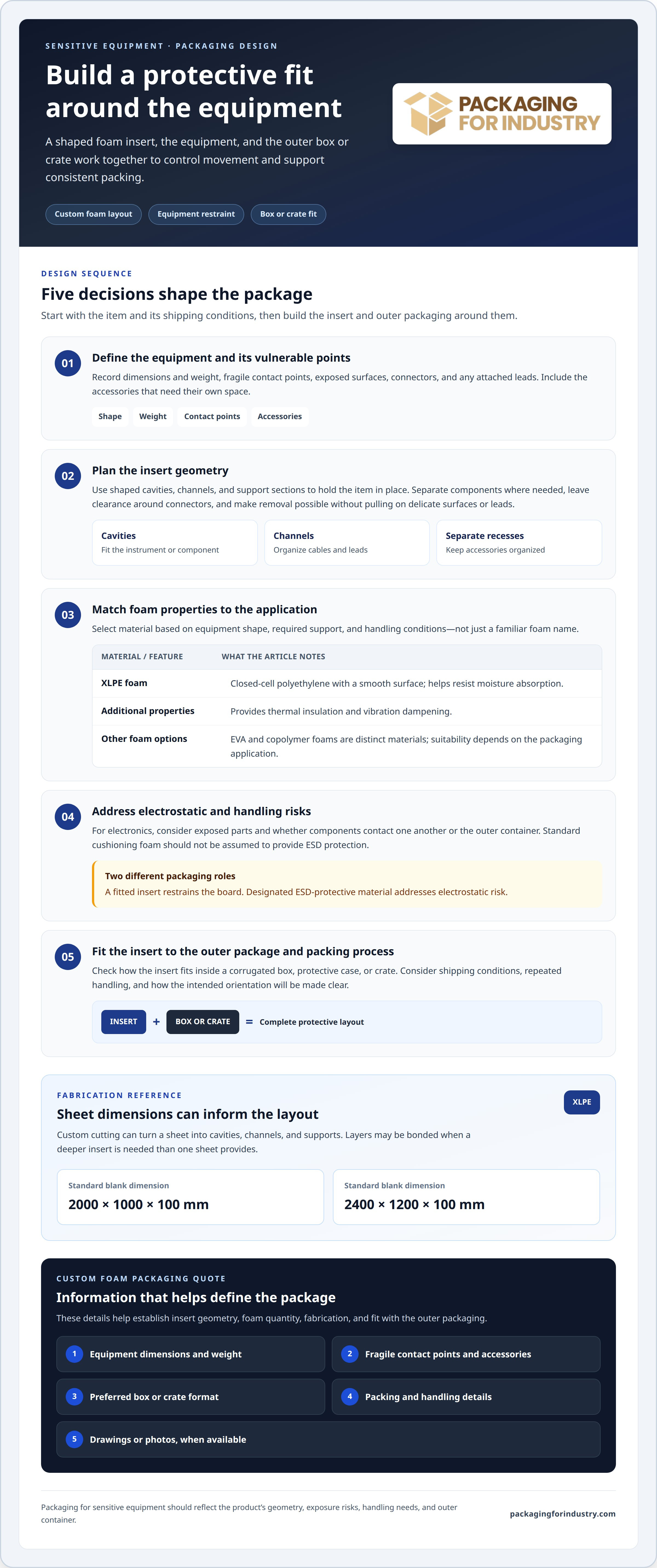
Sheet size affects the layout and number of components a fabrication plan can accommodate. Standard blank dimensions include 2000x1000x100 mm and 2400x1200x100 mm. Custom cutting turns a sheet into cavities, channels, and support sections matched to the item. Fabrication may also involve bonding layers when a deeper insert is needed than one sheet provides.
For a custom foam packaging quote, prepare the equipment dimensions and weight, fragile contact points, accessory list, and preferred box or crate format. Include drawings or photos when available, as well as details about how the shipment will be packed and handled. These details help define the insert geometry, foam quantity, fabrication, and fit with the outer packaging. PFI can design a shipping layout for Los Angeles businesses around the equipment and its corrugated container.
Inserts can be reused when they remain intact and continue to hold the equipment securely. Recycling depends on the local collection stream and foam construction; environmental compliance depends on the requirements that apply to its use and destination.
Industries Served: Packaging for Sensitive Equipment
Sensitive equipment needs packaging that addresses its actual failure risks. A circuit board may need electrostatic discharge control, while a laboratory sensor may need restraint against movement and vibration. Packaging for electronics starts with the component, its exposed surfaces, and the shipping conditions it must withstand.
Electronics shipments can include circuit boards, control modules, diagnostic devices, cables, and connectors. A fitted foam layout can separate each item, limit contact between components, and help prevent parts from shifting inside a shipping box. For example, a recessed space can hold a board while a separate channel organizes its cable. This keeps the packaging compact and makes the contents easier to inspect during packing and receiving.
ESD protection requires specific packaging materials designed to control electrostatic discharge. Do not assume standard cushioning foam provides this protection simply because it fits the component. The packaging design must account for exposed parts, handling, and whether items touch one another or the outer container. For a board with exposed contacts, an ESD-protective layer and a fitted insert may serve different roles: the insert restrains the board, while designated ESD material addresses electrostatic risk.
A protective layout can be built around the number and shape of the items. A field-service case might have a shaped cavity for a handheld instrument, a narrow channel for its cable, and a smaller recess for accessories. A larger control assembly may need support beneath its base and clearance around connectors. Preventing loose movement matters, but the insert should also allow controlled removal without pulling on delicate surfaces or attached leads.
Medical equipment, aerospace components, and industrial electronics each bring different packaging concerns. A diagnostic device may have a screen and controls that need clearance; a machined aerospace component may need contact surfaces isolated from harder parts. Aerospace packaging needs can involve assemblies with irregular shapes and vulnerable connectors. In each case, the packaging layout should reflect the item’s geometry, handling points, and sensitivity rather than relying on a generic block of cushioning.
For shipments with several components, a labeled layout can support consistent packing. Separate cavities distinguish the main unit from accessories, while an orientation mark shows how the assembly sits in the box. Packaging teams can also consider how the operator lifts each item and where hands can grip it. These details help reduce handling errors without adding unnecessary complexity to the protective design.
Electronics protection works best when cushioning, ESD control, and the outer package are treated as connected decisions. A fitted insert can restrain a sensor, designated ESD materials can address electrostatic exposure, and the box can contain the complete arrangement. For manufacturers shipping sensitive equipment in Los Angeles, Orange County, and San Diego, matching these elements to the product supports repeatable packing and safer movement through handling and transit.
Benefits and Properties of Cross-Linked Polyethylene Foam
Cross-linked polyethylene foam selection depends on more than a general description of the material. Density, surface texture, temperature exposure, and chemical contact can all affect how an insert performs around a specific product. These factors help buyers compare foam options against operating conditions, especially when packaging contains equipment used near lubricants, cleaning agents, or process materials.
Evaluate chemical resistance against the specific substance that could contact the foam. XLPE resists oil, chemicals, and solvents, but that does not establish compatibility with every formulation or exposure scenario. Equipment with lubricant residue, for example, presents a different contact condition from equipment cleaned with solvent before packing. Identifying the substance and expected contact helps guide material selection.
Temperature is another design consideration. Cross-linked foam inserts are listed for a range of −40 to +115 °C. This range can help buyers assess whether the material suits the temperature conditions expected during storage and transport. It does not by itself define the operating limits of the packaged equipment or guarantee a stable internal temperature. Those requirements depend on the product and the complete shipping setup.
Density options affect how foam responds to a product’s weight and contact points. L200 cross-linked polyethylene foam has a listed density of 2 pounds per cubic foot, while L300 has a listed density of 3 pounds per cubic foot. L200 is softer than L300 and has a smoother surface texture. For a part with a finished exterior, that surface difference may matter; heavier products may call for a design that accounts for how the foam supports their load.
Cross-linked foam can retain its shape and thickness over time under constant pressure or harsh environmental conditions. This matters when packaged equipment rests against an insert during storage or repeated handling. A consistent cavity can help keep the product in its designated position. The insert still needs to be designed for the equipment, since the foam’s material properties do not determine the cavity geometry.
- Chemical contact: Identify oils, solvents, or other substances near the foam.
- Temperature: Compare expected exposure with the listed −40 to +115 °C range.
- Density: Consider the product’s weight and the insert’s support points.
- Surface: Account for finish-sensitive parts when choosing between L200 and L300.
The practical takeaway is to evaluate cross-linked polyethylene foam by application, not by material name alone. Chemical exposure, temperature, density, surface contact, and sustained pressure each inform the design decision. Matching these factors to the product helps buyers specify an insert suited to the equipment and its storage and shipping conditions.
U.S. Packaging Standards and Shipping Tests for Sensitive Equipment
U.S. packaging decisions may involve separate questions: whether foam meets a specified material classification and whether the complete package protects its contents in transit. A flame-retardant classification does not demonstrate shipping performance. Likewise, a successful package test does not establish that foam meets a particular flammability specification. Buyers should connect each requirement to the product, shipment, and customer specification.
For flame-retardant XLPE foam, listed classifications include UL94 HF1, HF2, and HBF, as well as FMVSS 302. These references matter when a product specification calls for foam meeting one of those classifications. They are not universal requirements for sensitive-equipment packaging, and they do not replace testing the package’s performance during transport. The requested classification should be identified before material selection, so the design addresses the actual specification.
Shipping evaluation focuses on the assembled package and the risks along its route. A test plan can examine handling impacts, vibration during transit, and compression from stacking. Each check answers a different question. Impact evaluation examines damage after a sudden shock; vibration evaluation looks for movement or contact during repeated motion; compression evaluation considers whether loading deforms the container or its contents. Select tests based on the product and distribution conditions.
Test the intended configuration, not a convenient substitute. Use the actual equipment or a representative payload with matching dimensions and weight. Include the selected foam insert, closure method, and outer box or crate. If the package ships upright, record its orientation and keep it consistent during evaluation. Changes to the insert, container, or packing method can change how forces reach the product.
Set acceptance criteria before testing begins. Criteria might cover visible damage, movement from the intended position, or whether the package remains closed and usable after evaluation. Record the package configuration, test sequence, inspection findings, and any design changes. This gives engineering and operations teams a basis for repeating the evaluation when a product or packaging design changes.
- Material specification: Identify whether UL94 HF1, HF2, HBF, or FMVSS 302 is required.
- Package performance: Select impact, vibration, or compression evaluations that reflect shipment risks.
- Configuration: Record the payload, insert, outer container, and packing orientation.
- Review: Compare inspection results with criteria set before testing.
For sensitive equipment, the useful standard is the one required by the product specification or customer. Pair that requirement with a package evaluation designed around the shipping route. This separates material compliance from transit protection and helps teams understand what test results do and do not demonstrate.
Packaging For Industry (PFI): Foam Packaging
Packaging For Industry (PFI), a Los Angeles packaging supplier, can help when sensitive equipment needs a packaging plan tailored to its handling and supply requirements. Its foam packaging and custom packaging design services support manufacturers seeking fitted protection for equipment shipments. The design can account for the item’s dimensions, vulnerable contact points, accessories, and outer package, aligning the protective insert with day-to-day packing needs.
A custom foam layout can organize equipment and accessories while keeping parts separated during transit. This matters for shipments with irregular shapes, fragile surfaces, or components that should not rub together. PFI’s foam packaging options are relevant when standard cushioning does not provide a suitable fit. A custom design can also be coordinated with the box or crate format, so the insert and container work as one packaging system.
Stretch film can complement protective packaging after equipment is boxed and prepared for pallet movement. It helps secure packaged goods as a unit for storage or transport, while the foam insert cushions the product inside its container. Keeping these functions distinct helps operations teams plan for both product protection and load stability. For businesses in Los Angeles, Orange County, and San Diego shipping equipment through warehouses or distribution centers, combining suitable interior cushioning with secure unit loads supports a more repeatable packing process.
Supply planning matters too. PFI’s Vendor Managed Inventory (VMI) for Packaging can support businesses that want replenishment managed around their usage. Just-In-Time (JIT) Inventory Management for Packaging is relevant when supply timing needs to align with production or packing demand. These programs help purchasing and warehouse teams coordinate foam and other packaging supplies instead of treating each replenishment as an isolated order.
For example, an equipment manufacturer can use a defined insert layout for a recurring shipment, then align replenishment with production needs. If packaging consumption changes, inventory planning can reflect updated usage patterns. Useful starting details include the equipment being packed, the packaging format, and how the operation consumes supplies. These details connect product protection with purchasing and warehouse flow without assuming every operation needs the same inventory approach.
PFI serves businesses in Los Angeles, Orange County, and San Diego that need foam packaging and custom protection for sensitive equipment. Its foam and inventory offerings address distinct needs: fit and cushioning at the package level, and continuity of supply at the purchasing level. The right combination depends on whether the main concern is product movement, replenishment workload, or keeping packing materials aligned with demand.
Request a custom foam packaging quote from Packaging For Industry (PFI).
Frequently Asked Questions
How does a packaging provider specify the right foam insert for a product?
A packaging provider starts with the product’s dimensions, weight, shape, and vulnerable areas. Drawings, photos, or a sample help identify protrusions, contact surfaces, and accessory placement. The provider then considers the outer box or crate and how the item is packed and handled. For example, a device with a screen may need a recessed cavity that keeps pressure away from the display when the package is closed.
What is Cross Link Foam Insert?
A cross-linked foam insert is a shaped piece of foam designed to hold and cushion a specific item inside a case, box, or crate. Its cutouts position the product and can separate accessories or components. For example, a service kit insert might have distinct spaces for an instrument, power supply, and cable. The insert’s shape and material are selected to suit the item and packaging arrangement.
What is cross-linked foam packaging and how is it made?
Cross-linked foam packaging uses foam whose polymer chains are connected through chemical or physical bonds. A packaging design turns foam sheets or blocks into a protective layout using cuts and, where needed, bonded layers. The finished design can include shaped cavities, channels, or supports. This makes Cross-Linked Foam Packaging for Sensitive Equipment useful when standard cushioning cannot hold an item in the required position.
Which types of cross-linked foam are used for sensitive equipment packaging?
Common choices include physically cross-linked polyethylene foam and chemically cross-linked polyethylene foam. Their available densities vary by product. Examples of chemically cross-linked grades include XPE 25 at 25 kg/m³, XPE 33 at 33 kg/m³, and XPE 45 at 45 kg/m³. The grade alone does not determine suitability; insert design, item weight, contact points, and shipping conditions also matter.
How does a packaging provider determine the right foam density, thickness, and cushioning level for delicate equipment?
A provider evaluates the equipment’s weight, geometry, fragile areas, and expected handling before selecting foam dimensions. Density and thickness influence how the insert supports the item, but neither should be chosen in isolation. A compact sensor with a delicate connector may need support around its housing while keeping the connector clear. The outer package and available space also affect the final cushioning layout.
How does cross-linked polyethylene foam compare with polyurethane and expanded polyethylene foam?
Cross-linked polyethylene foam has a closed-cell structure and smooth feel. Polyurethane foam and expanded polyethylene foam have different structures and handling characteristics, so the best option depends on the application. Consider the product’s shape, desired surface contact, cushioning needs, and packaging format. An insert designed to hold a precisely positioned instrument, for instance, may differ from general void cushioning around a larger assembly.
How does a packaging provider design and test a custom cross-linked foam insert for equipment?
A provider uses product dimensions and packaging requirements to develop a layout, then fabricates a prototype or sample for fit review. The evaluation can check whether the item fits correctly, accessories remain organized, and closures avoid pressure on sensitive areas. Shipping tests can then assess the complete package for movement or damage. If results reveal an issue, the cavity or support layout can be revised.
What are the typical costs of custom cross-linked foam packaging in the United States?
Custom foam packaging costs depend on the design, material, dimensions, fabrication method, and order quantity. A simple pad differs from a multi-piece insert with shaped cavities and bonded layers. Packaging requirements and the insert’s fit with the outer container also affect the project. Request a quote from PFI to have the design and production needs considered together.