
An ESD-safe packaging inventory for manufacturers should match packaging to the parts being handled and the conditions they encounter. Manufacturers in Los Angeles, Orange County, and San Diego can plan packaging around production needs, shipping routes, and recurring supply. The aim is to build protection into the process, not treat it as an afterthought.
Operations differ in the components they handle, workloads, and movement patterns. A useful packaging plan accounts for how materials fit the workflow, how teams identify and track packaging, and how supply stays coordinated as production changes. These considerations help purchasing and operations teams choose formats for specific applications rather than relying on one package for everything.
This guide explains ESD packaging materials, the roles of shielding and dissipative options, and how containers support component movement. It also covers packaging across industries and supply-chain stages, inventory choices, and ways to plan stock around actual usage. For manufacturers in Los Angeles, Orange County, and San Diego, these points provide a practical starting place for reviewing packaging and inventory needs.
Key Takeaways
- Match conductive, static-dissipative, or insulative materials to the component and its handling process.
- Choose packaging formats based on the protection needed, including shielding, cushioning, moisture resistance, and corrosion control.
- Plan ESD protection across production, storage, transportation, and returns, with traceability built into container flows.
- Align inventory levels and packaging choices with manufacturing demand to support reliable supply and help control packaging costs.
- Explore how foam packaging, stretch film, VMI, and JIT inventory management can support packaging operations.
Conductive, Static-Dissipative, and Insulative Materials
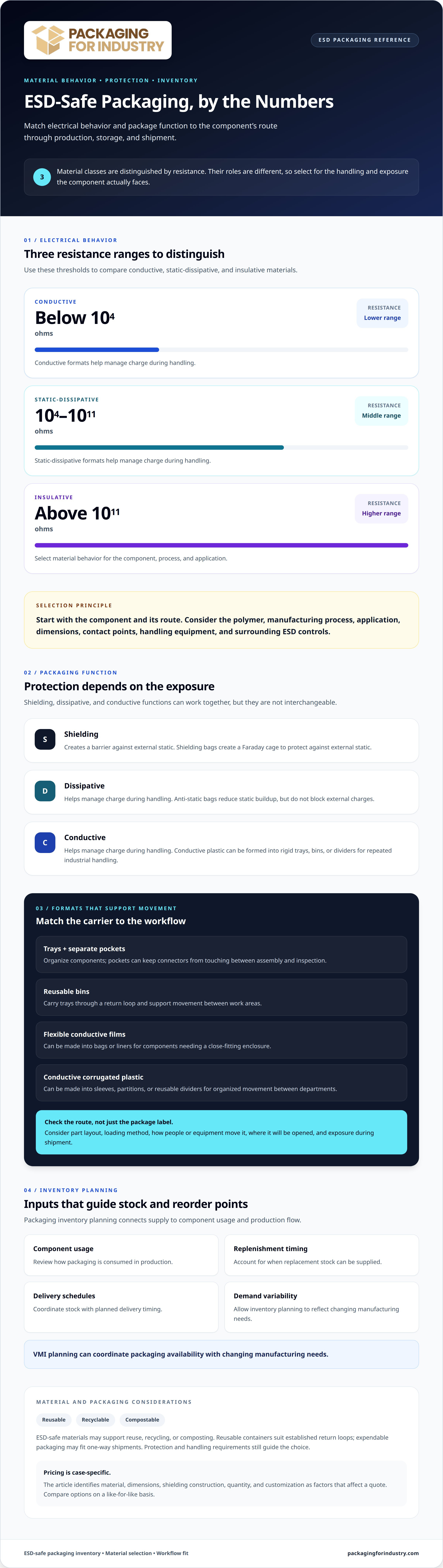
ESD packaging materials differ in how readily they conduct or control electrical charge. Conductive materials have resistance below 104 ohms, while static-dissipative materials range from 104 to 1011 ohms. Insulative materials have resistance above 1011 ohms. These distinctions help determine how containers, trays, and liners manage static discharge around sensitive electronics.
Start material selection with the component and its route through production. Consider the polymer, manufacturing process, and application, then match them to the required electrical behavior. For instance, a reusable container moving components between assembly stations may need different properties from a liner for a single shipment. Component dimensions, contact points, handling equipment, and surrounding ESD controls all affect the choice.
Polymer choice also affects durability, fit, and movement through the facility. A tray used in automated handling must keep components organized and accessible to the equipment. Separate compartments can help prevent mix-ups between part types, while a clear identifier can help workers route the container correctly. The material should support component flow, not get in its way.
Eco-friendly options can include ESD-safe materials designed for reuse, recycling, or composting. The practical choice depends on the application: reusable containers suit established return loops, while expendable packaging may fit one-way shipments. Protection and handling requirements still guide material selection.
In the United States, pricing depends on the case and is provided after a quote request; material, dimensions, shielding construction, quantity, and customization affect the quote. Comparing these factors helps manufacturers assess packaging options on a like-for-like basis.
To calculate ESD-safe packaging inventory levels and reorder points, a provider reviews component usage, replenishment timing, delivery schedules, and demand variability. Those inputs help align stock with production flow and identify when replenishment should begin. Vendor-managed inventory planning can coordinate packaging availability with changing manufacturing needs.
Static-dissipative materials are described as having resistance from 10^4 to 10^11 ohms, conductive materials as below 10^4 ohms, and insulative materials as above 10^11 ohms. ESD-safe materials may also be recyclable, reusable, or compostable while still providing protection.
Shielding, Dissipative, and Conductive Packaging
Choose packaging based on the exposure a component faces along its route. Shielding packaging creates a barrier against external static, while dissipative and conductive formats help manage charge during handling. These functions may work together in a packaging system, but they are not interchangeable. A part moving between workstations may need a different package from one traveling through a warehouse or shipping network.
For internal movement, bins and trays organize components around a defined handling process. A tray with separate pockets, for example, can keep connectors from touching as they move between assembly and inspection. A reusable bin can carry the trays through a return loop. Match the format to the part layout, how people or equipment move it, and where it will be opened.
Conductive plastic can be formed into rigid trays, bins, or dividers for repeated industrial handling. Coatings based on nanotechnology offer another way to add conductive or dissipative properties to a surface. Performance depends on the material and application, so assess the substrate, contact points, and movement through the process. A coating should address a specific ESD control need, not add complexity without purpose.
Flexible conductive films can be made into bags or liners for components that need a close-fitting enclosure. Anti-static bags reduce static buildup but do not block external charges. Shielding bags create a Faraday cage that protects against external static. When a package leaves a controlled area, match the bag to the exposure during shipment rather than choosing by appearance or a general ESD label.
Conductive corrugated plastic boards can be made into sleeves, partitions, or reusable dividers. A partitioned sleeve, for example, can keep assemblies organized as a production lot moves between departments. Its usefulness depends on fit, loading method, and route through the facility. Designers can coordinate the board format with trays, bins, and flexible liners, while keeping each layer’s function clear.
What Are ESD-Safe Material Handling Containers?
ESD-safe material-handling containers are packages or reusable carriers designed to protect sensitive components during movement and storage. They help maintain planned protection as products pass between people, equipment, and locations.
Protection During Handling, Storage, and Shipment
Containers carry protection along the route from production bench to shipping area. For example, a carrier can keep an assembly enclosed while it waits between inspection and packing. Storage layouts matter too: assigning containers to component families helps prevent unprotected transfers and misplaced parts. Packaging for shipment must also account for the journey after dispatch, including changes in handlers and environments.
Handling and Storage Risks
Frequent transfers increase the chance that packaging will be opened, misplaced, or replaced with an unsuitable carrier. Teams handling boards from several work orders may also mix parts if containers lack clear identification. During storage, keep packaging closed and tied to the correct inventory location. Defined procedures connect each container with its contents, status, and next operation.
Handling and Transportation Requirements
Design containers to suit how a facility lifts, stages, stacks, and loads them. Before dispatch, verify that parts are secured, identifiers are readable, and closures are intact. If a bag or container is punctured, cracked, or otherwise damaged, separate it from usable packaging and protect the contents in a suitable replacement. For returns, preserve identification and follow the facility’s established receiving process.
Bulk Suppliers, Sizes, and Specifications
US manufacturers can purchase in bulk from industrial packaging suppliers and compare quotes by material, configuration, order quantity, and replenishment support. There is no single standard size for every component. A provider bases dimensions on the part’s footprint, clearance, separation needs, assembly shape, and how it fits production equipment. Sharing representative components or drawings helps define suitable sizes and specifications for parts, subassemblies, or complete assemblies.
Packaging protection is needed as ESD-sensitive components move through manufacturing, assembly, storage, and transportation. Those stages place packaging within the broader handling route, so selection should reflect the component, the manufacturing environment, and the ESD control requirements. Conductive containers provide a conductive path and suit applications that require conductive handling solutions. This makes them an option to consider when the required handling approach calls for conductive solutions, while the choice should remain tied to the component and operating setting.
An electrostatic discharge event as small as 30 volts can permanently damage sensitive electronic components. The ESD Association attributes more than 25% of electronics failures to ESD damage. These figures underscore why packaging protection should be considered across each stage rather than only at dispatch. A participant recommends treating ESD bags as single-use packaging to protect ESD-sensitive devices. This recommendation is relevant when teams decide how packaging is used after a transfer; it also reinforces the need to choose a container and handling approach appropriate to the component and the ESD control requirements.
What Industries Require ESD Protective Packaging?
Electronics manufacturing, aerospace assembly, and electric-vehicle production use ESD protection wherever sensitive electronic parts move. Components may pass through receiving, assembly, inspection, storage, and shipment, so packaging must suit each handoff. A circuit board sent from a production cell for testing, for example, needs packaging suited to both the controlled work area and its next destination.
Inside an ESD Protected Area, packaging supports controlled movement between benches, automated equipment, and storage. Trays can separate small components during assembly, while containers organize work-in-process parts by job or destination. Outside the protected area, packaging should provide suitable shielding against external ESD events. A shipment leaving the facility needs protection for transport, not just for the dispatch station.
Delicate electronics may need cushioning as well as static control. A small sensor or populated circuit board may require packaging that limits movement and contact during transit. The interior layout should secure the part without compromising its electrical protection. A fitted insert, for example, can keep separate assemblies from striking each other inside a shipping container.
Moisture and corrosion risks can affect the packaging combination. In humid environments, moisture-barrier bags can protect sensitive parts; electric-vehicle manufacturing may call for packaging that addresses static, corrosion, and the handling of heavy, complex electronics. Desiccant and humidity indicator cards can support moisture-sensitive packaging plans. Choose based on the component, storage conditions, and expected route.
ESD protection matters throughout the supply chain, including at component suppliers, contract manufacturers, repair operations, and distribution centers handling electronic goods. Professional hardware repair specialists such as Stealth PC Technology similarly rely on static-controlled procedures when diagnosing and servicing sensitive devices. Receiving teams need packaging that preserves protection on arrival; production teams need it during assembly; shipping teams need it for outbound movement. Returned boards should stay identified and protected while teams assess, store, or route them for repair. A continuous packaging approach helps maintain protection from incoming inventory through shipment and return.
Essential ESD-Safe Packaging for Manufacturers
A practical inventory covers packaging for individual components, work in process, and shipment. A circuit-board line, for example, may need bags for incoming parts, trays between assembly stations, and containers for outbound orders. A dependable ESD-Safe Packaging Inventory for Manufacturers matches each format to its handling stage, helping workers choose suitable packaging at every handoff.
Stock bags by protection function. Anti-static bags reduce static buildup, while shielding bags protect electronics from external static. Moisture-barrier bags suit parts exposed to humidity during extended storage or transit. When moisture control is needed, pair them with desiccant and humidity indicator cards.
Trays and bins support organized handling. A compartmented tray can separate small components, while a stackable container can move assemblies between production cells. For automated lines, choose packaging that suits how robotic systems pick up, stack, and move trays. Barcodes or RFID can connect containers with identification and traceability processes.
Protective inserts limit movement and contact inside a package. ESD foam can hold a sensitive assembly in place within a shipping container, while a fitted tray can keep connectors or boards apart. Choose the format based on component shape, handling route, and whether packaging returns for reuse. A return loop can make reusable containers practical and reduce reliance on expendable packaging.
Some inventory combines ESD control with other protective functions. For example, a moisture-barrier bag paired with cushioning can address humidity and movement during transit. Electronic assemblies held for later production may need a different combination from parts moving directly between workstations. Define each packaging type by its intended use and destination.
Traceability features can support replenishment as well as identification. A barcode label can identify a container and component family; RFID tags or sensors can provide location or condition information. Reviewing an ESD-Safe Packaging Inventory for Manufacturers against production schedules and return flows helps keep packaging aligned with line requirements as demand changes.
Benefits of ESD-Safe Packaging Inventory
Appropriate ESD packaging helps manufacturers match protection to production needs. A circuit-board line, for example, may use different formats at receiving, during assembly, and for outbound orders. A well-managed ESD-Safe Packaging Inventory for Manufacturers can keep those formats available and reduce last-minute substitutions that disrupt handling. It also gives purchasing teams a clearer view of which materials support each component family and production stage.
Planned stock can help control packaging costs by limiting excess inventory and avoidable waste. Reusable containers may suit a regular return loop, while single-use packaging may fit shipments that leave the supply chain. The right balance depends on component flow, storage space, replenishment timing, and packaging use. Reviewing an ESD-Safe Packaging Inventory for Manufacturers against these needs can help avoid slow-moving stock and urgent purchases.
Product protection improves when packaging suits the component’s actual risks. A fitted tray, for example, can secure assemblies during movement, while a suitable bag provides the static protection needed for its route. Add moisture protection or cushioning when the application calls for it. Distinguishing packaging by component type and destination helps teams use the intended format.
Reliable supply depends on having packaging available where it is used. A shortage of one tray or bag format can interrupt packing, delay a shipment, or prompt an unsuitable substitute. Just-In-Time inventory management can coordinate replenishment with production schedules, while Vendor Managed Inventory can align stock planning with packaging consumption. Both approaches support clearer replenishment across manufacturing, storage, and shipping.
Clear identification supports consistent use. Labels or barcode records can connect packaging formats with component families and destinations, helping teams select the intended material. Reviewing usage and production changes lets inventory planning adapt without blanket stock increases. The result is a more controlled balance: protection remains available, purchasing reflects operational needs, and packaging supports dependable movement through the facility.
Packaging For Industry (PFI)
Packaging For Industry (PFI) helps manufacturers coordinate packaging choices with product protection and supply planning. For operations in Los Angeles, Orange County, and San Diego, that means considering how packaging moves through receiving, production, storage, and outbound shipping. The right approach depends on component handling, packaging consumption, and the schedules that keep production supplied.
Foam Packaging can cushion products within a broader protective setup and help limit movement during handling and transit. Stretch Film helps stabilize loads moving through warehouses and shipping areas. These materials serve different purposes, so select them based on the load, route, and role in the operation.
Inventory management matters when packaging demand fluctuates or replenishment competes with production priorities. PFI’s Vendor Managed Inventory (VMI) for Packaging can coordinate stock with consumption patterns. Just-In-Time (JIT) Inventory Management for Packaging aligns replenishment with operational timing. Both approaches focus on keeping needed packaging available while helping avoid unnecessary stock.
To plan ESD-safe packaging inventory, manufacturers can map component flow, packaging formats, production schedules, and storage constraints. This helps shape an inventory plan around where materials are used and how replenishment fits the workflow. PFI can coordinate foam packaging, stretch film, VMI, and JIT inventory management as part of a packaging plan tailored to the operation.
This approach can help when packaging availability affects manufacturing continuity, stock is difficult to manage across work areas, or product protection must fit a defined shipping process. Coordinating materials and replenishment gives purchasing and operations teams better supply visibility and supports consistent handling. The goal is a practical system based on actual use, not simply more stock in the warehouse.
For packaging support tailored to your operation, contact Packaging For Industry to request an ESD-safe packaging inventory quote.
Frequently Asked Questions
What is ESD packaging and why is it important?
ESD packaging helps protect electrostatic-sensitive items from charge-related damage during handling and movement. It is one part of a broader control approach, not a replacement for controls for people or work surfaces. For example, operators may use wrist straps or heel grounders while components travel in suitable packaging. Matching protections to the task supports consistent handling between production benches, inspection, and storage.
What ESD packaging standards and regulations apply to manufacturers in the United States?
Relevant references include IEC 61340-5-1, an international framework for protecting electronic devices, and IEC 61340-5-3, a standard for working with ESD in electronic devices. ANSI/ESD S541-2026 defines packaging properties for production, transport, and storage. These are standards and frameworks, not a single blanket rule for every operation. A facility that references an ESD standard may not be certified to it.
What are the risks of using damaged, expired, or noncompliant ESD packaging?
Damaged packaging may lose its protective function: a hole in a shielding bag can expose the enclosed device to an external electric field. Repeated handling can also damage a bag’s metal layers and reduce discharge attenuation. For reusable packaging, conduct inspections and any testing at intervals specified in the facility’s ESD control plan. Age alone does not establish suitability; physical condition and applicable resistance requirements matter.
How should ESD-sensitive products be packaged, labeled, stored, and shipped?
Package each item for its handling route, identify the component or assembly, and keep it in its assigned storage flow. For example, a serialized electronic assembly can travel in protective packaging with a label linking it to its work order. Use suitable shielding when it leaves an ESD Protected Area. Healthcare applications may have specific packaging requirements, so the package should suit the handling needs of the application.