
A standard warehouse skid is often the single greatest threat to a high-value aerospace assembly. When you’re moving multi-ton jigs or sensitive flight hardware, relying on a generic GMA pallet isn’t just risky; it’s a recipe for calibration drift and structural warping. You need custom pallets for aerospace tooling that are engineered to handle irregular footprints and massive point loads without flexing. As a dedicated industrial packaging supplier, we provide specialized packaging for manufacturers, packaging for warehouses, and packaging for distribution centers that understand the high stakes of precision aerospace logistics.
We know that maintaining zero transit damage is your top priority to keep critical defense and commercial contracts on track. This guide explains how to evaluate load-bearing requirements, ensure ISPM-15 export compliance, and select cleanroom-grade materials that eliminate FOD risks. You’ll learn how to compare packaging pricing and lower packaging costs through strategic engineering and VMI programs. We’ll also explore how to streamline your supply chain with local packaging delivery in Southern California, ensuring your team has heavy-duty skids exactly when they’re needed. Whether you’re ready to request a packaging quote or you’re just starting the design phase, this engineering-led approach helps you secure your most critical assets.
Key Takeaways
- Learn why standard 48×40 GMA pallets fail under heavy point loads and how to specify deflection control to preserve precision tooling calibration.
- Discover how custom pallets for aerospace tooling integrate structural timber with precision CNC-routed foam to isolate sensitive surfaces from transit vibration.
- Understand the importance of selecting heat-treated lumber to ensure 100% compliance with ISPM-15 export regulations and cleanroom-grade standards.
- Identify key manufacturer benchmarks, including in-house CAD/CAM design capabilities and rapid prototyping, to ensure your custom skids meet exact aerospace specs.
- Streamline procurement through scheduled VMI stocking programs and local Southern California delivery to reduce lead times and lower packaging costs.
Engineering Requirements: Aerospace Tooling Pallets vs. Standard Warehouse Pallets
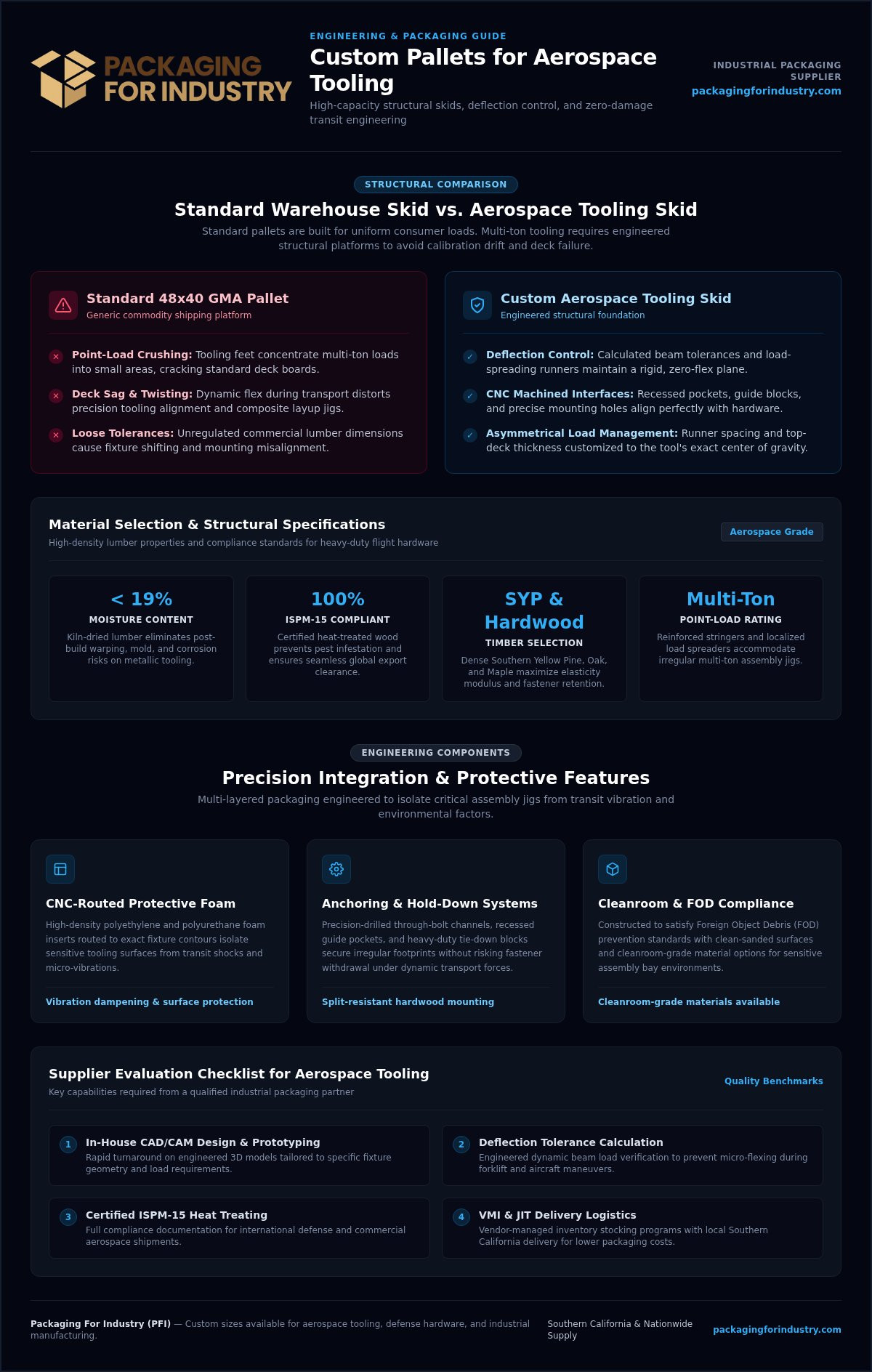
Standard 48×40 GMA pallets are designed for consumer goods, not multi-million dollar flight hardware. When you place a four-ton assembly jig on a standard skid, the point loads concentrated at the tooling feet will crush deck boards and cause catastrophic structural failure. Custom pallets for aerospace tooling are engineered to solve this specific physics problem. They replace generic lumber with high-density materials and reinforced stringers designed to handle asymmetrical weight distribution. We focus on structural integrity because even a minor failure in a runner can lead to the micro-twisting of precision calibrated fixtures.
Understanding how these loads interact with transport systems is vital for logistics managers. While a Unit Load Device (ULD) standardizes cargo for aircraft, the pallet beneath the tool serves as the primary structural foundation. It must prevent movement or distortion during flight maneuvers and ground handling. Our engineering team calculates runner spacing and top-deck thickness based on your tool’s specific footprint, ensuring the weight capacity meets multi-ton demands without compromising the skid’s footprint.
Dynamic Load Distribution and Deflection Limits
Deck sag is more than a cosmetic issue; it’s a precision killer. During forklift transport, standard pallets flex under dynamic forces. This flexing distorts tooling alignment, which is critical for precision composite layup molds. We calculate beam deflection tolerances to ensure the platform remains rigid under high-center-of-gravity loads. Our designs often feature localized load-spreading runners to distribute weight across a larger surface area. This prevents the pallet deck from sagging, which is essential for maintaining the calibration of sensitive aerospace equipment during long-haul transit.
Dimensional Tolerances and Machined Fixture Interfaces
Commercial lumber typically has loose tolerances that don’t align with aerospace engineering requirements. We bridge this gap by utilizing CNC-machined components for our custom pallets. This precision allows for recessed pockets, guide blocks, and mounting hole alignments that interface perfectly with your fixture’s hardware. By integrating these features directly into the skid, we eliminate the risk of the tool shifting. These aerospace packaging solutions provide a level of security that off-the-shelf options cannot match. Precision machining ensures that every custom pallets for aerospace tooling order meets the exact dimensions required for your specific assembly environment.
Material Selection and Structural Specifications for Heavy-Duty Tooling Skids
Selecting the right lumber is a matter of compressive strength and long-term dimensional stability. For custom pallets for aerospace tooling, we prioritize dense Southern Yellow Pine (SYP) or select hardwoods like Oak and Maple. These materials provide the high structural modulus of elasticity required to support multi-ton point loads without structural failure. We ensure all lumber maintains a moisture content below 19% to eliminate the risk of post-build warping, mold, or corrosion that can compromise sensitive metallic tooling surfaces. With custom sizes available for any jig footprint, using stabilized, kiln-dried timber is a critical step in preventing the micro-shifts that ruin fixture calibration.
Dense Hardwood vs. Engineered Softwood Lumber
Hardwoods offer superior split resistance, which is vital when anchoring heavy hold-down bolts into stringers. While Southern Yellow Pine is a versatile choice for many heavy-duty applications, high-value jigs often require the density of Oak to prevent fastener withdrawal under dynamic loads. We use specialized kiln-drying processes to stabilize the wood before fabrication. This prevents the timber from twisting or shrinking once it enters your climate-controlled assembly bays. This level of material control ensures that your fixtures stay level and true throughout their entire service life.
Fastener Integrity and Structural Reinforcements
Standard pallet nails don’t provide the shear strength needed for aerospace ground support. We specify heavy-duty hardware including carriage bolts, lag screws, and steel corner gussets for maximum rigidity. These fasteners handle dynamic shock loads during transit far better than traditional ring-shank nails. Our pallets and custom wood skids often incorporate integrated steel tie-down plates and forklift entry bevel plates to protect the timber from impact damage. Aligning with SAE general design requirements ensures that the structural foundation of your tool meets industry-wide safety and performance baselines.
Environmental Compliance and Cleanroom Preparation
International shipping requires 100% compliance with ISPM-15 heat treatment standards. We apply the mandatory IPPC heat-stamped marks to all export-ready skids, verifying they’ve reached a core temperature of 56°C for at least 30 minutes. To support cleanroom environments, we use planed timber and chamfered edges to significantly reduce Foreign Object Debris (FOD). We also offer vapor-barrier linings to shield sensitive tool surfaces from wood outgassing or moisture transfer. If you’re comparing bulk packaging pricing for an upcoming production run, you can request a packaging quote to evaluate material options and structural pricing for your specific application.
Integrated Cushioning, Hold-Downs, and Protective Enclosures
True tooling protection requires more than just a heavy-duty wooden base. You need a system that integrates structural skids with high-density engineered cushioning to prevent damage. We design custom pallets for aerospace tooling by calculating the specific static and dynamic loads your equipment exerts during transport. This allows our team to place CNC-routed polyethylene foam cradles exactly where they’re needed to isolate sensitive surfaces from transit vibration. By combining timber fabrication with protective foam packaging, we create a single unit that manages both weight and shock.
Closed-Cell Foam Blocking and Vibration Isolation
Generic foam fails immediately under multi-ton aerospace jigs. We select high-density polyethylene (PE) foam planks because they withstand high static PSI without bottoming out. Our engineers often place elastomeric shock pads under the runners to dampen specific road and rail frequencies. This prevents paint abrasion and surface micro-scratching on critical flight hardware. Using non-abrasive closed-cell foam ensures that your fixtures arrive in the same condition they left the cleanroom, preserving calibration and finish.
Positive Mechanical Restraints and Anchoring Hardware
A pallet is only as good as its hold-down system. We integrate ratchet strap tie-down points directly into heavy-duty 4×4 stringers to ensure the tool doesn’t shift during sudden stops or aircraft maneuvers. Our designs frequently feature custom timber chocks and polyurethane-lined steel saddle brackets to accommodate irregular footprints. We also incorporate threaded rod anchor points and E-track tie-downs for secondary security. These mechanical restraints are essential for high-center-of-gravity equipment that is prone to tipping.
For high-value optical or composite tooling, an open pallet might not provide enough protection from environmental contaminants. In these cases, we convert structural skids into hybrid crates by adding a protective hood or enclosure. This approach provides the mobility of a pallet with the total security of a crate. You can learn more about these specialized enclosures in our guide on engineering custom crates for international transit. Integrating these features into your initial design helps reduce shipping damage and significantly lowers packaging costs by eliminating the need for secondary wraps or external securing services.
Evaluation Checklist: How to Choose a Custom Aerospace Pallet Manufacturer
Choosing a partner for custom pallets for aerospace tooling requires looking beyond a simple price sheet. You’re not just buying wood; you’re buying a structural insurance policy for multi-million dollar assets. A reliable manufacturer must demonstrate strict quality controls and complete material traceability. Audit their lumber certifications to ensure they consistently meet ISPM-15 standards. If a vendor can’t provide documented proof of their heat-treatment processes or lumber grades, they aren’t equipped for the rigorous demands of the aerospace supply chain.
Engineering Capabilities and Prototyping Support
Don’t settle for a supplier that works off rough sketches. Demand a partner that offers custom packaging design services utilizing 3D CAD modeling. This allows for a finite element review of how the tool’s footprint interacts with the pallet’s structural runners. You should also confirm they provide physical sample builds. Testing a prototype with your actual tooling prior to a full production rollout is the only way to guarantee fitment and prevent costly field failures. This collaborative approach is vital when you’re dealing with complex, multi-component assemblies that have asymmetrical centers of gravity.
Supply Chain Reliability and Inventory Management
Shop-floor stockouts can halt a critical assembly line, costing thousands in lost productivity. Evaluate your manufacturer’s ability to support vendor managed inventory (VMI) programs. These programs shift the burden of stock monitoring to the supplier, ensuring you always have heavy-duty skids ready for the next build. For manufacturers in Orange County, Los Angeles, or San Diego, local proximity is a massive advantage. Localized delivery eliminates the long lead times and high freight costs associated with out-of-state catalog distributors.
Reliability also comes from just-in-time (JIT) packaging delivery. Aerospace hangars are crowded environments where floor space is at a premium. A local Southern California packaging supplier can deliver custom pallets for aerospace tooling exactly when the assembly is ready for crating. This lean approach reduces warehouse clutter and improves operational flow. When you compare packaging pricing, factor in these logistical efficiencies; a slightly lower unit price from a distant broker often disappears when you account for shipping delays and storage costs.
Custom Tooling Pallet Solutions from Packaging For Industry (PFI)
Packaging For Industry (PFI) operates as more than just a vendor; we’re a strategic engineering partner for the most demanding manufacturers in the world. As a premier industrial packaging supplier near me headquartered in Anaheim, we specialize in the complex requirements of custom pallets for aerospace tooling. We don’t just build skids; we engineer load-bearing systems that integrate timber, precision die-cut foam, and high-performance protective wrap. This holistic approach ensures that your multi-million dollar assets remain secure from the hangar floor to their final destination. Our dedicated account teams focus on a single goal: protecting your equipment while you lower packaging costs.
The PFI Engineering and Prototyping Process
We start every project with a consultative design review, evaluating your tool’s specific weight, center of gravity, and intended lifting methods. This isn’t a catalog-buying experience; it’s a technical partnership. Once the 3D CAD modeling is complete, we provide fast physical prototype delivery to ensure exact fitment. Whether you need a single prototype skid for a one-off jig or recurring multi-plant orders, we are the bulk packaging supplier equipped to handle your production volume. Our manufacturing floor remains flexible to your schedule, ensuring your custom packaging quote reflects the exact scale of your project.
Local Southern California Manufacturing and Nationwide Logistics
Proximity is a massive advantage in the aerospace sector. Because we are an industrial packaging supplier near me, we offer local next-day delivery to plants in Irvine, Carson, and Torrance. This rapid deployment eliminates the supply bottlenecks that frequently delay critical assembly schedules. Beyond custom wood skids, PFI provides a complete suite of industrial packaging supplies, including heavy-duty stretch film, high-tensile strapping, and double-wall corrugated boxes.
Choosing a packaging supplier near me reduces freight expenses and improves supply reliability. We understand the high stakes of defense and commercial aviation contracts. By combining engineering expertise with a robust local logistics network, we eliminate transit damage and preserve the tightest calibration tolerances. If you’re ready to secure your high-value tooling with a platform built to your exact specifications, our team is ready to help. Connect with PFI specialists to request a packaging quote for custom pallets for aerospace tooling today.
Securing Your Precision Assets for Long-Term Reliability
It’s clear that protecting multi-ton jigs requires a departure from standard warehouse skids. Successful deployment relies on structural deflection control and the integration of high-density foam cushioning to isolate sensitive components from vibration. By prioritizing ISPM-15 certified heat-treated lumber and CAD/CAM engineering, you eliminate the risks of warping, moisture damage, and transit failures. Selecting custom pallets for aerospace tooling designed for your specific footprint ensures that precision calibration remains intact from the assembly floor to the tarmac.
PFI provides the technical oversight needed to lower packaging costs through rapid prototyping and dedicated account management. Our team ensures your fixtures don’t miss defense or commercial standards. With local next-day delivery across Southern California and fast nationwide freight capabilities, your supply chain stays agile even during peak production cycles. We focus on the intersection of engineering and economics to keep your operations running at peak efficiency.
Taking these proactive steps today protects your high-value investments and streamlines your entire logistical operation for years to come.
Frequently Asked Questions
What makes a custom pallet suitable for aerospace tooling compared to standard pallets?
Custom pallets provide structural deflection control and high point-load capacities that standard GMA pallets lack. Standard pallets often fail under the concentrated weight of aerospace jigs. Custom designs use reinforced stringers and thicker deck boards to prevent the micro-twisting of precision fixtures. This engineering ensures that sensitive flight hardware remains in calibration during transit and storage across Southern California assembly floors. It’s a specialized approach that prioritizes asset protection over simple transport utility.
How do you determine the correct load rating for an asymmetrical aerospace tooling skid?
We determine load ratings through a consultative design review that evaluates the tool’s specific center of gravity and footprint. Our engineers calculate the required runner spacing to distribute weight evenly across the platform. This process prevents the platform from sagging or tipping when handling irregular equipment. We use 3D CAD modeling to simulate how the skid performs under dynamic forces during forklift transport or flight maneuvers, ensuring the structural foundation remains rigid under stress.
Are custom wooden pallets for aerospace tooling compliant with ISPM-15 export regulations?
Yes, all custom pallets for aerospace tooling intended for international transit are 100% compliant with ISPM-15 heat treatment standards. We apply the mandatory IPPC heat-stamped marks after the wood reaches a core temperature of 56°C for at least 30 minutes. This certification is essential for global export readiness, preventing delays at customs while ensuring your high-value tooling meets strict cleanroom and tarmac compliance requirements. We maintain full traceability for all treated lumber used in production.
Can custom aerospace pallets incorporate shock-dampening foam and mechanical hold-downs?
Custom aerospace pallets frequently integrate high-density polyethylene foam and mechanical restraints like E-track tie-downs or threaded rods. We route the foam to create precise cradles that isolate sensitive surfaces from road and rail frequencies. Integrated hold-down brackets are bolted directly into heavy-duty 4×4 stringers to ensure the tool doesn’t shift. This multi-material approach provides total protection for delicate optical or composite fixtures during long-haul shipping, effectively reducing shipping damage and preserving tool calibration.
What lumber species are recommended for heavy-duty aerospace manufacturing skids?
We recommend dense Southern Yellow Pine or select hardwoods like Oak and Maple for heavy-duty manufacturing skids. These species offer the high structural modulus of elasticity needed to support multi-ton point loads. We prioritize kiln-dried timber with a moisture content below 19% to eliminate warping and mold. Using these materials ensures the platform remains dimensionally stable inside climate-controlled assembly bays in regions like Orange County and Los Angeles, preventing post-build alignment issues.
How quickly can PFI engineer and produce a prototype pallet for aerospace tooling?
PFI provides rapid prototyping services to ensure your custom pallets for aerospace tooling fit perfectly before full production. We typically move from the initial design consultation to a physical sample build within a few business days. Because our manufacturing facility is located in Anaheim, we can deliver these prototypes to Southern California plants quickly. This agility helps our clients maintain tight assembly schedules and lower packaging costs by avoiding design errors before the full rollout.