
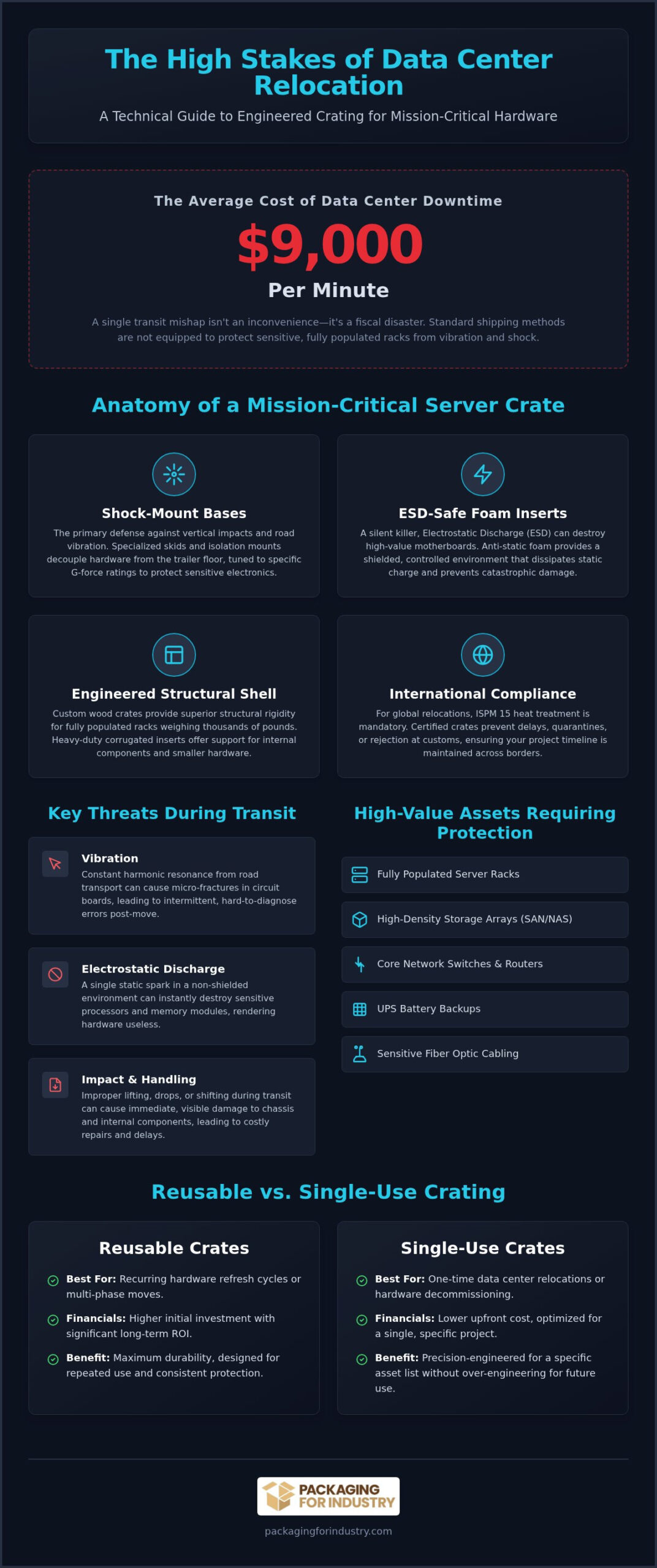
With the average cost of data center downtime now reaching $9,000 per minute, a single transit mishap during a move isn’t just an inconvenience; it’s a fiscal disaster. When you’re tasked with specifying custom crates for data center hardware relocation, you’re managing million dollar risks and tight delivery windows. You likely already know that standard shipping methods won’t protect sensitive AI infrastructure or fully populated racks from the vibrations and shocks of the road.
This guide provides the technical roadmap you need to source precision engineered packaging that eliminates transit damage and keeps your project on its critical path. We’ll show you how to evaluate shock mount bases, ESD safe foam, and structural integrity to meet strict insurance standards. You’ll also discover how a local Southern California partner can provide the fast lead times and CAD designed prototypes required to ensure your move stays on schedule and under budget.
Key Takeaways
- Identify the critical engineering specifications for custom crates for data center hardware relocation, including shock-mount bases and ESD-safe foam inserts.
- Evaluate the financial benefits of reusable versus single-use crating based on your decommissioning schedule or recurring hardware refresh cycles.
- Learn how to conduct a comprehensive asset audit and utilize CAD/CAM design to ensure a precision fit for fully populated server racks.
- Streamline your logistics by partnering with a local Southern California supplier that offers rapid prototyping and next-day delivery to minimize downtime.
The High Stakes of Data Center Relocation and Hardware Protection
Relocating mission-critical hardware involves risks that far exceed standard industrial logistics. While a typical shipment might involve durable components, a data center move involves interconnected systems where the margin for error is zero. Effective Data center management requires a proactive strategy for these transitions, as the financial consequences of a failed move are catastrophic. When you’re moving fully populated racks, you aren’t just moving metal; you’re moving the central nervous system of a business.
Standard freight carriers aren’t equipped for the complexities of fully populated server racks. These units are top-heavy and contain delicate drive arrays and processors susceptible to micro-fractures in circuit boards. These tiny cracks, often caused by transit-induced vibration, don’t always cause immediate failure. Instead, they lead to intermittent errors that can haunt your operations for months. Utilizing custom crates for data center hardware relocation acts as a direct insurance policy against these invisible failures.
Speed is just as critical as safety. Every minute of downtime costs an estimated $9,000. Using generic packaging often leads to delays during the crating process or, worse, damage that extends the re-commissioning window. Precision-engineered crates ensure that equipment is secured quickly and arrives ready for immediate installation. This efficiency is vital when you’re working within tight relocation windows that leave no room for logistical bottlenecks.
Identifying Sensitive IT Assets
Beyond the servers themselves, you must account for high-density storage arrays and network switches. UPS battery backups present a separate challenge due to their immense weight and chemical sensitivity. Even fiber optic cabling is at risk during a move. If cabling isn’t managed correctly within the crate, improper bend radiuses can lead to signal loss or physical breakage. A proper custom design packaging approach accounts for these specific hardware requirements before the move begins.
The Environmental Risks of Data Center Moves
Vibration is the primary enemy during road transport. Without specialized foam packaging and shock-mount bases, the constant harmonic resonance of a truck can shake components loose. Electrostatic Discharge (ESD) is another silent killer. In non-shielded environments, a single static spark can destroy a high-value motherboard. Finally, humidity fluctuations can cause condensation inside the chassis, leading to short circuits upon power-up. Your crating solution must provide a controlled environment that shields against these external variables.
Engineering the Anatomy of a Mission-Critical Server Crate
A custom data center crate is a multi-layered protective system specifically engineered for shock absorption and ESD mitigation. It’s a precision tool designed to maintain the physical and electrical integrity of high-density hardware. When we design custom crates for data center hardware relocation, we focus on the synergy between the outer structural shell and the internal dampening components. This holistic approach ensures that the equipment remains static and secure, even during the most turbulent phases of transport. Successful migrations often depend on implementing best practices during this initial engineering phase to account for every potential transit variable.
For fully populated server racks, custom wood crates remain the gold standard because they provide the superior structural rigidity required to support thousands of pounds. For internal components or smaller hardware batches, heavy-duty double-wall and triple-wall corrugated inserts offer excellent lateral support and weight distribution. If your relocation involves international transit, ISPM 15 compliance is a mandatory requirement to ensure your crates pass through customs without being quarantined or rejected. These engineered solutions are the most effective way to reduce shipping damage and maintain project timelines.
Shock-Mount Bases and Vibration Dampening
Vertical impacts and constant road vibrations are the primary causes of hardware failure during a move. Shock-mount bases serve as the primary defense against vertical impact. These bases utilize specialized skids and isolation mounts that decouple the hardware from the trailer floor. By selecting specific G-force ratings based on your electronic components’ sensitivity, we can tune the crate’s response to external shocks. This isolation is what prevents the structural stress that leads to component displacement or mechanical failure.
Protective Foam and ESD Shielding
Material science plays a vital role in securing heavy IT gear. Polyethylene (PE) foam is the preferred choice for high load-bearing applications, providing durable support for the corners and bases of heavy racks. For lighter, highly fragile components, softer Polyurethane (PU) foam offers the necessary cushioning to absorb smaller vibrations. Utilizing protective foam packaging allows us to create precision-cut end caps that lock equipment into a fixed position within the crate.
Static discharge is another silent threat to your infrastructure. Using anti-static and ESD-safe foam inserts is non-negotiable for modern server hardware. These materials prevent the buildup of triboelectric charges that can fry sensitive circuitry instantly. If you need to secure a specific equipment list, you can request a custom packaging quote to see how these engineered materials can be integrated into your relocation plan.
Evaluating Reusable vs. Single-Use Crating for IT Infrastructure
Decisions regarding custom crates for data center hardware relocation often hinge on the frequency of your moves. For one-way migrations or decommissioning legacy hardware, single-use export crates are the most pragmatic choice. These crates provide full industrial protection during a single transit cycle but aren’t designed for the wear and tear of repeated use. In contrast, hyperscale environments that undergo regular hardware refreshes see a much higher return on investment from reusable, trade-show style crates. These units feature reinforced structural elements and heavy-duty hardware designed to withstand dozens of deployment cycles over several years.
Strategic planning for physical assets is a massive undertaking. When analyzing high-profile projects like the U.S. Patent and Trademark Office data center relocation, it’s clear that crating choices impact both the speed of the transition and the total project budget. Single-use crates eliminate the need for reverse logistics and long-term storage, which is ideal when your destination facility lacks dedicated warehouse space. However, if your operations involve frequent equipment rotations between regional hubs, the durability of a reusable system quickly pays for itself by preventing recurring packaging costs.
Sustainability and Operational Efficiency
Reusable crates support corporate ESG goals by drastically reducing the volume of wood and foam waste generated during a large-scale migration. Managing these large units between moves can create operational bottlenecks. This is where Vendor Managed Inventory (VMI) becomes a critical service for data center managers. By partnering with a supplier that manages the storage and maintenance of your reusable crate fleet, you maintain the benefits of recurring packaging programs without sacrificing valuable floor space in your facility.
Durability Standards for Relocation Hardware
High-quality custom crates for data center hardware relocation must include specific engineering features to justify their role in your supply chain. Heavy-duty steel corners and recessed latches prevent damage during forklift handling and stacking. Ramp integration is another vital feature for efficiency; it allows teams to roll fully populated racks directly into the crate, which significantly reduces the risk of tipping or manual handling errors. For equipment that might sit in staging or long-term storage, moisture barrier bags and vapor protection are essential. These layers safeguard sensitive electronics from humidity and oxidation until the hardware is ready for re-commissioning in its new environment.
Specifying Your Requirements for Custom Relocation Packaging
Precision in documentation is the foundation of successful custom crates for data center hardware relocation. You must provide exact dimensions, total weight, and manufacturer-specified sensitivity ratings for every rack and component. This data prevents the over-engineering that inflates costs or under-engineering that leads to catastrophic damage. Procurement managers should treat this audit as a risk-management exercise. Providing these specifications early allows your packaging partner to calculate the exact foam density and shock-mount requirements needed to isolate your hardware from the physical torque encountered during loading and unloading.
CAD/CAM support is essential for high-value IT moves because it eliminates the guesswork associated with manual measurements. Utilizing 3D modeling allows for virtual fit-testing before any material is cut, ensuring that non-standard chassis heights and cable management systems are properly accommodated. Factoring in lead times is equally critical. Custom assemblies require dedicated time for precision cutting and foam curing, so starting the design phase at least four to six weeks before your move date is a best practice for maintaining a tight relocation window.
The Custom Design and Prototyping Process
Submitting your equipment specifications for CAD modeling allows engineers to test different foam densities against the weight of your fully populated racks. We offer free prototyping to verify that your specific server configurations fit perfectly within the protective system. By leveraging custom design packaging services, you can refine the internal layout to include specialized compartments for auxiliary components or cabling. This iterative process ensures the final product meets the exact physical demands of your mission-critical infrastructure.
Procurement and Supplier Evaluation
Searching for a reliable industrial packaging supplier near me often starts with verifying CAD/CAM capabilities and local manufacturing presence. If your facility is in Los Angeles, Anaheim, or the Inland Empire, working with a local partner allows for faster on-site audits and rapid prototyping adjustments. As a bulk packaging supplier, we understand that large-scale migrations require a vendor who can handle significant volume without compromising on precision or lead times.
When you compare industrial packaging pricing, look beyond the unit price and evaluate the supplier’s capacity to provide next-day delivery for urgent needs. A dependable partner should offer a clear checklist of specifications, ensuring you can accurately compare quotes between vendors. This level of transparency is vital for procurement managers who are responsible for both the project budget and the safety of the hardware.
Why Southern California Enterprises Partner with PFI for Data Center Logistics
Managing custom crates for data center hardware relocation in the tech-heavy corridors of Southern California requires a vendor with deep regional roots and industrial scale. As a primary Anaheim packaging supplier, we provide the rapid response times and engineering support that national catalog distributors simply cannot match. While we are the local choice for SoCal enterprises, we also maintain robust nationwide shipping capabilities to support your infrastructure moves to any facility across the United States. This dual capability ensures that your hardware receives consistent, high-level protection regardless of the destination.
Our background in aerospace and electronics packaging provides a unique advantage for data center managers. We apply high-precision engineering standards to every crate, ensuring that your most sensitive servers and storage arrays are shielded from the physical stresses of transport. By sourcing your custom boxes in Los Angeles or Anaheim directly from the manufacturer, you eliminate middleman markups and gain direct access to the designers who build your protective systems. This direct relationship is essential for maintaining the tight lead times required during critical decommissioning windows.
Local Support for High-Growth Tech Hubs
We provide specialized support for the data center clusters in Orange County, San Diego, and Riverside. Operating as an Orange County packaging supplier, we focus on reducing your logistical overhead through local manufacturing and distribution. This proximity allows our team to offer on-site support for complex kitting and assembly needs, ensuring that your relocation team has the necessary materials staged and ready before the first rack is moved. By manufacturing locally, we help you lower packaging costs and eliminate the shipping surcharges associated with out-of-state crate delivery.
Streamlined Purchasing and Inventory Flow
Efficiency in your supply chain is as critical as the physical safety of your equipment. Leveraging Just-In-Time (JIT) management allows you to coordinate the delivery of your crates with your specific relocation windows, preventing warehouse congestion. Whether you need heavy-duty triple-wall corrugated inserts or reinforced wood crates designed for repeat use, our systems are designed to improve reliability and reduce total project costs. Request a custom crate quote today to secure your critical IT infrastructure with a partner that understands the high stakes of Southern California data center logistics.
Secure Your Infrastructure for the Next Migration
Relocating a data center is an engineering challenge that demands more than generic boxes. It’s about protecting mission-critical assets from vibration damage and intermittent failures through specialized ESD and shock-mount engineering. Precision design through free prototyping and CAD modeling ensures that your hardware fits perfectly; choosing the right reusable or single-use materials optimizes your long-term ROI. You’ve seen how the right crating acts as an insurance policy against the high costs of downtime and hardware failure.
PFI provides the local expertise and next-day delivery capabilities that Southern California enterprises need to meet tight relocation windows. We help you specify the right custom crates for data center hardware relocation to eliminate downtime and keep your project on schedule. Our team’s ready to help you lower packaging costs and improve supply chain reliability through every phase of your move. We don’t just provide crates; we provide a system of protection designed for the bottom line.
We look forward to helping you achieve a zero-damage relocation and a seamless transition to your new facility.
Frequently Asked Questions
What is the difference between a standard shipping crate and a data center crate?
Standard shipping crates focus on basic containment, while custom crates for data center hardware relocation are engineered protective systems. These specialized crates incorporate shock-mount skids and ESD-safe materials to mitigate risks like vibration and static discharge. While a standard crate might protect against surface scratches, a specialized IT crate isolates sensitive internal components from the harmonic resonance of a truck. This level of engineering is what prevents invisible hardware failures during a move.
Why is ESD foam necessary for hardware relocation?
ESD foam is necessary because standard packaging materials can generate static electricity through friction during transit. A single electrostatic spark can instantly destroy a high-value motherboard or processor. Anti-static and ESD-safe foam inserts provide a controlled environment that prevents charge buildup. This protection is critical when moving hardware between climate-controlled environments where low humidity can increase the risk of static discharge during the handling process.
How do shock-mount bases protect server racks during transport?
Shock-mount bases protect server racks by utilizing isolation skids that decouple the equipment from the trailer floor. These mounts act as a suspension system, absorbing vertical impacts and high-frequency road vibrations. Without this dampening, the constant shaking of a long-haul move can loosen internal components or cause micro-fractures in delicate circuit boards. This isolation ensures the rack remains in a stable, neutral position regardless of road conditions or handling maneuvers.
Can you provide custom crates for international data center migrations?
Yes, we design and manufacture custom crates for data center hardware relocation that are fully compliant with international shipping regulations. Our engineering team accounts for the increased handling and diverse environmental conditions associated with global transit. We utilize moisture barrier bags and vapor protection to safeguard electronics against humidity during long-haul sea or air freight. This ensures your infrastructure arrives at its international destination ready for immediate re-commissioning without customs delays.
What information do I need to provide for a custom crate quote?
To receive an accurate custom packaging quote, you should provide the exact dimensions and total weight of your server racks or components. We also require the G-force sensitivity ratings of your hardware to calculate the necessary foam density and shock-mount specifications. Additional details like the destination, move date, and whether the racks will be fully populated help us determine the best structural design and material requirements for your specific project.
Does PFI offer on-site crating services in Southern California?
PFI provides on-site support for assembly and kitting across Southern California, including Los Angeles, Anaheim, and the Inland Empire. While we focus on manufacturing and delivery, our local team can assist with complex packaging setups to ensure your hardware is secured correctly before it leaves the dock. This local presence allows us to offer next-day delivery on critical supplies, helping you maintain your relocation schedule without the logistical delays of out-of-state shipping.
How does prototyping help reduce shipping damage for IT hardware?
Prototyping reduces shipping damage by allowing us to verify the rack-to-crate fit using CAD modeling before production begins. We test the foam compression and the crate’s structural response to the specific weight of your hardware. This process ensures that there’s zero movement within the crate during transit. By refining the design through a physical or digital prototype, we eliminate the guesswork that often leads to failures in generic or one-size-fits-all packaging.
Are your wood crates ISPM 15 certified for export?
Yes, all wood crates manufactured by PFI for international transit are ISPM 15 certified and heat-treated. This certification is a mandatory requirement for wood packaging used in global trade to prevent the spread of timber pests. Every crate is stamped with the official IPPC mark, ensuring it passes through international customs without the risk of being quarantined or rejected. This compliance is essential for maintaining your timeline during a global data center migration.