
In industrial logistics, a packaging prototype isn’t a luxury or a marketing mock-up; it’s a financial safeguard that proves ROI before you ship a single pallet. If you’ve dealt with high shipping damage rates or unexpected FedEx dimensional surcharges recently, you know that standard boxes often fail under the pressure of a modern supply chain. Securing a free packaging design prototype Southern California manufacturers can rely on is the most effective way to de-risk your operations. It allows you to test custom foam inserts or heavy duty corrugated designs against real-world vibration and impact without committing your entire budget to an unproven solution.
You likely already understand that precision engineering is cheaper than a warehouse full of rejected products. This guide explains how to secure a physical sample that fits your product perfectly, allowing you to validate protection levels while optimizing freight costs. We’ll walk through the process of moving from a CAD design to a physical prototype and eventually to bulk production with local delivery across Orange County, Los Angeles, and the Inland Empire. You’ll learn how to eliminate transit damage and stabilize your logistics expenses through a proven, local design process that prioritizes your bottom line.
Key Takeaways
- Understand why a physical prototype is the only reliable way to validate fit and protection before committing to high-volume industrial production runs.
- Learn how CAD/CAM engineering optimizes material usage to reduce shipping damage and lower overall packaging costs for aerospace and electronics components.
- Compare the performance of polyethylene and polyurethane foam inserts to determine the best cushioning strategy for your product’s weight and fragility.
- Follow our streamlined process to secure a free packaging design prototype Southern California manufacturers can use to eliminate specific transit pain points.
- Discover how an approved prototype becomes the “Golden Sample” for quality control and integrates into a Vendor Managed Inventory (VMI) program for just-in-time delivery.
Why Prototyping is the Critical First Step for Southern California Manufacturers
An industrial packaging prototype is a physical sample engineered to validate three essential factors: product fit, structural protection, and shipping efficiency. Unlike a marketing mock-up designed for retail shelf appeal, an industrial prototype serves as a functional proof of concept. For manufacturers in Los Angeles, Orange County, and the Inland Empire, this physical validation is the only way to ensure that a custom corrugated box or foam insert will perform under the stress of local and national distribution networks.
Guessing on dimensions or material density in a high-volume production run is a significant financial risk. If a design is off by even a fraction of an inch, you might face thousands of dollars in wasted materials or, worse, a high rate of transit damage. Southern California’s logistics landscape is particularly demanding. With heavy congestion at the Ports of Long Beach and Los Angeles and the rapid pace of regional cross-docking, your packaging must be robust enough to handle multiple touchpoints. A free packaging design prototype Southern California manufacturers can test in-house allows you to identify these vulnerabilities before you sign off on a bulk order.
Prototyping also identifies potential UPS and FedEx dimensional (DIM) weight surcharges. Carriers charge based on the space a package occupies, not just its weight. If your box is unnecessarily large, you’re paying for air. A physical sample allows you to refine the footprint of your shipment, ensuring you get the most protection for the lowest possible freight cost.
De-Risking High-Value Shipments
Manufacturers in the aerospace and medical device sectors can’t rely on stock catalog boxes. These high-value components require precision-engineered protective foam packaging that accounts for center of gravity and fragile calibration points. During the prototyping phase, we often identify “hidden” failure points, such as foam compression set or internal movement, that a CAD drawing might miss. Providing a physical sample also streamlines the approval process with internal QA and engineering stakeholders, giving them the confidence that the solution meets all safety and compliance standards.
The Economics of Precision Packaging
Precision packaging is a direct contributor to your bottom line. Reducing a box size by just one inch through careful prototyping can result in substantial annual freight savings, especially when shipping at scale. This optimization also reduces material waste, helping you meet corporate sustainability goals without compromising on the structural integrity of your manufacturing packaging. There is a direct, measurable correlation between rigorous prototype validation and a decrease in shipping insurance claims for damaged goods.
The PFI Custom Design Process: From CAD Engineering to Physical Samples
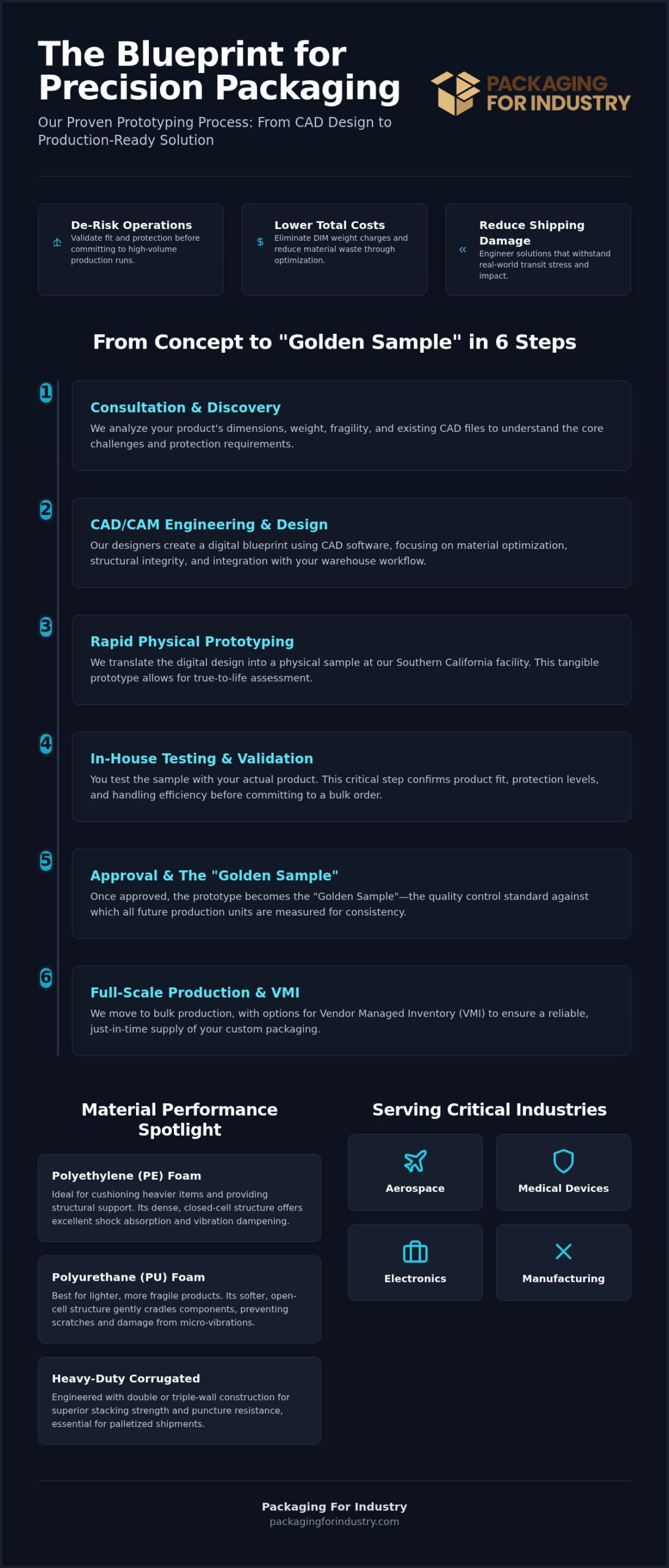
Moving from a shipping problem to a production-ready solution requires a methodical engineering approach. We don’t rely on generic templates or “close enough” measurements. Instead, our process is built on technical precision and rapid local execution. By following a structured five-step framework, we ensure that your custom packaging is optimized for both protection and cost-effectiveness before you commit to a bulk purchase.
- Step 1: Initial Consultation: We begin by reviewing your product’s physical dimensions, weight, and fragility. If you have existing CAD files, we analyze them to understand the specific geometries involved.
- Step 2: Engineering Phase: Our designers use CAD/CAM software to develop a digital blueprint. This phase focuses on optimizing material usage and ensuring the design integrates with your existing warehouse workflows.
- Step 3: Rapid Prototyping: We translate the digital design into a physical sample at our Southern California manufacturing facilities. This is where you receive your free packaging design prototype Southern California engineers have tailored to your specific application.
- Step 4: Fit Testing and Refinement: You test the sample with your actual product. We gather your feedback and make iterative refinements to the design to ensure a perfect fit and maximum security.
- Step 5: Final Sign-Off: Once the prototype is validated, it becomes the “Golden Sample.” This approved design serves as the quality benchmark for the subsequent transition to bulk production.
CAD/CAM Support for Complex Geometries
For manufacturers in the aerospace and defense sectors, products often feature irregular shapes and sensitive surfaces that standard packaging cannot accommodate. Our CAD/CAM support allows us to engineer custom foam packaging that mirrors these complex geometries exactly. Digital blueprints ensure that every multi-part assembly remains consistent across thousands of units. By integrating these custom inserts with heavy-duty corrugated outer shells, we create a unified system of protection that eliminates internal movement during transit.
Rapid Prototyping in Anaheim
Operating out of our Anaheim headquarters gives us a distinct logistical advantage for Southern California businesses. We understand that in a just-in-time manufacturing environment, you can’t afford to wait weeks for a sample from a catalog giant. Our local engineering team provides rapid turnaround, often delivering prototypes the next day for standard corrugated designs. This proximity allows for face-to-face consultations and immediate adjustments, moving your project from a digital concept to a physical sample you can hold and verify in real-time. If you are ready to see how a custom-engineered solution can improve your operations, you can request a packaging quote to begin the design process.
Evaluating Material Performance: Foam Inserts, Corrugated Strength, and Crate Fit
Selecting the right material is a balance between engineering requirements and economic constraints. A physical prototype allows you to test how specific materials respond to the G-forces and vibrations present in the Southern California shipping environment. While digital models provide a baseline, only a physical sample can confirm if your material choice prevents product migration or structural failure during transit. Utilizing a free packaging design prototype Southern California engineers have developed ensures that your material specifications are validated before you invest in wholesale quantities.
For heavy industrial gear or sensitive medical equipment, we evaluate several material categories:
- Foam Density: We compare Polyethylene (PE) for heavy, rugged items against Polyurethane (PU) for lighter, delicate components to ensure proper deceleration.
- Corrugated Wall Strength: We determine if your application requires the vertical stacking strength of double-wall boxes or the extreme puncture resistance of triple-wall corrugated.
- ESD Protection: For semiconductor and electronics manufacturers, we validate that anti-static properties are integrated into the foam or corrugated liners to prevent static discharge.
- Crate Integrity: For heavy machinery, we assess the load-bearing capacity of wood crates and internal bracing to prevent shifting on the pallet.
The Role of Protective Foam Inserts
A prototype is the only way to reveal if your foam cushioning is performing as intended. If the foam is too rigid, it transfers shock directly to the product; if it is too soft, the product will “bottom out” against the outer box during a drop. By testing custom foam inserts in a sample environment, we can adjust the density and thickness to match your product’s fragility. We also use this phase to decide between die-cut foam for high-volume efficiency or custom-cut foam for complex, low-volume aerospace assemblies, ensuring the prototype method aligns with your eventual production needs.
Corrugated Durability Standards
Industrial buyers often choose between the Edge Crush Test (ECT) and the Mullen (Burst) Test. We use the prototyping phase to verify which standard matters for your specific supply chain. For example, if your pallets are stacked four-high in a Riverside warehouse, ECT ratings for stacking strength are critical. However, if your product is heavy and prone to shifting, the puncture resistance of heavy-duty corrugated boxes measured by the Mullen test is more relevant. Prototyping also allows us to check flap alignment and the effectiveness of weather-resistant coatings, which are essential for shipments moving through coastal ports where humidity levels vary.
How to Secure Your Free Packaging Design Prototype in Southern California
Securing a functional prototype requires more than just a simple request; it’s a consultative process that relies on accurate data. To ensure the sample solves your specific operational hurdles, we start by defining your product’s fragility and weight. This information dictates whether your application requires 1.7lb polyethylene foam or the stacking strength of a triple-wall corrugated box. Be specific about your current shipping pain points. If you’re dealing with crushed corners, punctured walls, or internal movement, our engineers need to know so they can reinforce those failure points in the initial design.
Specify your projected annual volume during the consultation. This detail is vital because it determines how we engineer the prototype for production efficiency. A design for a low-volume custom crate differs significantly from a high-volume corrugated run that requires automated assembly. For complex or oversized equipment, we often schedule local site visits in Anaheim or Los Angeles. Seeing the machinery in person allows our team to take precise measurements and identify potential snag points that a photo or CAD file might miss.
Southern California Service Areas
Our local presence is a core advantage for manufacturers across Orange County, Los Angeles, and the Inland Empire. We provide direct support for San Diego and Riverside-based logistics hubs, ensuring regional supply chain nuances are accounted for in every design. Because our engineering and manufacturing are centralized in Anaheim, we offer local next-day delivery for finished prototypes. This speed allows you to test, refine, and move to bulk production without the delays associated with out-of-state suppliers or catalog giants.
The Information Needed for an Accurate Quote
To provide an accurate free packaging design prototype Southern California procurement managers can use for internal approvals, we require three key data points. First, we need the exact dimensions (L x W x H) and weight of the actual product. Second, specify your primary shipping method, whether it’s LTL, small parcel, or international air, as each carries different vibration and impact risks. Finally, provide your total annual quantity to ensure the design is cost-optimized for your specific scale.
Beyond the Sample: Transitioning from Prototype to Production and VMI
The approval of a prototype marks the transition from engineering to execution. This physical sample, validated through the free packaging design prototype Southern California process, now serves as your “Golden Sample.” It is the definitive quality control benchmark that ensures every unit in a bulk production run meets the exact specifications for fit and protection. By establishing this standard early, you eliminate the variability that often leads to shipping damage in high-volume manufacturing environments. Our production team uses this approved sample to calibrate equipment and verify material tolerances, ensuring that the first box off the line is as protective as the thousandth.
Transitioning to bulk production also introduces the challenge of inventory management. Custom corrugated boxes and foam inserts occupy significant warehouse space, which can be a bottleneck for growing operations. We solve this through a Vendor Managed Inventory (VMI) program. Instead of crowding your facility with pallets of packaging, PFI stocks your custom-engineered supplies at our local Southern California facilities. We monitor your usage levels and replenish your stock automatically, ensuring you always have the necessary materials without the overhead of excess inventory. This partnership allows you to focus on your core manufacturing while we handle the logistical flow of your packaging supplies.
Just-In-Time Packaging Replenishment
Lead-time surprises are a common cause of production delays. When you rely on custom-engineered packaging, a sudden spike in orders can leave you without the protection your product requires. Our just-in-time replenishment model prevents these production stops by maintaining a safety stock of your validated designs at our Anaheim headquarters. This approach offers significant financial benefits; you optimize your cash flow by paying only for the packaging you pull into production, rather than tying up capital in months of sitting stock. It’s a pragmatic solution for manufacturers who need to remain agile in a fluctuating market.
Comprehensive Industrial Solutions
A successful logistics plan requires more than just a box and foam. To ensure total load stability, we combine your custom prototypes with high-performance stretch film and corner and edge protection. This holistic approach allows PFI to act as your single-source supplier for boxes, foam, crates, and pallets. By consolidating your packaging needs with a local partner, you streamline your procurement process and improve the overall reliability of your supply chain. We don’t just provide a sample; we provide a complete system of protection that scales with your business.
Contact us to start your custom design project
De-Risk Your Logistics with Engineered Packaging Samples
Securing an industrial packaging sample is the most effective way to eliminate the guesswork that leads to transit damage and unexpected freight surcharges. By utilizing CAD/CAM engineering support, you ensure that your custom corrugated boxes and foam inserts are optimized for both protection and material efficiency. This is especially critical for manufacturers in the aerospace and defense sectors, where precision is a requirement rather than an option.
Our Anaheim headquarters is positioned to provide a free packaging design prototype Southern California businesses can test immediately. With local next-day delivery on finished samples, you can validate your design and move into bulk production or a Vendor Managed Inventory program without logistical delays. We’re here to help you stabilize your supply chain and lower operational costs through engineered reliability.
We look forward to helping you optimize your next shipment and improve your bottom line.
Frequently Asked Questions
Is there really no cost for a packaging design prototype in Southern California?
Yes, we provide this as a value-added service for qualified industrial and manufacturing projects to ensure design viability. This free packaging design prototype Southern California manufacturers receive functions as a damage reduction audit, allowing you to prove the ROI of a custom solution before you commit your budget to a bulk production run.
How long does it take to receive a physical sample of a custom box or foam insert?
Standard corrugated prototypes are typically delivered the next day for our local Southern California clients. More complex assemblies involving custom-cut foam inserts or heavy-duty wood crates may require additional engineering time, but our Anaheim-based team prioritizes rapid turnaround to keep your production schedule on track.
Can you provide prototypes that meet Mil-Spec or Aerospace standards?
Yes, we specialize in engineering packaging that adheres to rigorous Aerospace, Defense, and medical device standards. Our CAD/CAM support is included in the prototyping process to ensure that every dimension and material choice meets the exact technical specifications required for high-value, sensitive components.
Do I need to provide a CAD file, or can you design the packaging from my product?
You don’t need to provide a CAD file to begin the design process. While we can work from your digital blueprints to accelerate engineering, our team is fully equipped to measure your physical product or equipment at your facility to create a custom-fit solution from scratch.
What is the minimum order quantity (MOQ) after the prototype is approved?
MOQs depend on the specific materials used and the complexity of the design, but we focus on serving bulk industrial needs. We’ll work with your procurement team to establish a production scale that optimizes your unit pricing while aligning with your warehouse capacity and annual usage forecasts.
Can you test the prototype for transit damage before I place a bulk order?
Yes, the physical sample allows your team to perform internal drop tests and vibration checks to validate the protection levels. This step is essential for identifying “hidden” failure points in the foam or corrugated structure, ensuring the final product survives the rigors of the modern supply chain.
Do you offer local delivery for prototypes in Los Angeles or Orange County?
Yes, we offer local delivery for every free packaging design prototype Southern California businesses request from us. Our delivery network covers Orange County, Los Angeles, San Diego, and the Inland Empire, ensuring you can review the physical sample without the delays or risks of third-party shipping.
How does prototyping help reduce my overall shipping costs?
Prototyping allows us to refine the external footprint of your packaging to the smallest possible dimensions. By eliminating even one inch of unnecessary space, we help you avoid expensive dimensional weight surcharges from carriers like UPS and FedEx, which significantly lowers your annual freight expenses.