
What if a crate protects a machine in storage but does not suit the way it will be handled, transported, and installed? Custom crating for factory relocation projects needs to account for the equipment’s full journey, not just its dimensions. Preventing damage is essential, but the right packaging plan can also help teams handle equipment consistently and keep the move organized.
Before specifying crates, gather information about the machinery, handling methods, and relocation schedule. Equipment size, weight, vulnerable components, and planned handling all affect crate design and cushioning choices. Use those details to prepare a quote request that supports a practical discussion of the packaging scope.
Packaging For Industry designs custom wood crates, foam-lined crates, and protective foam packaging for industrial applications. CAD-engineered designs and prototypes let teams evaluate fit before broader production. The guidance below helps you compare protective approaches against project needs and coordinate crate specifications with the relocation plan.
Key Takeaways
- Build the crating plan around each asset’s dimensions, weight, condition, and handling requirements, not size alone.
- Use clear equipment photos to identify protruding, removable, or vulnerable components that may need tailored protection.
- Compare custom wood crates, foam-lined crates, and added cushioning based on protection needs, handling, and potential reuse.
- Organize assets by size, fragility, handling needs, and move sequence to make your quote request more complete and actionable.
- CAD-engineered design and prototypes can help teams assess fit before broader production.
Why custom crating matters in factory relocation projects
Custom crating is packaging designed around a specific asset and the requirements of its planned move. Unlike a standard container, a custom crate’s dimensions, internal support, and cushioning can be tailored to the equipment and its handling needs. That planning matters because factory equipment may pass through several handling and transport stages before it reaches its new position.
Relocation packaging is one part of Logistics, the coordinated planning and movement of goods. The packaging plan should reflect more than the destination. Account for how each asset will be prepared, handled, transported, and unpacked. Do not assume every machine follows the same route or process.
Which factory assets may need custom crates?
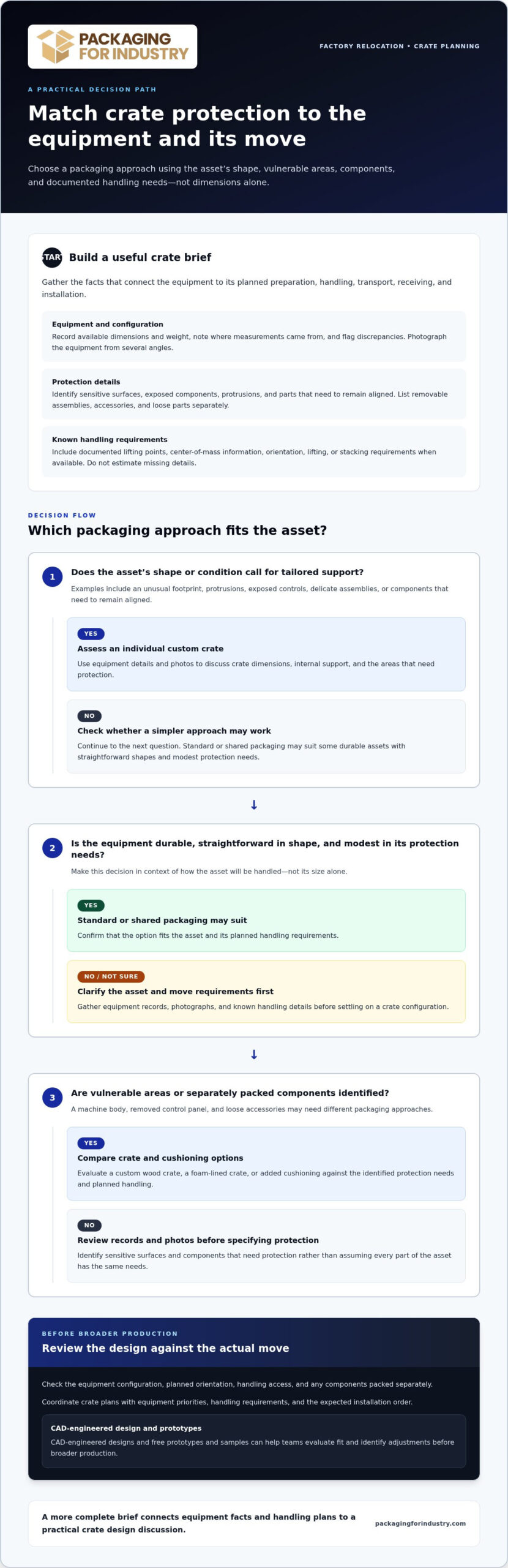
Identify assets whose shape, condition, or protection needs make standard packaging a poor fit. A machine with an unusual footprint may not sit securely in a stock container. Exposed controls, delicate assemblies, or components that must remain aligned may need tailored support. Durable items with straightforward shapes and modest protection needs may suit standard or shared packaging, depending on how they will be handled.
- List complete machines separately from removable assemblies, accessories, and loose components.
- Note unusual dimensions, protrusions, fragile areas, and surfaces that need protection.
- Gather equipment photographs and existing dimensional records to make design discussions more specific.
This inventory helps teams decide which assets need individual crates, which components can be grouped, and where a simpler packaging approach may work. It also gives a packaging supplier more to work with than a machine name alone.
What custom crating contributes to a relocation plan
A fitted crate can organize and support an asset during planned handling, while cushioning can protect identified vulnerable areas. For example, a machine body and its removed control panel may need different packaging approaches. Identifying and separating them can help crews track components and match them to the right equipment during unpacking.
Packaging choices also affect move sequencing. Teams can organize crate plans around equipment priorities, handling requirements, and the expected installation order. This supports production planning without assuming every item needs its own crate or promising damage-free delivery. PFI designs and supplies custom wooden crates and protective packaging for industrial assets.
What to specify when designing custom crates for factory equipment
A useful crate brief turns equipment information into practical design inputs. For custom crating for factory relocation projects, include what the asset is, how it will be configured for the move, what needs protection, and how the crate will be handled. Specific information ties design decisions to the project instead of generic assumptions.
Equipment information to gather before requesting a crate
Start with the equipment’s identity and current configuration. Record available dimensions and weight, and note the source of each measurement, such as an equipment drawing, nameplate, or recent measurement. If sources differ, flag the discrepancy rather than choosing one value without explanation. Photographs from several angles can show protrusions and other details that a simple dimension list may miss.
- Identify sensitive surfaces, exposed components, and areas that need additional protection.
- Separate the main machine from removable assemblies, accessories, and loose parts, then indicate which items will travel together.
- Include documented lifting points or center-of-mass information when available. Do not estimate these details.
- Note the equipment’s condition and any preparation planned before packing.
This information helps the design team understand where the asset needs support and where a crate or cushioning must avoid pressure. A control panel, projecting handle, or disassembled attachment may need different treatment from the machine body.
Translate handling requirements into crate-design inputs
Describe the known sequence from preparation through transport, receiving, and installation. Include who will handle the packaged asset at each stage, if known, and explain established requirements for orientation, lifting, or stacking. If the crate will be stored before installation, include expected storage conditions when the project team has defined them. Clear inputs help align packaging with the plan.
Handling information also supports coordination with workplace procedures. OSHA’s standards for material handling address safe handling and storage of materials in covered workplaces. Use applicable site procedures and documented handling plans to inform the packaging brief. A general reference does not replace project-specific instructions.
PFI’s CAD-engineered custom packaging design services translate equipment and handling details into a design for review. Free prototypes and samples let teams evaluate fit before broader production and identify adjustments while the plan is still being developed.
Before production, review the design against the equipment configuration, planned orientation, handling access, and any components packed separately. Include equipment records and known handling requirements in your custom packaging quote request.
How to compare custom crate and cushioning options
Compare crate configurations against the asset and the documented conditions of its move, rather than choosing materials by habit. A crate that fits the equipment may still need internal cushioning, separate compartments, or a layout suited to the planned handling sequence. The Project Management for Factory Relocation resource from the Project Management Institute provides broader context for coordinating packaging decisions with relocation planning.
The comparison below is a starting point, not a specification. The right configuration depends on equipment dimensions, vulnerable areas, handling and receiving requirements, and whether the packaging is expected to be reused.
| Configuration | Asset fit | Protection considerations | Handling and reuse |
|---|---|---|---|
| Custom wood crate | Useful when equipment needs a package designed around its footprint or shape. | Provides an enclosing structure; consider additional internal support if the asset has vulnerable areas. | Plan access and handling around the project’s known requirements. Reuse depends on the crate’s condition and future fit. |
| Foam-lined crate | Can suit equipment that needs a shaped or cushioned interior. | Foam lining can address identified contact points and areas where movement needs to be managed. | Review how equipment will be placed and removed, and whether the interior will suit later use. |
| Crate with added cushioning | Can pair a crate structure with cushioning positioned where needed. | Useful when specific components or surfaces need extra separation or support. | Consider how cushioning is arranged, handled, and replaced if the packaging will be reused. |
When to consider wood crates, foam lining, or both
Custom wooden crates are a configurable packaging option for industrial equipment. Pairing a crate with protective foam packaging can cushion identified vulnerable areas, while separate compartments can keep related components organized. Match the configuration to documented needs rather than adding materials without a clear purpose.
Compare designs against the move’s actual requirements
Review each option against the equipment’s recorded dimensions and the planned handling, transport, and receiving process. Check whether removable parts need protected space of their own, whether placement inside the crate is clear, and whether the crate can be handled in the required orientation. If reuse is planned, consider whether the asset configuration and handling needs will be the same next time.
PFI’s custom packaging design process can turn these requirements into a practical crate and cushioning plan. To compare a configuration against your equipment and relocation needs, request a custom packaging quote with the available asset details and handling information.
A practical planning checklist for relocation crating
A clear schedule connects packaging decisions to the order in which equipment will be prepared, moved, received, and installed. For custom crating for factory relocation projects, this helps teams identify which crates need early design review and where packaging details depend on operations or relocation planning. Coordinate the working list across packaging, operations, procurement, and the relocation team so changes reach everyone affected.
Build an asset and packaging schedule
Use one schedule to connect each machine or assembly with its packaging needs and move sequence. Group assets by dimensions, fragility, handling requirements, and planned move order. Record project due dates, dependencies, and any crate or foam design that needs prototype review. A shared record makes exceptions visible and helps procurement align quote and purchasing work with the operational plan.
- Inventory assets: Assign a clear name or identifier to each machine, assembly, and related component.
- Group requirements: Sort items by size, fragility, handling needs, and sequence, and mark assets that need a distinct packaging approach.
- Record dependencies: Note planned disassembly, parts traveling separately, receiving access constraints, and installation order provided by the project team.
- Map dates: Add required-by dates and sequencing from the relocation team. Flag packaging that needs design or prototype review before production.
- Review ownership: Have operations, procurement, packaging, and relocation stakeholders check the schedule for missing details or changes.
This schedule is a planning tool, not a substitute for the relocation team’s handling plan. The Project Management Institute’s Project Management for Factory Relocation resource offers broader context on coordinating workstreams. Keep crate requirements linked to current project information so revisions to timing, equipment configuration, or receiving arrangements can be reflected in the packaging plan.
Prepare a useful custom crating quote request
A quote request is more actionable when it connects each package to the move. For each asset, provide its description, available dimensions and weight, photographs, quantity, and known packaging requirements. Identify confirmed measurements and note any gaps. Include project timing, known handling and transport conditions, and receiving or installation constraints that could affect crate access, orientation, or placement.
Before submitting, check that component counts match the asset list and that timing reflects the relocation team’s current schedule. If design review or a prototype is needed, identify the items and decision-makers involved. For international transit, include that project requirement in the brief so the packaging plan reflects it. These details give the packaging team a practical basis for evaluating the request and coordinating design work.
Request custom crating for your factory relocation project
A well-prepared packaging brief gives your team and packaging supplier a practical basis for discussing crate design, quantities, and project coordination. Packaging For Industry (PFI) designs and supplies custom wood crates, foam-lined crates, and related protective packaging for industrial equipment. The goal is to align the packaging scope with the assets and relocation requirements, not to treat every machine as the same package.
What to expect when discussing the packaging scope
Project details guide the proposed crate configuration. Asset dimensions and photographs help the design team assess fit; known handling needs, vulnerable components, and separate parts help determine where cushioning or organized placement may be useful. The packaging scope centers on design and supply, coordinated with the handling and installation plans established by your project team.
PFI uses CAD-engineered design to develop packaging around project requirements. Free prototypes and samples give teams an opportunity to evaluate a design before broader production. This review helps manufacturing, operations, and procurement align on the proposed fit and packaging approach, then identify adjustments through the design process. Where equipment needs added protection, crates can be paired with foam or other related protective packaging.
Move from project requirements to a quote
Before requesting pricing, gather information that defines the scope and project context. An asset schedule is useful when the move includes multiple machines, assemblies, or separately packed components. Include:
- Asset descriptions and available dimensions, with photographs where possible.
- Quantities, separate components, and known configuration changes before packing.
- Documented handling needs and known transport or receiving conditions.
- Project schedule, required-by dates, move sequence, and planned installation details.
Share what is known and identify details still being developed. This keeps the quote discussion grounded in available project information and gives stakeholders a shared view of open packaging questions. It also helps procurement compare the proposed packaging scope with the relocation schedule, while operations can assess how the plan fits asset preparation and receiving.
PFI’s experience includes an AeroTech Manufacturing testimonial describing custom crates and foam inserts for aerospace components. For factory teams, the same planning discipline starts with accurate asset information and clear coordination across the people responsible for equipment, purchasing, and the move schedule.
Have your asset details and relocation requirements ready? Request a custom crating quote from PFI to start a packaging scope discussion for your factory relocation.
Put your relocation packaging plan into action
Use the packaging plan as a working document from preparation through execution. Assign an owner to track updates to asset configurations, quantities, and schedule details, then share relevant changes with procurement, operations, and the relocation team before they affect crate requirements. This keeps purchasing decisions and packaging plans aligned as project details evolve.
For custom crating for factory relocation projects, turn current asset information into a project-specific quote request. Include the details your team has gathered and flag open questions so the packaging scope can be discussed against the requirements you know today.
With a coordinated plan in place, your team can keep packaging decisions connected to the work ahead.
Frequently Asked Questions
What information should I include in a custom crating quote request for a factory relocation?
Include an asset identifier for each machine, the quantity to package, available drawings or photographs, and known handling or receiving constraints. Note which details are confirmed and which are estimates so the design discussion can focus on gaps. A spreadsheet matching each asset to its photos and supporting documents can help purchasing and operations review the same information.
Can custom crates be designed for machinery with removable components?
Yes. A crate plan can account for assemblies removed before packing, treating the main machine and loose components as distinct package contents. For example, list a detached control unit under the machine’s asset ID and state whether it should travel in a separate protected space or package. Clear identification helps receiving teams connect each piece with the correct equipment during unpacking and installation.
How do I decide whether factory equipment needs a foam-lined crate?
Consider foam lining when equipment has identified contact points, delicate surfaces, or components that need cushioning inside the crate. Base the decision on the asset’s condition and the protection needs documented for the project, rather than assuming every machine needs foam. A design review or sample can help the team assess fit and whether the proposed arrangement suits packing and removal.
Can custom wood crates be reused after a factory move?
They may be reusable, depending on the crate’s condition and whether it fits the equipment and requirements of a later move. Before reuse, inspect the structure, closures, and interior supports for damage or changes that could affect fit. Record which asset the crate was designed for, since a crate made for one configuration may not suit a modified machine or a different package.
Should every machine in a factory relocation receive its own custom crate?
No. The packaging plan should reflect each asset’s protection and handling needs, rather than assigning one crate per machine by default. Related components may be packaged together when their arrangement is clear and their individual protection needs are addressed. Grouping assets with similar requirements can simplify inventory and purchasing, while unusual shapes or delicate assemblies may need a separate packaging approach.
How can we coordinate crate requirements with a factory relocation schedule?
Assign a project owner to maintain the asset list and share changes with packaging, operations, procurement, and the relocation team. Set internal review points for confirming equipment configurations, approving designs, and matching packaging quantities to the move sequence. For custom crating in Orange County, Los Angeles, or San Diego, sharing the project schedule with the packaging team connects design discussions to planned milestones.
Does PFI provide custom crate design and prototypes?
Yes. Packaging For Industry provides CAD-engineered packaging design, with free prototypes and samples to support project evaluation. The design process accounts for the equipment and packaging requirements your team provides, helping reviewers assess the proposed fit before broader production. PFI serves industrial customers in Orange County, Los Angeles, and San Diego, including manufacturers coordinating packaging for machinery and other equipment.