
When cartons arrive with crushed corners or products show abrasion, the cause may be a mismatch between the protector and the load, not simply weak packaging. Strapping can concentrate pressure on vulnerable edges, and a protector that is too short or poorly positioned can leave those areas exposed. If you’re working out how to choose the right edge and corner protectors, begin by identifying where and how damage occurs.
Then assess the product geometry, pallet configuration, and shipping method. The right fit can help distribute strap pressure and protect corners during handling without adding material that does not address the problem.
This guide covers how to match protection to your product and shipment, then coordinate it with cartons, cushioning, stretch film, and other load-stabilization materials. Packaging For Industry supplies edge and corner protection for industrial shipping, along with custom packaging design, prototypes, and samples. Use the selection steps below to develop a practical specification for your operation.
Key Takeaways
- Identify whether damage comes from abrasion, crushing, handling, or load pressure before choosing a protector.
- Compare material, dimensions, and design with the load’s contact points and shipping conditions.
- Assess product weight, configuration, and where straps or cartons apply force.
- Match coverage to the shipment, whether products move on pallets, in boxes, or inside crates.
- Review edge protection as part of the full packaging plan to avoid gaps or unnecessary materials.
What Edge and Corner Protectors Prevent in Industrial Shipping
Industrial shipments are vulnerable where packaging meets a strap, another surface, or handling equipment. Edge protectors run along exposed edges to shield them and help distribute contact pressure. Corner protectors cover vulnerable corners, where carton panels or product surfaces meet. These components address specific contact points. They do not replace cushioning or other packaging needed to control product movement and impact.
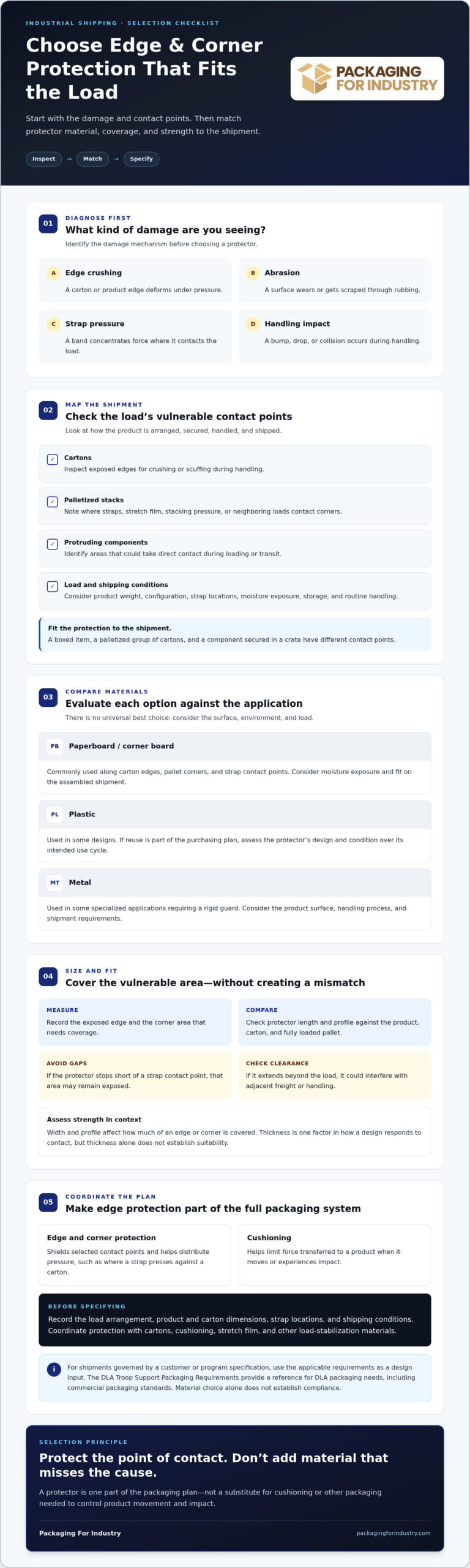
First, distinguish the type of damage. Edge crushing deforms a carton or product edge under pressure. Abrasion wears or scrapes a surface through rubbing. Strap pressure concentrates force where a band contacts the load. Impact results from a bump, drop, or collision during handling. Identifying the damage mechanism is a practical first step in choosing the right edge and corner protectors.
This is one part of the broader role of packaging and labeling, which supports protection, handling, storage, and movement through the supply chain. An edge protector reinforces or shields selected contact points, not every surface of a product.
How edge protection differs from cushioning
Edge protection guards exposed edges and corners against concentrated contact, such as a strap pressing against a carton or a neighboring load rubbing against a product. Cushioning helps limit the force transferred to a product when it moves or experiences impact. A shipment may need both. For example, a manufacturer shipping a finished component could use cushioning around the item and edge protection where its carton is strapped or stacked.
Where industrial shipments are most vulnerable
Inspect exposed carton edges, the corners of palletized stacks, and any product corners that extend beyond surrounding packaging. Stacking pressure, strap tension, routine handling, and rubbing between adjacent items create different risks. A distribution center shipping cartons of machine parts on a pallet, for example, should check whether straps cross the outer cartons and whether the top layer bears pressure from stacking.
- Cartons: Check exposed edges for crushing or scuffing during handling.
- Palletized stacks: Note where straps, stretch film, or neighboring loads contact the corners.
- Protruding components: Identify areas that could take direct contact during loading or transit.
Choose protection based on the product, load arrangement, handling process, and shipping conditions. A boxed item, a palletized group of cartons, and a component secured in a crate have different contact points. Adding more material will not necessarily help if it misses the vulnerable area or fails to address the cause of damage.
Packaging For Industry supplies industrial edge and corner protection and offers custom packaging design to help coordinate protection with cartons, cushioning, and load stabilization. Mapping pressure and contact points gives buyers a clear basis for selecting components and treating edge guards as one part of the packaging plan.
How to Choose Edge and Corner Protectors by Material, Size, and Strength
Material is only one selection factor. The protector must fit the contact area, the way the load is secured, and the conditions it will face in transit. The following common material categories are useful for comparison. Evaluate each against the shipment rather than assuming there is a universal best option.
- Paperboard or corner board: Commonly used along carton edges, pallet corners, and strap contact points. Consider moisture exposure and how the board fits the assembled shipment.
- Plastic: Used in some edge and corner protection designs. If reuse is part of the purchasing plan, assess the protector’s design and condition over its intended use cycle.
- Metal: Used in some specialized applications requiring a rigid guard. Consider the product surface, handling process, and shipment requirements when evaluating this option.
Match material to the load and shipping environment
Start with the surface the protector will touch. A finished or easily marked product may need a different contact approach from a corrugated carton. Moisture exposure, storage conditions, strap placement, and routine handling can also affect material selection. If a shipment will be handled repeatedly, account for that pattern, but do not assume a protector is suitable for reuse without assessing its design and use cycle.
For shipments governed by a customer or program specification, treat the applicable requirements as a design input. The DLA Troop Support Packaging Requirements provide a reference for DLA packaging needs, including commercial packaging standards. Choosing a material alone does not establish that a package meets a specified requirement.
Size protection to the vulnerable contact area
Measure the exposed edge and the corner area that needs coverage. Compare the protector’s length and profile with the product, carton, and fully loaded pallet. If it stops short of a strap contact point, that area may remain exposed. If it extends beyond the load, it could interfere with adjacent freight or handling.
Width and profile affect how much of an edge or corner is covered. Thickness is one factor in how a design responds to contact, but it does not prove that the protector is suitable by itself. Record the load arrangement, product and carton dimensions, strap locations, and shipping conditions. Use those details to assess fit and strength against the shipment’s actual requirements.
When comparing options, consider what the protector touches, where pressure is applied, and whether moisture or repeated handling is part of the shipping environment. A clear specification makes it easier for purchasing to compare suitable options and maintain consistency across orders.
Match Edge Protection to Pallets, Straps, Cartons, and Shipping Methods
Protection needs vary with the shipment format. A pallet of stacked cartons has different pressure points from a boxed item or a machine component secured in a crate. Trace the route from the packing line to delivery: note how the load is unitized, where restraints touch it, and how it may be moved or stacked. This ties protector placement to real contact points instead of applying the same layout to every shipment.
Protect palletized loads without overlooking the full load
Before wrapping or securing a pallet, map its exposed vertical edges and outside corners. Check where straps cross the load and whether stacking could put pressure on upper cartons. Protectors should cover the areas exposed to these forces while allowing the load to remain stable and manageable during handling.
Stretch film helps hold a palletized load together, but it does not replace edge protection or cushioning. Consider it as one part of the stabilization plan, then place edge protection where straps or adjacent freight may contact exposed carton edges. For rail shipments, the AAR Damage Prevention & Loading Services offer a reference for damage prevention and loading considerations.
Coordinate protectors with cartons and engineered packaging
A carton encloses a product, but its structure may not address pressure at every strap path or exposed edge. Assess whether contact could crush a carton corner, scuff a finished surface, or affect the product inside. Add cushioning or a protective carton when the risk involves movement or impact beyond the areas an edge protector covers.
Fragile or high-value components may need a broader packaging design that coordinates the product, carton or crate, cushioning, and restraint points. A crate can contain and protect a component, but exposed corners and internal movement still need consideration. Packaging For Industry supplies industrial edge and corner protection and offers custom packaging design, prototypes, and samples to support a coordinated packaging approach.
Use the shipment configuration to guide placement:
- Palletized cartons: Map outside corners, vertical edges, strap paths, and stacking contact before applying stretch film.
- Boxed goods: Check whether the carton addresses exposed contact points, and add cushioning if movement or impact is also a concern.
- Crated components: Review how the item sits inside the crate, where restraints meet it, and whether vulnerable surfaces need added protection.
For manufacturers shipping from Orange County, Los Angeles, or San Diego, apply the same planning whether a load moves by truck, rail, or a combination of methods. When you request a packaging quote, describe the product, pallet or crate arrangement, strap locations, and shipping method. These details help align edge protection with the rest of the packaging plan.
How to Specify the Right Edge and Corner Protectors
A clear specification turns shipping observations into a repeatable packaging decision. It helps purchasing compare options, gives packing teams consistent instructions, and reduces guesswork when materials are reordered. To decide how to choose the right edge and corner protectors, document the damage and describe the shipment as it is actually prepared, not just the product by itself.
- Identify the damage. Record whether the issue is crushing, abrasion, strap marks, or impact. Note where it appears and whether it affects the product, carton, or both.
- Record dimensions and configuration. Capture product and carton dimensions, exposed edge lengths, corner profiles, product weight, and orientation. For palletized shipments, describe the pallet pattern and overall load arrangement.
- Map contact points. Mark where straps, adjacent cartons, handling equipment, or other surfaces touch the load. Photos of the packed unit and damaged areas can clarify the location and pattern.
- Define shipping conditions. Note the shipping method, relevant storage or handling conditions, and any stacking or restraint details that may affect the package.
Document product, load, and handling requirements
Include surface sensitivity and product features that affect contact, such as a finished edge or a component extending beyond its carton. Record whether the item ships individually, in a group of cartons, on a pallet, or inside a crate. These details help distinguish a product-protection need from a load-configuration issue and give purchasing and packing teams a consistent reference.
Keep the specification practical. A photo marked with the strap path, a simple pallet sketch, and product dimensions can be more useful than a general note such as “add stronger corner protection.” If damage occurs in a specific location, connect it to the relevant contact point so a packaging change addresses the observed issue instead of adding material throughout the shipment.
Review fit before standardizing the packaging
Use a prototype or trial shipment to assess the complete packing process before adopting a change for regular orders. Check whether the protector covers the intended area, fits the product or carton, and stays positioned during packing and securing. Then review the package after it has passed through the normal handling and shipping workflow. A fit that works during packing may need adjustment once the load is assembled and restrained.
Record the proposed change, what the trial showed, and any adjustments made. Once the configuration has been evaluated, document the selected setup and packing instructions. Clear records help teams maintain consistency across shifts or locations and give purchasing a sound basis for comparing options and planning supply needs.
When requesting a packaging quote, share product dimensions, weight, load configuration, observed damage, and shipping conditions. These inputs connect the protector specification to the actual shipment and make the purchasing request more focused.
Build Edge and Corner Protection into a Reliable Packaging Plan
A protector should address a defined contact point and fit the shipment configuration. Treat it as one component in the packaging plan, then consider whether cartons, cushioning, stretch film, or crates address other identified risks. This gives purchasing a consistent specification for comparing options rather than a decision based on material or price alone.
When a coordinated packaging review can help
Repeated edge damage may indicate that the full packaging configuration needs review. Look for patterns in where damage occurs and whether they vary by product, packing method, or shipment configuration. For manufacturers, warehouses, and distribution centers, documenting those patterns helps teams make consistent decisions across recurring orders.
Choose complementary materials to address specific needs. Corrugated packaging can contain or reinforce a product, cushioning can help address movement or impact, and stretch film can help stabilize a pallet load. If the product is affected beyond its outer edges, assess whether cushioning should be part of the solution. Packaging For Industry (PFI)’s cushioning materials can be considered alongside edge protection.
For example, damage limited to carton corners may call for better edge coverage or a change to how the load is secured. If the product also shifts inside its package, review the internal fit. A focused assessment helps avoid adding materials that do not address the source of the problem.
Prepare a useful request for a packaging quote
Share product and carton dimensions, product weight, pallet or crate configuration, shipping method, and observed damage. Photos can clarify where contact occurs. Include order patterns and expected quantities so the quote reflects how your operation purchases packaging. With a consistent specification, buyers can compare packaging pricing and bulk packaging pricing on a like-for-like basis, then consider options to lower packaging costs without overlooking protection or supply requirements.
Put Your Packaging Specification to Work
A useful protector specification can guide more than one shipment. It gives purchasing and warehouse teams a consistent reference as products, packing configurations, or shipping routes change. Keep a record of damage patterns and packaging adjustments, then use that information to refine future orders. This makes edge and corner protector selection an ongoing decision grounded in shipment needs rather than a one-time guess.
Packaging For Industry supplies edge and corner protection and provides packaging design resources, including prototypes and samples. For operations in Orange County, Los Angeles, and San Diego, next-day delivery is available in those counties, as well as Riverside and Ventura counties. Nationwide shipping is also available. Share your product and load details to request a quote and align protection with your packaging and supply needs.
With a clear specification and practical review process, your team can make more consistent decisions about packaging for each shipment.
Frequently Asked Questions
Can edge protectors reduce damage caused by shipping straps?
Yes. Properly positioned edge protectors can help distribute strap pressure and reduce direct contact between a strap and a vulnerable carton or product edge. They will not address every cause of damage. Strap placement, load arrangement, and protector fit also matter. If a shipment shows strap marks, record where the straps cross the load and whether the damage appears on the carton, product, or both.
How many corner protectors should I use on a pallet?
There is no fixed number for every pallet. Check which corners are exposed and where straps or nearby freight contact the load. A pallet of uniform cartons may need protection in different places from an irregular load with protruding items. Map the contact areas during packing, then assess whether protection stays in position after the load is secured and handled.
Can edge protectors be used with stretch film?
Yes. Edge protectors and stretch film serve different roles and can be used together in a pallet pack. Place protectors where corners or edges need coverage, then apply film as part of load stabilization. Review the finished pallet to make sure the film holds the protectors in position without leaving important contact areas exposed.
Are edge protectors suitable for fragile products?
They can protect fragile products at exposed edges and corners, but they are not a complete protection system. A delicate instrument or finished component may also need a fitted carton and cushioning to limit movement inside the package. Selection depends on where contact occurs and whether the risk extends beyond the outer edges.
What information should I provide when requesting an edge protector quote?
Share product and carton dimensions, product weight, how items are arranged on a pallet or in a crate, and the shipping method. Include the damage location and photos if available. Order quantity and recurring purchase patterns can also help frame a quote for operations in Orange County, Los Angeles, or San Diego. These details connect the request to the actual shipment.
Can edge protectors prevent a pallet load from shifting?
Not by themselves. Edge protectors may support a stable unitized load, but they do not replace a suitable pallet arrangement or load-securing materials. If cartons move during transit, inspect the pallet pattern, gaps between items, and how the load is restrained. A loose top layer, for example, may need a packaging adjustment beyond corner coverage.