
A single micro-crack in a high-value circuit board can cost your operation more than an entire year’s worth of specialized industrial containers. You already know that standard shipping methods aren’t enough for delicate components. The frustration of opening a crate to find ESD damage or vibration-induced failure is a professional stress you shouldn’t have to manage. Finding reliable custom crating solutions for sensitive electronic equipment is often the difference between a successful delivery and a costly insurance claim. It’s a challenge that requires a balance of precise engineering and fiscal responsibility to protect your bottom line alongside your hardware.
This guide teaches you how to engineer high-performance crates that eliminate ESD, vibration, and moisture damage while using our professional supplier scorecard to evaluate your packaging partners. We’ll examine technical material selection, compliance with international export and military standards, and how to streamline your procurement process for consistent results. By the end of this article, you’ll have a repeatable framework for securing zero-damage shipping and eliminating the hidden costs of over-engineered or under-protected packaging.
Key Takeaways
- Standard packaging often fails for high-value gear; engineered crates are essential to mitigate the specific risks of impact, moisture, and environmental exposure.
- A successful interior design integrates ESD protection and vibration dampening using specialized materials like polyethylene or polyurethane foam.
- The provided supplier scorecard allows you to objectively evaluate the engineering capabilities of providers offering custom crating solutions for sensitive electronic equipment.
- Leveraging local logistics in Southern California through VMI programs can lower packaging costs and eliminate lead-time delays for just-in-time manufacturing.
- CAD/CAM design and free prototyping ensure your custom wood crates and heavy-duty corrugated boxes fit perfectly before you commit to a bulk order.
Why Custom Crating Solutions for Sensitive Electronic Equipment are Essential
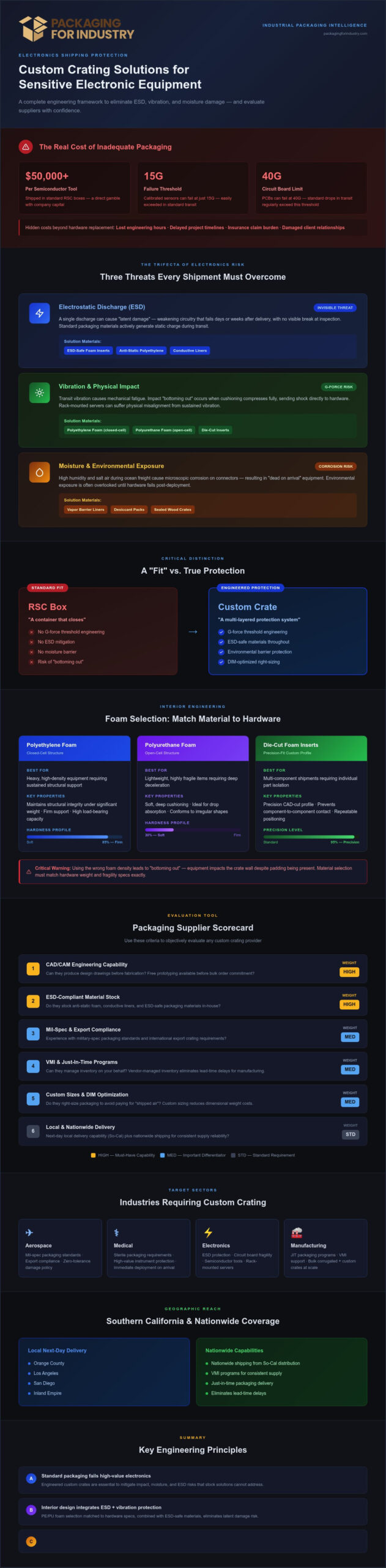
Shipping a $50,000 semiconductor tool in standard RSC boxes (Regular Slotted Containers) is a gamble with your company’s capital. While heavy-duty corrugated boxes are reliable for general warehouse needs, they often lack the structural integrity required for heavy, high-value technical assets. Custom crating solutions for sensitive electronic equipment provide a rigid outer shell and an engineered interior that stock options simply can’t replicate. In industrial logistics, there’s a critical difference between a “fit” and “protection.” A fit is just a container that closes; protection is a multi-layered system designed to absorb energy before it reaches the payload. We often utilize corner boards for edge protection in bulk shipping, but for delicate electronics, custom wood crates are necessary to meet mil-spec packaging standards. By utilizing custom design packaging, you effectively reduce damage claims while you lower packaging costs through better asset protection.
Identifying Vulnerabilities in Electronic Hardware
Electronic components often have specific fragility ratings measured in G-force thresholds. A circuit board might fail at 40G, while a calibrated sensor could be compromised at just 15G. Without custom engineering, a standard drop during transit easily exceeds these limits. Environmental threats also play a major role. High humidity or salt air during ocean freight can cause microscopic corrosion on connectors, leading to “dead on arrival” equipment. For rack-mounted servers, shock sensitivity is the maximum acceleration the hardware can withstand without suffering physical misalignment. Our custom sizes available ensure that whether you’re shipping a single server or a full rack, the container is built to handle these specific vulnerabilities.
The ROI of Engineered Crating Systems
The true cost of shipping damage extends far beyond the replacement value of the hardware. You have to account for lost engineering hours, delayed project timelines, and the administrative burden of filing insurance claims. High-performance crating reduces these risks while helping you manage your budget through dimensional weight (DIM) optimization. By right-sizing the crate, you avoid paying for “shipped air” while ensuring maximum protection. Reliable delivery builds customer trust, especially in the aerospace and medical sectors. When your equipment arrives ready for immediate deployment, you eliminate the professional stress of transit-related failures and strengthen your reputation for operational excellence. It’s a pragmatic solution that balances technical precision with fiscal responsibility.
Engineering the Interior: ESD Protection and Vibration Dampening
High-performance custom crating solutions for sensitive electronic equipment require more than just a sturdy outer shell. True security depends on an engineered interior that addresses the “trifecta” of electronics protection: ESD mitigation, physical cushioning, and environmental barrier protection. When these three layers work in unison, you eliminate the risk of latent damage. This is a specific type of electronic failure that occurs days or weeks after delivery because a discharge weakened the circuitry without causing an immediate, visible break. Implementing custom crating solutions for sensitive electronic equipment ensures that every variable, from G-force thresholds to electrostatic sensitivity, is accounted for during the design phase.
Material selection is the next critical step in safeguarding your hardware. Polyethylene foam is a closed-cell material used for heavier equipment because it maintains its structural integrity under significant weight. In contrast, polyurethane foam is an open-cell, softer material ideal for lightweight, highly fragile items that require deep deceleration during a drop. Using the wrong density leads to “bottoming out,” where the equipment hits the crate wall despite the padding. To ensure your materials match your hardware specs, you can request a packaging quote for a customized material analysis.
Custom Foam Inserts and Cushioning
Die-cut foam inserts provide a precision fit that keeps multiple components organized and immobile. This level of detail is vital for kitting, where several delicate parts must ship in a single container without colliding. For larger assemblies like server racks or medical imaging systems, we often implement floating base crate designs. These utilize shock-absorbing pallets that isolate the entire payload from transit vibrations. You can explore our full range of protective foam packaging to see how different densities and ESD ratings impact your total protection strategy.
ESD and Moisture Control Standards
Environmental control is non-negotiable for international transit or long-term storage. Vapor barrier bagging creates a hermetically sealed environment that blocks humidity and salt air, preventing corrosion on sensitive connectors. We integrate desiccants and humidity indicator cards within these seals to maintain a dry atmosphere and provide visual proof of integrity upon arrival. For electrical protection, it’s vital to distinguish between anti-static bubble wrap, which simply doesn’t generate a charge, and static shielding bags. These bags act as a Faraday cage to block external charges entirely. These integrated systems ensure full compliance with Mil-Spec standards for electronic component preservation, protecting your equipment from the factory floor to the final destination.
The Packaging Supplier Scorecard Template for Industrial Buyers
Selecting a vendor for custom crating solutions for sensitive electronic equipment shouldn’t be a matter of guesswork or lowest-bidder selection. It’s a technical procurement decision that directly impacts your operational uptime. A well-designed scorecard moves procurement from a subjective choice to a data-driven process that protects your hardware and your budget. By evaluating partners across four specific metrics, you ensure that your provider has the industrial capacity to meet your standards.
- Engineering Capability: Verify if the supplier offers CAD/CAM support and free prototyping. You need to see the design before you commit to a production run.
- Material Integration: A partner that handles wood, foam, and ESD shielding in-house reduces logistical markups and lead-time delays.
- Compliance and Certification: Confirm their current ISPM-15 status for export and their ability to meet Mil-Spec or aerospace requirements.
- Supply Chain Reliability: Assess vendors on their ability to offer Vendor Managed Inventory (VMI) or Just-in-Time (JIT) programs to optimize your warehouse space.
How to Use the Scorecard to Lower Packaging Costs
Weight your scorecard criteria based on the equipment’s value and the shipping distance. If you’re shipping a high-value asset across the ocean, engineering capability and moisture barrier expertise should carry more weight than the unit price. When you compare packaging pricing, don’t just look at the invoice total; evaluate the provider’s ability to reduce total landed costs through engineering. Finding reliable custom crating solutions for sensitive electronic equipment requires you to look at “hidden” costs like lead times and freight charges. This approach aligns with our packaging cost savings framework, which prioritizes long-term fiscal responsibility over the initial bid.
Auditing Supplier Facilities and Quality Control
A facility audit reveals if a supplier truly understands the electronics sector. Check for clean, organized foam-cutting areas and dedicated ESD-safe zones. High-quality vendors should offer integrated kitting and assembly services, allowing you to outsource the complex task of securing multi-part electronic assemblies. If a supplier doesn’t offer free prototyping or CAD design, they’re likely a box builder rather than an engineering partner. Choosing a firm that provides proactive problem-solving ensures your packaging evolves alongside your product designs, maintaining technical reliability and professional peace of mind.
Navigating Logistics: Southern California Local and Nationwide Shipping
Southern California serves as a primary hub for the global electronics and aerospace industries. Manufacturers in cities like Anaheim, Irvine, and San Diego require a logistics partner that understands the urgency of just-in-time (JIT) manufacturing. Implementing custom crating solutions for sensitive electronic equipment at the local level reduces the risks associated with long-distance transit. It’s about speed and precision. If your supplier is outside your immediate region, you’re likely dealing with unnecessary freight costs and lead-time delays that threaten your production schedules.
Local Service Advantages in Orange County and LA
Businesses in Anaheim and Irvine benefit from local next-day delivery. This is a critical advantage for high-volume distributors. This proximity allows for on-site crating services. By packaging sensitive gear at your facility, you eliminate the damage risks inherent in transporting unprotected equipment to a separate packaging house. It’s a safer way to move gear. This approach also helps reduce the carbon footprint of your packaging supply chain by cutting down on redundant transport legs. Whether you’re operating out of Los Angeles, the Inland Empire, or Orange County, local expertise ensures your equipment is ready when the production line stops.
Managing Lead Times with Vendor Managed Inventory (VMI)
Custom-sized wood crates often have complex lead times compared to standard boxes. To mitigate this, we implement VMI services that allow us to stock your specific crate designs at our local facilities. This strategy prevents production stops and frees up valuable warehouse floor space for your assembly lines. Our logistics network also supports nationwide shipping for clients with multiple US locations, maintaining consistent quality across your entire operation. For international trade, every wood crate we produce meets ISPM-15 standards for export. This heat-treatment process is mandatory for international transit, ensuring your electronics pass through customs without the risk of quarantine or costly re-packaging at the port.
The PFI Advantage: Custom Design and Prototyping for Electronics
Generic catalog vendors provide basic containers, but they lack the technical infrastructure required for high-performance hardware protection. For equipment valued at $50,000 or more, a stock box is an operational liability. Packaging For Industry (PFI) provides custom crating solutions for sensitive electronic equipment built to your specific CAD specifications. Our integrated solutions combine heavy-duty corrugated with custom wood crates to maximize protection while strictly managing your total cost of ownership. This multi-material approach ensures that every component, from delicate circuit boards to heavy power supplies, has the exact cushioning it needs. Our team maintains deep expertise in aerospace packaging, meeting rigorous Mil-Spec and defense standards that mass-market suppliers cannot navigate. We don’t just sell you a container; we provide a complete system of protection designed for industrial reliability.
From Prototype to Production: Ensuring the Perfect Fit
The value of our design model lies in the free prototype. We use CAD/CAM design to create a physical sample you can test with your actual hardware before committing to a full production run. This iterative process allows us to refine foam density and crate dimensions to ensure maximum ROI. For example, a semiconductor client recently utilized our prototyping service to address a complex shipping issue where internal components were shifting during long-haul transit. By testing a custom-engineered foam insert within a floating-base crate, we verified the solution’s effectiveness before the client finalized their procurement order. This “try before you buy” approach eliminates the professional stress of transit-related failure and ensures your packaging evolves alongside your product designs.
Ready to Protect Your Sensitive Equipment?
Choosing a consultative packaging partner means having an expert audit your entire logistical flow. We focus on the intersection of engineering and economics, ensuring your crates are as light as possible to minimize DIM weight charges without sacrificing safety. If you’re ready to secure your high-value assets, it’s time for a professional packaging review. Our specialists in Southern California are ready to help you lower packaging costs while achieving zero-damage shipping. Whether you need custom sizes available for a single high-value shipment or a VMI program for a high-volume production line, PFI has the capacity to deliver technical excellence and logistical stability.
Securing Your High-Value Logistics Strategy
Protecting technical assets requires a shift from simply buying boxes to investing in precision-engineered systems. By utilizing a rigorous supplier scorecard and prioritizing metrics like G-force thresholds and ESD shielding, you eliminate the professional stress of transit damage. Implementing custom crating solutions for sensitive electronic equipment ensures your hardware arrives ready for immediate deployment, regardless of the shipping distance or environmental conditions.
Our team provides the technical precision required for Mil-Spec and aerospace compliance, backed by free prototyping and samples to guarantee a perfect fit before you commit to a bulk order. For operations throughout Southern California, our local next-day delivery and VMI programs keep your production lines moving with maximum efficiency. You’ll lower packaging costs and improve supply reliability by choosing a partner focused on the intersection of engineering and economics.
We’re ready to help you optimize your logistics flow and achieve zero-damage shipping for your most critical gear.
Frequently Asked Questions
What is the best way to prevent ESD during shipping?
The most effective method involves a combination of static shielding bags and ESD safe foam packaging. While standard materials can generate friction based charges, specialized anti static foam prevents the buildup of electricity during transit. This integrated approach protects against latent damage, which is a common failure where components malfunction weeks after delivery. Implementing custom crating solutions for sensitive electronic equipment ensures that every layer of the package actively mitigates electrical risks for high value circuit boards.
What are the requirements for ISPM-15 export crates for electronics?
International shipping requires all wood crates to be heat treated and stamped according to ISPM-15 standards. This process ensures that the wood is free from pests that could threaten foreign ecosystems. If your electronics arrive at a port in a non compliant crate, they face quarantine or expensive re packaging fees. We ensure every custom wood crate meets these heat treatment specifications, allowing your sensitive gear to pass through international customs without logistical delays or additional costs.
How do custom foam inserts differ from standard bubble wrap for electronics?
Custom foam inserts provide engineered deceleration, whereas standard bubble wrap only offers basic surface protection. For electronics, the primary risk is bottoming out during a drop, where the item hits the container wall because the wrapping was too thin. Precision cut polyethylene or polyurethane foam is designed to absorb specific G force levels based on the item’s weight. This ensures a secure fit that prevents movement and manages vibration much more effectively than generic rolls of bubble wrap.
Can you provide custom crates for aerospace-grade sensitive equipment?
We specialize in meeting the rigorous demands of the aerospace and defense sectors. Our team utilizes CAD/CAM design to develop custom crating solutions for sensitive electronic equipment that comply with Mil-Spec standards. These engineered crates protect high value flight sensors, communication gear, and satellite components from the extreme vibrations of air and sea transport. By providing free prototyping and samples, we verify that the packaging meets all technical requirements before you move into full scale production.
How does a Vendor Managed Inventory (VMI) program work for custom crates?
A Vendor Managed Inventory program allows PFI to monitor your crate stock levels and replenish them automatically. Instead of using your warehouse floor for bulky empty crates, we stock them at our facility and deliver them as needed. This prevents production stops caused by lead time delays and improves your cash flow by only billing for what you use. It’s an efficient way to manage custom sized packaging without the administrative burden of constant re ordering from multiple suppliers.
What is the difference between anti-static and static shielding packaging?
Anti static packaging materials are treated to prevent the generation of static electricity through friction, but they don’t block external electrical fields. Static shielding bags incorporate a metallic layer that creates a Faraday cage effect. This layer actively blocks outside electrical charges from reaching the internal components. For sensitive semiconductors or microprocessors, using shielding bags is the industry standard to ensure total protection against both internal friction and external environmental electrical surges that occur during transit.
Do you offer local delivery for custom crates in Orange County?
Yes, we provide local next day delivery throughout Orange County, including Anaheim, Irvine, and Costa Mesa. Proximity to your facility is a major advantage because it allows for on site crating services and reduces the duration your sensitive gear spends in transit. Local delivery also helps you lower packaging costs by eliminating long distance freight charges. Our logistics network is optimized to support Southern California manufacturers who require just in time delivery to maintain their production schedules.
How do I calculate the G-force protection needed for my electronic device?
Calculating G force protection requires identifying the fragility rating of your device, which is the maximum acceleration it can withstand without failure. Our engineers use these specifications to determine the correct thickness and density of the protective foam. Through CAD/CAM prototyping, we simulate transit conditions to ensure the cushioning provides enough deceleration during an impact. This technical approach prevents damage by keeping the force exerted on the electronics well below their established breakage thresholds during a drop.