
If your dunnage isn’t as precisely engineered as the robots handling it, your entire automated system is destined for failure. You’ve likely seen how a single tray with inconsistent dimensions or a reflective surface can trigger a sensor error and halt an entire production line. It’s frustrating to watch high-speed transit lead to high damage rates because the packaging simply can’t keep up with the pace of modern robotics. You need reliability that matches your equipment’s sophistication to maintain a competitive edge.
Investing in custom dunnage for automated material handling systems ensures that every component is oriented perfectly for robotic grippers while eliminating the material interference that causes costly downtime. This article explains how custom-engineered foam and corrugated solutions optimize throughput and protect high-value parts during rapid movement. We’ll also discuss how vendor-managed inventory and local next-day delivery across Orange County and the Inland Empire can simplify your procurement. You’ll discover how to lower packaging costs while guaranteeing that your automated lines never stop due to a packaging shortage or a precision error.
Key Takeaways
- Learn how precision-engineered dunnage prevents robotic sensor errors and costly line stoppages caused by inconsistent stock packaging dimensions.
- Discover why Polyethylene (PE) foam is the preferred material for durability and precision in high-speed automated environments.
- Understand the importance of designing dunnage with specific robotic grip points and sensor clearance to maximize system throughput.
- See how implementing custom dunnage for automated material handling systems through a VMI program eliminates stockouts and simplifies procurement.
- Find out how free prototyping and CAD support allow you to verify product fit and robotic compatibility before committing to full-scale production.
The Critical Role of Custom Dunnage in Automated Material Handling
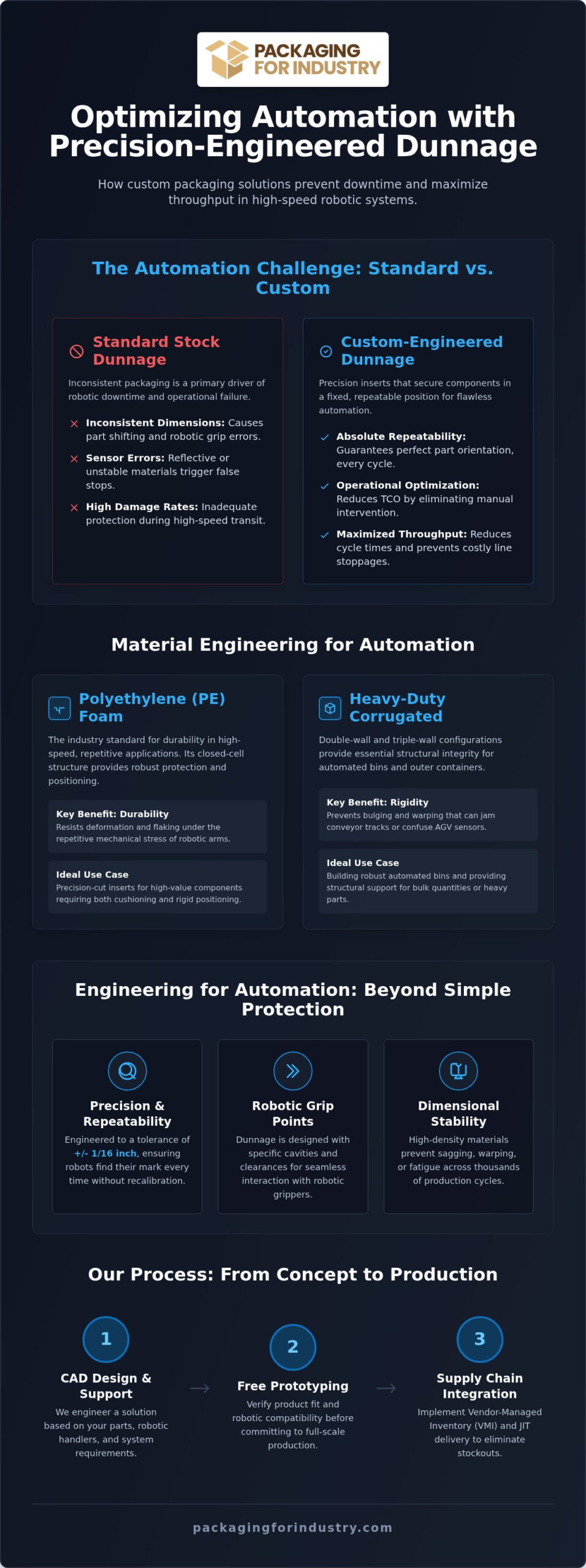
In the manual warehouse, Dunnage often meant crumpled paper or loose-fill peanuts meant to stop a product from rattling. Automated environments require a much higher standard. We define dunnage in the automated era as precision-engineered inserts that secure components in a fixed, repeatable position. Standard stock solutions often fail in these environments because they lack the rigid tolerances required by high-speed robotic sensors. Using custom dunnage for automated material handling systems ensures that every part arrives at the pick point in the exact same orientation, every time.
Inconsistent packaging is a primary driver of robotic downtime. If a part shifts just a fraction of an inch, the robotic arm might miss the grip point or trigger a safety stop. This degrades your cycle times and lowers overall throughput. By investing in custom dunnage for automated material handling systems, you reduce the Total Cost of Ownership (TCO) by eliminating manual intervention and reducing the scrap rate of damaged components. It’s a strategic shift from simple “protection” to “operational optimization.”
Repeatability: The Backbone of Automation
Robots operate on precise coordinates. A tolerance of +/- 1/16 inch is often the difference between a successful cycle and a system jam. Custom inserts must maintain their shape across thousands of cycles without sagging or warping. Dimensional stability is the ability of a material to maintain its original proportions and shape while under stress or subjected to environmental changes. We use high-density materials to prevent material fatigue, ensuring your system maintains peak efficiency throughout the shift without the need for constant recalibration.
Protecting High-Value Industrial Components
High-value sectors like aerospace packaging demand more than just cushioning. High-speed sorting systems create significant vibration that can mar precision-machined surfaces. We solve this by combining heavy-duty corrugated outer containers with protective foam packaging inserts. This hybrid approach provides the structural rigidity of a box with the delicate touch of precision-cut foam. It’s a critical requirement for manufacturers in Southern California hubs like Orange County and the Inland Empire who ship sensitive electronics or medical devices nationwide.
Material Engineering: Selecting Foam and Corrugated for Automation
Material selection is the foundation of any high-performing automated line. While basic bins provide a container, the internal protective foam packaging defines the system’s success. For custom dunnage for automated material handling systems, we prioritize materials that resist deformation under pressure. Polyethylene (PE) foam has become the industry standard for durability because its closed-cell structure withstands the repetitive mechanical stress of robotic arms. Unlike softer alternatives, PE foam won’t flake or lose its shape, which prevents sensor contamination and ensures consistent part positioning during every cycle.
When handling bulk quantities or heavy industrial components, standard boxes often fail to provide the necessary structural integrity. We utilize heavy-duty corrugated boxes, including double-wall and triple-wall configurations, to build rigid automated bins. These high-strength materials prevent the bulging effect that causes automated guided vehicles (AGVs) to misread aisle clearances or jam conveyor tracks. For manufacturers in Los Angeles or San Diego, combining these structural outer layers with precision foam inserts creates a robust solution for high-speed transit. If you’re looking to upgrade your material specifications, you can request a packaging quote to compare high-performance options.
Foam Density and Shock Absorption
Matching foam density to the specific weight of your part is a critical engineering step. Polyurethane (PU) foam is excellent for light, fragile items, but it often lacks the rigidity needed for high-speed robotic pick-and-place cycles. PE foam offers the structural integrity required for custom dunnage for automated material handling systems when handling heavier industrial loads. We use precision die-cutting to ensure a snug component fit. This eliminates part migration during rapid conveyor movements and reduces the risk of vibration-induced surface damage that occurs in high-speed sorting environments.
ESD Protection for Sensitive Electronics
Automated systems are prone to static buildup due to constant friction between parts, packaging, and conveyor belts. For electronics and semiconductor manufacturers, this poses a significant risk to component integrity. We provide specialized Anti-Static and ESD foam that dissipates electrical charges safely. These materials are often integrated with conductive corrugated partitions to create a complete static-shielding environment. This level of protection is essential for meeting the stringent standards of the medical device and aerospace industries across Southern California, ensuring that precision electronics remain functional throughout the entire logistical chain.
Engineering for Automation: Beyond Simple Protection
Traditional packaging focuses primarily on surviving the rigors of transit. However, for custom dunnage for automated material handling systems, the focus shifts to how the material interacts with machine vision and robotic end-effectors. If the dunnage geometry blocks a sensor or the material is too reflective, your entire system stops. We engineer dunnage as a functional extension of your robotics. Every tray and insert is designed to facilitate speed rather than hindering it. This ensures that your automation investment delivers the expected throughput without constant manual resets.
Weight optimization is another critical engineering factor. Every ounce of dunnage weight is an ounce of payload capacity lost on your conveyors or Autonomous Mobile Robots (AMRs). We use lightweight yet rigid polyethylene foam to minimize the tare weight of your shipping units. This allows you to stay within the load limits of your automated sorting tracks while maintaining the structural integrity needed for high-speed travel across your facility.
Vision System and Sensor Optimization
Vision systems and laser sensors are highly sensitive to light and shadow. We select non-reflective foam and corrugated surfaces to prevent the “noise” that leads to false positives and sensor errors. High-contrast dunnage colors, such as deep blue or matte black against metallic parts, allow vision systems to recognize and orient objects significantly faster. The height and angle of dunnage sidewalls must be engineered to prevent casting shadows or creating ‘blind spots’ that obstruct a sensor’s line of sight to the part. This level of precision reduces the computational load on your system, which directly translates to faster cycle times.
Ergonomics and Robotic Accessibility
Robotic grippers require specific clearance to engage with a part safely. We design “finger-wells” and robotic pockets that provide the necessary swing room for an arm to descend without colliding with the packaging walls. Tapered lead-ins are also a vital feature; they act as funnels to guide parts into place during automated assembly or kitting. This level of detail is a core component of our packaging kitting services. By precisely staging multiple components, we ensure your robots can build final assemblies without the risk of misaligned parts or mechanical interference. This engineering-first approach is what separates a simple box from a high-performance logistics tool.
Optimizing the Automated Supply Chain with VMI and JIT
Automated lines are only as fast as their slowest supply link. If you run out of custom dunnage for automated material handling systems, the entire robotic cell sits idle. This is a catastrophic failure for high-volume manufacturers because, unlike stock boxes, custom inserts can’t be sourced overnight from a generic catalog. We integrate Vendor Managed Inventory (VMI) to eliminate this risk. By monitoring your real-time usage rates and maintaining dedicated safety stock, we ensure your line never stops due to a packaging shortage. It’s about building a resilient supply chain that mirrors the precision of your floor operations.
Just-In-Time (JIT) delivery further optimizes this process. High-volume facilities often struggle with the massive physical footprint required to store bulky foam inserts and heavy-duty corrugated bins. Our stocking programs allow you to stabilize packaging costs by locking in material rates, protecting your bottom line from market volatility. This proactive approach transforms packaging from a variable expense into a predictable operational utility. By managing the flow of custom dunnage for automated material handling systems, we help you avoid the hidden costs of overstocking and the panic of understocking.
Reducing Warehouse Footprint
Every square foot of your facility should generate revenue through manufacturing, not storage. Moving your dunnage inventory from your floor to our warehouse converts expensive overhead into productive manufacturing space. For businesses in Anaheim and throughout Orange County, our local delivery capabilities mean you receive what you need exactly when you need it. This proximity allows for a much leaner operation and significantly reduces the logistical complexity of managing bulk supplies. It turns your warehouse into a high-efficiency flow zone rather than a stagnant storage area.
Procurement Simplification for Operations Managers
Operational stress often stems from the constant fear of stockouts and the subsequent scramble for emergency rush orders. VMI removes the burden of manual reordering from your team’s plate, allowing them to focus on core production goals. Scheduled replenishment improves your cash flow by ensuring you only pay for what you use, rather than sitting on months of paid-for inventory. If you’re ready to lower packaging costs through a more intelligent supply model, our managed programs provide the stability your automated environment requires. We act as a partner in your fiscal responsibility, ensuring every dollar spent on packaging contributes to system uptime.
Partnering with PFI for Custom Dunnage Solutions in Southern California
Selecting the right partner is as important as selecting the right automation hardware. At PFI, we bridge the gap between complex robotic requirements and physical protection through a specialized custom design packaging process. We start with your CAD files to ensure every dimension is accounted for before a single piece of foam is cut. By combining heavy-duty corrugated outer containers with precision-engineered inserts, we provide a unified system that handles the rigors of high-speed sorting. This integrated approach ensures your custom dunnage for automated material handling systems performs reliably across every stage of your internal logistics.
Manufacturers in Los Angeles, Orange County, and San Diego face unique logistical pressures that require more than a generic catalog supplier can offer. You need a partner that understands the specific needs of aerospace, medical, and electronics sectors. We provide a consultative experience that focuses on lowering your total operational costs rather than just selling boxes. Our team acts as a proactive “fixer,” identifying potential bottlenecks in your automated line and engineering them out of the packaging design before they cause a stoppage.
The Prototyping Advantage
Digital models are essential, but physical testing is where system failures are truly prevented. We provide free prototyping to ensure a 100% fit before you commit to a full-scale production run. This allows you to run our custom dunnage for automated material handling systems through your actual robotic cells and conveyors. You can verify sensor clearance, check grip points, and test material durability in your specific environment. Our CAD/CAM support allows for rapid iterations, meaning we can adjust designs in days rather than weeks. This eliminates the risk of a full-scale rollout failing due to a minor design oversight.
Nationwide Support and Local Delivery
Our local presence in Southern California allows us to offer next-day delivery for many of our managed inventory clients. Whether your facility is in Irvine, Carson, or San Diego, we provide the localized support needed for agile manufacturing. For companies with multiple facilities across the country, we leverage our nationwide shipping capabilities to ensure consistency across your entire automated network. This dual approach gives you the responsiveness of a local shop with the reach of a national leader. If you’re ready to optimize your automated lines and eliminate packaging-related downtime, contact us today to request a packaging quote and see how our engineered solutions can improve your throughput.
Future-Proofing Your Automated Operations
Success in the automated era requires more than just high-speed robotics; it demands a packaging partner that understands the intersection of engineering and economics. We’ve discussed how precision inserts prevent sensor errors and how high-density materials like polyethylene foam ensure the repeatability your robots require. By integrating custom dunnage for automated material handling systems into your facility, you secure both your throughput and your bottom line.
PFI provides the specialized support needed to eliminate professional stress and operational bottlenecks. Our free prototyping and CAD/CAM design services allow you to verify product fit before full-scale production. With specialized VMI programs and local next-day delivery across Southern California, we ensure your high-volume lines never sit idle. Transitioning to a managed, engineered solution is the most effective way to lower packaging costs while maintaining zero-damage transit for precision parts.
We’re ready to help you optimize your supply chain for the challenges of 2026 and beyond.
Frequently Asked Questions
What is custom dunnage and why is it used in automated systems?
Custom dunnage consists of specialized inserts designed to hold parts in a fixed, repeatable position. In automated systems, it replaces generic void fill to ensure robotic grippers can locate components at exact coordinates every time. This precision is vital for high-speed lines where manual adjustments aren’t possible. It prevents parts from shifting during rapid conveyor movement, which is a common cause of mechanical jams and system errors in modern warehouses.
How does custom dunnage help reduce robotic downtime?
It reduces downtime by ensuring dimensional consistency and sensor compatibility. When you use custom dunnage for automated material handling systems, you eliminate the variability that causes robotic sensors to trigger a safety stop. Precision-cut pockets ensure that every part is oriented correctly for the end-effector. This prevents the mispicks that force operators to manually reset the system, keeping your throughput at peak levels throughout the entire shift.
Can I get ESD-safe dunnage for automated electronics handling?
Yes, we provide specialized anti-static and ESD-safe dunnage for sensitive electronics. Automated lines generate significant static through friction, which can destroy semiconductors or medical sensors. We use conductive or dissipative foam inserts paired with static-shielding corrugated boxes to ground these charges safely. This protection is essential for electronics manufacturers in Orange County and Los Angeles who must meet stringent aerospace or medical device handling standards during high-speed transit.
How long does it take to design and prototype custom dunnage inserts?
The design process starts with your CAD files, allowing our engineering team to create a digital model quickly. We offer free prototyping to verify the fit within your actual robotic cells before you commit to production. While timelines vary based on complexity, our local Southern California presence allows us to iterate designs in just a few days. This rapid turnaround ensures you can test and validate your packaging system without delaying your rollout.
What are the benefits of a VMI program for custom packaging?
A Vendor Managed Inventory (VMI) program ensures you never run out of critical packaging supplies. We monitor your usage and maintain safety stock in our warehouse, delivering replacements just-in-time. This is particularly beneficial for custom dunnage for automated material handling systems because these items can’t be sourced instantly from a catalog. VMI also frees up valuable manufacturing floor space in your facility by moving bulk storage to our local distribution centers.
How do I choose between polyethylene and polyurethane foam for my dunnage?
Selection depends on part weight and the level of mechanical stress in your system. Polyethylene (PE) is a closed-cell, rigid foam ideal for heavy parts and high-repetition robotic handling because it maintains its shape across thousands of cycles. Polyurethane (PU) is a softer, open-cell foam better suited for very light, highly fragile components. For most automated environments, PE is the preferred choice due to its durability and resistance to flaking or deformation.
Does PFI provide custom dunnage for aerospace and medical industries?
We specialize in high-precision packaging for the aerospace, medical device, and electronics industries. These sectors require dunnage that meets rigorous cleanliness and protection standards. Our team understands how to design inserts that protect delicate surfaces from vibration while facilitating automated assembly. Whether you’re shipping flight-critical components or sensitive surgical tools, we provide integrated foam and corrugated systems that ensure zero-damage transit and full compliance with your specific industry requirements.
How can I lower my packaging costs for high-volume automated lines?
You can lower costs by optimizing material usage and implementing a managed stocking program. Many businesses find that switching from a large catalog supplier to PFI’s custom solutions reduces the total cost of ownership through lower damage rates and improved uptime. We encourage operations managers to request a packaging quote to compare pricing on high-volume runs. Managed inventory also improves your cash flow by ensuring you only pay for dunnage as you consume it.