
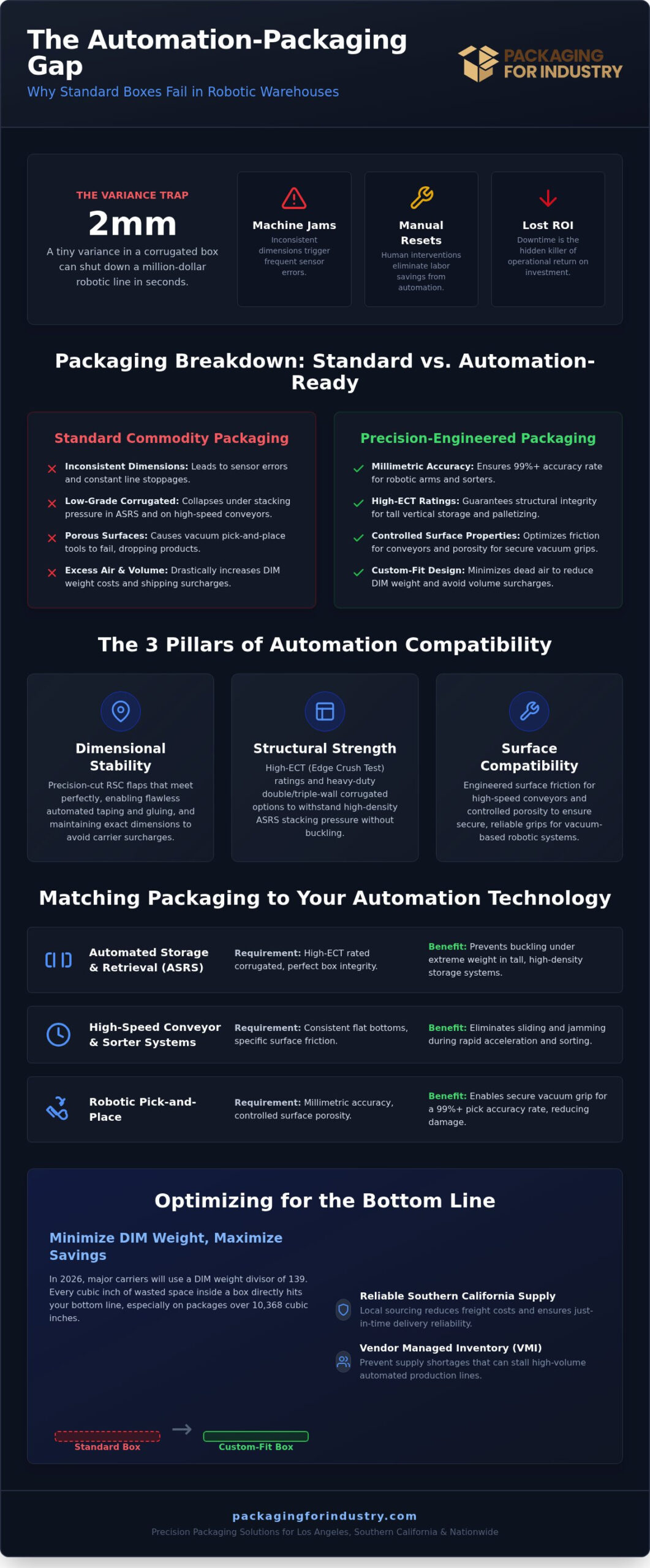
A 2mm variance in a corrugated box can shut down a million-dollar robotic line in seconds. While the global warehouse automation market is valued at over 34 billion dollars in 2026, many Los Angeles operators find their ROI stalled by frequent machine jams and manual resets. The issue isn’t usually the robotics; it’s the material. Sourcing packaging that integrates with warehouse automation Los Angeles facilities need requires a shift from commodity buying to precision engineering.
We understand the frustration of seeing an automated line grind to a halt because of inconsistent material dimensions or poor-quality corrugated. This guide provides a roadmap for selecting materials that eliminate downtime and maximize the throughput of your AS/RS and AMR systems. You’ll learn how to optimize dimensions to navigate the 2026 DIM weight divisor of 139 and how to ensure your supplies meet the latest California SB 54 mandates. We will examine the critical role of precision-engineered RSC boxes and why a reliable Southern California supply chain is the key to maintaining a truly automated workflow.
Key Takeaways
- Understand why standard corrugated variance causes robotic sensor errors and how precision-engineered materials eliminate costly machine downtime.
- Identify specific material requirements for different technologies, including high-ECT ratings for AS/RS stability and flat-bottom consistency for conveyor systems.
- Discover how sourcing packaging that integrates with warehouse automation Los Angeles directly from local manufacturers reduces freight costs and ensures delivery reliability.
- Evaluate the economic impact of custom-engineered RSC boxes and foam inserts on your total per-unit shipping costs and DIM weight optimization.
- Learn how Vendor Managed Inventory (VMI) programs prevent supply shortages that can stall high-volume automated production lines.
Why Standard Packaging Fails in Automated Warehouses
Automation-ready packaging isn’t just a box; it’s a precision component engineered for high dimensional consistency and mechanical grip. Standard corrugated often fails because it’s produced with tolerances acceptable for manual handling but disastrous for robotics. When you source packaging that integrates with warehouse automation Los Angeles facilities require, you’re prioritizing millimetric accuracy over commodity pricing. If a box isn’t built for the machine, the machine won’t work for you.
The “Variance Trap” is the most common cause of system failure. A mere 1/8th inch difference in flap height or box width can trigger robotic sensor errors, leading to false positives that halt production. Every time a human has to clear a jam, the labor savings promised by automation vanish. These manual interventions are the hidden killers of operational ROI. Beyond dimensions, material fatigue plays a critical role. Low-grade corrugated may seem cost-effective, but it often collapses under the tension of high-speed conveyor belts or the weight of stacked units in Automated Storage and Retrieval Systems (ASRS).
The Impact of Dimensional Weight (DIM) on Automation
Modern automated sorters calculate shipping costs instantly based on exterior dimensions. In 2026, with major carriers using a DIM weight divisor of 139, excess air inside a box is a direct hit to your bottom line. Precision custom design packaging reduces this dead air, ensuring boxes remain stable on high-speed lines while avoiding cubic volume surcharges that trigger at 10,368 cubic inches. Standardizing your box sizes also allows for optimized robotic palletizing patterns, which prevents shifting during transit.
Mechanical Compatibility: Grip, Slip, and Suction
Robots interact with packaging through friction and vacuum pressure. High-speed belt conveyors require specific surface friction to prevent sliding during rapid acceleration. Conversely, vacuum pick-and-place tools rely on the porosity of the corrugated board. Economy boxes often fail the suction test because their liners are too porous, preventing the vacuum from maintaining a secure grip. This leads to dropped products and increased damage rates. Investing in packaging that integrates with warehouse automation Los Angeles operations depend on ensures your materials have the structural integrity to withstand vacuum pressure without delaminating or losing grip during the fulfillment cycle.
Key Features of Packaging That Integrates With Warehouse Automation
Successful implementation of packaging that integrates with warehouse automation Los Angeles facilities deploy depends on three pillars: dimensional stability, structural strength, and surface compatibility. While standard boxes rely on tape to mask inconsistencies, automation-grade Regular Slotted Cartons (RSC) require precision-cut flaps that meet perfectly every time. If flaps overlap or leave a gap, automated taping heads and glue systems often fail. This causes downstream bottlenecks in the fulfillment cycle. Precision-cut RSCs also help maintain the exact exterior dimensions needed to avoid cubic volume surcharges, which apply to packages exceeding 10,368 cubic inches under 2026 carrier rules.
Structural integrity is equally vital. High-ECT (Edge Crush Test) ratings are non-negotiable for units stored in high-density rack systems. As warehouses move toward taller vertical storage to optimize Los Angeles real estate, the bottom boxes must withstand significant pressure without buckling. For high-volume palletizing, we recommend automation-grade stretch film. This material offers high pre-stretch capabilities, allowing machines to apply maximum load tension without the film snapping, which is a common failure point for economy alternatives.
Custom Corrugated: Beyond the Standard Box
Industrial applications often require more than a single-wall container. We provide heavy-duty double and triple-wall corrugated options for manufacturers moving heavy aerospace or automotive components. Our CAD/CAM-driven die-cutting ensures every box is an exact clone of the prototype. This level of repeatability is what allows robotic arms to maintain a 99% accuracy rate. When sourcing packaging that integrates with warehouse automation Los Angeles manufacturers must also consider the environment. For temperature-controlled zones, we apply moisture-resistant coatings to prevent the corrugated from softening in high-humidity or cold-storage areas.
Protective Foam Inserts for Robotic Lines
Robotic kitting requires inserts that don’t just protect the product but also assist the machine. We engineer foam density to match the specific pressure of your robotic grippers. If the foam is too soft, the arm may crush the insert; too hard, and the sensor might register an obstruction. For electronics manufacturers, we provide anti-static (ESD) foam to prevent discharge during high-speed assembly. If you’re looking to streamline your intake, you can request a packaging quote for pre-assembled kitting solutions that arrive ready for your automated line.
Comparing Packaging Materials for Different Automation Technologies
Choosing packaging that integrates with warehouse automation Los Angeles facilities deploy requires a technical understanding of how different machines interact with physical materials. A box that performs well at a manual station may fail when subjected to the rapid acceleration of a high-speed sorter. Because different automation technologies place unique stresses on containers, selecting the right material is essential to prevent system errors and lower packaging costs across your entire operation.
Conveyor systems rely on surface friction and flat-bottom stability to maintain throughput. If a container has a rounded or uneven base, it won’t track correctly on rollers, leading to misaligned scans or physical jams at transfer points. The exterior liner must have enough “bite” to handle belt inclines without sliding backward. In contrast, Automated Storage and Retrieval Systems (ASRS) prioritize vertical integrity. Because these systems often utilize high-density racking, the containers must exhibit minimal deflection. Even a slight bulge can cause a box to snag on the retrieval carriage, resulting in a system-wide shutdown that requires manual intervention to clear.
Robotic palletizers and automated bagging lines have their own material requirements. Palletizers need rigid RSC boxes that maintain their structural squareness during high-speed pick-and-place movements. If the corrugated is too soft, the robotic gripper may deform the box, creating an unstable pallet stack. For automated bagging, the slip-factor (Coefficient of Friction) of the film is the most critical metric. If the film is too tacky, it won’t feed through the rollers; if it’s too thin, it will tear during high-speed filling. With custom sizes available for every application, we ensure the material matches the specific mechanical limits of your hardware.
Load Stabilization with Machine Stretch Film
Machine-grade stretch film is the standard for high-volume automated lines because it provides consistent containment force that hand-wrapping can’t match. This film is engineered to handle pre-stretch levels of 250% or more, which maximizes material yield and lowers your overall spend. High-performance film ensures that loads remain stable when Autonomous Mobile Robots (AMRs) execute sharp turns. You can explore our high-performance stretch film options to find the right gauge for your specific turntable or orbital wrapper.
Corner Boards in High-Density Storage
Automated racking environments require perfect pallet geometry to ensure retrieval forks engage safely every time. We recommend using heavy-duty corner boards to protect the edges of your loads from strap-crush and to provide additional vertical stacking strength. These components act as a rigid skeleton for the pallet, preventing the shifting that often triggers sensor errors in ASRS environments. Our custom corner boards and edge protection solutions are designed to maintain the precise footprints required by robotic arm reach-envelopes.
Sourcing Automation-Ready Packaging in Los Angeles
Strategic sourcing for packaging that integrates with warehouse automation Los Angeles operations depend on requires a partner with a deep Southern California footprint. While Los Angeles remains the central hub, the massive distribution centers in the Inland Empire and the specialized manufacturing labs in San Diego have unique logistical needs. Freight expenses from national catalog suppliers often negate the efficiency gains of a new robotic system. Sourcing locally allows you to lower packaging costs by eliminating long-haul shipping fees and reducing the lead times that can stall a high-speed facility.
Our proximity to major industrial zones like Carson, Torrance, and Santa Fe Springs ensures that custom prototypes arrive for testing within days, not weeks. When fine-tuning a robotic arm’s reach or a conveyor’s sensor sensitivity, immediate access to physical samples is critical. We have custom sizes available for any hardware configuration, allowing engineers in San Diego’s aerospace sector or Orange County’s medical device industry to iterate quickly. This local agility prevents the implementation delays that often plague large-scale automation rollouts in the region.
Vendor Managed Inventory (VMI) for Automation
High-volume automated facilities can’t afford a stockout. A missing pallet of corrugated or a shortage of foam inserts can bring an entire Inland Empire fulfillment center to a standstill. Our VMI programs utilize automated replenishment to maintain your safety stock levels without manual oversight. By utilizing our local warehousing, you free up premium Los Angeles floor space for additional hardware or revenue-generating inventory. Learn about our VMI services to see how we provide a shortage-free supply chain for your automated lines.
Just-In-Time (JIT) Delivery for High-Volume Sites
Efficiency in 2026 is measured by how well you manage your cash flow and floor space. Our JIT programs coordinate the arrival of bulky materials like heavy-duty crates or custom foam with your actual production schedule. This is vital for facilities across San Diego and the Inland Empire that operate on tight timelines. We manage the inventory of long lead-time items so they’re ready for next-day delivery when your system triggers an order. Just-in-time inventory management ensures your automated systems stay fed without the clutter of excess on-site stock.
How Packaging For Industry Optimizes Your Automation ROI
Maximizing the fiscal efficiency of a warehouse investment requires a transition from purchasing commodities to securing engineered components. Packaging For Industry (PFI) provides the packaging that integrates with warehouse automation Los Angeles facilities need to turn theoretical throughput into actual profit. We go beyond the physical container to analyze how material performance impacts your total operational expenditure. By aligning material specs with machine capabilities, we help you eliminate the hidden costs of system downtime.
When you compare packaging pricing between PFI and national catalog suppliers, the unit cost is only one part of the equation. We help you lower packaging costs by identifying where sub-standard materials are causing micro-stoppages and expensive return cycles. Our team provides an end-to-end partnership that begins with technical design and extends through recurring VMI supply, ensuring your automation ROI isn’t eroded by supply chain unreliability. This pragmatic approach focuses on tangible results, from reduced labor intervention to optimized shipping volumes.
Custom Design and Prototyping
We utilize CAD/CAM support to ensure every insert and RSC box is an exact match for your robotic grippers and sensors. This precision prevents the variance traps where minor millimetric errors trigger system-wide resets. With custom sizes available for any hardware configuration, we provide the flexibility to scale your automation without compromising on material fit. You can request a packaging quote to begin the prototyping phase for your specific equipment and validate performance before you commit to bulk quantities.
Aerospace and Medical Device Specialization
Southern California’s specialized manufacturing sectors require a higher tier of accountability and precision. We provide mil-spec and cleanroom-ready solutions that meet the strict tolerances of automated assembly lines in the medical and aerospace fields. These high-precision industries can’t afford the debris or structural failures common with economy-grade corrugated. Our aerospace packaging solutions are engineered to withstand the extreme handling forces of automated hubs while maintaining total product integrity and regulatory compliance.
Securing Your Automation ROI Through Material Precision
Precision in your supply chain is the final piece of the automation puzzle. By prioritizing dimensional consistency and material integrity, you eliminate the mechanical variances that lead to costly machine jams and manual resets. Sourcing packaging that integrates with warehouse automation Los Angeles facilities depend on ensures that your robotic arms, conveyors, and ASRS units operate at peak efficiency. It’s the difference between a high-speed workflow and a line that requires constant human intervention.
Partnering with a local Southern California supplier provides the agility needed for high-volume production. We offer custom CAD/CAM prototyping to validate every design against your specific hardware before full production runs begin. Our specialized VMI programs and local next-day delivery across Orange County and Los Angeles ensure your lines never stop due to a supply shortage. This proactive approach protects your capital investment and lowers your total per-unit shipping costs through optimized DIM weight and reduced damage. We provide the engineering-minded support you need to maintain a truly autonomous fulfillment cycle.
We’re ready to help you stabilize your automated workflows and achieve the long-term reliability your operation demands.
Frequently Asked Questions
What is automation-ready packaging?
Automation-ready packaging refers to materials engineered with strict dimensional tolerances and specific surface properties for mechanical handling. Unlike standard corrugated, these products emphasize millimetric consistency to prevent sensor errors. This category includes precision-cut RSC boxes and custom foam inserts designed to interface with robotic grippers. When sourcing packaging that integrates with warehouse automation Los Angeles facilities require, the focus shifts from simple containment to ensuring seamless interaction with high-speed sorters and retrieval systems.
How do I prevent my robotic arm from dropping boxes?
Dropping boxes usually results from inconsistent vacuum suction or incorrect surface friction. You should verify the porosity of your corrugated liners; if they’re too porous, vacuum pick-and-place tools can’t maintain a secure grip. We also analyze the weight distribution of your product. Custom-engineered foam inserts ensure the center of gravity remains constant, allowing robotic grippers to apply uniform pressure without the box shifting or slipping during high-speed movement cycles.
Does custom packaging for automation cost more than stock boxes?
Custom packaging often has a higher unit price than stock boxes, but it significantly reduces your total operating costs. Precision engineering eliminates the expenses associated with machine downtime, manual intervention, and shipping damage. Additionally, custom sizes allow you to optimize DIM weight, which helps you avoid cubic volume surcharges under current carrier rules. When you compare packaging pricing, you must factor in the ROI gained from increased throughput and reduced labor expenses.
What is the best stretch film for automated pallet wrappers?
The best choice is a high-performance, machine-grade stretch film with high pre-stretch capabilities. This material is designed to be stretched by 250% or more by the machine without snapping. Consistency is vital for automated wrappers to maintain the necessary load-holding force. Using the correct film prevents load-shifting during high-speed transport by Autonomous Mobile Robots (AMRs) and ensures your pallets meet the strict vertical stability requirements of high-density storage racks.
How can I reduce machine jams on my conveyor system?
Reducing machine jams requires eliminating dimensional variance and ensuring flat-bottom stability. Boxes with bulging bottoms or uneven flaps often snag on conveyor rollers or trigger optical sensor errors. Standardizing your box dimensions and using high-ECT corrugated helps the package maintain its shape under tension. Sourcing packaging that integrates with warehouse automation Los Angeles operations depend on ensures that every box is an exact clone of the prototype, which minimizes mechanical interference and jams.
Can PFI help design packaging for a new AS/RS system in Los Angeles?
Yes, our engineering team provides full CAD/CAM support to design packaging specifically for your AS/RS hardware. We focus on vertical stacking strength and minimizing box deflection to ensure your retrieval carriages can engage pallets without obstruction. Our local Los Angeles presence allows us to provide rapid prototyping and on-site testing. This ensures your custom corrugated and foam solutions meet the strict tolerances of your new automated storage and retrieval system.
What are the lead times for custom die-cut boxes in Southern California?
Lead times for custom die-cut boxes vary based on complexity, but our local manufacturing capabilities allow for significantly faster turnarounds than national catalog suppliers. We prioritize agility for our Southern California partners to support rapid implementation phases. For recurring high-volume production, we coordinate delivery through our Just-In-Time programs. This local proximity means you can move from the initial prototype to a full production run without the transit delays common with out-of-state vendors.
Do you offer stocking programs for high-volume automated facilities?
We provide specialized Vendor Managed Inventory (VMI) programs tailored for high-volume automated facilities in Los Angeles and Orange County. These programs use automated replenishment to maintain your safety stock levels, ensuring your lines never stop due to a supply shortage. By stocking your custom-sized boxes and foam inserts in our local facilities, you can free up valuable floor space on-site. We also offer local next-day delivery to keep your operation running at peak efficiency.