
If your rental fleet’s damage repair costs are consuming up to 7% of your operational budget, you aren’t just losing equipment; you’re losing the narrow margins that keep your business profitable. Professional fleet managers know that the moment a high-value asset leaves the warehouse, it’s at the mercy of the carrier. It’s frustrating to receive a returned kit only to find a critical component missing or a precision tool shattered because it shifted during transit. You expect your gear to arrive in the same condition it left, but the reality of industrial logistics often tells a different story.
Investing in custom foam case inserts for rental equipment fleets is the most effective way to reduce shipping damage and ensure your assets remain in peak condition. This article explains how engineered foam inserts protect high-value assets and streamline inventory management. You’ll learn how to lower total operational costs by utilizing local packaging delivery and specialized packaging for manufacturers/warehouses/distribution centers. We will preview the financial benefits of custom engineering, the importance of material memory, and how to request a quote for your entire fleet rollout.
Key Takeaways
- Calculate the total cost of ownership by identifying how engineered inserts mitigate the expense of repairs and shipping damage.
- Understand the technical differences between polyethylene and polyurethane foam to ensure protection survives high-frequency rental cycles.
- Discover why custom foam case inserts for rental equipment fleets outperform standard pluck-and-pull options in durability and professional presentation.
- Implement “shadow boarding” techniques to enable instant visual inventory checks and prevent missing components in returned kits.
- Learn how to lower packaging costs by utilizing bulk pricing and PFI’s local next-day delivery across Southern California.
The Financial Impact of Transit Damage on Rental Fleets
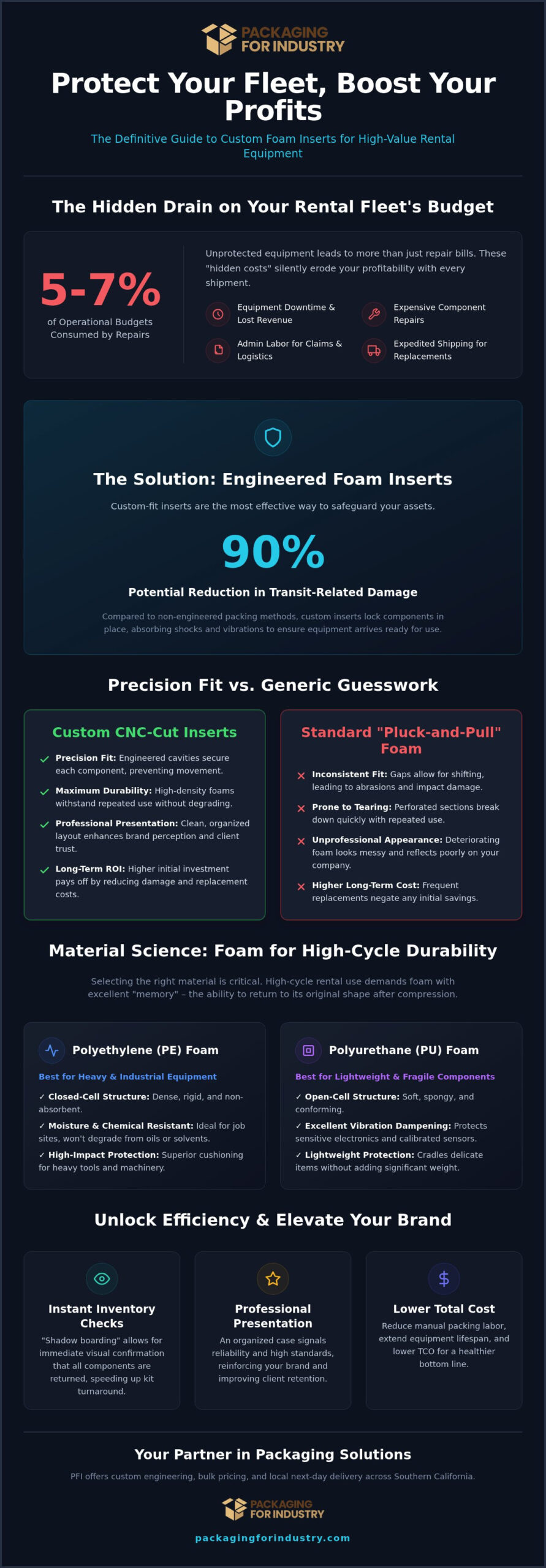
In the high-stakes world of industrial rentals, custom foam case inserts for rental equipment fleets serve as more than just a buffer; they are a precision-engineered safeguard for your most valuable assets. When equipment is constantly in motion between job sites, it faces a gauntlet of vibrations, drops, and improper handling. Standard padding often fails to address these specific stresses. By contrast, engineered inserts are designed to lock components in place, ensuring that precision instruments and heavy-duty tools arrive ready for immediate use. Industry data suggests that implementing custom inserts can reduce transit-related damage rates by up to 90% compared to non-engineered packing methods.
The “hidden costs” of transit damage are often what erode a rental house’s profitability. These expenses go far beyond the immediate repair bill. Consider the logistical nightmare of expedited shipping for replacement parts, the administrative labor required to process damage claims, and the significant revenue lost during “dead days” when an asset is out of service. For construction equipment fleets, repair costs can average 5-7% of total operational expenses. Protecting these margins requires a move away from generic, disposable packaging toward durable, long-term solutions.
Calculating Total Cost of Ownership (TCO)
To lower packaging costs, decision-makers must evaluate the total cost of ownership rather than just the unit price of the foam. Superior vibration dampening, rooted in the principles of package cushioning, significantly extends the lifespan of sensitive electronics and mechanical components. Using custom inserts also eliminates the need for warehouse staff to spend hours on manual bubble wrapping or using loose-fill materials. This reduction in labor, combined with the potential for lower insurance premiums by meeting professional packing standards, creates a clear path to improved ROI. For businesses in Southern California, PFI provides local next-day delivery across Anaheim, Irvine, and Los Angeles, ensuring your fleet stays protected without the wait.
Presentation as a Competitive Advantage
The first interaction a client has with your brand often occurs when they open the equipment case. In a B2B environment, an organized layout signals reliability and high maintenance standards. When you request a packaging quote for custom foam packaging, you’re also investing in client retention. A professional presentation suggests that the equipment inside has been handled with the same level of care. Additionally, custom-cut foam offers branding opportunities, such as integrated logos, which reinforce your company’s identity every time the gear is deployed in the field. This attention to detail differentiates your fleet from competitors who rely on disorganized or deteriorating foam solutions.
Selecting the Best Foam Material for High-Cycle Rental Use
Rental equipment isn’t just shipped once; it’s shipped dozens of times a year. This high-cycle environment demands materials with excellent memory, which is the ability of the foam to return to its original shape after being compressed. If the foam loses its structure, the equipment shifts. This leads to the transit damage and disorganized kits mentioned earlier. Selecting the right material for custom foam case inserts for rental equipment fleets is a balance of engineering requirements and long-term fiscal responsibility.
The choice of foam also depends on the environmental conditions your fleet will encounter. If your gear is used in humid environments or exposed to industrial fluids, your packaging must be chemically stable. Choosing the wrong material can lead to premature failure of the insert, forcing you to replace it long before the case or the equipment wears out. It’s often more cost-effective to invest in higher-grade materials upfront than to deal with the logistics of frequent replacements.
Closed-Cell vs. Open-Cell Foam for Fleets
Polyethylene (PE) is the industry standard for heavy industrial equipment and tools. It’s a closed-cell foam, which means it’s dense, rigid, and naturally resistant to moisture and chemicals. It won’t absorb oils or cleaning solvents often found on construction or manufacturing sites. For lightweight, highly fragile components like calibrated sensors or optics, Polyurethane (PU) is often the superior choice. It’s an open-cell foam that provides a softer ride for delicate items. When aesthetic finish and long-term durability are top priorities, cross-linked polyethylene offers a smooth, non-abrasive surface that doesn’t shed or scratch sensitive finishes. You can compare custom foam packaging specifications to find the right density for your specific fleet volume.
Specialized Foam Additives
Modern rental fleets often carry sensitive electronics or medical devices that require specialized protection. Anti-static (ESD) foam is essential for semiconductor and aerospace components. It dissipates static charges that could fry internal circuitry. These materials are typically color-coded so warehouse staff can easily identify the correct protective level. Fire-retardant foam may also be necessary for specific regulatory compliance in certain industrial sectors. Beyond impact protection, you must consider the physical environment of the job site. If your gear is used outdoors, closed-cell PE is non-negotiable. It doesn’t harbor mold or degrade when wet, which helps you maintain a professional presentation to your clients.
To ensure your material choice aligns with your operational goals and helps you reduce shipping damage, you should consult with an experienced supplier. Our Anaheim-based engineering team can help you select the exact density and additive profile required for your high-value assets. Before you finalize your fleet specifications, request a packaging quote to review the most durable material options for your application.
Custom CNC-Cut Inserts vs. Standard Off-the-Shelf Foam
Many fleet managers start with “pick-and-pluck” foam because it’s cheap and immediate. However, for professional custom foam case inserts for rental equipment fleets, these DIY options are a liability. They lack the structural integrity needed for the heavy-duty cycles of the rental industry. While DIY might work for a one-off hobbyist case, it fails to meet the standards of an industrial warehouse or aerospace fulfillment center. Choosing an engineered solution isn’t just about protection; it’s about avoiding the recurring cost of replacing failed padding.
The Failure of Pick-and-Pluck Foam
The most significant issue with standard off-the-shelf foam is its rapid degradation. Because the material is pre-scored into small cubes, the remaining “walls” are inherently weak. After just 10 to 15 rental cycles, these cubes begin to tear and crumble. This creates a “mess factor” where foam debris migrates into sensitive equipment ports or lens assemblies, potentially causing mechanical failure. Standard foam also doesn’t provide the lateral support needed for heavy tools. This allows equipment to shift and collide with the case walls during transit, negating the purpose of the packaging entirely.
The Engineering Advantage of CNC Cutting
CNC routing allows for a zero-clearance fit that “pick-and-pluck” simply cannot replicate. By using precision measurements, we create cavities that match the exact geometry of your assets. This maximizes shock absorption by distributing force across the entire surface area of the equipment. Unlike die-cutting, which requires expensive tooling and is best for simple shapes, CNC routing handles complex geometries and varying depths with ease. Our custom design services include free prototyping to verify this fit before you commit to a full production run.
For fleets of 50 cases or more, the cost-benefit analysis heavily favors custom engineering. Beyond durability, CNC cutting allows for multi-layer, tiered layouts. This kitting strategy lets you fit more accessories into a smaller footprint. By optimizing the case and box sizing, you can significantly reduce your dimensional weight shipping costs. This is a critical factor in lowering packaging costs across a large-scale operation. If you’re managing a growing fleet in Anaheim or Los Angeles, our local engineering support ensures your designs are optimized for both protection and logistics efficiency.
Stop settling for crumbling foam that puts your high-value assets at risk. When you request a packaging quote, we’ll help you compare the long-term savings of CNC-cut inserts against the hidden costs of standard foam failure.
Engineering Inserts for Inventory Management and Rapid Turnaround
Asset protection is only half the battle for a successful rental operation. If your warehouse team spends thirty minutes checking every returned kit for missing screws, cables, or accessories, your labor costs will eventually outpace your rental margins. custom foam case inserts for rental equipment fleets solve this operational bottleneck by turning every case into its own inventory management system. By engineering the layout to be intuitive, you reduce the cognitive load on your staff and ensure that every asset is ready for its next deployment in record time.
Designing for “kitting” is a strategic way to improve client satisfaction while protecting your bottom line. When you group primary assets with their necessary accessories in a logical, tiered layout, you minimize the risk of a client arriving at a job site with an incomplete setup. This proactive approach to warehouse packaging and logistics prevents costly service calls and emergency shipping fees. It also streamlines the kitting process for your team, allowing for faster order fulfillment and improved supply reliability.
Implementing Shadow Boarding in Case Design
Shadow boarding is a visual management technique that uses contrasting foam colors to highlight missing items instantly. By using a dark top layer of polyethylene foam over a bright red or yellow base layer, any empty slot becomes immediately obvious. This visual cue allows warehouse technicians to perform a full inventory check in seconds rather than minutes. We also integrate ergonomic features like finger wells and pull tabs into the CNC design. These small details ensure that even heavy or tightly fitted equipment can be removed safely without damaging the foam or the asset. Standardizing these layouts across different case brands in your fleet ensures a consistent workflow for your technicians, regardless of the outer container used.
Optimizing the Rental Return Process
The return phase is where most rental houses lose money through unbilled losses. Manual equipment checklists are prone to human error, especially during peak periods. High-visibility custom foam case inserts for rental equipment fleets make it impossible to overlook a missing component. This accuracy allows your billing department to charge for lost accessories immediately, rather than discovering the loss weeks later when the kit is next needed. Reducing the labor hours spent on manual inspections directly impacts your ROI. For fleets operating in Anaheim, Irvine, or Los Angeles, PFI’s local engineering support can help you design these high-efficiency layouts to match your specific operational flow.
Request a Custom Foam Quote: PFI’s Local Engineering and VMI Solutions
Selecting the right materials and engineering is only half of the equation; the other half is ensuring a reliable, recurring supply. If you are searching for a dependable packaging supplier near me in Southern California, Packaging For Industry (PFI) offers the infrastructure to support large-scale fleet deployments. We don’t just provide inserts; we offer integrated solutions that simplify your entire procurement process. If your fleet requires a corrugated box quote for heavy-duty shipping containers or a stretch film quote for palletized transport, our team can bundle these needs into a single, cost-effective program. This holistic approach ensures that every layer of your packaging works together to reduce shipping damage and lower your total operational costs.
VMI Programs for Fleet Managers
Managing recurring packaging needs shouldn’t consume your warehouse floor space or your team’s administrative time. Our VMI services allow fleet managers to maintain optimal stock levels without the burden of over-purchasing. We monitor your usage and provide planned replenishment for your custom foam case inserts for rental equipment fleets, ensuring that a replacement is always ready when a case is damaged or retired from the field. This just-in-time approach reduces capital tied up in inventory and eliminates the risk of stockouts during peak rental seasons. By offloading inventory management to us, your purchasing team can focus on higher-level operations while we handle the logistics of your protective packaging supply.
Local Support in Southern California
Proximity matters when you need rapid prototyping and on-site reviews to identify cost-saving opportunities. Based in Anaheim, PFI provides local engineering support that national catalog suppliers simply cannot match. We offer free prototyping to ensure every component fits perfectly before you commit to a full fleet rollout. This local focus allows us to offer next-day delivery across Orange County, Los Angeles, and the Inland Empire, as well as San Diego and Riverside. By working with a local partner, you reduce lead times and improve your overall supply reliability. Our engineering team can even perform on-site audits of your current packing process to find ways to reduce material waste and optimize your shipping dimensions.
Maximize Your Asset Lifecycle and Operational Efficiency
Managing a high-value rental fleet requires a shift from viewing packaging as a consumable to seeing it as a strategic asset. By implementing custom foam case inserts for rental equipment fleets, you directly address the hidden costs of transit damage and disorganized kits. High-performance materials like polyethylene and polyurethane ensure your gear survives dozens of rental cycles while maintaining a professional presentation that builds client trust.
Our Anaheim-based team specializes in engineering solutions for complex aerospace and medical gear, ensuring a zero-clearance fit through CNC precision. We eliminate the guesswork with free prototyping and support your ongoing operations through local next-day delivery across Orange County, Los Angeles, and the Inland Empire. These efficiencies don’t just protect your equipment; they streamline your warehouse workflow and improve your total ROI. It’s time to replace crumbling, standard foam with a solution that works as hard as your fleet does.
Take the next step toward a more reliable and cost-effective fleet management system. We’re ready to help you build a more durable future for your assets.
Frequently Asked Questions
What is the best foam for heavy rental equipment?
Polyethylene (PE) is the industry standard for protecting heavy industrial equipment and tools. This closed-cell foam offers high density and rigidity, ensuring heavy assets don’t bottom out or shift during transit. Unlike softer materials, PE is resistant to oils, chemicals, and moisture, making it ideal for construction and manufacturing environments. We often recommend specific densities based on your equipment’s weight to maximize shock absorption and long-term durability.
How do custom foam inserts help with inventory control?
Custom foam case inserts for rental equipment fleets utilize a visual management technique known as shadow boarding. By using contrasting foam colors, such as a black top layer over a bright red base, warehouse technicians can identify missing components in seconds. This layout ensures that every accessory has a dedicated, CNC-cut slot. It simplifies the kitting process and allows your team to perform instant visual inventory checks before and after every rental deployment.
Can you design foam inserts for existing Pelican or SKB cases?
We design precision-engineered foam inserts for all major case brands, including Pelican, SKB, and Seahorse. Our engineering team utilizes CAD/CAM support to ensure a zero-clearance fit within your existing containers. With custom sizes available for any equipment geometry, we can customize the internal layout to optimize space and protection. This allows you to upgrade your asset protection without the cost of replacing your outer cases or shipping containers.
What is the lead time for custom foam prototypes in Southern California?
We provide fast turnaround for custom foam prototypes from our Anaheim headquarters. While specific timelines depend on design complexity, our Southern California location allows us to offer local next-day delivery across Orange County and Los Angeles once the design is finalized. This local presence ensures you can verify the product fit and protection levels quickly, preventing delays in your fleet deployment or warehouse operations.
How much can custom foam inserts lower my equipment repair costs?
While exact savings vary by industry, engineered foam solutions can reduce transit-related damage by up to 90%. When you compare packaging pricing between standard foam and custom inserts, the ROI becomes clear through reduced dead days and fewer asset replacements. For construction equipment fleets, repair costs typically average 5% to 7% of operational expenses. Protecting these margins requires moving away from generic solutions toward durable, fleet-wide protection.
Do you offer anti-static foam for rental electronics?
Yes, we specialize in anti-static and ESD foam for sensitive rental electronics and semiconductor components. These materials are engineered to dissipate static charges that could damage internal circuitry during handling or transport. We often combine ESD foam with other protective materials to create an integrated solution for aerospace or medical device fleets. This ensures your high-tech assets remain compliant with safety standards and operational upon arrival at the job site.
What information do I need to provide for a custom foam quote?
To provide an accurate custom packaging quote, we need the interior dimensions of your cases and a list of the components you intend to kit. Providing physical equipment or CAD files allows our designers to create a zero-clearance fit. You should also specify the equipment weight and any environmental requirements, such as moisture resistance or ESD protection. This information helps us recommend the best foam density and layout for your specific fleet volume.
Is there a minimum order quantity for custom fleet inserts?
We focus on industrial, manufacturing, and warehouse clients with recurring fleet needs rather than one-off residential purchases. While we don’t have a rigid minimum, our pricing is optimized for bulk packaging pricing and fleet-scale orders. We specialize in supporting companies that require consistent, repeat supply for their rental assets. For larger fleets, our Vendor Managed Inventory (VMI) programs can further lower packaging costs by managing replenishment based on your actual usage.