
The most expensive failure in your supply chain isn’t a broken screen; it’s the microscopic ESD damage that passes initial quality control but fails once it reaches your customer. These latent failures often stem from a misunderstanding of how static truly behaves within a shipping container. If you are sourcing custom foam inserts for electronics packaging Southern California manufacturers rely on, you know that basic cushioning isn’t enough to protect high-value sensors or circuit boards. You need a precision-engineered system that manages surface resistivity and prevents electrostatic discharge from ever reaching sensitive components.
We recognize the frustration of high scrap rates during assembly and the confusion that often surrounds anti-static versus conductive terminology. It’s vital to have a packaging strategy that ensures zero ESD-related field returns while maintaining full compliance with strict MIL-SPEC standards. This article explains how to design integrated ESD systems that eliminate latent failures and significantly reduce your total replacement costs. We’ll examine the specific material science behind dissipative foams and how localized, bulk packaging solutions can improve your bottom line and overall supply chain reliability.
Key Takeaways
- Identify the “silent killer” of micro-circuitry by distinguishing between immediate catastrophic failure and the latent damage that leads to expensive field returns.
- Navigate the resistivity scale to choose between conductive and dissipative materials that offer measurable protection rather than just generic anti-static properties.
- Engineer a complete protective system with custom foam inserts for electronics packaging Southern California electronics firms rely on to shield sensitive components from external fields.
- Apply design best practices to eliminate the air gaps that cause friction-based charging and ensure material compatibility to prevent sensor-damaging outgassing.
- Partner with local specialists to access free prototyping and custom-cut ESD solutions that guarantee compliance with MIL-SPEC standards and aerospace requirements.
The High Cost of Static: Why ESD Packaging Design Matters
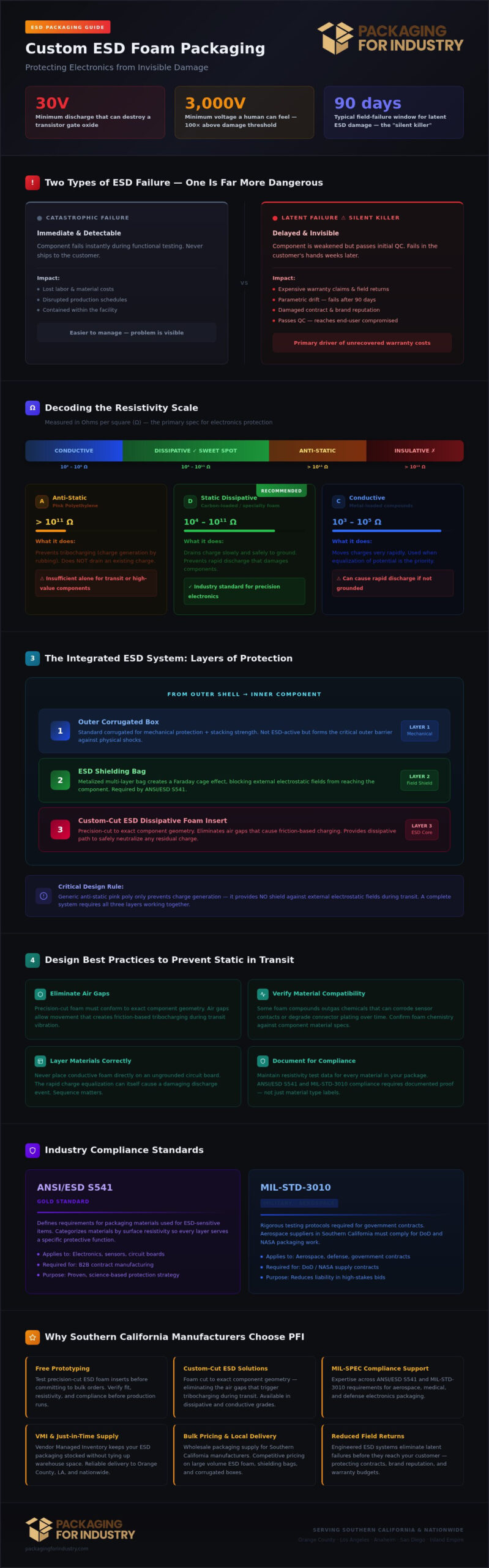
Static electricity is often dismissed as a minor shipping nuisance, but for high-value electronics manufacturers, it represents a significant financial liability. Modern micro-circuitry is increasingly dense and sensitive. A discharge as low as 30V can puncture the gate oxide of a transistor, rendering a complex board useless. This is a staggering reality when you consider that a human being cannot even feel a static shock until it reaches approximately 3,000V. When procurement teams evaluate custom foam inserts for electronics packaging Southern California facilities require, they must look beyond simple mechanical protection. You’re designing a system to manage invisible energy that can bypass standard quality control measures.
The financial ripple effect of poor ESD design extends far beyond the cost of a single damaged component. High scrap rates during the assembly phase directly erode profit margins and disrupt production schedules. If your packaging doesn’t provide a true dissipative or conductive path, you risk more than just hardware. You risk your contract status and brand reputation. Many generic anti-static materials, such as standard pink polyethylene, only prevent the generation of a charge; they don’t provide an effective shield against external electrostatic fields during transit through a complex supply chain.
Catastrophic vs. Latent ESD Failures
Catastrophic failures are the easiest to manage because the component fails immediately during functional testing. While this still results in lost labor and material costs, the product never leaves the facility. The real danger lies in the silent killer of electronics: latent damage. This occurs when an ESD event weakens a component without causing a total breakdown. The part may experience parametric drift, meaning it operates within specifications initially but fails prematurely after 90 days of field use. Latent failure is the primary driver of unrecovered warranty costs because it allows compromised products to pass initial quality control only to fail in the hands of the end-user. Utilizing precision-cut custom foam inserts for electronics packaging Southern California companies trust, with specific resistivity ratings, is the only way to mitigate this risk effectively.
Industry Standards for ESD Protection
Compliance with established industry standards isn’t optional for professional manufacturers. ANSI/ESD S541 is the gold standard for defining the requirements of packaging materials used for ESD-sensitive items. It categorizes materials based on their surface resistivity, ensuring that every layer of the package serves a specific protective function. For aerospace suppliers in Southern California, MIL-STD-3010 provides additional rigorous testing protocols that are often required for government contracts. Adhering to these standards during the design phase reduces your liability in B2B contract manufacturing. It proves that you’ve implemented a scientifically sound protection strategy, which is a powerful selling point when bidding on high-stakes electronics projects.
Decoding the Resistivity Scale: Conductive vs. Dissipative Materials
Surface resistivity is the metric that defines how effectively a material moves or blocks an electrical charge. It’s measured in Ohms per square (Ω), and it’s the primary specification that determines whether a material is fit for electronics protection. When you source custom foam inserts for electronics packaging Southern California facilities often encounter three distinct categories: anti-static, dissipative, and conductive. Understanding the specific Ohm range of each is critical for engineering a reliable protection system that prevents both immediate and latent failures.
Anti-static materials, often identified by their pink color, generally fall into the high-resistance range of 10^11 Ω or greater. These materials don’t generate a charge when they rub against other surfaces, a process known as tribocharging, but they lack the ability to drain an existing charge effectively. For long-term transit or high-value components, relying solely on pink poly is a common operational mistake. Static dissipative materials occupy the essential “sweet spot” between 10^4 and 10^11 Ω. They allow charges to flow to ground at a controlled, slower rate, which prevents the sudden spark that causes catastrophic damage to micro-circuitry.
Conductive materials have the lowest resistance, typically below 10^4 Ω. These are used primarily to create a Faraday Cage effect, which redirects external electrostatic fields around the component rather than through it. For aerospace and defense contractors, combining these materials in a multi-layered approach is the standard for ensuring product integrity. If you’re unsure which level of protection your PCB geometry requires, you can request a packaging resistivity analysis to confirm your specifications before placing a bulk order.
The Role of Surface and Volume Resistivity
Surface-treated foams rely on a chemical coating to achieve ESD properties. These coatings are susceptible to environmental factors like humidity and can “slough off” or outgas over time, potentially contaminating sensitive sensors. Volume-loaded materials, such as carbon-impregnated polyethylene foam, provide permanent protection because the conductive elements are integrated throughout the material’s structure. We recommend using a calibrated surface resistance meter to verify every batch of custom foam inserts for electronics packaging Southern California suppliers deliver to your warehouse floor.
Choosing the Right Material for Your Component
The physical properties of the foam are just as important as the electrical ones. You must match the foam density to the weight and fragility of your device to prevent mechanical shock during handling. For electronics that are sensitive to both static and humidity, integrating moisture barrier bags (MBB) with custom foam packaging creates a comprehensive barrier against the elements. This dual-layered approach is standard for high-performance optics and medical electronics that require clean-room compatible materials and precise fitments.
Engineering the Integrated ESD System: Boxes, Foam, and Bags
Effective ESD protection is never the result of a single material. It’s a multi-layered engineering system designed to achieve the Faraday Cage principle. This principle ensures that electrostatic charges remain on the exterior of the packaging rather than penetrating through to the sensitive components inside. When we design custom foam inserts for electronics packaging Southern California manufacturers use, we look at the interaction between three distinct layers of protection. If any layer is missing or poorly specified, the entire system’s integrity is compromised, leading to the latent failures discussed earlier.
Layer 1 is the primary interface, usually consisting of a static shielding bag. This bag provides a direct dissipative surface for the component and acts as the first barrier against external fields. Layer 2 involves the mechanical and electrical stabilization provided by custom foam inserts for electronics packaging Southern California facilities require for high-value shipping. This layer handles vibration damping and impact protection while maintaining the necessary surface resistivity. Finally, Layer 3 is the outer shell, typically a conductive or anti-static corrugated box that provides the structural strength needed for palletization and bulk transport.
Custom ESD Foam Inserts: Polyethylene vs. Polyurethane
Choosing the right foam chemistry is vital for both protection and budget. Pink Polyethylene (PE) foam is a cost-effective choice for non-scratch surface protection and is ideal for components that aren’t extremely sensitive to high-voltage discharge. However, for high-sensitivity parts, black conductive foam is the professional standard. It provides a permanent grounding path that won’t degrade over time. We focus on designing precision die-cut inserts that lock the component into place. This prevents part migration during transit, which is a major cause of friction-based static generation in loosely packed shipments.
Corrugated Solutions for ESD Environments
The outer box does more than just hold the foam. For permanent shielding, we utilize carbon-coated corrugated boxes that maintain their conductive properties regardless of humidity levels or age. For heavy industrial electronics or aerospace assemblies, double-wall and triple-wall options provide the necessary stacking strength to prevent crushing. These industrial corrugated boxes can be kitted with your custom foam and shielding bags to streamline your assembly line operations. By integrating these layers into a single SKU, you reduce warehouse complexity and ensure that every unit shipped meets your internal quality standards and MIL-SPEC requirements.
Design Best Practices to Prevent Static Discharge in Transit
Eliminating the “Air Gap” is the first step in a successful ESD design. When you specify custom foam inserts for electronics packaging Southern California procurement managers often overlook the precision of the fit. If a component can shift even a fraction of an inch during transit, it creates friction. This movement generates a charge that can overwhelm basic anti-static coatings. A snug, engineered fit ensures the component remains in constant contact with the dissipative material, allowing any built-up energy to drain away safely rather than accumulating until it sparks.
Material compatibility is another critical factor for high-precision electronics. Some standard foams can “outgas” chemical vapors that deposit a film on sensitive optical sensors or laser components. Always verify that your foam supplier uses clean-room compatible or low-outgassing materials for these applications. Additionally, consider your secondary packaging materials. Standard adhesive tape is a major generator of static; pulling a strip of regular tape off a roll can generate thousands of volts. Use only ESD-safe tapes and labels to ensure the exterior of your package doesn’t become a source of discharge for the person opening it.
The Dangers of Tribocharging
Tribocharging is the technical term for the “rubbing effect” that occurs when two different materials make contact and then separate. This happens constantly inside a moving delivery truck. To prevent this, use anti-static bubble wrap or dissipative cushioning to fill any remaining voids in the master carton. For larger shipments, integrating corner and edge protection ensures that palletized electronics don’t shift or vibrate excessively, which reduces the overall risk of friction-based charging across the entire load.
Environmental Considerations: Humidity and Temperature
Static electricity is significantly more volatile in dry conditions. When humidity levels drop below 30 percent, the air becomes less conductive, making it easier for charges to build up on surfaces. This is why we recommend a combination of desiccants and moisture barrier bags for international freight or long-term warehouse storage. Pink polyethylene fails in low-humidity environments because it relies on ambient moisture to maintain its anti-static properties. By using custom foam inserts for electronics packaging Southern California manufacturers can ensure their products are protected regardless of the climate at the final destination.
Prototyping is the final, non-negotiable step in the design process. Before committing to a full production run, test your packaging with actual hardware. We provide free prototyping services to Southern California manufacturers to verify that the foam density and resistivity levels meet your specific engineering requirements. This proactive approach identifies potential design flaws before they become expensive field failures.
Why Manufacturers Partner with PFI for Custom ESD Solutions
Southern California remains a global hub for aerospace and electronics innovation. Manufacturers in Anaheim, Orange County, and Los Angeles require more than just a packaging vendor; they need a technical partner who understands the high stakes of electrostatic damage. By providing custom foam inserts for electronics packaging Southern California firms can rely on, PFI bridges the gap between complex engineering requirements and operational reality. We don’t just sell materials. We engineer integrated systems that protect your bottom line from the hidden costs of shipping damage and latent component failure.
One of the primary advantages of partnering with PFI is our ability to offer a consolidated supply chain. Sourcing ESD bags from one vendor, protective foam from another, and corrugated boxes from a third creates unnecessary logistical friction and increases the risk of material incompatibility. We provide a single-source solution where every component is designed to work together. Our team offers free prototyping for custom designs, allowing you to verify the fit and resistivity of your packaging with actual hardware before committing to a full production run. This proactive approach eliminates the guesswork and ensures your high-value electronics reach their destination in perfect working order.
Streamlining Procurement with VMI
Production stops due to packaging shortages are an expensive operational failure that any facility can avoid. Our Vendor Managed Inventory (VMI) services are designed to eliminate this risk by placing the responsibility for stock levels on us. We monitor your usage patterns and maintain your ESD-safe supplies at optimal levels, ensuring you always have the materials you need for your next assembly run. This system doesn’t just prevent downtime; it also reduces your on-site warehouse footprint. You only keep what you need for immediate production, freeing up valuable floor space for manufacturing and testing operations.
Request a Custom ESD Packaging Quote
When you’re ready to upgrade your protection strategy, our team is prepared to conduct a comprehensive cost-reduction analysis. To provide an accurate Request a Quote for Custom ESD Packaging, it’s helpful to have your component’s sensitivity levels (HBM or CDM) and the intended transit route. Whether you’re shipping sensitive PCBs across the country or managing local logistics in Anaheim, Irvine, or San Diego, we offer the technical expertise to secure your supply chain.
We provide local next-day delivery throughout Southern California and robust nationwide shipping capabilities for manufacturers with multi-site operations. By combining specialized custom foam inserts for electronics packaging Southern California expertise with a deep inventory of military-spec materials, we ensure your facility stays compliant and your scrap rates stay low. Contact us today to compare packaging pricing and see how an integrated ESD system can improve your long-term reliability.
Secure Your Supply Chain with Precision ESD Engineering
Protecting sensitive micro-circuitry requires a shift from reactive cushioning to proactive engineering. By implementing an integrated system that combines dissipative foams with conductive shielding, you eliminate the threat of latent failures that erode your brand reputation. We’ve seen how the right resistivity levels and snug, die-cut fits prevent the friction-based charging that standard packaging fails to address. This technical oversight is what separates a reliable shipment from an expensive warranty claim.
Partnering with a local specialist gives your facility access to free CAD/CAM prototyping and expertise tailored to the rigorous demands of Aerospace and Defense electronics. When you source custom foam inserts for electronics packaging Southern California manufacturers depend on, you benefit from local next-day delivery and a streamlined procurement process. This holistic approach reduces your total replacement costs while ensuring full compliance with ANSI/ESD S541 and MIL-SPEC standards.
Our team is ready to help you optimize your logistical flow and achieve zero ESD-related field returns. Let’s build a more reliable and cost-effective packaging strategy for your high-value electronics. We’re here to ensure your products arrive in perfect working order, every time.
Frequently Asked Questions
What is the difference between anti-static and static shielding bags?
Anti-static bags, typically pink in color, are designed to prevent the generation of static electricity but do not protect components from external electrostatic fields. In contrast, static shielding bags contain a metalized layer that creates a Faraday Cage, protecting sensitive electronics from outside discharge. For high-value PCB transit, shielding bags are the industry standard for preventing catastrophic and latent failures during the shipping process.
How long does ESD protection last in ‘pink poly’ anti-static foam?
ESD protection in pink anti-static foam is temporary because it relies on chemical additives that migrate to the surface to attract moisture. These additives eventually dissipate or wear off, usually within six to twelve months depending on storage conditions and humidity. If you’re using custom foam inserts for electronics packaging Southern California warehouses have held for over a year, you should verify their surface resistivity with a meter before use.
Do I need a moisture barrier bag if my components aren’t going overseas?
Moisture barrier bags (MBB) are necessary for any moisture-sensitive device (MSD), regardless of the destination, if the storage environment is not climate-controlled. Humidity can cause oxidation on solder pads or lead to “popcorning” during the reflow process. Even for local Southern California transit, using an MBB with a desiccant pack provides an essential layer of protection against micro-cracking and long-term component degradation.
Can I reuse ESD packaging for multiple shipments?
Reusing ESD packaging is possible but requires strict quality control to ensure the material hasn’t lost its dissipative properties. Foam can lose its structural integrity and resistivity over time, while shielding bags can develop micro-tears or crinkles that break the conductive layer. We generally recommend using fresh materials for high-value electronics to avoid the risk of latent failures caused by degraded or contaminated packaging.
How do I know if my current packaging is ESD-safe?
The only reliable way to confirm if packaging is ESD-safe is to measure its surface resistivity using a calibrated resistance meter. Safe dissipative materials typically fall between 10^4 and 10^11 Ohms. Visual cues like pink or black coloring are helpful indicators, but they don’t guarantee that the material still meets ANSI/ESD S541 standards. Regular testing of your bulk packaging supplies is a critical part of a professional quality management system.
What is the Faraday Cage effect in packaging design?
The Faraday Cage effect occurs when a conductive outer layer redirects electrostatic charges around the exterior of a package rather than through the contents. This is achieved by using metalized shielding bags or carbon-loaded corrugated boxes. By creating this protective shell, you ensure that external static events, such as a person touching the box, don’t reach the sensitive micro-circuitry housed within the internal foam inserts.
Why is black ESD foam different from pink ESD foam?
Black ESD foam is carbon-loaded, making it permanently conductive and independent of atmospheric humidity. Pink foam is treated with a topical anti-static agent that prevents charge generation but is temporary and relies on ambient moisture to function. For high-sensitivity aerospace components, black conductive custom foam inserts for electronics packaging Southern California manufacturers prefer offer a more stable and long-lasting grounding path than standard pink alternatives.
Does PFI provide custom-size ESD boxes for small production runs?
PFI specializes in custom-size ESD boxes and foam inserts tailored to your specific production volumes, including small-to-mid-sized runs. We understand that not every project requires thousands of units, so we offer flexible manufacturing options and free prototyping to ensure a perfect fit. Our local facility provides fast turnaround times for Southern California manufacturers, helping you maintain production schedules without the burden of excessive minimum order quantities.