
A rigid tray isn’t automatically the right choice for a medical device kit. If components shift, contact one another, or arrive damaged, the better format depends on the devices, shipping conditions, and how the kit is assembled and handled. Buyers searching for custom foam inserts for medical kits Southern California need to compare foam and thermoformed trays without assuming they are interchangeable.
To assess the options, start with component placement, protection needs, and the actual pack-out process. This article explains where custom foam inserts may fit, what to evaluate when considering thermoformed trays, and what to prepare for a useful packaging quote, including component dimensions, cavity layout, outer packaging, and workflow requirements.
Packaging For Industry (PFI), headquartered in Anaheim, serves medical device manufacturers with protective foam packaging, custom design support, prototypes and samples, and packaging kitting and assembly. Buyers can discuss these capabilities for a foam insert project. Thermoformed trays are not a confirmed PFI offering, so verify tray production with a supplier that provides them. Confirm project-specific material, quality, and regulatory requirements with your internal team.
Key Takeaways
- Choose foam or a thermoformed tray based on the kit’s protection, organization, handling, and packaging workflow requirements.
- Prepare a component inventory, measurements, and cavity requirements before requesting a custom foam quote.
- When sourcing custom foam inserts for medical kits Southern California, compare quotes based on equivalent designs, quantities, samples, and delivery assumptions.
- Separate your team’s requirements from supplier recommendations, then document the approved specifications for revisions and repeat orders.
- PFI offers protective foam packaging, custom design support, prototypes, samples, and kitting for buyers to discuss with its team.
Custom packaging for medical device kits: what must it protect and organize?
A custom insert is shaped around specified kit contents and handling needs. In a medical device kit, it can assign positions to instruments, accessories, and other components inside an outer package. Design it around the real pack-out and shipping process, not just the outline of each item.
Quotable definition: Protective kit packaging organizes components and helps manage movement during handling and transit. It is not, by itself, validated medical packaging or evidence of sterility, clinical suitability, or regulatory compliance.
That distinction matters. An insert may help protect items during shipping and make component placement easier to check, but buyers must confirm applicable quality, cleanliness, and regulatory requirements with their internal team. Don’t assume a foam material or cavity design is suitable for direct product contact or a sterile barrier unless that has been specifically verified.
Which medical device kit problems can a custom insert address?
Loose components can move during transit, contact one another, or arrive out of position. A dedicated cavity for each item may help keep the kit arranged during packing and handling. An empty cavity may also be easier to spot during a visual pack-out check, although packaging alone does not verify that a kit is complete.
Identify where contact, movement, or abrasion could occur, and note which components need separation. Consider instrument shapes, accessories, and kit parts together, including how staff place and remove each item. If pack-outs vary between operators or shifts, a defined layout may help make the process more consistent. PFI offers protective foam packaging. Confirm the suitable design and material for your project with the supplier.
What should buyers clarify before discussing packaging format?
Bring project details to the format discussion. Separate requirements defined by your team from design recommendations that a supplier still needs to confirm.
- Kit contents: List each component, its dimensions and weight, and any items that need separation or a specific orientation.
- Pack-out steps: Describe who places the components, in what order, and how the assembled kit is checked or closed.
- Handling and distribution: Explain expected handling conditions, the shipping route, the outer packaging, and how the receiving team unloads and unpacks the kit.
- Internal requirements: Identify quality, cleanliness, and regulatory requirements for your team to verify before approving a design or material.
Foam inserts and thermoformed trays are different packaging formats. First document what the kit needs to do. A reference on blister-pack construction can help clarify the distinction, but the right choice depends on your specified workflow and a supplier-confirmed design.
How to specify custom foam inserts for medical device kits
A clear project brief helps a supplier assess the layout, discuss a design for review, and identify what needs to be tested in a sample. Keep buyer-provided requirements separate from supplier recommendations. For example, your team defines component orientation and separation needs, while the supplier confirms which design details are feasible for the project.
Accurate dimensions and pack-out details make design discussions more useful and help suppliers assess the project against the way your team actually assembles the kit.
What information belongs in a foam insert design brief?
Start with a complete kit inventory. Record each component’s dimensions and weight, preferred orientation, and any separation requirements. Include the quantity of each item per kit, the assembly sequence, and current packaging samples or drawings if available. Add handling, shipping, and storage conditions, along with expected repeat-order needs. Flag quality or regulatory criteria for your internal team to confirm. The FDA’s overview of medical device regulations can help direct compliance questions to the appropriate internal reviewers.
How should buyers review a prototype or sample?
Test a sample with the actual components and intended pack-out steps. Check that items fit as specified, can be removed and reinserted without disrupting neighboring components, and remain accessible in the required sequence. Ask the people who assemble or receive the kits to review the sample. Record their concerns and request revisions before approving a production specification. PFI offers custom packaging design support, prototypes, and samples. Discuss the sample scope available for your project.
Use this sequence to move from initial requirements to repeat-order documentation:
- 1. Inventory the kit: List every component, quantity, dimensions, weight, orientation, and separation requirement.
- 2. Assemble the project files: Provide dimensioned drawings or CAD files if available, clear photographs with a scale reference, and a component list. Label each item consistently across files.
- 3. Document the workflow: Describe assembly order, pack-out steps, outer packaging, shipping and storage conditions, and receiving or unpacking needs.
- 4. Separate requirements from recommendations: Mark buyer-defined needs clearly. Ask the supplier to identify proposed design details, assumptions, and specifications that require your approval.
- 5. Review and record the sample: Test fit, access, removal, reinsertion, and pack-out consistency. Document revisions and approve the final specification before production.
- 6. Prepare for repeat orders: Keep the approved drawing, revision status, sample notes, and order details together so future requests refer to the same specification.
This brief gives a supplier a clearer basis for discussing custom foam inserts for medical kits Southern California projects. To share your kit details, request a packaging quote and ask which files or samples would help the supplier assess the design.
Foam inserts vs. thermoformed trays: which kit format fits your workflow?
Foam inserts and thermoformed trays are different packaging components, not interchangeable names for the same format. Compare them against the kit’s handling, pack-out process, outer packaging, and approved requirements. A design’s fit and performance depend on its specifications, so confirm materials and capabilities with the supplier before selecting a format.
| Decision factor | Foam insert | Thermoformed tray |
|---|---|---|
| Structure | A shaped insert that may provide cushioning and component positions, depending on its design and material. | A formed tray with a defined shape and compartments, as confirmed by the tray supplier’s design. |
| Organization | Cavities can be designed around specified kit components and layout needs. | Formed pockets can organize components according to the approved tray layout. |
| Handling | Assess fit, removal, reinsertion, and whether the design aligns with pack-out and transit conditions. | Assess component access, orientation, handling, and how the tray fits the kit workflow. |
| Packaging integration | Confirm how the insert fits inside the outer package and works with the complete assembly. | Confirm whether the tray is used alone or as part of a larger packaging assembly. |
| Supplier capability | Verify available foam materials, design process, samples, and project specifications. | Verify tray materials, forming process, design ownership, tooling, and sample capabilities directly with a tray supplier. |
When might a foam insert be the appropriate option?
Consider a foam insert if the kit needs shaped cushioning and organized component positions within its existing packaging format. Review the actual kit contents and handling conditions, then confirm whether a proposed design addresses those needs. PFI offers protective foam packaging, including custom foam inserts subject to project review and quote confirmation. See its protective foam packaging information for category details, and confirm specific materials and design recommendations for your project.
When should buyers investigate thermoformed trays separately?
If your specification calls for a formed tray, contact suppliers that confirm they provide that format. Ask whether you need a tray, a cushioning insert, or a combined assembly. Before comparing quotes, verify materials, process, design ownership, tooling responsibilities, and sample availability. Don’t assume a supplier that offers foam also produces trays.
PFI’s confirmed capability is protective foam packaging, not thermoformed trays. Buyers sourcing custom foam inserts for medical kits Southern California can discuss their kit requirements with PFI. Buyers requiring trays should verify that capability with prospective tray suppliers. For either format, confirm applicable quality, cleanliness, regulatory, or direct-contact requirements with your internal team rather than inferring suitability from the packaging format alone.
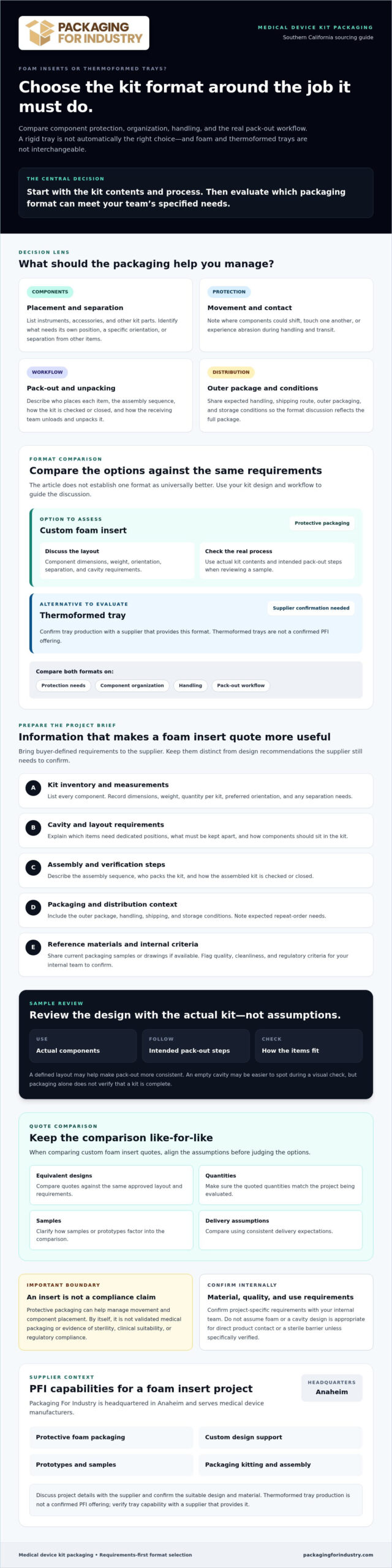
How to evaluate a Southern California supplier and compare foam quotes
Compare quotes against the same project scope. Differences in insert design, quantities, sample requirements, outer packaging, or delivery assumptions make a direct price comparison less useful. Share one project brief with each supplier and ask what is included, what remains unconfirmed, and whether custom sizes are available for your kit. A consistent scope helps your team evaluate packaging costs and options for addressing shipping damage risks.
What should a medical device foam packaging quote include?
Ask each supplier to specify the proposed insert format, design scope, materials, sample or prototype process, quoted quantities, and assumptions. Confirm whether the quote covers the insert alone or considers its fit within the complete packaging assembly. Compare the full project scope, not just a material description.
- Design and samples: Confirm what design work and sample review are included, how revisions are handled, and what approval is needed before production.
- Quantity and pricing: Compare the same order quantities and request bulk packaging pricing where relevant. Ask how the approved design will be identified for repeat orders.
- Assembly needs: If the kit requires packing or assembly, ask whether those needs can be discussed alongside the protective packaging.
- Delivery assumptions: Provide the delivery location and ask what local delivery arrangements and timing can be confirmed for that site.
A complete quote helps your team assess the packaging in the context of its manufacturing workflow, including how kits move through packing, shipping, and receiving. Similar considerations apply to packaging for warehouses and packaging for distribution centers, where handling and order coordination also affect project scope. Confirm proposed materials and designs against your requirements rather than assuming different suppliers have quoted equivalent solutions.
How can buyers assess local service and repeat supply?
Share your facility location and ask the supplier to confirm service coverage, delivery expectations, and order coordination for that address. Local needs can vary across Anaheim, Orange County, Los Angeles County, San Diego County, and the Inland Empire. Packaging For Industry is headquartered in Anaheim and serves Southern California. Confirm delivery arrangements and timing for your project directly.
For repeat supply, ask how the approved specification, revision history, sample notes, and order details will be documented. Clarify who approves design changes and how updated versions will be identified. If kit assembly support is relevant, discuss PFI’s packaging kitting services as part of the project.
Compare equivalent designs, quantities, sample scope, materials, packaging formats, and delivery assumptions when evaluating custom foam inserts for medical kits Southern California. A clear scope helps your team assess supplier fit and supply coordination without treating different proposals as interchangeable.
Source custom foam inserts for medical device kits from a Southern California supplier
For medical device manufacturers, packaging needs to fit both the kit and its handling workflow. Packaging For Industry (PFI) serves medical device manufacturers and other B2B industries with protective foam packaging, including custom foam inserts. Its Anaheim headquarters offers a local point of coordination for buyers across Southern California.
What can buyers discuss with PFI about a custom foam project?
Share the kit layout, component dimensions, order quantities, shipping context, and pack-out workflow. PFI’s custom design support, prototypes and samples, and packaging kitting and assembly are relevant capabilities to discuss for a project. A well-matched insert may help organize kit contents and support shipping protection, subject to the design and project requirements. Learn more about custom packaging design services, and confirm material, sample scope, and design details directly with PFI.
What is the next step for a Southern California quote?
Prepare a concise project brief and identify the internal contacts who will review quality or regulatory requirements. Ask PFI to confirm the proposed material and design, sample options, quantities, and delivery arrangements for your location. This gives buyers a basis for assessing whether PFI’s foam, design, and kitting capabilities fit the project. PFI does not list thermoformed trays as an offering, so buyers requiring that format should verify availability with a tray supplier.
For custom foam inserts for medical kits Southern California, a clear brief is a practical starting point for discussing project fit and repeat supply with a local packaging supplier.
Move your medical kit packaging project forward
Select the format around the kit’s components, handling, and workflow, not an assumption that foam inserts and thermoformed trays are interchangeable. A brief that includes dimensions, pack-out steps, quantities, and review requirements gives suppliers a stronger basis for discussing a design, sample, and repeat-order specification.
For buyers evaluating custom foam inserts for medical kits Southern California, Packaging For Industry serves medical device manufacturers with protective foam packaging, custom design support, prototypes and samples, and packaging kitting. PFI is headquartered in Anaheim and serves Southern California, including Orange County, Los Angeles, San Diego, and Riverside. Confirm project-specific materials and design details with the supplier, and verify applicable quality or regulatory requirements with your internal team. If your specification requires thermoformed trays, confirm that capability separately with a tray supplier.
Bring your kit requirements together to start a focused supplier conversation. The right information helps your team assess a practical packaging path and determine what needs further review.
Frequently Asked Questions
Are custom foam inserts or thermoformed trays better for medical device kits?
Neither format is automatically better. The right choice depends on the kit, handling needs, and packaging workflow. Assess how components need to be positioned, separated, accessed, and protected during distribution, then confirm material and design details with suppliers. Foam inserts and thermoformed trays are different formats, so compare quotes only after confirming that each supplier can provide the specific solution and scope your team requires.
Does Packaging For Industry make thermoformed trays for medical device kits?
Thermoformed trays are not a confirmed Packaging For Industry offering. PFI offers protective foam packaging, including custom foam inserts, with design support, prototypes, samples, and packaging kitting available to discuss for a project. If your specification requires a formed tray, verify that capability directly with prospective tray suppliers. Confirm material, process, sample options, and project requirements before comparing their quotes with a foam proposal.
What information do I need to request a custom foam insert quote?
Prepare a kit inventory with component dimensions, weights, quantities, orientation, and separation needs. Include drawings or clear photographs, the assembly sequence, existing packaging samples if available, and details about shipping, storage, and handling. Note expected order quantities and repeat-order needs. Identify quality or regulatory requirements for your internal team to review. This information helps a supplier understand the project and identify details that still need confirmation.
Can custom foam inserts be used for medical device kits?
Custom foam inserts can be considered for organizing and protecting medical device kit components during packing and distribution, subject to project review. A shaped insert may provide assigned positions for components, but that alone does not establish sterility, clinical suitability, regulatory compliance, or suitability for direct product contact. Have your internal quality and regulatory teams confirm applicable requirements, and ask the supplier to confirm the proposed material and design against the approved specification.
How do I choose foam material for a medical device kit insert?
Define the kit’s requirements first, then confirm available material options with the supplier. Share component details, handling conditions, outer packaging, and separation needs, and ask which materials and design approaches are available for review. Don’t assume a material is suitable for direct contact, a sterile application, or a specific environment without verification. Your internal team should assess quality, cleanliness, and regulatory requirements before approving the specification.
Can a packaging supplier prototype a custom medical kit insert?
Some packaging suppliers can provide prototypes or samples, but confirm their scope and availability for your project. Packaging For Industry offers prototypes and samples as part of its custom solutions. Provide the kit contents and intended pack-out process, then review fit, component removal, access, and assembly consistency. Record requested revisions and approve the final specification before relying on it for production or repeat orders.
How can I compare custom foam packaging suppliers in Southern California?
Compare suppliers using the same insert design, material assumptions, order quantities, sample scope, packaging format, and delivery location. Ask how design revisions, approved specifications, and repeat orders will be documented. Confirm service coverage and delivery expectations for your facility in Orange County, Los Angeles, San Diego, or Riverside. When sourcing custom foam inserts for medical kits Southern California, also verify project-specific capabilities and confirm quality requirements with your internal team.