
A broad catalog won’t keep a production line moving if the right packaging isn’t available when it’s needed. The right packaging supplier that helps streamline our operations fits the way your team buys, stores, packs, and ships, not simply one that offers the most products.
Recurring shortages, custom packaging lead times, emergency orders, and fragmented purchasing tasks can pull time away from production and fulfillment. Choosing a supplier is an operational decision, so look beyond unit price and product range.
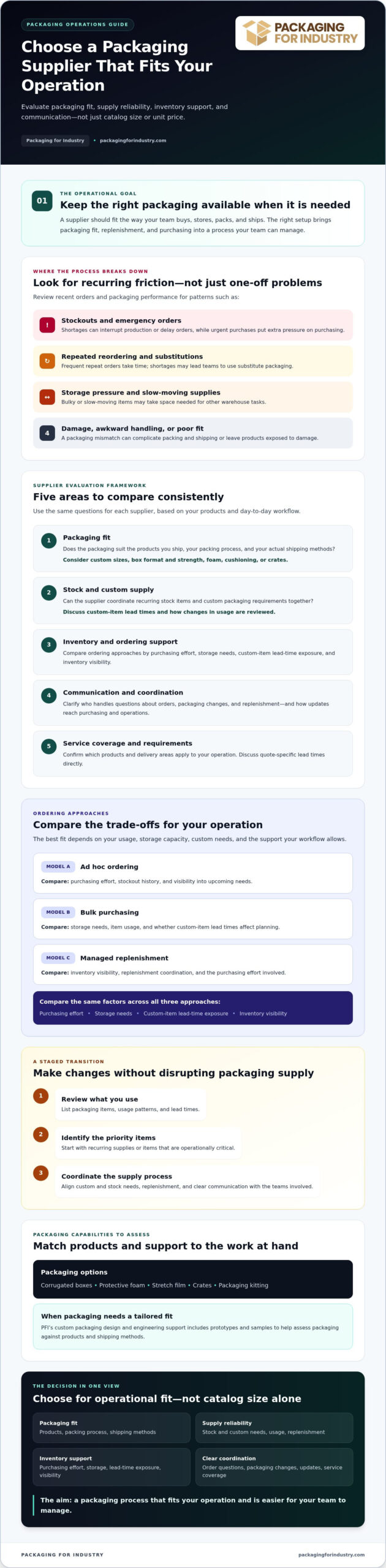
This guide offers a practical way to assess packaging fit, supply reliability, inventory support, and communication. You’ll learn how to evaluate stock and custom needs together, compare ordering approaches such as vendor managed inventory, and identify ways to address damage, shortages, and unnecessary inventory. The goal is a packaging process that fits your operation and is easier to manage.
Key Takeaways
- Assess packaging fit against the products you ship, your packing process, and your actual shipping methods, not just a supplier’s catalog.
- Compare ad hoc ordering, bulk purchasing, and managed replenishment by purchasing effort, storage needs, custom-item lead-time exposure, and inventory visibility.
- Choose a packaging supplier that helps streamline our operations by coordinating custom and stock needs, replenishment, and clear communication.
- Plan a transition in stages: review packaging items, usage, and lead times, then begin with recurring or operationally critical supplies.
- Explore how PFI’s corrugated boxes, protective foam, stretch film, crates, and packaging kitting may fit your ongoing operational needs.
What an Operations-Focused Packaging Supplier Should Solve
Packaging problems rarely stay in the supply room. A stockout can interrupt production or delay orders. An emergency purchase adds pressure for purchasing, while poor packaging fit can leave products exposed to damage or add handling during packing and shipping. Reordering the same supplies again and again also takes time away from work that keeps a warehouse or production floor moving.
A packaging supplier that helps streamline our operations does more than offer a wide product range. The goal is to match packaging, product protection, replenishment, and purchasing to the way your team works. The right setup depends on what you use, how often you use it, what your products require, and how much storage and supplier support your workflow allows.
Which packaging problems are disrupting your workflow?
Review recent orders and identify where the process breaks down. Have stockouts led to rush orders or substitutions? Do recurring items need frequent reordering? Are bulky or slow-moving supplies taking up space needed for other warehouse tasks?
Check packaging performance, too. Damage, awkward handling, or a box that doesn’t fit the product or shipping method can create avoidable complications. The basic functions of packaging and labeling include protecting products and communicating information. If your current packaging makes either task harder, it’s worth investigating the supplier and packaging fit.
- Track stockouts, emergency orders, and substitutions.
- Identify items that take up space or require repeated purchasing.
- Note damage, handling problems, or dimensional mismatches during shipping.
This review helps distinguish one-off disruptions from recurring gaps that a better supply or packaging plan could address.
What does a supplier contribute beyond packaging products?
A transactional supplier fills orders. An operations-focused partner can also help assess packaging requirements, coordinate custom design, and plan replenishment for recurring items. For example, if a product needs a different protective fit, custom packaging design services can help assess the requirement. PFI’s design support includes prototypes and samples.
Coordination matters when purchasing and operations share responsibility for packaging. Clear communication about item requirements, ordering patterns, and replenishment can reduce repeated follow-up and improve visibility. Ask how a supplier handles custom and stock requirements together, and what information it needs to support a consistent supply process.
Operationally useful packaging supply means the right packaging fit, available through a purchasing and replenishment process your team can manage.
How to Evaluate a Packaging Supplier for Operational Fit
Start your comparison with your shipping and purchasing process, not a product catalog. Evaluate each supplier against the same criteria to see whether its capabilities suit your products, replenishment needs, and day-to-day coordination.
Match packaging capabilities to products and shipping needs
Review the products you ship, how they move through your facility, and the handling they encounter in transit. A box that doesn’t fit the product or packing process can add materials and handling. Inadequate protection can increase the risk of damage. Consider custom sizes, box format and strength, and whether foam, cushioning, or a crate may better suit the item. Evaluate custom corrugated box options alongside your other packaging needs.
For items that need a more tailored fit, ask how a supplier assesses packaging design and validates a proposed approach. PFI’s custom packaging design and engineering includes prototypes and samples. The aim is to evaluate packaging against your actual products and shipping methods, rather than selecting materials by category alone.
Check supply, communication, and service coverage
Packaging is one part of broader supply chain management, so consider how a supplier coordinates requirements from ordering through replenishment. Ask how it reviews recurring stock items, custom items, and changes in usage. Confirm which products and delivery areas apply to your operation, and discuss quote-specific lead times directly.
Review the supplier’s communication process as well. Who handles questions about an order, packaging changes, or replenishment reviews? How are updates shared with purchasing and operations? Clear answers help you assess responsiveness without relying on unsupported promises.
Use this five-part framework to compare potential suppliers:
- 1. Packaging fit: Can they assess box formats, custom sizes, protective materials, and packaging design against your products and shipping methods?
- 2. Product range: Can they coordinate the items you need, such as boxes, foam, stretch film, and crates?
- 3. Replenishment: Can they discuss a workable process for recurring orders and changing usage?
- 4. Service coverage: Do their confirmed delivery areas and product coverage meet your requirements?
- 5. Communication: Are ordering questions, changes, and next steps handled clearly?
A packaging supplier that helps streamline our operations should fit both product requirements and purchasing routines. To compare your requirements with available options, request a packaging quote with your packaging list, usage patterns, and delivery requirements.
Compare Supplier Models, Inventory Support, and Total Operational Impact
Ordering method affects more than how often a purchase order is placed. It influences the time buyers spend managing supplies, the space reserved for inventory, and how clearly teams can see what needs replenishment. Compare models against actual usage, storage constraints, and the share of packaging that requires custom production.
| Ordering model | Purchasing effort | Onsite storage needs | Custom-item lead-time exposure | Replenishment visibility |
|---|---|---|---|---|
| Ad hoc ordering | More frequent ordering and follow-up | Potentially lower routine stock, but depends on order timing | May be harder to plan for if a custom item is needed urgently | Usually depends on the buyer tracking stock and initiating orders |
| Bulk purchasing | Fewer orders, with larger purchases to coordinate | More space may be needed for stored packaging | Can provide a buffer if custom items are ordered ahead | Requires monitoring stock levels between purchases |
| Managed replenishment | Can reduce repeated ordering tasks through planned reviews | Stock levels can be reviewed against available space and usage | Reviewing recurring needs can help teams plan custom-item replenishment | Scheduled reviews provide a defined opportunity to assess inventory |
No model automatically lowers costs or suits every item. A frequently used stock box may be a good candidate for planned replenishment, while a low-volume custom crate may need a separate ordering plan. Review purchasing and usage history before choosing a model, and consider whether demand is consistent enough to plan around.
When does vendor managed inventory make sense?
Vendor managed inventory (VMI) may suit recurring packaging needs when usage can be reviewed and replenishment planned, rather than leaving every reorder to a buyer. PFI’s vendor managed inventory for packaging can use weekly, biweekly, or monthly review cycles. Discuss which items to include, how usage will be reviewed, and how the process can account for changing demand.
How should buyers assess total operational impact?
Set a baseline before comparing options. Record emergency orders, excess stock, space used, packaging waste, and time spent purchasing or tracking supplies. Separate information you can directly observe, such as order frequency or storage locations, from projected benefits that haven’t yet been measured.
Unit price alone doesn’t show whether a packaging model fits the work required to order, store, and replenish supplies. Evaluate a packaging supplier that helps streamline our operations against the full purchasing and inventory process, not just the price of an individual item.
Plan a Supplier Transition Without Disrupting Packaging Supply
You don’t have to move every packaging item at once when changing suppliers. A staged transition lets your team confirm requirements, protect current supply, and learn the new ordering process before expanding it. Start with recurring or operationally critical items, then add other packaging categories once responsibilities and replenishment are clear.
Prepare packaging and usage information for supplier review
Gather item descriptions, current packaging formats, usage history, and known supply constraints. Note production and shipping schedules, available warehouse space, and which items require custom packaging. Flag damage concerns and products that can’t use a stock substitute. This information helps a supplier assess your operation and identify items that may need custom design or advance planning.
Move through onboarding in stages
- Review items: Group supplies by product, use, and whether they’re stock or custom.
- Assess usage and lead times: Review order history, demand changes, supply timing, and items that need advance planning.
- Design the program: Agree which items to transition first, how ordering or inventory reviews will work, and who approves changes.
- Begin replenishment: Confirm how the team will check needs, communicate inventory changes, and place or approve orders before adding more items.
For custom packaging, prototypes or samples can help your team assess fit and handling before broader production. PFI’s custom packaging design services include prototypes and samples. For custom crate requirements, review the design, product protection needs, and expected timing with the supplier before including the crate in a recurring program.
Set review and replenishment expectations
Define which items are included, how often inventory is reviewed, and how changes in usage are communicated. Clarify who provides forecasts, approves orders, and makes replenishment decisions. These details matter when purchasing, warehouse, and production teams share responsibility.
Buyers in Orange County, Los Angeles, San Diego, and Riverside should confirm delivery coverage, product availability, and quote-specific lead times for their requirements. PFI offers local next-day delivery throughout Southern California, but buyers should verify that their products and location qualify. A packaging supplier that helps streamline our operations should make these expectations clear before a shortage appears.
Once you’ve identified the packaging items and supply requirements to review, you can start a conversation with PFI.
Why Consider PFI as Your Packaging Supplier?
Packaging For Industry serves manufacturers, warehouses, distributors, and fulfillment operations that need a practical mix of custom and stock packaging. Rather than treating every item as a separate purchase, PFI can discuss how products and recurring supply needs work together, from corrugated boxes and protective foam to stretch film, crates, and packaging kitting.
For Southern California businesses, PFI offers local next-day delivery throughout the region. Nationwide support is available for certain products and larger recurring programs, so confirm product coverage and quote-specific lead times for your location. This helps buyers assess whether a supplier can support local requirements as well as broader purchasing needs.
Which operations can benefit from PFI’s packaging support?
Packaging for manufacturers, distribution centers, and warehouses often involves repeat-use items alongside products that need a custom fit. PFI provides custom packaging design, prototyping, and samples to help evaluate packaging for specific products and protection needs. Its packaging support is relevant to teams reviewing packaging alongside production and shipping processes.
Available options include corrugated boxes, foam packaging, stretch film, crates, and packaging kitting and assembly services. Buyers can discuss whether stock items, custom packaging, or a combination better fits their operation. The right choice depends on the product, protection requirements, and supply needs.
What should buyers include in a quote request?
Useful details help a supplier understand the requirement and prepare a focused response. Share the packaging types you use, dimensions if known, typical usage patterns, and order frequency. Describe any product damage or protection concerns, warehouse storage limits, and the locations that need delivery.
If some information isn’t available, explain what your team does know and where it needs guidance. You can also ask about stock supply, custom design, or inventory programs such as vendor managed inventory. Evaluate whether the proposed approach fits your actual packaging and purchasing needs, rather than relying on assumptions about results.
PFI works with industrial buyers to review packaging requirements and supply options. A quote request is an opportunity to discuss your items, usage, and delivery needs.
Build a Packaging Supply Process Your Team Can Rely On
The right supplier should match packaging to your products, support dependable replenishment, and make purchasing easier to manage. Use order and usage history to compare supply models, identify critical items, and plan any transition in stages. These practical checks can help you choose a packaging supplier that helps streamline our operations based on your actual requirements.
PFI works with industrial buyers on custom and stock packaging, with design support that includes prototypes and samples. Vendor managed inventory reviews can be scheduled weekly, biweekly, or monthly. For businesses across Southern California, local next-day delivery is available. Confirm product coverage and quote-specific lead times for your needs.
Start with the packaging categories, usage patterns, and supply concerns you want to address. A clear review can help your team determine whether custom design, recurring stock supply, or an inventory program is the right fit.
A more coordinated packaging process is achievable, one well-planned step at a time.
Frequently Asked Questions
How can a packaging supplier help streamline operations?
A packaging supplier can streamline operations by coordinating packaging fit, recurring supply, and purchasing support. For example, a supplier may review how boxes, foam, or crates protect products and how often stock items are reordered. Considering custom and stock needs together can help teams plan supply more clearly, reduce repeated purchasing tasks, and address packaging issues that interfere with production or shipping.
What should I look for in an industrial packaging supplier?
Look for an industrial packaging supplier that can match packaging to your products, shipping methods, usage patterns, and storage limits. Check whether it can provide the product categories you use, discuss custom design when standard options don’t fit, and explain its replenishment and communication processes. Confirm service coverage and quote-specific lead times directly. These criteria help you assess whether the supplier fits your operation, not just your product list.
Can one packaging supplier provide boxes, foam, stretch film, and crates?
Yes. Packaging For Industry supplies corrugated boxes, foam packaging, stretch film, and crates, along with other industrial packaging products. Coordinating several categories through one supplier can make it easier for purchasing and operations teams to discuss related requirements together. Product availability and fit depend on the specific request, so share your packaging types, dimensions, usage, and delivery needs when asking about supply.
How does vendor managed inventory work for packaging supplies?
Vendor managed inventory (VMI) uses scheduled inventory reviews and planned replenishment based on a business’s packaging usage. The buyer and supplier agree which items to review, how inventory changes will be communicated, and who handles approvals. PFI offers VMI review cycles that can be weekly, biweekly, or monthly. This approach may reduce routine reorder work for businesses with recurring packaging needs, but the program should reflect actual usage and storage requirements.
Is a custom packaging supplier a good fit for recurring orders?
A custom packaging supplier can be a good fit when recurring orders include packaging designed for particular products or shipping needs. Custom and stock items can be reviewed together, allowing buyers to plan repeat supply while addressing fit or protection concerns. PFI’s custom packaging design support includes prototypes and samples, which teams can assess before broader production. Discuss usage patterns and quote-specific lead times so the supply plan reflects your requirements.
How can packaging suppliers help reduce shipping damage and emergency orders?
Suppliers can help address damage concerns by reviewing packaging fit, product handling, and shipping methods, then discussing suitable stock or custom options. Planned replenishment for recurring items can also help teams identify supply needs before stock runs low. Neither approach guarantees a particular result. Track damage incidents, stockouts, substitutions, and rush orders to identify recurring issues and evaluate whether packaging or replenishment changes are appropriate.
Does PFI provide packaging delivery in Southern California and nationwide?
PFI offers local next-day delivery throughout Southern California, including Orange County, Los Angeles, San Diego, and Riverside areas. Nationwide support is available for certain products and larger recurring programs through distribution and manufacturing partners. Coverage can vary by product and program, so confirm whether your location and packaging requirements qualify. Ask about current availability and quote-specific lead times when discussing packaging delivery for your operation.