
A single hairline fracture in a high-value aerospace sensor doesn’t just represent a lost component; it can ground an entire production schedule and compromise critical mission timelines. Finding reliable custom foam packaging for aerospace parts Anaheim manufacturers can trust is often the difference between a successful delivery and a costly insurance claim. You likely already understand that off-the-shelf solutions from national catalog suppliers rarely provide the precision fit required for sensitive flight hardware. It’s frustrating to wait weeks for a shipment only to find that standard foam doesn’t meet FAR 25.853 fire-safety standards or MIL-STD-2073-1 preservation requirements.
This guide explains how precision-engineered foam inserts can achieve zero-damage shipping while reducing your overall logistical costs. We’ll show you how die-cut polyethylene and ESD foam provide a professional presentation for stakeholder kits and ensure your parts arrive in perfect condition. By focusing on local, next-day delivery and CAD/CAM engineering, you can bypass the long lead times of national distributors. We’ll preview the specific materials and design strategies that help Anaheim’s aerospace sector maintain its competitive edge in a regional market that’s currently seeing record-breaking venture investment and rapid expansion.
Key Takeaways
- Identify how selecting specific densities of Polyethylene and Polyurethane foam prevents surface abrasion and structural damage to sensitive flight hardware.
- Discover why sourcing custom foam packaging for aerospace parts Anaheim manufacturers rely on reduces freight surcharges and enables critical on-site engineering reviews.
- Learn to optimize your total cost of ownership by using precision die-cutting to eliminate “shipping air” and reduce labor through professional packaging kitting.
- Understand the CAD-to-prototype workflow that ensures zero-tolerance fits for complex components while accelerating your production timeline.
- See how local vendor-managed inventory (VMI) programs stabilize your supply chain with reliable next-day delivery for recurring aerospace production runs.
The Critical Role of Custom Foam Packaging for Aerospace Parts
In the aerospace sector, packaging isn’t just a container; it’s a structural extension of the component itself. For manufacturers in Orange County, securing custom foam packaging for aerospace parts Anaheim provides a precision-engineered barrier that shields high-value flight hardware from the rigors of global logistics. Unlike generic cushioning, these custom inserts are designed to maintain the integrity of zero-tolerance parts during multi-modal transport. When you’re shipping a sensor worth fifty thousand dollars, the packaging must be as reliable as the part it protects.
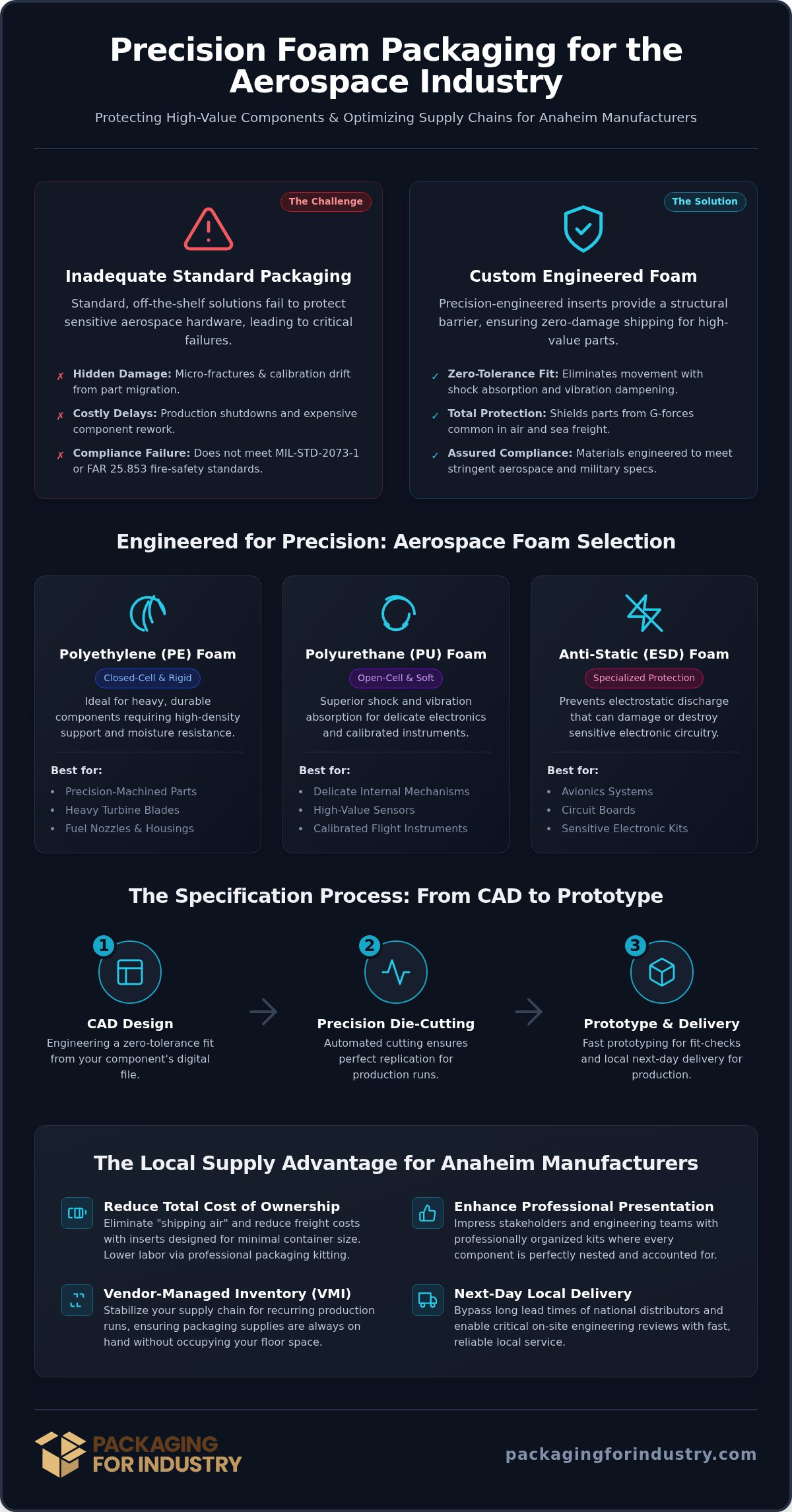
“Hidden” damage represents a significant drain on aerospace profit margins. While a crushed corrugated box is obvious, internal damage like calibration drift in avionics or micro-fractures in turbine blades often goes undetected until final assembly or testing. This leads to expensive rework, missed deadlines, and potential liability. Standard off-the-shelf cushioning fails to meet the stringent requirements of MIL-STD-2073-1 or FAA-regulated fire-safety standards like FAR 25.853. These regulations demand materials that are not only durable but often self-extinguishing to ensure safety during transit and storage.
Aerospace Protection vs. Standard Industrial Cushioning
Sensitive sensors and machined components require custom-fitted cavities to eliminate part migration. If a component shifts even slightly during transit, it can strike the outer wall of the container or other parts in the kit. Precision die-cutting ensures each part remains stationary, even when a crate is tipped or dropped. There’s also a technical distinction between vibration dampening and shock absorption. While standard bubble wrap might handle minor bumps, aerospace hardware requires specialized materials like Polyurethane foam to absorb the high-G impacts common in air and sea freight. This material choice is critical for protecting delicate internal mechanisms from harmonic vibrations that can occur during flight.
Common Aerospace Components Requiring Custom Die-Cut Foam
Manufacturers frequently require custom foam packaging for aerospace parts Anaheim to secure high-risk hardware. Certain items demand specific material properties to ensure they arrive within tolerance. We often design solutions for:
- Avionics and flight instruments: These require foam packaging with anti-static (ESD) properties to prevent discharge that can fry sensitive circuitry.
- Precision-machined engine components: High-density foams prevent heavy turbine blades or fuel nozzles from piercing the packaging walls.
- Prototyping kits: Custom inserts provide a professional-grade presentation for B2B stakeholders and engineering reviews, ensuring every tool and part is accounted for.
Beyond physical protection, organized presentation kits have real psychological value. When an engineer or stakeholder opens a kit where every component is perfectly nested in a custom cavity, it communicates a level of competence and stability that stock solutions can’t match. This professional-grade presentation is essential for high-stakes aerospace contracts where first impressions and operational efficiency are scrutinized. It also reduces labor costs by allowing technicians to quickly identify missing parts before they reach the assembly line.
Engineering for Precision: Material Selection for Aerospace Kits
Engineering a kit for aerospace components requires balancing protection levels with strict weight constraints. Selecting the right material is essential to meet the National Aerospace Standard for packaging. For those sourcing custom foam packaging for aerospace parts Anaheim, the decision typically starts with a choice between Polyethylene (PE) and Polyurethane (PU). These materials serve different functional roles within the supply chain, and choosing correctly prevents both product damage and unnecessary shipping surcharges.
Polyethylene is a closed-cell foam known for its rigidity and moisture resistance. It’s the preferred choice for heavy machined parts that require structural support. In contrast, Polyurethane is an open-cell foam used for lighter, more fragile items needing soft cushioning. For high-end finishes that can’t tolerate surface abrasion, we recommend Cross-Linked Polyethylene (XLPE). XLPE has a smooth, non-abrasive surface that protects Class-A aerospace finishes from scuffing during long-haul transport. It’s also highly durable, making it ideal for reusable transit cases and internal plant handling.
Understanding Foam Density and Shock Absorption
Foam performance is measured in pounds per cubic foot (pcf). Matching this density to the weight and fragility of your part is critical for mitigating impact forces, often referred to as the “G-factor.” A foam that’s too soft will bottom out upon impact, while foam that’s too rigid will transfer shock directly to the component. Precision-engineered inserts ensure that reusable transit cases maintain their protective properties over hundreds of cycles. This longevity lowers long-term procurement costs by reducing the frequency of packaging replacement.
Specialized Foam for Electronics and Cleanrooms
Sensitive electronic assemblies require more than just physical cushioning; they need protection from invisible threats. Pink anti-static foam is chemically treated to prevent the buildup of triboelectric charges during handling. For cleanroom environments, low-outgassing foam is required to prevent chemical vapors from contaminating optics or sensors. Often, these custom foam inserts are used in conjunction with static shielding bags to provide a multi-layered defense against ESD and environmental factors. This combination ensures that sensitive avionics remain flight-ready upon arrival.
Material choice directly impacts the total weight of the shipping kit. Over-engineering with high-density foam when a lighter PU alternative would suffice increases dimensional weight and shipping surcharges. By optimizing the foam volume and density, Anaheim manufacturers can significantly reduce logistical expenses without compromising safety. If you’re looking to optimize your current design for better efficiency, you can request a packaging quote to compare material performance and costs for your specific parts.
Custom Die-Cut Foam vs. Stock Solutions: The TCO Advantage
Many purchasing managers default to stock foam sheets from national catalogs to avoid upfront tooling fees. However, this approach often increases the Total Cost of Ownership (TCO) through hidden logistical expenses. For those procuring custom foam packaging for aerospace parts Anaheim, the initial investment in custom dies is quickly offset by substantial long-term savings. Local manufacturers typically see 15% to 40% cost savings compared to national catalog suppliers. These savings aren’t just in the material price; they’re realized through optimized material usage, reduced labor, and lower freight costs.
The cost of custom tooling is a one-time expense that pays for itself by drastically lowering damage rates. When a part is worth thousands of dollars, even a 1% reduction in shipping damage provides a massive return on investment. Precision die-cutting ensures that every component is nested securely, removing the variability and human error associated with hand-wrapping parts in stock foam or bubble wrap. This consistency is vital for maintaining the strict quality control standards required in aerospace manufacturing.
Reducing UPS and FedEx Surcharges with Optimized Sizing
Oversized packaging is a primary driver of high shipping costs. When you rely on stock foam, you’re often forced to use larger custom corrugated boxes to accommodate standard sheet sizes or excessive void-fill. This triggers dimensional weight (DIM) pricing from carriers like UPS and FedEx, where you pay for the space the box occupies rather than its actual weight. Precision-engineered foam allows for tight-tolerance designs that minimize exterior box dimensions. By reducing box size by just 20% through better foam engineering, companies can often bypass oversized shipping surcharges entirely.
Streamlining the Unboxing Experience for B2B Clients
Efficiency on the assembly line is just as critical as protection during transit. Utilizing packaging kitting allows aerospace manufacturers to receive components in pre-organized sets. This eliminates the time-consuming process of digging through messy void-fill like packing peanuts or crumpled paper. Instead, technicians can pull parts directly from the foam cavities in the exact order needed for assembly, which significantly reduces labor time and prevents part loss on the warehouse floor.
A custom solution also enhances your brand’s professional presentation to stakeholders. Combining custom foam with custom printed boxes ensures that your kits reflect the high quality of the flight hardware inside. This organized unboxing experience communicates a level of engineering discipline that stock solutions simply can’t match. When you compare the cost of a custom tool to the recurring expense of damaged parts and inefficient warehouse labor, the economic advantage of custom foam is clear.
The Anaheim Specification Process: From CAD to Prototype
The procurement of custom foam packaging for aerospace parts Anaheim requires a methodical engineering approach. It starts with gathering precise technical requirements: the exact dimensions of the component, its total weight, and its fragility rating. Without these data points, any packaging design is merely guesswork. We begin by analyzing these variables to determine the appropriate foam density and cavity geometry needed to ensure a zero-tolerance fit. This data-driven process ensures that your high-value hardware remains stationary and protected throughout the entire shipping cycle.
CAD/CAM Design and Prototyping at PFI
Manufacturers can submit digital CAD files or physical parts for an engineering review. Using CAD/CAM software, we design the foam layout to maximize protection while minimizing the overall footprint of the kit. The primary advantage of a local Anaheim supplier is the speed of the prototyping cycle. You don’t have to wait weeks for a sample from a national supplier; local prototyping allows for rapid adjustments to fit, finish, and aesthetic appeal. We offer free prototyping to ensure the design meets your specifications before you commit to full-scale die-cut production. This iterative process eliminates the risk of receiving thousands of inserts that don’t fit your hardware.
Integrating Multi-Material Protection
Aerospace components often require more than just a foam insert. For international transit or heavy machinery, we integrate foam inserts with custom wood crates to provide a rigid exterior shield. This multi-material approach often includes corner and edge protection to reinforce the outer container. For exceptionally heavy parts, foam end caps are engineered to suspend the component within the crate, preventing any contact with the walls. This suspended design is critical for items that cannot tolerate even minor surface vibrations during long-haul freight.
Designing for reusable “closed-loop” logistics is another critical consideration for reducing long-term packaging costs. High-durability foams like XLPE are ideal for these programs, as they maintain their structural integrity over multiple transit cycles. Once the prototype is approved, the design moves into full-scale production. This transition is seamless because the same CAD data used for the sample drives the die-cutting equipment. This ensures that the thousandth part produced is identical to the first approved prototype, providing the consistency required for aerospace quality standards and ensuring your custom foam packaging for aerospace parts Anaheim remains reliable across every production run.
Local Supply Benefits: Why Anaheim Manufacturers Choose PFI
Sourcing custom foam packaging for aerospace parts Anaheim from a local supplier eliminates the exorbitant freight costs associated with bulky materials. National catalog suppliers often ship foam from distant distribution centers, meaning you pay to transport “air” across state lines. By choosing a local partner, you redirect those shipping surcharges back into your production budget. Beyond the economics of freight, a local presence allows for on-site engineering reviews. Complex aerospace assemblies often require a physical review of the part in its operational environment to ensure the foam cavities provide the necessary protection and clearance. This face-to-face collaboration ensures that zero-tolerance requirements are met before production begins.
Reliability is the cornerstone of aerospace logistics. Many local firms utilize Vendor Managed Inventory (VMI) to stabilize their supply chain. Under a VMI program, we monitor your stock levels and replenish your foam inserts automatically. This prevents production shutdowns caused by packaging shortages and supports Just-In-Time (JIT) manufacturing schedules. It’s a proactive approach that shifts the burden of inventory management from your operations team to our logistical experts. This system provides a steady flow of materials that matches your assembly pace, eliminating the stress of lead-time variability from national distributors.
Anaheim Next-Day Delivery and Logistics Support
Local delivery keeps production lines moving without the need for massive on-site storage. Foam is space-intensive; storing months of inventory occupies valuable square footage that could be used for assembly or testing hardware. By storing your custom inserts at our facility and utilizing our Anaheim service area page logistics, you can receive next-day delivery on an as-needed basis. This optimization of warehouse space directly improves your facility’s operational efficiency and lowers overhead costs. It allows you to maintain a lean inventory while ensuring you’re never more than 24 hours away from a restock.
Request Your Aerospace Foam Quote Today
Receiving an accurate custom foam packaging for aerospace parts Anaheim quote is a straightforward process. To provide a precise estimate, our team requires the part weight, desired material type (PE, PU, or ESD), and your projected annual volume. We also review any specific MIL-SPEC or fire-safety requirements your project demands, such as FAR 25.853 compliance. Once we have these technical details, we can provide a comprehensive quote that includes material, tooling, and delivery schedules. Request a packaging quote today to begin your engineering review and secure your aerospace supply chain.
Optimizing Your Aerospace Supply Chain in Anaheim
Precision-engineered foam is a critical tool for protecting zero-tolerance flight hardware while controlling operational costs. By moving away from stock catalog solutions, you eliminate the “shipping air” that drives up dimensional weight surcharges. Our CAD design support and free prototyping ensure that your specific components fit perfectly, which reduces transit damage and improves stakeholder presentation. These technical optimizations transform your packaging from a simple expense into a strategic asset for your production line.
Transitioning to a local partner for custom foam packaging for aerospace parts Anaheim allows you to realize 15% to 40% savings compared to national suppliers. You’ll benefit from local next-day delivery and the reliability of vendor managed inventory programs that keep your assembly schedules on track. We’re ready to help you streamline your logistics and protect your high-value assets through expert engineering and dependable local support.
We look forward to engineering a solution that meets your exact specifications and strengthens your local supply chain reliability. Let’s start protecting your mission-critical components today.
Frequently Asked Questions
What is the best foam material for protecting heavy aerospace parts?
High-density polyethylene (PE) foam is the industry standard for protecting heavy aerospace hardware. Its closed-cell structure provides the structural integrity needed to support significant weight without bottoming out during impact. This material is also moisture-resistant and durable enough for reusable transit cycles. For parts with delicate finishes, we often recommend cross-linked polyethylene to prevent surface abrasion while maintaining the necessary load-bearing capacity for engine components or heavy machinery.
How much does custom die-cut foam tooling cost for Anaheim businesses?
Tooling costs for custom die-cut foam are determined by the complexity of the part cavities and the overall size of the insert. While there is an upfront investment for custom dies, this one-time fee is typically offset by the 15% to 40% savings realized over national catalog pricing. We provide a detailed breakdown of tooling fees during the quote process to ensure your total cost of ownership remains lower than stock alternatives.
Do you offer anti-static (ESD) foam for aerospace electronics?
Yes, we specialize in providing ESD foam packaging for sensitive avionics and electronic flight instruments. We offer pink anti-static foam, which prevents triboelectric charging, as well as conductive black foams for more sensitive applications. These materials are often integrated into custom foam packaging for aerospace parts Anaheim manufacturers use to meet strict ESD safety protocols and prevent damage to delicate circuitry during handling and transit.
Can PFI provide free prototypes for my aerospace presentation kit?
We provide free prototyping for custom foam designs to ensure a zero-tolerance fit before full production begins. Our CAD/CAM engineering support allows us to create precise samples from your digital files or physical parts. This process lets you test the fit, finish, and layout of your aerospace presentation kits, ensuring that the final product meets your exact professional standards and protects every component correctly.
What is the lead time for custom die-cut foam in Southern California?
Lead times for custom die-cut foam are significantly shorter when sourcing locally in Southern California compared to national suppliers. Once a design is approved, production typically begins within days. For recurring aerospace production needs, our Vendor Managed Inventory (VMI) programs offer even greater speed. We can stock your custom inserts at our facility and provide local next-day delivery to Anaheim and surrounding areas, keeping your production lines moving.
How does custom foam help reduce UPS or FedEx shipping surcharges?
Custom foam allows for much tighter tolerances than stock sheets, which enables the use of smaller exterior corrugated boxes. By reducing the overall dimensions of the package, you can often bypass dimensional weight (DIM) pricing and oversized surcharges from carriers like UPS and FedEx. This precision engineering ensures you aren’t paying to ship “air,” which directly lowers your total logistical expenses for high-volume aerospace shipments.
Is there a minimum order quantity for custom aerospace foam inserts?
We focus on supporting recurring industrial production and bulk orders for manufacturers and warehouses. While we don’t serve one-time residential needs, our minimum order quantities are designed to be flexible for high-value aerospace projects. We prioritize building long-term partnerships through stocking programs and VMI, ensuring that you have a reliable supply of custom foam without having to manage large quantities of inventory on your own warehouse floor.
Can you integrate foam inserts into custom wood crates for export?
Yes, we provide integrated custom foam packaging for aerospace parts Anaheim that combines die-cut inserts with custom wood crates. This multi-material approach is ideal for international export, where parts require both internal cushioning and a rigid external shield. We can design foam end caps or suspended inserts that secure heavy machinery within heat-treated export crates, ensuring compliance with international shipping regulations and providing maximum protection for long-haul freight.