
The cheapest roll of pallet wrap in your warehouse is likely the most expensive one you’ll ever use. While a low price-per-roll looks good on a purchase order, standard films often fail during application, requiring more revolutions and leading to excessive material waste. You’ve probably dealt with the frustration of snapping film and inconsistent load containment that results in costly shipping damage. It’s a common cycle that drains your budget and creates unnecessary warehouse waste.
We understand that operational efficiency and fiscal responsibility are your top priorities. This guide explores how utilizing high-yield stretch film to reduce costs can transform your packaging department by prioritizing structural performance over thickness. You’ll discover how to lower your total packaging spend while improving pallet stability and meeting sustainability goals. We’ll break down the technical differences between standard and high-performance films, providing the data you need to compare packaging pricing and choose solutions that actually improve your bottom line. From downgauging strategies to improved load containment, this is your roadmap to a more efficient shipping operation.
Key Takeaways
- Shift your procurement focus from price-per-roll to cost-per-load to identify the true impact of packaging on your bottom line.
- Discover how high-yield stretch film to reduce costs utilizes advanced resin technology to provide superior puncture resistance at thinner gauges.
- Learn the step-by-step process for conducting a “wrap-and-weigh” audit to establish a baseline for your current material usage and waste.
- Improve load containment and reduce shipping damage by matching specific pre-stretch capabilities to your unique pallet profiles.
- Understand how local next-day delivery and vendor-managed inventory programs in Southern California can stabilize your supply chain and prevent stockouts.
Understanding the Hidden Costs of Traditional Pallet Wrapping
Many purchasing departments focus on the price-per-roll as their primary KPI. This approach is fundamentally flawed because it ignores the actual efficiency of the material. A standard roll might be cheaper upfront, but if it lacks the puncture resistance or tensile strength required for your specific load, your team will likely compensate by over-wrapping. This creates a cycle of waste where you pay for extra plastic that doesn’t actually improve load containment. It’s a common mistake that hides the true expense of your shipping operations.
The Cost-Per-Load Metric vs. Cost-Per-Roll
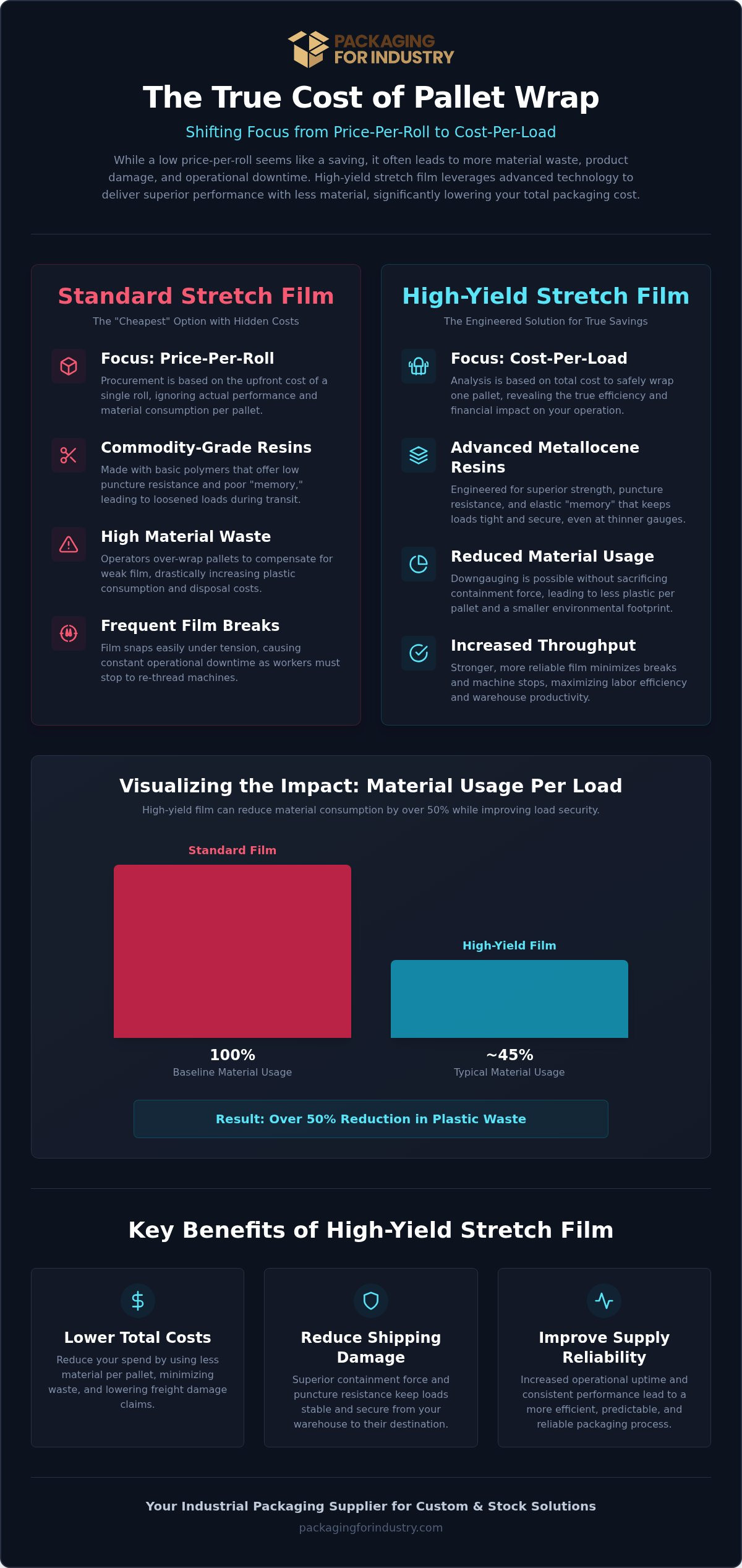
To truly lower packaging costs, you must pivot to the cost-per-load metric. This calculation considers how many pallets a single roll can safely secure. When you use high-yield stretch film to reduce costs, you’re leveraging advanced resin technology that allows for thinner gauges without sacrificing strength. While the roll price might be higher than a standard commodity film, the total material used per pallet is significantly lower. This shift also reduces the hidden financial burden of shipping damage. Inconsistent containment leads to shifted loads and rejected deliveries, costs that never appear on a film invoice but directly impact your profitability. You should always compare packaging pricing based on the total pallets wrapped, not the number of rolls in the warehouse.
Labor Efficiency in the Wrapping Process
Operational downtime is another hidden expense that standard suppliers often overlook. Standard films are prone to snapping under tension, forcing operators to stop and re-thread machines or restart hand-wrapping. Every film break represents lost labor time and decreased throughput. By switching to a stretch film supplier that provides high-performance materials, you minimize these interruptions. Understanding the Science of Yield helps explain why these films perform better under high tension; they are designed to stretch further while maintaining a high “memory” that pulls the load tight. Fewer breaks mean your team spends more time moving product and less time fixing film issues.
Beyond the direct financial impact, excessive plastic usage works against your sustainability goals. Thicker, standard films generate more warehouse waste that must be managed and hauled away. Using high-yield stretch film to reduce costs helps you meet environmental targets by achieving superior containment with less raw material. It’s a pragmatic solution for manufacturers and distribution centers looking to balance fiscal responsibility with modern sustainability mandates.
What is High-Yield Stretch Film? (The Science of Yield)
High-yield stretch film isn’t simply a thinner version of standard wrap; it’s a specialized material engineered with advanced metallocene resins. These resins allow the film to be drawn down to significantly lower gauges while maintaining, or even exceeding, the puncture resistance of traditional 80-gauge products. When businesses switch to high-yield stretch film to reduce costs, they’re moving away from commodity-grade plastics toward a solution defined by chemical performance. This engineering allows for superior load containment with a fraction of the material weight normally required.
Resin Technology and Puncture Resistance
The primary advantage of these films lies in their “memory”—the physical property that causes the plastic to tighten after application. While standard films might stretch and stay loose, high-yield options provide a constant compressive force. According to packaging science research, optimizing this containment force is one of the most effective ways to Lower Packaging Costs because it prevents the internal load shifting that causes shipping damage. This elastic recovery is vital when protecting sharp corners on heavy duty corrugated boxes or securing irregular loads that would normally puncture thinner, low-grade films.
Most high-yield films are manufactured using the cast extrusion process, which results in excellent clarity and quiet unwind. Clarity is a functional requirement for modern warehouses, as it ensures that barcodes remain readable through multiple layers of film. For high-volume operations, machine films are designed to handle pre-stretch levels of 250% or higher. This means your stretch wrap supplier can provide a roll that covers significantly more pallets than a standard alternative, reducing the frequency of roll changes and improving throughput.
Machine vs. Hand High-Yield Applications
Pre-stretch is the mechanical process of elongating the film before it’s applied to the pallet. In a machine environment, the film passes through rollers that rotate at different speeds, stretching the material by as much as 300%. This allows a single foot of film on the roll to cover three feet of the pallet surface. In hand-wrap scenarios, high-yield films are often pre-stretched during manufacturing. This makes the rolls lighter and more ergonomic for warehouse staff, which reduces worker fatigue and improves wrapping consistency across a shift. To find the optimal balance between gauge and containment for your specific industry, you can request a packaging quote for a customized cost-reduction analysis.
High-Yield vs. Standard Stretch Film: A Performance Comparison
While many buyers consider 80-gauge film the industry standard, a technical comparison reveals significant performance gaps. Standard film often suffers from “neck-down,” where the material narrows as it’s stretched. This forces operators to increase the number of revolutions to cover the same surface area, consuming more plastic and labor time. In contrast, using high-yield stretch film to reduce costs provides a material that resists narrowing, maintaining its width and structural integrity. This allows for faster wrapping cycles and more consistent coverage across the entire pallet face.
Tear propagation is another critical differentiator. When a standard film is nicked by a rough pallet edge or a protruding corner of a heavy duty corrugated box, the tear typically travels across the entire web, causing a total containment failure. High-yield films utilize multi-layer co-extrusion to isolate punctures. If a nick occurs, the film’s chemical structure prevents the tear from spreading, ensuring the load remains secure until it reaches its destination. This durability is paired with superior clarity, which is essential for ensuring barcodes remain readable through multiple layers of pallet wrap during automated scanning.
Load Containment and Shipping Safety
Containment force, the total pressure the film exerts on the load, is the most reliable predictor of shipping success. For industries like aerospace packaging, where high-value components must remain perfectly stationary, measuring “force-to-load” is essential. High-yield film provides a higher elastic recovery, which is particularly effective during the vibrations of Less-Than-Truckload (LTL) transit. By maintaining a constant squeeze, these films prevent the shifting that leads to crushed corners or collapsed stacks, directly reducing your rate of shipping damage.
Warehouse Space and Inventory Management
The efficiency of high-yield film extends beyond the loading dock and into your storage racks. Because these films are thinner yet stronger, a single roll often contains more linear footage than a standard commodity roll. This means you can store more “wrapping power” in the same square footage, freeing up valuable warehouse space for finished goods. For high-volume distribution centers, this density reduces the frequency of replenishment orders and the labor required for receiving.
Integrating these materials into a Vendor Managed Inventory (VMI) program with PFI further streamlines operations. We monitor your usage levels and provide local next-day delivery across Southern California, ensuring you never face a stockout while keeping your on-hand inventory lean. This proactive approach to industrial packaging solutions ensures that your supply chain remains reliable and cost-effective without the burden of excessive overhead.
Implement High-Yield Film to Lower Packaging Costs
Transitioning to high-yield stretch film to reduce costs is a strategic process that requires more than just swapping rolls on the loading dock. It’s an operational shift that involves auditing your current baseline and calibrating your equipment to handle high-performance materials. Without a structured implementation plan, you risk under-stretching the film, which negates the economic benefits of the advanced resin technology. Follow these four steps to ensure a successful transition:
- Step 1: Conduct a “wrap-and-weigh” audit. This is the most pragmatic way to establish a baseline. Wrap a standard pallet, then cut the film off and weigh it. This provides a precise gram-weight per load that you can compare against high-yield alternatives.
- Step 2: Identify the right gauge for your profile. Not all high-yield films are identical. A 50-gauge high-performance film might replace an 80-gauge standard film for uniform loads, but irregular or heavy industrial equipment may require a specialized high-yield grade.
- Step 3: Train staff on hand application. If your warehouse relies on hand-wrapping, your team must understand proper tensioning. High-yield films are designed to be applied at specific tension levels to activate their “memory” and ensure maximum containment.
- Step 4: Calibrate machine settings. For automated operations, ensure your pre-stretch rollers are set to the film’s specific ratio. Most high-yield films perform best at 250% pre-stretch or higher, allowing a single foot of film to cover significantly more surface area.
Optimizing the Pallet Unitization Strategy
High-performance film works most effectively when it’s part of a holistic unitization system. Integrating corner and edge protection allows your team to maintain high tension without crushing the corners of your corrugated boxes. This structural reinforcement often enables you to reduce the number of film revolutions required per pallet, further lowering your total material spend. Additionally, using quality wooden pallets that are free of splinters prevents the punctures that lead to film breaks. For high-value shipments, switching to opaque high-yield film can provide an extra layer of security by concealing contents from view during transit.
Conducting a Cost-Reduction Packaging Analysis
Many warehouses in Southern California suffer from “over-packaging” waste, where excessive material is used out of a misplaced concern for shipping safety. Working with an industrial packaging consultant helps you identify these inefficiencies through a formal cost-reduction analysis. By setting clear KPIs for monthly film consumption, you can track the ROI of your transition to high-yield stretch film to reduce costs. We recommend starting with a trial run on your highest-volume lines to see the performance difference in a real-world environment. You can request a packaging quote to begin this assessment and identify exactly where your current wrapping process is losing money.
Custom Stretch Film Solutions for Southern California Operations
PFI operates as more than a simple vendor; we are a dedicated industrial packaging supplier near Anaheim. While large catalog suppliers prioritize volume and generic solutions, we focus on precision and local responsiveness. If your team is searching for an industrial packaging supplier near me, we offer the technical oversight and on-site consultations needed to identify exactly how to use high-yield stretch film to reduce costs for your specific facility. We understand the logistical pressures of the region’s major ports and distribution hubs, ensuring our solutions align with the fast-paced nature of local commerce.
Local Support and Next-Day Delivery
Reliability in the supply chain is non-negotiable for high-volume warehouses. We provide reliable packaging delivery in Los Angeles and the Inland Empire, ensuring your operations never stall due to material shortages. As a leading bulk packaging supplier, we maintain a vast inventory that supports our Just-In-Time (JIT) programs. Being a stretch film supplier in Riverside and San Diego means we can offer next-day service that national distributors simply cannot match. This local presence allows us to manage your entire unitization strategy, providing custom boxes in Orange County alongside your stabilization materials to free up valuable floor space.
Request Your High-Yield Stretch Film Quote
Every industrial operation has unique requirements. Whether you need vented film for food products, anti-static film for electronics, or colored film for inventory identification, we provide custom sizes and specialty materials to meet those needs. We also provide integrated solutions like foam packaging in Anaheim and corner protection for aerospace components. Our team doesn’t just sell rolls; we provide a comprehensive cost-comparison analysis. We’ll help you evaluate your current spend and demonstrate how high-yield stretch film to reduce costs can improve your load containment while lowering your total packaging spend. Contact PFI today to lower your packaging costs and secure your supply chain with a partner that understands your operational reality.
Optimize Your Packaging Operations Today
Implementing high-yield stretch film to reduce costs is a pragmatic step toward operational efficiency. By shifting your focus from cost-per-roll to cost-per-load, you’ll identify significant savings that commodity suppliers often overlook. These advanced films don’t just use less material; they provide the superior containment force required to eliminate shipping damage and stabilize irregular loads. It’s an investment in both your bottom line and your logistical reliability.
PFI serves as a steady partner for manufacturers and distribution centers across Southern California. We offer specialized cost-reduction analysis and maintain a deep stock of custom-engineered materials to meet your specific needs. With our local next-day delivery and vendor-managed inventory programs, you can reclaim warehouse space while ensuring your supply chain remains resilient and cost-effective. We understand the intersection of engineering and economics, providing the peace of mind that comes with a well-oiled operation.
We’re ready to help you streamline your operations and achieve your fiscal goals. Let’s build a more efficient and reliable packaging system for your business together.
Frequently Asked Questions
What is the difference between standard and high-yield stretch film?
Standard film relies on thickness, or gauge, for strength, while high-yield film is engineered with advanced metallocene resins that provide higher puncture resistance at thinner gauges. By using high-yield stretch film to reduce costs, you leverage superior pre-stretch capabilities that allow the material to elongate further without snapping. This technology ensures that you use significantly less plastic per pallet while maintaining the same, or better, containment force for your shipments.
Which industries served by PFI benefit most from high-performance wrap?
Our industrial packaging solutions are ideal for manufacturers, warehouses, and distribution centers across diverse sectors. We provide specialized support for aerospace companies, food producers, medical device manufacturers, and electronics companies that require precise load containment. Additionally, construction suppliers and fulfillment centers use these films to stabilize heavy or irregular loads, ensuring product safety during long-haul transit while reducing overall warehouse waste across Southern California.
How much can I expect to save on bulk packaging pricing?
Switching to high-performance film allows you to compare packaging pricing based on the total cost-per-load rather than just the roll price. While high-yield film may have a different upfront cost than commodity wrap, you will lower packaging costs by using 25% to 40% less material per pallet. We provide competitive bulk packaging pricing that, when combined with reduced shipping damage and labor downtime, significantly improves your operational bottom line.
Can high-yield stretch film really hold heavy industrial loads?
Yes, these films provide exceptional “memory” that keeps the material tight throughout the shipping cycle. Unlike standard films that may loosen or “relax” over time, high-yield options exert a constant compressive force. This is particularly effective for heavy industrial equipment and dense pallet loads of corrugated boxes, preventing the internal shifting that often occurs during the vibrations of Less-Than-Truckload (LTL) transit.
Do I need new equipment to use high-yield machine stretch film?
Most modern stretch wrappers are compatible with high-yield films, though they may require simple adjustments to the pre-stretch rollers. To maximize the efficiency of the material and use high-yield stretch film to reduce costs, your machine should be calibrated to reach pre-stretch levels of 250% or higher. Our technical team can assist with these settings during a trial, ensuring your equipment is fully optimized for the advanced resin technology of high-performance wrap.
Is high-yield film better for the environment?
High-yield film is a more sustainable choice because it achieves superior unitization with a lower total material weight. By downgauging from standard 80-gauge film to a high-performance alternative, you reduce the volume of plastic waste generated in your warehouse. This reduction in source material means fewer rolls are manufactured, shipped, and eventually managed as waste, helping your business meet environmental and ESG goals without sacrificing load security.
How do I calculate my current cost-per-load?
The most accurate way to calculate cost-per-load is through a “wrap-and-weigh” audit. First, wrap a standard pallet as you normally would, then cut the film off and weigh it. By multiplying this weight by your cost-per-gram of film, you establish a precise baseline. This metric reveals the true cost of your wrapping process, accounting for over-wrapping and material waste that standard price-per-roll metrics often hide.
Does PFI offer local packaging delivery in Orange County?
PFI provides local next-day delivery throughout Southern California, including Anaheim, Irvine, and Santa Ana. As an industrial packaging supplier near Los Angeles, we maintain deep stock levels of stretch film, custom crates, and foam packaging to prevent production shortages. Our local presence allows us to offer Vendor Managed Inventory (VMI) programs that simplify your purchasing process and ensure you always have necessary supplies on hand for your distribution center.