
An insert may cushion an electronic module yet still allow it to shift, contact another module, or face an unmet ESD requirement. Choosing custom inserts for electronic modules means balancing several needs: a fit that matches the module’s geometry, protection suited to its handling and transit risks, and an insert that works with the outer box or crate. Cushioning and ESD protection serve different purposes, so the right material depends on the product and packaging system.
A generic insert may leave excess space or interfere with connectors, edges, and other features. This guide explains which design details to gather, how to assess fit and material together, and how to plan the insert alongside foam-lined boxes or corrugated packaging. You’ll also learn how to prepare for a quote and prototype review. PFI supports custom packaging design with CAD/CAM, design reviews, prototypes, and samples for electronics and semiconductor manufacturers developing packaging for recurring shipping needs.
Key Takeaways
- Define how modules should sit, stay separated, and be handled before settling on an insert design.
- Compare polyethylene, polyurethane, and ESD foam against the project’s requirements, not assumed performance rankings.
- Evaluate the insert, module placement, cushioning, and outer package as one shipping system.
- Prepare dimensions, drawings or samples, quantities, shipping context, and known ESD requirements to support a useful quote request for custom inserts for electronic modules.
- Use CAD/CAM support, design reviews, prototypes, and samples to refine a custom packaging solution before recurring supply.
What Custom Inserts for Electronic Modules Need to Do
A custom electronic-module insert is a shaped protective component designed around a specific module and its package to position and separate the product during handling and shipment. The goal is to define what the insert must do, rather than choose a material or shape first.
For custom inserts for electronic modules, begin with how the module is loaded, carried, stored, and shipped. A package for one module may need a different layout from one holding several units. Define each module’s position and identify features that must not press against neighboring modules or the box. Then check that the insert fits the box or crate used for shipment, including its interior dimensions and arrangement.
Physical cushioning and ESD protection address different concerns. An insert can support a module and limit unwanted movement, while ESD requirements relate to protecting sensitive electronics from electrostatic discharge. One function does not automatically provide the other. Specify both physical handling needs and known ESD requirements instead of assuming foam alone addresses every risk.
Which module details shape the insert design?
Give the packaging designer the module’s dimensions, overall shape, and intended orientation. Identify connectors, protrusions, delicate features, and areas that need clearance. These details help determine cavity placement and prevent an opening from interfering with how the module needs to sit.
Drawings, CAD files, or a representative sample make design discussions more specific. Include the number of modules per package and whether operators load them in a particular sequence. For an Orange County manufacturer shipping recurring orders, a defined layout can also make packing more consistent.
When should ESD foam be considered?
Choose ESD material based on the module and its handling or storage process. ESD foam is an option when the packaging brief identifies a static-control requirement, but it is not an automatic requirement for every module. State known handling requirements and related packaging steps so the insert can be considered as part of the broader process.
For background on electrostatic discharge (ESD) protection, antistatic bags are one packaging approach used with electronic components. Specify the required protection clearly and distinguish it from cushioning. That gives the design discussion a practical starting point without treating every foam insert or package as interchangeable.
Compare Foam and Insert Design Options for Electronic Modules
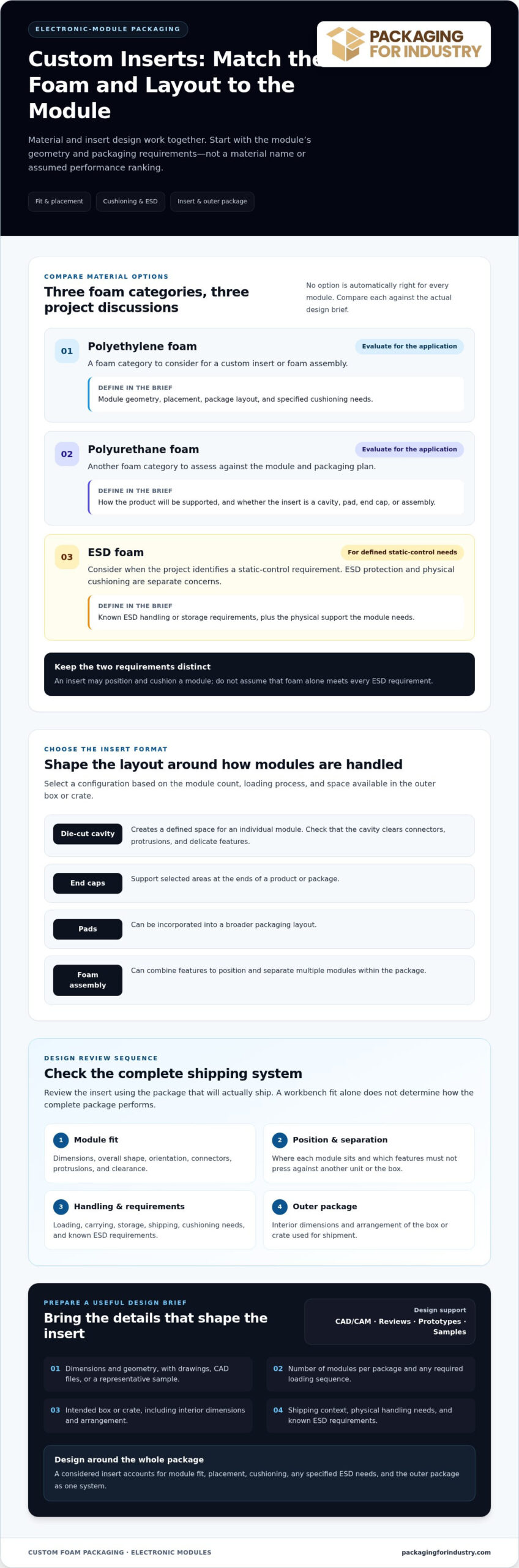
Material and layout decisions work together. For custom inserts for electronic modules, start with the module’s shape, positioning, and packaging requirements. Then compare foam categories and insert formats against those needs instead of assuming one material or design suits every shipment.
| Option | Useful design discussion | What to define in the project brief |
|---|---|---|
| Polyethylene foam | A foam category to consider for a custom insert or foam assembly. | Module geometry, placement, package layout, and any specified cushioning needs. |
| Polyurethane foam | Another foam category to evaluate against the module and packaging plan. | How the product will be supported and whether the insert is a cavity, pad, end cap, or part of an assembly. |
| ESD foam | An option for projects with defined static-control requirements. | Known ESD handling or storage requirements, plus the physical support the module needs. |
How do polyethylene and polyurethane foam differ as insert options?
Polyethylene and polyurethane are distinct foam categories, but the material name alone does not determine the right choice. Match the selection to the module’s geometry, placement, package configuration, and project requirements. Avoid choosing based on a general claim that one is best. PFI’s custom foam packaging can be developed around the specific application.
The insert format also determines how modules are located and handled. A die-cut cavity creates a defined space for an individual module. End caps support selected areas at the ends of a product or package, while pads can be incorporated into a broader layout. For multiple modules, a foam assembly can combine features to position and separate units within the package. Choose a configuration based on the number of modules, loading process, and space available in the outer box or crate.
How should ESD needs and physical cushioning be specified?
Specify static-control requirements separately from cushioning and positioning needs. A project may require physical support, ESD foam, or both, depending on the module and its handling process. The ESD Association provides guidance on ESD protective packaging standards. Use known requirements from your own process to guide material discussions, and do not assume every foam option provides the same function.
For an Orange County packaging project, include the module layout, intended package, and known ESD requirements in the design brief. PFI can use these details to develop a foam insert concept. To discuss a specific configuration, request a foam packaging quote.
Will a Custom Insert Protect the Module in Its Actual Shipping Package?
An insert can help position and cushion a module, but it cannot determine how the complete package will perform on its own. The fit between module and cavity, the position of each unit, the cushioning arrangement, and the outer box or crate all affect the design. Review them together using the package that will actually ship.
For example, an insert that fits a module on a workbench may not sit correctly inside the shipping box. If the box dimensions change, the insert layout may need to change too. Include the shipping method and handling context in the design brief. Those details help the packaging design reflect the actual configuration instead of treating the insert in isolation.
What should a prototype review check?
A prototype or sample lets your team inspect the proposed fit and packing sequence before a wider rollout. Load the module as warehouse staff would, then check whether it seats in the intended orientation and stays positioned during ordinary handling.
Check that cavities accommodate connectors and protrusions without forcing the module into place or leaving important features unsupported. Review how modules sit beside one another, how the insert fits inside the outer package, and whether operators can load and remove products consistently. A sample review is a practical design step, not a guarantee of shipping outcomes.
When should the insert and outer box be designed together?
Design the insert and outer package together when the inner fit depends on the box’s dimensions or structure. A foam-lined box, for instance, needs coordinated space for the module, insert, and box interior. The shipping method and package configuration help define the design brief and guide the overall layout.
PFI can bring custom foam inserts and corrugated packaging into one design discussion. Reviewing the insert alongside custom corrugated boxes helps align the components and clarify how the package will be assembled and handled.
For electronics manufacturers in Orange County, a system-level review can help identify unnecessary space or extra packaging components that affect packing efficiency and costs. PFI’s custom packaging design support includes CAD/CAM, design reviews, prototypes, and samples. Share your module and shipping-package details to begin a custom packaging design discussion.
How to Prepare a Custom Insert Quote Request
A clear packaging brief turns a request for custom inserts for electronic modules into a focused design discussion. Gather the details below before requesting a quote. If some information is unavailable, state what you know and identify what still needs review.
What information helps define the insert?
Document the module and its normal handling process, not just the product name. Drawings, CAD files, or a representative sample help communicate geometry and layout needs.
How can the packaging brief include the full solution?
Describe the complete package and recurring operational requirements. This connects the insert to the box, loading process, and shipping context.
- 1. Record module details. Provide dimensions, overall shape, orientation, and quantity per package. Identify connectors, protrusions, clearance areas, and surfaces that should not contact other modules.
- 2. Share design references. Include available drawings, CAD files, or a representative sample. Note product variations that could affect cavity layout.
- 3. Describe normal handling. Explain how modules are stored, moved, loaded into packaging, and prepared for shipment. Include the shipping method and destination context where known.
- 4. State ESD requirements. Document known static-control requirements and relevant handling or storage procedures. Separate these from physical cushioning needs so each can be addressed in the design discussion.
- 5. Explain the package you need. Indicate whether the project calls for foam inserts alone, a foam-lined box, or related packaging components. Include the current outer package’s dimensions or a sample if available.
- 6. Describe current problems. Note if modules shift, contact one another, arrive damaged, or take too long to pack. Specific observations help focus design reviews on the operational issue.
- 7. Include repeat-order needs. Share expected order patterns and quantities, plus any changes in shipment volume. Recurring requirements can inform a practical approach to ongoing packaging supply.
With these details assembled, PFI can discuss the packaging requirement and support custom design development with CAD/CAM, design reviews, prototypes, and samples. A well-prepared brief also helps you compare packaging pricing against the needs of your electronics operation.
Custom Electronic-Module Inserts from PFI: Design Through Supply
For electronics and semiconductor operations, packaging design needs to reflect the module, how teams handle it, and the shipment it will travel in. PFI develops custom foam inserts and foam assemblies, including ESD foam options, and can consider them alongside a foam-lined box or corrugated outer package when the project calls for an integrated solution. This keeps the design discussion focused on the complete packaging system, not just a stand-alone insert.
How does PFI approach a custom packaging project?
The design discussion starts with the module and its packaging needs: product geometry, placement, known ESD requirements, handling process, and shipping context. CAD/CAM support helps develop the design, while reviews provide an opportunity to assess the proposed layout. If the application needs a foam assembly or foam-lined box, those elements can be considered with the outer package.
This approach suits recurring industrial requirements as well as new packaging projects. Manufacturers reviewing broader manufacturing packaging solutions can consider how a custom insert fits their packing workflow and supply needs.
What happens after the design brief is ready?
Share available module dimensions, drawings or CAD files, quantities, the current package, shipment context, and known ESD handling requirements. Include recurring order patterns and the packaging issues you want the design to address. These details give PFI a useful starting point for a tailored packaging quote and design review.
Prototypes and samples let your team review a proposed design before a wider rollout. Assess how the module sits in the insert, how the insert fits the intended package, and whether the layout works with the normal packing process. The review can inform refinements without treating a sample as a guarantee of shipment results.
PFI supports custom packaging development from initial design discussions through prototype and sample review. For electronics manufacturers in Orange County, Los Angeles, San Diego, and Riverside, this provides a clear path from a packaging requirement to a solution designed around the module and shipping package. Submit your project details to begin.
Build a Better-Fitting Packaging System for Your Modules
Choosing custom inserts for electronic modules involves more than selecting foam. Module geometry, placement, known ESD requirements, handling, and the outer shipping package all inform the design. Reviewing these needs together helps your team plan packaging for consistent packing and address shipment risks.
PFI works with electronics and semiconductor manufacturers on custom foam inserts, ESD foam options, and foam assemblies. Where the project calls for it, foam can be combined with corrugated packaging as an integrated solution. CAD/CAM support, design reviews, prototypes, and samples give your team a path to develop and review a packaging concept before broader use.
Bring your module details, package information, order needs, and known handling requirements to the quote discussion. These inputs help shape a solution around your operation.
With a clear brief and a packaging system designed around the product, you can make a more informed packaging decision. PFI supports electronics manufacturers across Orange County, Los Angeles, San Diego, and Riverside with custom packaging design and supply.
Frequently Asked Questions
Do electronic modules always need ESD foam inserts?
Not every electronic module automatically needs ESD foam. The choice depends on the module’s known static-control requirements and its handling and storage process. Foam used to locate or cushion a product serves a different role from material selected for ESD requirements, so do not assume one addresses the other. Describe your established ESD procedures in the packaging brief. PFI offers ESD foam as an option within custom protective packaging.
How do I choose foam for custom inserts for electronic modules?
Choose foam based on the module’s geometry, intended placement, packaging configuration, and project requirements. Polyethylene foam, polyurethane foam, and ESD foam are categories to consider, not a universal ranking of performance. Define whether the insert needs cavities, pads, end caps, or an assembly, and state known ESD requirements separately from cushioning needs. PFI can use your project details to guide custom foam design discussions.
Can custom foam inserts be designed around connectors and irregular shapes?
Yes. Custom foam inserts can be designed around a module’s shape and features, including connectors and protrusions that affect cavity layout or require clearance. Share dimensions and orientation along with drawings, CAD files, or a representative sample when available. These references help inform the design and make it easier to review how the module sits in the insert and how the insert fits within its package.
What information should I provide for a custom insert quote?
Provide module dimensions, orientation, quantity per package, and available drawings, CAD files, or samples. Describe how the modules are handled, stored, packed, and shipped, and include current box or crate details if available. Note known ESD requirements, areas needing clearance or separation, existing packaging problems, and expected repeat-order patterns. These details help PFI discuss a design and prepare a tailored packaging quote.
Should I order a custom insert separately from the shipping box?
That depends on how closely the insert relies on the outer package for fit and placement. If you already use a suitable box, its interior dimensions can inform the insert design. If the package is changing, or you need a foam-lined box, consider foam and corrugated packaging together. PFI can combine these components in an integrated solution, with the project brief guiding whether they’re developed separately or as a system.
Can I review a sample before moving to a larger order?
Yes. PFI provides prototypes and samples as part of custom packaging development. A review lets your team check how the module seats, whether the layout accommodates its features, and how the insert fits the intended package and packing process. Use that review to assess the design and identify refinements before a wider rollout. A sample helps evaluate fit and handling, but does not guarantee shipping outcomes.
Can custom inserts support recurring electronics production needs?
Yes. A custom insert can be developed for an ongoing packaging requirement, with repeat quantities and normal packing processes included in the design discussion. Share how often you order, how modules are packed, and any supply or storage considerations. PFI serves electronics and semiconductor manufacturers in Orange County, Los Angeles, San Diego, and Riverside, and can discuss custom packaging in the context of recurring industrial needs.