
A single non-compliant wood pallet can halt an entire high-value shipment at Los Angeles International Airport, leading to expensive storage fees and missed delivery windows. For manufacturers in Carson or Torrance, the challenge isn’t just about finding a platform. It’s about engineering custom pallets for air freight from LAX that balance structural integrity with minimal tare weight. Every additional pound of pallet weight translates directly into higher fuel surcharges and reduced profit margins.
We know that navigating the intersection of ISPM 15 regulations and air freight economics is a constant source of operational stress for logistics managers. You need to ensure your electronics or aerospace components arrive safely without paying for unnecessary bulk. This guide explains how to specify custom, heat-treated pallets that satisfy international export standards while slashing your total shipping costs.
We’ll examine the technical requirements for air-ready platforms, the benefits of lightweight custom designs, and how local Southern California logistics support can streamline your transit through one of the world’s busiest cargo hubs.
Key Takeaways
- Identify why standard pallet dimensions often lead to inefficient space utilization in air cargo containers and how custom sizes available can resolve these logistical gaps.
- Learn how to specify custom pallets for air freight from LAX that minimize tare weight to reduce fuel surcharges while maintaining the durability required for rigorous airport handling.
- Ensure seamless international transit by implementing ISPM 15 compliant heat treatment processes for all wood packaging materials to avoid terminal delays.
- Leverage local next-day delivery and VMI programs in Southern California to maintain supply reliability and lower overall packaging costs for facilities in Carson and Torrance.
- Discover how to integrate custom foam inserts with engineered pallet systems to provide maximum protection for sensitive aerospace and electronic components.
Air Freight Logistics at LAX: Why Standard Pallets Fail
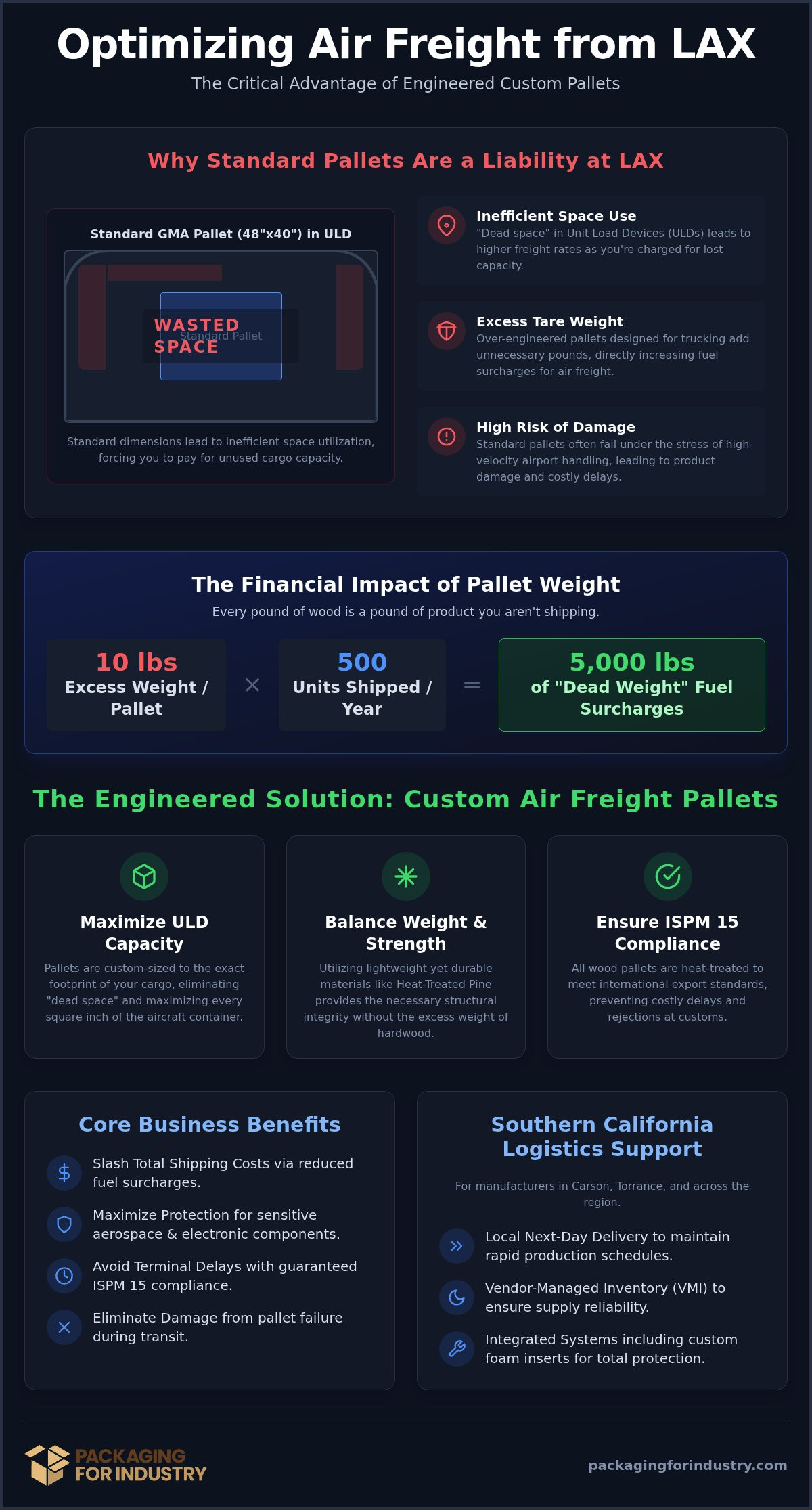
Standard GMA 48×40 pallets are the backbone of domestic trucking, but they’re often a liability at LAX cargo terminals. Most air freight travels inside Unit Load Devices (ULDs), which are contoured to fit the fuselage of specific aircraft. When you use standard dimensions, you often leave “dead space” in these containers. This inefficiency doesn’t just waste volume; it forces freight forwarders to charge higher rates to compensate for the lost capacity. Using custom pallets for air freight from LAX allows you to maximize every square inch of the ULD, ensuring your cargo fits the specific footprint of the aircraft belly or main deck.
Understanding the LAX Cargo Environment
For manufacturers in Carson and Torrance, proximity to LAX means rapid turnaround is expected. However, rapid handling at the terminal puts immense stress on wood packaging. Standard pallets often fail during the high-velocity loading and unloading processes common in air transit. Forklift punctures, deck board shearing, and collapsed stringers are frequent points of failure when a pallet isn’t engineered for the specific weight distribution of aerospace or medical components. Custom-designed bases provide the necessary reinforcement at critical stress points without adding unnecessary bulk. We work closely with freight forwarders to ensure every base matches the specific requirements of the intended airframe.
The Financial Impact of Pallet Weight
Air freight costs are determined by “chargeable weight,” which is the greater of the actual weight or the volumetric weight of the shipment. Every pound of wood you ship is a pound of product you aren’t shipping. If your pallet is over-engineered by just 10 pounds, and you ship 500 units annually, you’re paying for 5,000 pounds of “dead weight” fuel surcharges. Our custom design packaging services focus on identifying the exact material requirements for your load. We select softwood or composite options that maintain structural integrity while shaving off every possible ounce of tare weight. This precision engineering directly impacts your bottom line by helping you lower packaging costs and reduce total freight spend. Precision doesn’t just protect the product; it protects your margins.
- Standard Pallets: Often too heavy and sized for trucks, leading to ULD dead space.
- Custom Air Pallets: Engineered for specific aircraft contours and lightweight materials.
- Failure Points: Most damage occurs during rapid terminal sorting and ULD consolidation.
Choosing custom pallets for air freight from LAX ensures your shipment is optimized for the specific economics of air travel. By reducing the footprint and weight of the transit base, you eliminate the fiscal waste associated with off-the-shelf solutions.
Engineering Custom Pallets: Balancing Weight and Strength
Engineering a pallet for air cargo requires a shift in priorities. In trucking, durability often comes from bulk; in the air, every ounce of material must justify its existence. High-performance custom pallets for air freight from LAX are designed using a “material where it matters” approach. We analyze the footprint of your specific cargo to determine the optimal placement of deck boards and stringers. This ensures the base supports the load without carrying excess wood that inflates your freight bill. Specifying custom pallets for air freight from LAX allows for precise forklift entry points tailored to both your warehouse equipment and the rapid-handling needs of airport terminals.
Material Optimization for Air Cargo
We primarily utilize heat-treated (HT) pine for weight-sensitive air shipments. It offers a superior strength-to-weight ratio compared to hardwood, which is often too heavy for cost-effective air transit. For specialized industrial machinery, we design heavy-duty skids that distribute weight across the floor of the ULD to prevent floor-loading violations. If your shipment has a unique footprint, we create custom sizes available to prevent overhang. Composite materials are also an option when moisture resistance and extreme weight reduction are paramount for long-haul international routes.
Protection doesn’t stop at the wood. For sensitive electronics or medical devices, we integrate custom foam packaging directly onto the pallet deck. This creates a shock-absorbing buffer that mitigates the vibrations experienced during takeoff and landing. By combining the pallet and protective cushioning into a single engineered unit, we reduce the overall profile of the shipment. This integration helps you lower packaging costs by eliminating the need for oversized outer containers and redundant internal padding.
Structural Integrity for High-Value Goods
Aerospace components often have irregular centers of gravity that can cause standard pallets to tip or fail. We use custom blocking and bracing techniques to secure these parts directly to the pallet stringers, ensuring the load remains centered. This prevents shifting during the rapid lateral movements common in airport ground handling. Before moving to full-scale manufacturing, we offer free prototyping to ensure the fit is exact. This proactive step eliminates the risk of transit damage and ensures your high-value goods are flight-ready the moment they leave your facility.
Logistics efficiency at the terminal depends on speed. We design our custom bases with four-way forklift and pallet jack entry to ensure they can be handled from any angle. This accessibility is critical in the tight confines of cargo holds where maneuverability is limited. If you want to optimize your logistics chain and reduce chargeable weight, you can request a packaging quote to see how an engineered approach saves money.
ISPM 15 Compliance and International Export Standards
International shipping involves more than just structural engineering; it requires strict adherence to global phytosanitary regulations. The International Standards for Phytosanitary Measures No. 15 (ISPM 15) is a mandatory requirement for all wood packaging materials crossing international borders. For logistics managers, selecting custom pallets for air freight from LAX ensures that every piece of wood in your shipment is legally compliant and ready for global transit. Customs authorities at international hubs are vigilant. If your wood packaging lacks the proper certification, your entire shipment can be grounded, leading to significant delays and financial penalties.
The Heat Treatment Certification Process
The core of ISPM 15 compliance is the Heat Treatment (HT) process. This requires wood to be heated until its core temperature reaches at least 56 degrees Celsius for a minimum of 30 minutes. This specific protocol eliminates wood-boring pests that could threaten foreign ecosystems. Once treated, the wood is marked with the International Plant Protection Convention (IPPC) stamp. This mark includes the country of origin, the unique producer code, and the HT treatment designation. It’s a permanent identifier that tells customs officials the material is safe for entry. If you’re using recycled materials, they must be re-certified and re-stamped if any boards are replaced or modified, as the original certification is tied to the integrity of the initial unit.
Compliance for Aerospace and Electronics
In sectors like aerospace and electronics, cleanliness is as important as compliance. Heat-treated wood is naturally drier than green lumber, which reduces the risk of mold and moisture damage to sensitive tech components. We ensure that the HT process doesn’t compromise the material strength required for your specific load. For total protection, many manufacturers integrate these pallets with custom shipping crates that meet the same rigorous ISPM 15 standards. This holistic approach to packaging ensures that your goods are protected from both biological and physical threats during their journey from Southern California to their final destination.
Non-compliance is an expensive mistake. Beyond the risk of fines, your shipment could be denied entry, forced into expensive off-site quarantine, or even destroyed at your expense. By sourcing custom pallets for air freight from LAX that are fully certified and stamped, you eliminate these variables from your supply chain. We provide the necessary documentation to ensure your paperwork is as ready as your product. If you’re planning an international launch and need to compare packaging pricing for compliant solutions, our team can provide the technical guidance to keep your cargo moving without incident.
Procurement Strategies for Southern California Manufacturers
Manufacturers in the South Bay and LAX-adjacent corridors often struggle with the logistical friction of long-distance procurement. Sourcing custom pallets for air freight from LAX from local suppliers removes the uncertainty of national shipping delays. When your production schedule relies on immediate outbound air cargo, a three-day delay in pallet delivery is unacceptable. Local next-day delivery options allow you to maintain a lean warehouse while ensuring your aerospace or medical components are always flight-ready.
Optimizing Your Pallet Supply Chain
Traditional procurement models often lead to either overstocking or critical shortages. We solve this through Vendor Managed Inventory (VMI) programs tailored for industrial pallets. By monitoring your usage patterns, we manage the replenishment process for you. This prevents production stops and frees up valuable square footage in your facility. Instead of storing 500 pallets on-site, you can utilize our off-site stocking programs and receive just-in-time delivery based on your actual air freight volume. This proactive approach ensures you never face a shipping delay due to a lack of compliant wood packaging.
Lowering Total Packaging Costs
Many businesses mistakenly compare packaging pricing solely on a per-unit basis. However, national catalog suppliers often hide the true cost of procurement in high shipping fees and rigid lead times. We offer a cost-saving alternative by consolidating your supplies. Beyond pallets, you can source stretch film and corner and edge protection from a single local partner. This consolidation reduces administrative overhead and lowers total packaging costs through tiered replenishment strategies. You don’t have to manage multiple vendors or pay multiple freight charges for basic warehouse supplies.
Hidden costs in standard procurement often include the emergency surcharge when you need a custom size quickly. Because we offer free prototyping and local manufacturing, we eliminate those premiums. Our goal is to provide a transparent system where you only pay for the protection you need. By engineering custom pallets for air freight from LAX that minimize weight and maximize space, the savings extend far beyond the unit price of the wood. You’re reducing the chargeable weight of every shipment while improving supply reliability.
Why PFI is the Preferred Choice for LAX Air Freight
PFI doesn’t just sell wood; we provide logistical insurance for your most critical shipments. For businesses operating near the airport, the ability to source custom pallets for air freight from LAX from a partner that understands the specific handling protocols of local terminals is a significant competitive advantage. We bridge the gap between the engineering requirements of your product and the economic constraints of the airline. Our proximity to the South Bay allows for local next-day delivery to facilities in Carson and Torrance, as well as the Inland Empire. This proximity isn’t just about speed; it’s about the accountability that comes with a local industrial partnership.
Tailored Solutions for Specialized Industries
Aerospace engines and defense components require skids that handle massive, uneven loads without failing under the G-forces of takeoff. We design these using reinforced stringer configurations and integrated blocking systems that exceed standard industrial specs. For electronics manufacturers, we incorporate ESD-safe foam packaging to prevent static discharge and vibration damage during long-haul flights. Medical device manufacturers rely on us for packaging that meets strict cleanliness protocols, ensuring that the heat-treated wood and protective cushioning don’t introduce contaminants into sensitive environments. By combining custom pallets for air freight from LAX with custom-engineered crates, we provide a total protection system that slashes damage rates and ensures your cargo arrives in “as-shipped” condition.
Get a Custom Pallet Quote
Our process begins with a technical review of your current packaging performance. We use CAD design to model the optimal base for your product, focusing on weight reduction and structural stability. This engineering-first approach identifies exactly where we can shave off unnecessary material to lower your chargeable weight. We offer free prototyping for custom designs, allowing you to test the fit and function before committing to a full production run. This proactive step eliminates the risk of over-engineering or under-protecting your goods, both of which are costly mistakes in the air cargo world.
If you’re seeing high freight surcharges or frequent handling damage at the terminal, it’s time for a professional packaging audit. We focus on the intersection of engineering and economics to ensure your supply chain is as efficient as possible. Our team is ready to help you optimize your outbound logistics with reliable, ISPM 15 compliant solutions.
Optimize Your Air Cargo Logistics Today
Successful air cargo operations require a precise balance between structural durability and fiscal efficiency. By specifying custom pallets for air freight from LAX, you ensure every shipment meets mandatory ISPM 15 heat treatment standards while minimizing the “chargeable weight” that inflates your freight bills. Our specialized expertise in aerospace and medical packaging allows us to design bases that integrate seamlessly with custom foam and protective crates. This holistic approach reduces damage risks and ensures your high-value goods are flight-ready the moment they leave your facility.
Managing a complex supply chain shouldn’t be a source of professional stress. When you consolidate your supplies with a local partner, you gain access to vendor-managed inventory programs that prevent costly production stops. Leveraging local next-day delivery in Southern California provides the supply reliability needed to maintain a lean, just-in-time warehouse operation. It’s time to stop paying for unnecessary bulk and start streamlining your outbound transit with engineered solutions that protect your margins.
We look forward to helping you optimize your next international shipment and improve your logistical flow.
Frequently Asked Questions
What are the standard dimensions for air freight pallets at LAX?
Standard GMA 48×40 pallets are frequently used, but they’re rarely the most efficient choice for air cargo. Most air freight is consolidated into Unit Load Devices (ULDs), which have specific internal footprints such as 88×125 or 96×125 inches. We provide custom sizes available to ensure your shipment maximizes the usable volume of these containers. This precision prevents wasted space and reduces the likelihood of your cargo shifting during the rapid handling cycles at LAX terminals.
Do custom pallets for air freight need to be ISPM 15 certified?
Yes, ISPM 15 certification is mandatory for all wood packaging materials crossing international borders, including those exported from LAX. This regulation requires wood to undergo heat treatment to eliminate pests. Every pallet must feature the IPPC stamp, which serves as a permanent record of compliance for customs officials. Using non-certified wood can lead to immediate shipment rejection, quarantine, or heavy fines. We ensure all our custom pallets for air freight from LAX meet these rigorous global standards.
How does pallet weight affect my air freight shipping costs?
Pallet weight directly impacts your chargeable weight, which is the metric airlines use to calculate shipping fees. Since air freight costs are significantly higher than ground transport, every additional pound of wood increases your fuel surcharges. Our engineering team focuses on material optimization, using lightweight heat-treated softwood to maintain structural integrity while shaving off tare weight. This approach helps manufacturers lower packaging costs by ensuring they aren’t paying to ship unnecessary bulk across the globe.
What is the difference between a pallet and a heavy-duty skid?
The primary difference lies in the base construction; a pallet has both top and bottom deck boards, while a skid is a single-deck platform resting on stringers or blocks. Skids are often preferred for heavy industrial machinery because they lack bottom boards, making them easier to drag or position in tight spaces. We design heavy-duty skids for aerospace components that require high weight-bearing capacities and specialized blocking to secure irregular centers of gravity during flight.
Can I get custom pallets delivered next-day in Southern California?
We provide local next-day delivery for many of our standard and custom products throughout Southern California, including Carson, Torrance, and the Inland Empire. This rapid turnaround is essential for businesses that operate with lean inventory levels or face sudden spikes in air freight volume. By partnering with a local supplier, you can maintain a just-in-time supply chain. You can request a packaging quote to see how our local support reduces your lead times and shipping costs.
Does PFI offer prototyping for new custom pallet designs?
PFI offers free prototyping for all new custom designs to ensure your product fits perfectly before we begin a full production run. This process allows our engineers to verify the structural integrity and weight of the pallet using actual load samples. Prototyping is a critical step for manufacturers who need to compare packaging pricing and performance for high-value aerospace or medical equipment. It eliminates the risk of transit damage and ensures your packaging is fully optimized.
How do I know if my pallets are ISPM 15 compliant?
You can verify compliance by looking for the IPPC mark permanently stamped onto the wood. This mark must include:
- The IPPC symbol.
- A two-letter country code (e.g., US).
- A unique producer or treatment provider code.
- The “HT” designation for heat treatment.
Documentation provided at purchase also serves as proof. We maintain strict quality control to ensure every stamp is legible, preventing administrative delays at international customs checkpoints.
What industries benefit most from custom air freight pallets?
The aerospace, electronics, and medical device sectors benefit most from custom pallets for air freight from LAX due to their high-value and sensitive nature. These industries require precision-engineered bases that incorporate custom foam packaging for shock absorption and ESD protection. By moving away from one-size-fits-all options, these sectors can significantly reduce shipping damage and improve logistical flow. Our custom solutions are designed to meet the stringent cleanliness and reliability standards these specialized fields demand.