
What if the most expensive part of your logistics chain isn’t the freight carrier, but the empty air and inefficient cushioning inside your boxes? You’ve likely seen the “damage tax” eat into your margins when fragile aerospace or medical components arrive broken. It’s frustrating to watch UPS and FedEx surcharges climb because your packaging is oversized, or to wait weeks for a national catalog supplier to ship a standard insert that doesn’t quite fit. Working with a specialized foam packaging fabricator Anaheim businesses trust can turn these logistical hurdles into a clear competitive advantage.
By focusing on custom-engineered inserts, you can ensure zero-damage shipping for high-value parts while significantly reducing the physical footprint of your parcels. This article explains how a local partner can eliminate transit damage, optimize dimensional weight to lower surcharges, and streamline your supply chain using vendor-managed inventory (VMI). We’ll explore the technical benefits of materials like polyethylene and ESD foam, demonstrating how local engineering provides a faster, more reliable alternative to generic catalog options. Discover how the “Anaheim Advantage” can lower your total cost of ownership and improve delivery reliability across Southern California.
Key Takeaways
- Learn why choosing a local foam packaging fabricator Anaheim reduces lead times and eliminates the high freight costs associated with national catalog suppliers.
- Understand the technical differences between polyethylene and polyurethane foams to ensure your high-value components receive the correct density of protection.
- Discover how custom die-cutting and CNC routing can optimize your dimensional weight, helping you avoid expensive carrier surcharges.
- Explore how Vendor Managed Inventory (VMI) and kitting services can reclaim warehouse space and reduce labor time for your assembly team.
The Strategic Advantage of Local Foam Packaging Fabrication in Anaheim
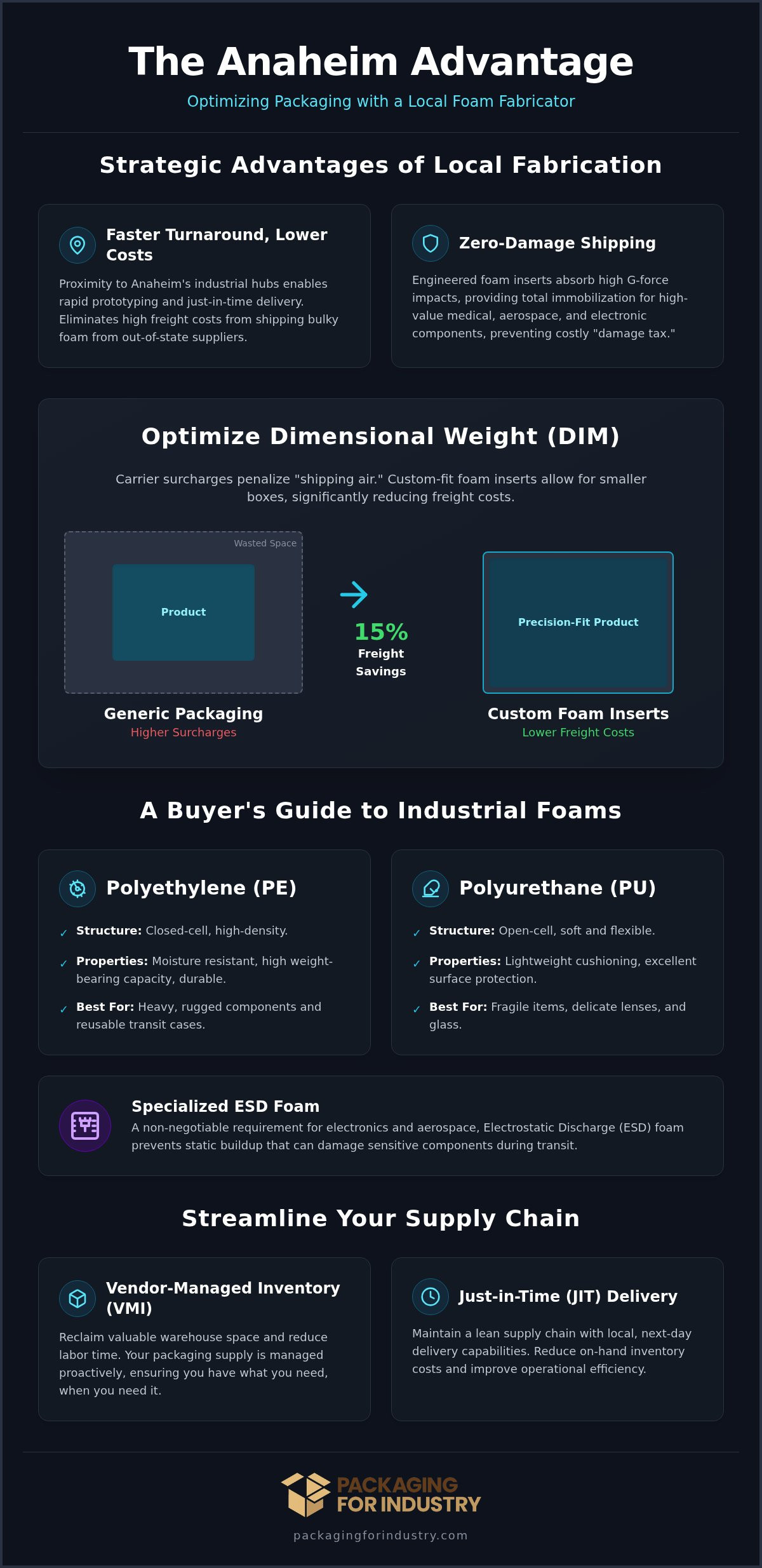
Custom foam fabrication is the engineering of specific material densities and geometries to immobilize high-value products within their containers. For manufacturers in Orange County, choosing a local foam packaging fabricator Anaheim offers a distinct logistical edge. Proximity to the Anaheim Industrial Park and local logistics hubs reduces lead times significantly compared to national catalog suppliers. This local presence allows for rapid prototyping and just-in-time delivery, which is essential for maintaining a lean supply chain. It also eliminates the freight costs associated with shipping bulky, uncompressed foam from out-of-state facilities, ensuring your packaging budget is spent on protection rather than transport.
Beyond speed, the financial impact of custom protection is substantial. Every broken component carries a “damage tax” comprising the cost of the return, the replacement, and lost reputation. Precision Package cushioning materials mitigate these risks by providing repeatable, calibrated protection. A foam packaging fabricator Anaheim helps you move from reactive damage control to proactive cost management. By investing in custom engineering, you replace the recurring cost of transit failures with a one-time design solution that protects your bottom line.
Eliminating Transit Damage for High-Value Goods
Engineered foam absorbs high G-force impacts that standard bubble wrap cannot handle. While bubble wrap offers surface protection, it fails when heavy components crush the air pockets during a drop. Foam inserts provide total immobilization, preventing surface abrasion on polished medical instruments or sensitive electronics. Shock absorption is defined as the ability of a material to dissipate kinetic energy during impact, typically measured by G-force transmission under ASTM standards. This technical precision ensures your product survives the rigors of the modern hub-and-spoke distribution system without requiring excessive outer wrap.
Optimizing Dimensional Weight (DIM) to Lower Freight Costs
In 2026, carriers like UPS and FedEx enforce strict dimensional weight rules that penalize “shipping air.” Because carriers round up to the nearest whole inch, even a small amount of excess space pushes parcels into higher pricing tiers. Custom inserts allow for smaller corrugated boxes. Reducing box dimensions by just two inches can save 15% in freight costs by optimizing the DIM factor. This strategy is critical for e-commerce and industrial distributors who need to maintain margins despite rising carrier surcharges. Precision-fit foam ensures you aren’t paying to ship empty space.
Selecting the Right Material: A Buyer’s Guide to Industrial Foams
Choosing the correct material is a technical decision that balances product weight with fragility. A qualified foam packaging fabricator Anaheim partner will analyze your G-force requirements to select between closed-cell and open-cell structures. This selection process is vital for maintaining U.S. manufacturing standards for quality and durability in the supply chain. Using the wrong density can lead to “bottoming out” during a drop, while over-engineering leads to unnecessary material costs.
Polyethylene vs. Polyurethane: Which Density Do You Need?
Polyethylene (PE) serves as the industrial workhorse for heavy, rugged components. As a closed-cell foam, it resists moisture and provides a high weight-bearing capacity that won’t collapse under heavy loads. It’s the preferred choice for recurring shipping cycles and reusable transit cases where durability is paramount. In contrast, Polyurethane (PU) is an open-cell foam. It offers soft, flexible protection for lightweight items, fragile glass, or delicate lenses. While PU has a lower initial price point, PE’s resilience often makes it more cost-effective for long-term industrial use. If you aren’t sure which density fits your specific application, you can request a packaging quote to receive a professional engineering assessment.
Specialized ESD Foam for Electronics and Aerospace
For Anaheim’s semiconductor and electronics sectors, ESD (Electrostatic Discharge) foam is a non-negotiable requirement. Anti-static foam prevents triboelectric charging, which is the buildup of static electricity caused by the friction of products rubbing against packaging during transit. This is critical in aerospace packaging, where even a small discharge can compromise sensitive flight systems. Color-coding standards help warehouse teams identify protection levels quickly. Pink foam is generally treated with anti-static agents to prevent charge generation, while black foam is typically conductive or dissipative, providing a path for existing charges to safely bleed off.
For medical device manufacturers, Cross-linked Polyethylene (XLPE) provides a much finer, more uniform cell structure than standard PE. This makes it exceptionally non-abrasive, which is a critical requirement for components with highly polished surfaces. XLPE also offers high chemical resistance and doesn’t shed particles, making it suitable for cleanroom environments. Its superior aesthetics also enhance the presentation of high-value kits, ensuring that the packaging reflects the quality of the engineered part inside. Matching the material to the specific environmental and physical stresses of your supply chain is the first step toward zero-damage shipping.
Precision Fabrication Methods: Die-Cutting vs. CNC Routing
A professional foam packaging fabricator Anaheim manufacturers rely on doesn’t just cut material; they engineer a manufacturing process based on your specific production volume and part complexity. The bridge between your engineering files and a physical prototype is our integrated CAD/CAM system. This technology allows us to move from digital designs to physical samples in days, not weeks. Because precision is critical for industrial protection, PFI provides free prototyping to ensure a perfect fit before you commit to a full production run. This phase is also where we evaluate material compliance with shifting environmental regulations for foam packaging, ensuring your supply chain remains resilient and compliant.
When to Invest in Die-Cut Tooling
Die-cutting is the high-volume solution for consistent, repetitive foam inserts. While this method requires an initial investment in custom steel-rule dies, the per-unit cost drops significantly as volume increases. For recurring production lines, the speed advantage of die-cutting is unmatched, often processing hundreds of inserts in the time it takes to route a dozen. This method is particularly effective for high-density polyethylene used in foam packaging applications that require high throughput. Die-cutting ensures 100% repeatability for RSC box inserts, meaning every part fits exactly the same way every time. When you compare packaging pricing for long-term contracts, the ROI on die tooling usually breaks even within the first few thousand units.
The Flexibility of CNC Routing for Complex Components
CNC routing is the precision choice for complex, multi-depth parts and low-to-medium volumes. Unlike die-cutting, CNC routing uses a computer-controlled spindle to carve intricate geometries directly from foam blocks, eliminating the need for expensive tooling. This makes it ideal for multi-layered shadow foam trays where different components sit at varying depths. It’s also the superior choice for evolving product designs or short-run aerospace components that require tight tolerances. We use CNC routing to handle the intricate geometries required for medical and aerospace parts, where a standard die-cut might not capture the necessary detail. This flexibility allows you to lower packaging costs on small batches by avoiding upfront setup fees. Whether you’re shipping a single satellite component or a thousand medical kits, our Anaheim facility has the fabrication technology to match your scale.
Streamlining Procurement with VMI and Just-In-Time Delivery
Bulk foam presents a unique logistical challenge for warehouse managers. While lightweight, fabricated foam inserts occupy significant volume, consuming valuable floor space that could be used for production or finished goods. In a market where Orange County industrial asking rents averaged approximately $19.39 per square foot in the second quarter of 2026, “shipping air” within your own warehouse is a costly inefficiency. Partnering with a foam packaging fabricator Anaheim businesses can access locally allows you to offload this storage burden to us. We transform your packaging from a space-consuming liability into a streamlined, just-in-time resource.
Our approach focuses on lowering your Total Cost of Ownership (TCO). By reducing the need for emergency orders and minimizing administrative overhead, we help your team focus on core manufacturing tasks. We don’t just deliver a product; we manage a system of protection that adapts to your fluctuating production schedules. This proactive problem-solving ensures that your packaging supply is as precisely engineered as the foam inserts themselves.
The Financial Benefits of VMI for Packaging
Vendor Managed Inventory (VMI) fundamentally shifts how you account for packaging costs. Instead of tying up capital in large bulk orders that sit on your shelves for months, you improve cash flow by paying for inventory as it’s pulled for use. PFI monitors your stock levels and automatically replenishes your supply, eliminating the risk of packaging shortages that can bring a production line to a standstill. This level of oversight provides peace of mind for high-stakes sectors like medical device manufacturing and aerospace. You can learn more about how we manage these logistics through our Vendor Managed Inventory services.
Local Next-Day Delivery in Southern California
The “Anaheim Advantage” is rooted in proximity. PFI operates a dedicated fleet of trucks serving Anaheim, Irvine, and the greater Los Angeles area. This local sourcing reduces freight costs and minimizes the environmental impact of your supply chain, which is increasingly important as California’s SB 54 regulations take full effect. Being local also means we’re available for on-site packaging reviews. We can visit your facility to observe how the foam performs on the assembly line and make real-time design adjustments to improve efficiency. This collaborative relationship ensures your protection strategies evolve alongside your products, maintaining zero-damage shipping standards without the lead times of national suppliers.
Partnering with PFI: Your Anaheim Foam Packaging Fabricator
PFI operates as more than just a component supplier; we are an integrated engineering partner. Many businesses struggle with managing multiple vendors for their protective needs, but as a premier foam packaging fabricator Anaheim manufacturers rely on, we provide a single point of accountability. We combine custom-engineered foam with heavy-duty corrugated boxes and specialized crates to create a total protection system. This holistic approach is especially critical for aerospace and military sectors, where we maintain strict compliance with Mil-Spec foam requirements and ESD standards. By sourcing your entire packaging bill of materials from one local facility, you reduce administrative overhead and ensure that every component fits with the precision your high-value parts require.
Custom Kitting: Saving Labor on the Production Floor
Labor costs on the production floor often exceed the material costs of the packaging itself. Our packaging kitting services eliminate the time your team spends folding boxes, searching for inserts, and taping seams. We deliver your packaging pre-assembled and ready for the product to be dropped in. This “Ready-to-Ship” advantage allows your technicians to focus on assembly rather than logistics. Sourcing foam, boxes, and tape from a single local partner streamlines your procurement and ensures that your assembly line never waits for a missing component. This integrated delivery model reduces the number of inbound shipments and simplifies your accounting by consolidating multiple line items into a single kit price.
Request a Packaging Review and Cost Analysis
Our engagement typically begins with a comprehensive audit of your current transit damage rates and packaging expenses. We don’t just sell foam; we design for maximum protection with minimum material waste, which is essential for both your bottom line and California regulatory compliance. During a packaging review, our engineers analyze your current failures and carrier surcharges to identify specific areas for cost reduction. We then provide a detailed analysis showing how custom engineering can lower your total cost of ownership. This consultative process ensures that every cubic inch of foam serves a functional purpose, preventing the over-packaging that leads to excessive shipping fees.
Securing Your Supply Chain with Local Engineering Expertise
Custom foam fabrication is an essential fiscal strategy for modern manufacturers. By partnering with a dedicated foam packaging fabricator Anaheim businesses can access locally, you move beyond generic catalog solutions to precision engineering. This shift directly addresses the high costs of transit damage and the rising surcharges associated with inefficient dimensional weight. Whether you require ESD protection for electronics or rugged polyethylene for heavy machinery, the right material choice paired with local fabrication ensures your products arrive in pristine condition every time.
PFI provides the technical expertise and logistical support needed to streamline your operations. Our service model includes free prototyping to guarantee fit, specialized aerospace and medical-grade compliance, and reliable local next-day delivery throughout Southern California. We help you eliminate the administrative burden of managing multiple vendors by providing integrated kitting and Vendor Managed Inventory (VMI) solutions that adapt to your specific production volume.
We look forward to partnering with your team to solve your most complex logistics challenges and protect your reputation for quality. Contact us today to begin your comprehensive packaging audit and cost analysis.
Frequently Asked Questions
What is the minimum order quantity (MOQ) for custom foam inserts in Anaheim?
Minimum order quantities depend on the fabrication method and material requirements of your specific project. As a dedicated foam packaging fabricator Anaheim manufacturers rely on, we provide flexibility for both low-volume CNC routing and high-volume die-cutting production. While we specialize in bulk industrial orders, our engineering team evaluates each request based on technical complexity and the recurring nature of your supply chain to ensure a cost-effective solution for your business.
How long does it take to get a prototype for a custom foam insert?
Our integrated CAD/CAM systems allow us to move from your engineering files to a physical prototype within a few business days. We offer free prototyping to ensure a precision fit before full-scale production begins. This rapid turnaround is a key advantage of working with a local Anaheim partner. It eliminates the long lead times typically associated with national catalog suppliers or out-of-state fabricators who must ship samples across the country for review.
Can you provide ESD-safe foam for sensitive electronic components?
We provide a full range of ESD-safe and anti-static foams designed specifically for the semiconductor and electronics industries. These materials prevent triboelectric charging during transit, protecting sensitive components from electrostatic discharge. Our inventory includes pink anti-static polyethylene and black conductive or dissipative foams. These materials are essential for maintaining compliance with strict aerospace and medical device quality standards throughout the Southern California electronics manufacturing corridor and surrounding industrial parks.
Do you offer local delivery for businesses in Orange County and Los Angeles?
PFI operates a dedicated fleet of trucks providing local next-day delivery to businesses throughout Orange County, Los Angeles, and the Inland Empire. This local proximity eliminates traditional freight costs and reduces the risk of transit delays. Our drivers frequently serve industrial hubs in Anaheim, Irvine, Brea, and Santa Fe Springs. This ensures that your production lines remain moving with a steady, reliable supply of protective packaging materials and custom inserts.
What is the difference between polyethylene and polyurethane foam for shipping?
Polyethylene (PE) is a high-density, closed-cell foam that provides superior weight-bearing capacity for heavy machinery and rugged industrial parts. It resists moisture and is highly durable for multiple transit cycles. Polyurethane (PU) is a soft, open-cell foam designed to cushion lightweight, fragile items like glass or delicate instrumentation. Choosing the correct density prevents your product from “bottoming out” during impact, which is a common cause of transit damage in poorly engineered packaging.
Can you engineer foam inserts that meet Mil-Spec or aerospace standards?
Our engineering team specializes in designing protective solutions that meet rigorous Mil-Spec and aerospace industry standards. We understand the complex documentation and material performance requirements necessary for government and aviation contracts. By utilizing specialized materials like Cross-linked Polyethylene (XLPE) and anti-static foams, we ensure your high-value components remain protected against the extreme G-forces and environmental stresses often encountered in global military logistics and specialized aerospace distribution chains.
How does custom foam help lower my UPS and FedEx shipping costs?
Custom foam inserts allow you to use the smallest possible outer corrugated box while maintaining total product protection. This optimization is critical for lowering UPS and FedEx costs because carriers base pricing on dimensional (DIM) weight rather than just physical weight. By eliminating “empty air” and reducing box dimensions by even a few inches, you can avoid expensive surcharges and significantly lower your total freight expenditure across high-volume shipping cycles.
Do you provide the boxes to go along with the custom foam inserts?
We provide a completely integrated solution by supplying both custom foam inserts and the outer corrugated boxes or crates they fit into. This includes heavy-duty RSC boxes, double-wall containers, and custom-engineered wooden crates for international transit. Sourcing your entire packaging kit from a single foam packaging fabricator Anaheim partner ensures a perfect fit between the cushioning and the container, while also simplifying your procurement process and reducing administrative overhead.