
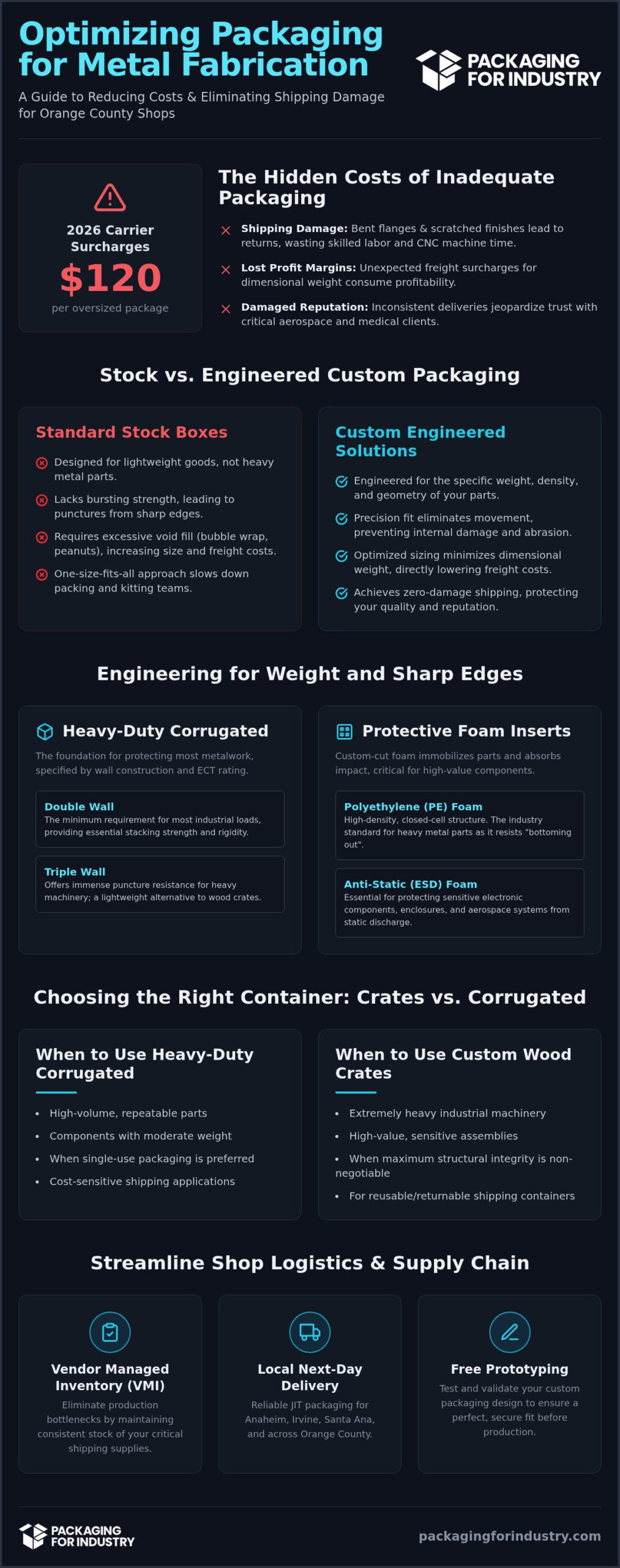
How much of your profit margin is currently being consumed by UPS and FedEx surcharges for “Additional Handling” or “Large Package” fees? You’ve likely spent weeks perfecting a precision-engineered component, only to have it arrive at the job site with a bent flange or a scratched finish because of inadequate protection. It’s frustrating when inconsistent packaging supplies slow down your production line or when freight costs spike unexpectedly. With 2026 surcharges for oversized items reaching nearly $120 per package, finding the right custom packaging for metal fabrication shops Orange County isn’t just about protection; it’s a critical financial strategy.
Precision-engineered parts require protection that matches their complexity. This guide will show you how to achieve zero-damage shipping while lowering freight costs through optimized sizing. We’ll explore engineered solutions like heavy-duty corrugated boxes and custom foam inserts designed to survive the rigors of LTL and parcel transit. You’ll gain a clear roadmap for securing your supply chain and leveraging a local partner for reliable, next-day delivery in Anaheim, Irvine, and Santa Ana.
Key Takeaways
- Prevent punctures and transit damage by selecting the correct specifications for double and triple-wall heavy-duty corrugated boxes tailored for sharp-edged metal components.
- Mitigate the impact of 2026 freight price hikes by using precision-sized packaging to stay below expensive UPS and FedEx dimensional weight surcharge thresholds.
- Evaluate the cost-effectiveness of custom wood crates versus single-use corrugated materials for shipping heavy industrial machinery and high-value metalwork.
- Streamline your shop operations with custom packaging for metal fabrication shops Orange County that includes free prototyping and local next-day delivery.
- Eliminate production bottlenecks by using Vendor Managed Inventory (VMI) to maintain consistent stock levels of your critical shipping supplies.
Protecting High-Value Metalwork: Why Custom Packaging is Non-Negotiable
Precision metalwork requires more than a simple container. When you ship high-tolerance parts across Southern California, the packaging must act as a final stage of your quality control process. Standard catalog solutions often fall short because they aren’t engineered for the specific density and geometry of fabricated metal. Utilizing custom packaging for metal fabrication shops Orange County ensures your components arrive in the exact condition they left your facility, maintaining the tight tolerances your customers demand.
The Hidden Costs of Shipping Damage
The true cost of a shipping failure extends far beyond the price of the raw materials. When a fabrication project is returned due to transit damage, you’re losing hours of CNC machine time, skilled labor, and the energy costs associated with the initial production. These operational losses can quickly erase the profit margin on a single contract. Customer trust is harder to replace than a steel plate. Consistent damage issues jeopardize your reputation with long-term aerospace or medical clients who rely on just-in-time deliveries.
Relying on insurance claims is a reactive strategy that doesn’t account for administrative overhead or the friction caused by missed deadlines. Engineering a preventative solution is a more fiscally responsible approach. By investing in industrial-grade protection upfront, you eliminate the professional stress of hoping a part survives LTL transit. It’s about securing your supply chain against the predictable vibrations and impacts of the shipping environment.
Stock vs. Custom: The Industrial Gap
Standard RSC boxes are designed for lightweight consumer goods, not 60-pound steel brackets or sharp-edged aluminum housings. These stock containers often lack the bursting strength required to contain high-density metal parts. Many shops try to compensate by using excessive amounts of bubble wrap or loose-fill peanuts. This over-packing strategy is often a sign of inefficient logistics; it adds bulk, increases dimensional weight fees, and fails to stop heavy parts from shifting and puncturing the box wall.
Professional custom design packaging addresses these gaps by creating a direct interface between the part and the container. For larger assemblies or heavy machinery, custom wood crates provide the structural integrity that corrugated materials cannot match. Choosing the right custom packaging for metal fabrication shops Orange County allows you to optimize your warehouse flow by moving away from generic, one-size-fits-all supplies that slow down your kitting and packing teams.
Engineering for Weight and Sharp Edges: Material Specifications
Shipping fabricated metal involves managing extreme density and concentrated weight. Unlike consumer goods, metal parts exert high pressure on small surface areas. This often leads to “box walk,” where the part’s vibration causes it to shift or even cut through standard containers. Implementing custom packaging for metal fabrication shops Orange County requires a technical understanding of material limits to ensure structural integrity throughout the transit cycle.
Corrugated Strength for Fabrication
Standard boxes often fail because their Edge Crush Test (ECT) rating isn’t sufficient for industrial loads. For most metalwork, double-wall corrugated is the minimum requirement. It provides the stacking strength needed to support heavy parts without collapsing. When you’re shipping heavy machinery or large structural components, triple-wall corrugated boxes offer a lightweight alternative to wood while maintaining immense puncture resistance. Many shops also benefit from weather-resistant coatings. These treatments protect the material’s integrity if parts are staged in outdoor loading docks or high-humidity environments.
Foam and Edge Protection Strategies
Selecting the right cushioning is about more than just padding. Polyethylene (PE) foam is the industry standard for metal because its closed-cell structure doesn’t bottom out under heavy weight. In contrast, softer Polyurethane (PU) is better suited for protecting sensitive finishes or light electronic enclosures. If your shop produces enclosures for data centers or aerospace systems, anti-static (ESD) foam is necessary to prevent electrostatic discharge during handling. Die-cut foam inserts ensure a precise fit, locking the part in place to prevent internal movement.
Sharp corners are the primary cause of container failure. Using heavy-duty corner and edge protection reinforces the box’s weakest points and prevents straps from crushing the package. Streamlining Shop Logistics involves more than just speed; it’s about ensuring every package is safe for warehouse personnel to handle. When sourcing custom packaging for metal fabrication shops Orange County, it’s vital to match the material density to the weight of the part. If you’re unsure which material grade fits your specific part geometry, you can request a packaging quote to evaluate custom-engineered options for your next production run.
Choosing Between Heavy-Duty Corrugated and Custom Wood Crates
Selecting the right container for industrial metalwork is a balance between material costs and total protection. While previous sections detailed the benefits of high-ECT corrugated boxes, certain fabricated assemblies require the rigid structural support of timber. The decision usually hinges on weight thresholds and the shipping destination. For components exceeding 500 pounds or those with highly irregular centers of gravity, custom packaging for metal fabrication shops Orange County often transitions from corrugated to wood to prevent container failure during mechanical handling.
When to Upgrade to Custom Wood Crates
Custom wood crates are the standard for protecting oversized frames, heavy industrial equipment, and high-precision assemblies that can’t tolerate any flex. Unlike corrugated materials, wood provides a solid anchoring point for internal blocking and bracing. This is critical for preventing heavy parts from shifting. For fabrication projects heading overseas, using custom shipping crates ensures compliance with ISPM 15 international standards, which require heat-treated wood to prevent the spread of pests.
Hybrid solutions often provide the best ROI for complex projects. By lining a rigid wood crate with custom-engineered foam inserts, you combine the puncture resistance of timber with the vibration dampening of polyethylene. This approach is particularly effective for aerospace components where surface finish and dimensional accuracy are non-negotiable. It’s a pragmatic way to secure high-value assets against the unpredictable forces of ocean or air freight.
Optimizing Pallet Logistics
The pallet is the foundation of your shipping unit. Using standard 48×40 pallets for oversized metal fabrications often leads to overhang, which is a primary cause of edge damage in LTL environments. Custom-sized pallets eliminate this risk by ensuring the part stays within the footprint of the wood. Adhering to OSHA’s general materials handling requirements ensures that your loads are stacked and secured to prevent sliding or collapse during warehouse maneuvers.
Once the part is positioned, high-performance stretch film is essential for unitizing the load. It provides a secondary layer of containment and protects metal surfaces from dust and moisture. For shops involved in defense or aerospace exports, using heat-treated pallets isn’t just a best practice; it’s a regulatory necessity. Transitioning to a local partner for custom packaging for metal fabrication shops Orange County allows you to source these specialized materials with next-day reliability, keeping your production lines moving without the delays of catalog-based ordering.
Reducing Freight Costs and surcharges in Orange County
In 2026, the financial burden of shipping fabricated parts has reached a new peak. Major carriers like UPS and FedEx implemented a 5.9% general rate increase, but the real costs lie in accessorial fees. For metal fabricators, shipping heavy or irregularly shaped items often triggers surcharges that can exceed the base freight rate. Optimizing your custom packaging for metal fabrication shops Orange County is the most direct way to reclaim these lost margins and protect your bottom line.
Navigating FedEx and UPS Surcharges
The 2026 peak season brought significant hikes to non-standard package fees. UPS surcharges for “Additional Handling” now range from $8.75 to $11.90 per package, while “Large Package” surcharges can cost up to $117.50. If a shipment exceeds maximum limits, you might face a penalty as high as $590. These triggers are often based on dimensional weight (DIM) or specific length and girth measurements that don’t account for the density of metal parts.
By engineering boxes that fit the part precisely, you eliminate the excess “air” that inflates DIM weight. Staying just one inch under a carrier threshold can save over $100 per unit in surcharges. PFI specializes in this type of logistical optimization, helping manufacturers lower packaging costs by redesigning containers to bypass expensive carrier penalties.
Local Logistics Advantage in SoCal
Proximity matters for your operational efficiency. Sourcing supplies from national catalog vendors often involves hidden cross-country shipping fees and long lead times. By partnering with a local supplier, fabricators in Irvine and Anaheim can eliminate these unnecessary expenses. We provide local next-day delivery, ensuring your production line never stalls because you’re waiting on a shipment of boxes.
This local presence enables a more agile just-in-time delivery model. Instead of dedicating valuable shop floor space to stacks of empty inventory, you can utilize our Vendor Managed Inventory (VMI) services. This approach maximizes your square footage for fabrication rather than storage. Managing your custom packaging for metal fabrication shops Orange County through a local expert ensures you have the right materials exactly when the job is finished, without the overhead of bulk warehousing.
Streamlining Shop Logistics with PFI’s Custom Design and VMI
Efficiency in a metal fabrication shop is often measured by throughput. However, a production bottleneck frequently occurs at the final stage: the packing station. If your team is struggling with inconsistent box sizes or waiting on a delayed shipment of supplies, your entire lead time is at risk. Implementing custom packaging for metal fabrication shops Orange County allows you to integrate your shipping process directly into your manufacturing workflow. It’s about moving from a reactive “making it fit” mentality to a proactive, engineered system of protection.
We provide free prototyping to ensure every custom design is validated before full production begins. Our engineering team utilizes CAD/CAM support to match the exact dimensions of your precision parts. This precision eliminates the guesswork associated with using oversized standard boxes. A perfect fit doesn’t just protect the part; it speeds up the packing process and reduces the volume of void-fill materials your team has to manage. It’s a pragmatic solution that prioritizes both the safety of the component and the productivity of your staff.
The Power of Vendor Managed Inventory (VMI)
Managing a high-volume fabrication facility requires focus on welding, machining, and finishing; it shouldn’t require constant inventory counts of corrugated supplies. Our VMI programs transfer the burden of inventory management to our local team. We monitor your usage levels and provide scheduled replenishment, ensuring you never run out of critical supplies during a peak production run. This proactive approach eliminates the need for expensive emergency rush orders. It also allows you to optimize your warehouse space by stocking only what you need for your immediate production schedule, freeing up floor space for additional machinery or raw material storage.
Kitting and Prototyping for Fabrication
For complex fabrication projects involving multiple components or specialized hardware, packaging kitting simplifies the final assembly stage. We deliver pre-assembled kits that include the heavy-duty box, custom foam inserts, and necessary labels in one unit. This reduces the number of touchpoints for your warehouse staff and minimizes the risk of shipping incomplete orders. Local support from a Southern California partner provides a level of accountability that large national catalog suppliers can’t match. When you need a design adjustment or a quick prototype for a new project, we’re available for on-site consultations to ensure your custom packaging for metal fabrication shops Orange County meets every technical requirement.
Ready to protect your precision work? Request a packaging quote today.
Securing Your Supply Chain and Protecting Your Bottom Line
Managing a metal fabrication shop in 2026 requires balancing high production standards with rising logistical costs. We’ve explored how shifting away from generic catalog supplies toward custom packaging for metal fabrication shops Orange County directly impacts your profitability. By optimizing box dimensions and material strength, you bypass expensive carrier surcharges and eliminate the high cost of transit damage for precision-engineered components.
Packaging For Industry provides the technical expertise needed for aerospace and high-end manufacturing sectors. We offer free prototyping and samples to ensure your protection strategy is validated before production. With local next-day delivery in Anaheim, Irvine, and Santa Ana, you can maintain a lean inventory without risking stockouts.
It’s time to stop letting shipping damage and freight fees erode your margins. Let’s build a reliable, cost-effective system that supports your shop’s long-term growth.
Frequently Asked Questions
How do I protect sharp metal edges from cutting through boxes?
You protect sharp edges by utilizing heavy-duty corner boards and edge protection made from laminated paper or plastic. These reinforcements prevent the metal from puncturing the container and help maintain the box’s structural integrity under compression. For highly specialized parts, custom packaging for metal fabrication shops Orange County often includes die-cut foam inserts. These inserts lock the component in place, ensuring that sharp points never make direct contact with the corrugated walls during transit.
What is the best packaging for heavy steel parts over 100 lbs?
For steel parts exceeding 100 lbs, heavy-duty double-wall or triple-wall corrugated boxes provide the necessary bursting strength. However, for extreme loads or high-density components, custom wood crates or heavy-duty skids are the most reliable option. These solutions provide rigid support and allow for secure blocking and bracing. This prevents the heavy parts from shifting, which is the primary cause of container failure and transit damage in industrial environments.
Does PFI offer local delivery for fabrication shops in Costa Mesa or Huntington Beach?
Yes, we provide local next-day delivery throughout Orange County, including Costa Mesa and Huntington Beach. Our proximity to your facility allows us to support your production schedule with just-in-time replenishment of critical shipping supplies. By choosing a local partner, you eliminate the long lead times and high freight costs associated with national catalog suppliers. This ensures your shipping department always has the materials needed to keep your orders moving.
Can you design custom foam inserts for irregular metal components?
We utilize CAD/CAM support to design precise foam inserts for even the most complex metal geometries. Whether you need closed-cell polyethylene for heavy parts or anti-static polyurethane for electronic enclosures, we engineer a solution that fits perfectly. Our process includes free prototyping and samples so you can validate the protection before committing to a full production run. This custom approach ensures your precision-engineered parts remain immobilized and protected during the shipping cycle.
What are the benefits of triple-wall corrugated for metal fabrication?
Triple-wall corrugated is a high-strength material that offers immense puncture resistance and stacking capabilities. It serves as a lightweight, cost-effective alternative to wood crates for many industrial applications. In the context of custom packaging for metal fabrication shops Orange County, triple-wall provides the durability needed for heavy loads while reducing overall package weight. This helps lower shipping costs and makes the containers easier for your warehouse staff to handle during the kitting process.
How can custom packaging help me avoid UPS oversized surcharges?
Custom packaging allows you to stay below expensive “Additional Handling” or “Large Package” thresholds by using precision-sized boxes. Standard catalog boxes often contain excess air, which inflates your dimensional weight (DIM) and triggers surcharges that can exceed $100 per package in 2026. By engineering a box that fits your part exactly, you minimize the footprint of your shipment. This strategic sizing is a direct way to reduce your total freight spend and reclaim profit margins.
Do you provide free prototypes for custom crate designs?
Yes, we provide free prototypes and samples for custom wood crates and corrugated designs. This allows your engineering and operations teams to test the fit and durability of the packaging with your actual fabricated parts. Validating the design upfront prevents costly errors and ensures the final product meets your protection requirements. Our goal is to provide a reliable, engineered solution that gives you peace of mind before you commit to a full production rollout.
How does a VMI program help a busy fabrication shop?
A Vendor Managed Inventory (VMI) program eliminates the stress of emergency rush orders by automating your replenishment. We conduct scheduled inventory reviews and restock your supplies based on your actual production usage. This prevents stockouts and frees up valuable shop floor space by keeping only the inventory you need on-site. By outsourcing your inventory management, your team can focus on fabrication while we ensure your shipping supplies are always available for your outbound freight.