
Why are you paying to ship air and damaged parts just because a box was in stock and ready to ship? Many industrial manufacturers start with catalog giants for the sake of convenience. However, they quickly find that “close enough” stock sizes lead to expensive carrier surcharges and unacceptably high product damage rates. You need more than a commodity distributor when you’re shipping high-value aerospace or medical components. You need the specific custom packaging engineering Uline doesn’t offer, such as precision-cut foam inserts and multi-material protective systems designed for your exact part geometry.
We understand that your goal is to protect your bottom line as much as your product. It’s frustrating to manage warehouse clutter from bulk-buying supplies just to hit a price break. By switching to a dedicated industrial packaging supplier, you can eliminate transit damage and streamline your operations. This article explores how bespoke engineering and managed inventory programs can reduce your total packaging spend by 15% to 40%. We’ll show you how moving beyond the catalog can free up warehouse space and ensure your most sensitive products arrive in perfect condition every time.
Key Takeaways
- Learn why stock catalog boxes fail high-value parts and how custom packaging engineering Uline doesn’t offer provides superior protection through CAD/CAM design and free prototyping.
- Identify the hidden costs of “shipping air” and learn how right-sized custom corrugated boxes can lower your overall freight expenses and carrier surcharges.
- Discover how Vendor Managed Inventory (VMI) programs eliminate warehouse clutter and ensure your facility maintains a reliable supply without the stress of emergency orders.
- Understand the technical requirements for aerospace, medical, and military-grade packaging that standard distributors cannot meet, including MIL-STD-2073 compliance.
- Find out how to conduct a professional packaging review to identify areas where your operation is currently over-spending on materials or suffering from preventable damage.
The Limits of Catalog Packaging: Why Stock Boxes Fail Complex Industrial Needs
Catalog giants like Uline promote thousands of stock sizes as a universal solution for every business. However, for industrial manufacturers, “close enough” is rarely sufficient. True protection requires a deep understanding of packaging engineering principles, which involves the technical science of matching specific materials to the fragility and weight distribution of a product. This level of precision is the custom packaging engineering Uline doesn’t offer. While a catalog distributor focuses on moving high volumes of standard inventory, an industrial partner focuses on the structural integrity of the container and its internal components.
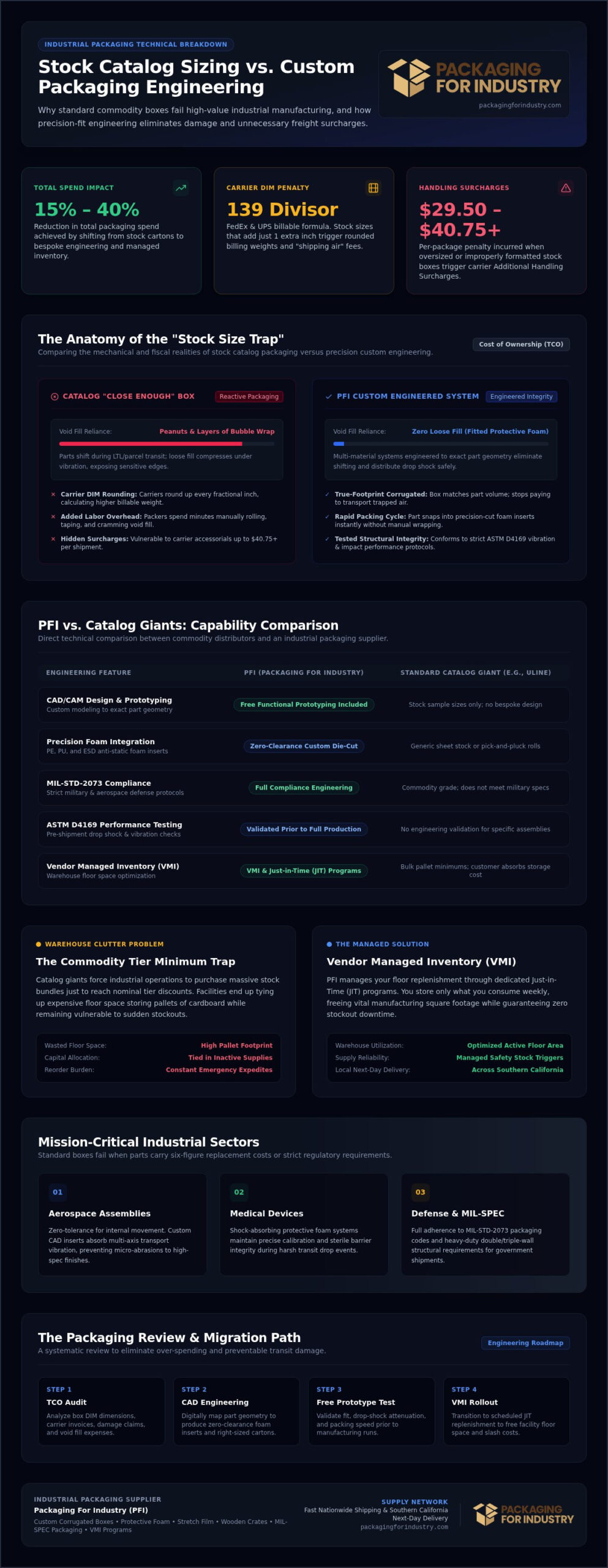
Using oversized stock boxes creates a cascade of hidden expenses. Carriers like FedEx and UPS use a dimensional weight (DIM) divisor of 139 to calculate billable weight. If your box is even one inch larger than necessary in any dimension, the carrier rounds that fraction up to the next whole inch. This practice often triggers Additional Handling Surcharges that range from $29.50 to over $40.75 per package. When you rely on stock sizes, you aren’t just paying for the box; you’re paying a premium to ship air.
The ‘Stock Size’ Trap for Manufacturers
Manufacturers often attempt to bridge the gap between a stock box and a sensitive part by using excessive void fill. Relying on layers of bubble wrap or packing peanuts is a reactive strategy that fails to secure high-value industrial components. In industries like aerospace and medical manufacturing, product movement during transit is the primary cause of damage. PFI helps manufacturers move away from this one-size-fits-all thinking by designing custom corrugated boxes that mirror the exact footprint of the product. This eliminates the need for loose fill and ensures the item remains stationary through every vibration and drop shock encountered in the LTL or parcel network.
Hidden Costs of Catalog Markups
The convenience of a national catalog comes with a significant price premium that impacts your Total Cost of Ownership (TCO). While the unit price per box might seem manageable, the cumulative cost of shipping damage, carrier surcharges, and the labor required to wrap parts manually adds up quickly. Large distributors can’t compete with direct industrial suppliers on custom runs because their business model is built on standardization, not adaptation. By switching to protective foam packaging integrated into a custom-fit carton, you reduce material waste and labor time. This shift in strategy allows businesses to lower packaging costs while simultaneously improving the reliability of their supply chain.
PFI vs. Uline: Comparing Custom Engineering Capabilities
PFI operates as an industrial engineering partner rather than a simple distributor. While catalog giants rely on a “buy as-is” inventory model, PFI focuses on technical specifications and material performance. This proactive approach allows manufacturers to realize 15% to 40% cost savings by eliminating over-packaging and reducing damage claims. This level of precision represents the specific custom packaging engineering Uline doesn’t offer. By focusing on the intersection of engineering and economics, we ensure that every material used serves a functional purpose while minimizing waste.
CAD Support and Prototyping
Precision is non-negotiable when shipping high-value components. PFI utilizes CAD/CAM design support to create zero-clearance protection for fragile parts. By modeling the packaging around the actual product dimensions, we ensure that every internal component fits securely without the need for manual wrapping. Our custom design packaging services include free prototyping to validate the design before full-scale production begins. This step is critical for preventing costly errors and ensuring that the final assembly meets the rigorous requirements of ASTM D4169 performance testing. Unlike catalog suppliers who only provide stock samples, PFI delivers a functional prototype of your specific industrial solution to confirm fit and protection levels.
Multi-Material Integration
Catalog suppliers typically struggle with complex, multi-material assemblies. Their systems are optimized for selling individual items like rolls of bubble wrap or standard boxes. PFI, however, specializes in integrating diverse materials into a single, cohesive SKU. We can combine custom foam inserts with heavy-duty double-wall or triple-wall boxes; we can even engineer foam-lined wood crates for international transport. This capability is essential for companies requiring Aerospace or Mil-Spec compliance, where protection must be both robust and lightweight. By consolidating these materials into one engineered unit, you simplify your procurement process and ensure consistent protection across your entire product line. If you are ready to move away from generic catalog options, you can request a custom packaging quote to see how an engineered approach improves your logistical efficiency.
Beyond the Box: VMI and Just-In-Time Programs Uline Can’t Match
Catalog distributors prioritize their own warehouse efficiency by pushing you to buy bulk quantities of stock items. PFI prioritizes your facility’s efficiency through Vendor Managed Inventory (VMI). Under a VMI program, we manage your packaging stock levels for you, ensuring that custom-engineered components are always available without cluttering your floor. This tailored logistical support is the kind of custom packaging engineering Uline doesn’t offer because their business model relies on high-volume, standardized shipments. By switching to a managed system, you shift the burden of inventory risk to us, allowing your team to focus on production rather than procurement.
The cash flow benefits of this arrangement are immediate. Instead of tying up capital in months of “just-in-case” inventory, you pay for packaging materials as they are consumed. This partnership model projects a sense of reliability; you no longer need to worry about the “emergency order” stress that happens when a catalog shipment is delayed or a stock item is backordered. We act as an extension of your operations, providing a steady flow of supplies that matches your real-time production demand.
Eliminating Packaging Shortages
Manufacturing delays are often caused by the smallest missing component. A scheduled inventory review ensures that your production lines never stop because of a missing custom insert or specific corrugated size. Moving from a reactive ordering model to a “just-in-time” strategy improves your operational flow. When handling high-stakes contracts, such as those following Defense Logistics Agency packaging requirements, a stockout of specialized military-grade materials can shut down a shipping line. Our Vendor Managed Inventory Services provide the reliability required for defense, aerospace, and medical sectors where compliance and timing are mandatory.
Optimizing Your Warehouse Floor Space
Storing ten pallets of oversized catalog boxes consumes valuable square footage that could be used for revenue-generating production. PFI’s local Southern California presence allows you to reclaim that floor space. We stock your custom boxes and protective foam at our facility and deliver them in smaller, frequent batches. Our local next-day delivery across Anaheim and Orange County means you only keep a few days’ worth of supplies on hand. By partnering with a local industrial packaging supplier near you, you gain the agility of a lean operation without the risk of running dry. This logistical precision ensures that your warehouse remains organized and your capital remains liquid.
Industry-Specific Engineering: Aerospace, Medical, and Military Compliance
Standard catalog supplies often fail to meet the rigorous safety and quality standards required for specialized industrial sectors. When shipping critical components for Aerospace & Aviation Packaging, the consequences of a packaging failure go beyond a simple damaged part; they involve safety risks and significant financial penalties. This level of specialized compliance is the custom packaging engineering Uline doesn’t offer. Catalog distributors are optimized for volume, not the technical preservation and physical cushioning standards required by the Department of Defense or medical device manufacturers. We focus on the engineering required to protect high-value assets through uncontrolled transit environments.
Mil-Spec and Defense Packaging
Military contracts demand strict adherence to MIL-STD-2073-1E, which governs preservation methods and packaging levels. Catalog suppliers often ignore these complexities, leaving contractors to handle the risk of non-compliance and potential contract rejection. PFI acts as a preferred Military Packaging Solutions provider in Southern California, offering the specific CAD modeling and barrier pouching required for defense logistics. We ensure that every shipment meets Level A or Level B protection requirements, providing the necessary documentation to pass DCMA inspections. Our team understands that military packaging isn’t just about the box; it’s about a complete system of preservation that protects assets during long-term storage.
Medical Device and Electronics Protection
The semiconductor and medical device industries require an entirely different set of material properties. Standard void fill can generate static electricity that destroys sensitive circuitry. We engineer ESD-safe packaging systems using specialized anti-static foam inserts to lock high-precision equipment into place. For medical logistics, we design cleanroom-compatible solutions that prevent contamination while offering superior shock and vibration resistance. A custom packaging review often reveals that manufacturers use three times the necessary material because they’re trying to force a generic solution to work. By switching to an engineered approach, you eliminate the waste and ensure your equipment arrives calibrated and ready for use.
How to Switch and Save: Your Path to Lower Packaging Costs
Transitioning from a catalog-based model to an engineered system is a strategic shift that yields long-term financial benefits. Most manufacturers find that they can lower packaging costs by 15% to 40% simply by right-sizing their containers and eliminating unnecessary materials. The first step in this transition is to request a packaging quote and compare your current catalog pricing against a custom-engineered solution. This comparison often reveals that while a stock box has a lower initial unit price, the total cost of shipping air and paying carrier surcharges makes it the more expensive option over time.
The Packaging Audit Process
A formal packaging review is a systematic analysis of your current materials and processes used to identify opportunities for damage reduction and cost savings. During this audit, PFI engineers analyze your current catalog spend to find “low-hanging fruit,” such as oversized boxes that require excessive void fill. We compare these against engineered alternatives, such as custom die-cut inserts that provide better protection with less material. This level of granular analysis is the custom packaging engineering Uline doesn’t offer. By identifying areas of over-packaging, you can reduce waste and streamline your assembly line labor while ensuring your high-value parts are fully secured.
Local Delivery Advantage in SoCal
Freight costs represent a significant portion of your total packaging spend, especially when ordering from national distributors with remote shipping hubs. PFI leverages a local Southern California presence to slash these expenses for businesses in Anaheim, Irvine, and Los Angeles. Our local next-day delivery model eliminates the long lead times and high freight charges associated with long-distance shipping. This proximity allows for smaller, more frequent deliveries, which reduces your carbon footprint and frees up valuable warehouse space. You no longer need to buy in massive bulk just to offset the cost of shipping from a distant warehouse.
Finalizing a custom stocking program is the final step in streamlining your procurement. By moving to a managed inventory system, you ensure that your custom corrugated boxes and foam inserts are always available without the need for bulk-buying stock supplies to get price breaks. You gain the peace of mind that comes from a steady, reliable supply chain managed by a local expert who understands your specific operational challenges. Contact the PFI team today for a local packaging consultation and begin your transition to a more efficient system.
Optimize Your Industrial Supply Chain with Precision Engineering
Relying on a standard catalog often means accepting higher transit damage and inflated shipping fees. PFI offers a direct alternative by replacing “close enough” stock boxes with engineered systems designed specifically for your high-value components. This approach delivers the custom packaging engineering Uline doesn’t offer, ensuring your products are secured through expert CAD/CAM design and validated with free prototyping. We move beyond simple distribution to provide a comprehensive protection system that prioritizes your bottom line.
Beyond physical protection, our local Southern California presence provides a significant logistical advantage. Manufacturers in Anaheim, Irvine, and Los Angeles can realize 15% to 40% cost savings by leveraging our local next-day delivery and Vendor Managed Inventory (VMI) programs. These services eliminate warehouse clutter and ensure your production lines never stop due to packaging shortages. It’s time to stop paying for “shipping air” and start investing in a partnership that prioritizes your operational efficiency.
We look forward to helping you streamline your procurement and protect your most sensitive industrial equipment. Our team is ready to demonstrate how a tailored approach to packaging can transform your logistics from a cost center into a competitive advantage.
Frequently Asked Questions
What is the difference between custom packaging engineering and stock packaging?
Custom packaging engineering focuses on designing protection around the specific fragility and dimensions of a product, whereas stock packaging relies on fixed catalog sizes. We use CAD/CAM support to create integrated solutions like foam-lined crates or precision die-cut inserts. This level of technical design is the custom packaging engineering Uline doesn’t offer. It ensures that every material used serves a functional purpose, reducing both material waste and transit damage.
How much can I actually save by switching from Uline to a custom packaging supplier like PFI?
Most industrial manufacturers realize between 15% and 40% cost savings by switching to an engineered approach. These savings come from a combination of lower unit pricing on custom runs and the elimination of hidden costs like “shipping air” and carrier surcharges. By right-sizing your corrugated boxes and optimizing internal cushioning, you reduce the total cost of ownership rather than just the price of a single box.
Does PFI offer free prototypes for custom corrugated boxes and foam inserts?
Yes, we provide free prototyping and samples for our industrial clients to ensure a perfect fit before a full production rollout. Our design process includes CAD/CAM support to model your specific parts and create functional prototypes of multi-material assemblies. This allows your operations team to test the protection levels and assembly speed, preventing expensive errors that often occur when trying to force a product into a generic catalog box.
Can PFI handle Mil-Spec and Aerospace packaging compliance?
We specialize in meeting the rigorous standards required for aerospace and military contracts, including MIL-STD-2073-1E compliance. Unlike catalog distributors, we understand the technical preservation and marking requirements mandated by the Defense Logistics Agency. We engineer solutions that include moisture barrier bags, ESD foam, and heavy-duty export crates, ensuring your high-value components pass DCMA inspections and survive uncontrolled shipping environments worldwide.
What areas in Southern California do you provide next-day delivery for?
We provide local next-day delivery for businesses throughout Anaheim, Orange County, Los Angeles County, the Inland Empire, and San Diego County. Our regional focus allows us to support manufacturers in cities like Huntington Beach, Irvine, Santa Ana, Long Beach, Riverside, and San Bernardino. By maintaining a local distribution network, we help you slash freight costs and reduce the lead times associated with national catalog suppliers.
What is a Vendor Managed Inventory (VMI) program for packaging?
A VMI program is a managed stocking service where PFI monitors your packaging inventory and replenishes supplies based on your actual usage. We conduct scheduled weekly or biweekly reviews to prevent stockouts and eliminate the need for emergency orders. This system allows you to free up valuable warehouse floor space and capital by only storing what you need for immediate production while we hold your custom safety stock.
Can you engineer packaging to reduce UPS and FedEx dimensional weight surcharges?
We specifically design custom cardboard boxes to match your product dimensions, which directly reduces billable dimensional weight. Carriers use a 139 DIM divisor and round fractions of an inch up, meaning oversized stock boxes often trigger Additional Handling Surcharges. Our engineering team identifies these opportunities to right-size your packaging, helping you avoid thousands of dollars in unnecessary shipping fees and accessorial charges that catalog boxes typically incur.
Do I have to buy in massive bulk to get custom packaging pricing?
No, you don’t need to over-order to receive competitive pricing on custom solutions. We specialize in recurring industrial orders and offer stocking programs that allow you to receive smaller, frequent deliveries at bulk pricing rates. This model is part of the custom packaging engineering Uline doesn’t offer, as it focuses on your operational flow rather than forcing you to warehouse months of inventory just to hit a price break.