
How much is that “next-day delivery” promise actually costing your operation when a custom project turns into a six-week production delay? While catalog giants excel at shipping standard stock items, the logistical math changes once you require custom corrugated boxes or precision-engineered foam inserts. Many procurement managers find themselves stuck in a cycle of production stops and high freight costs because they don’t realize getting better lead times than Uline for custom packaging is a matter of proximity and inventory strategy, not catalog size.
It’s frustrating to watch an assembly line stall while a non-stock item sits in a lengthy converting cycle. We understand that for an industrial packaging supplier, reliability is the only metric that truly impacts your bottom line. This article reveals how to bypass catalog bottlenecks by partnering with a local manufacturer that offers dedicated stocking programs. You’ll learn how to secure zero-day lead times through Vendor Managed Inventory (VMI) and local Southern California manufacturing. We’ll show you how to lower your total cost of ownership by eliminating stockouts and reducing the dimensional weight penalties that come with oversized, off-the-shelf boxes.
Key Takeaways
- Understand why catalog giants often face 4-to-6-week delays on custom orders and how local manufacturing bypasses these production bottlenecks.
- Discover how getting better lead times than Uline for custom packaging is achieved through strategic Vendor Managed Inventory (VMI) and local stocking programs.
- Reduce your total cost of ownership by eliminating carrier dimensional weight penalties with right-sized, custom-engineered corrugated boxes.
- Leverage local delivery fleets in Southern California to secure next-day delivery and eliminate the unpredictability of third-party freight delays.
Understanding the Lead Time Gap: Catalog Giants vs. Industrial Partners
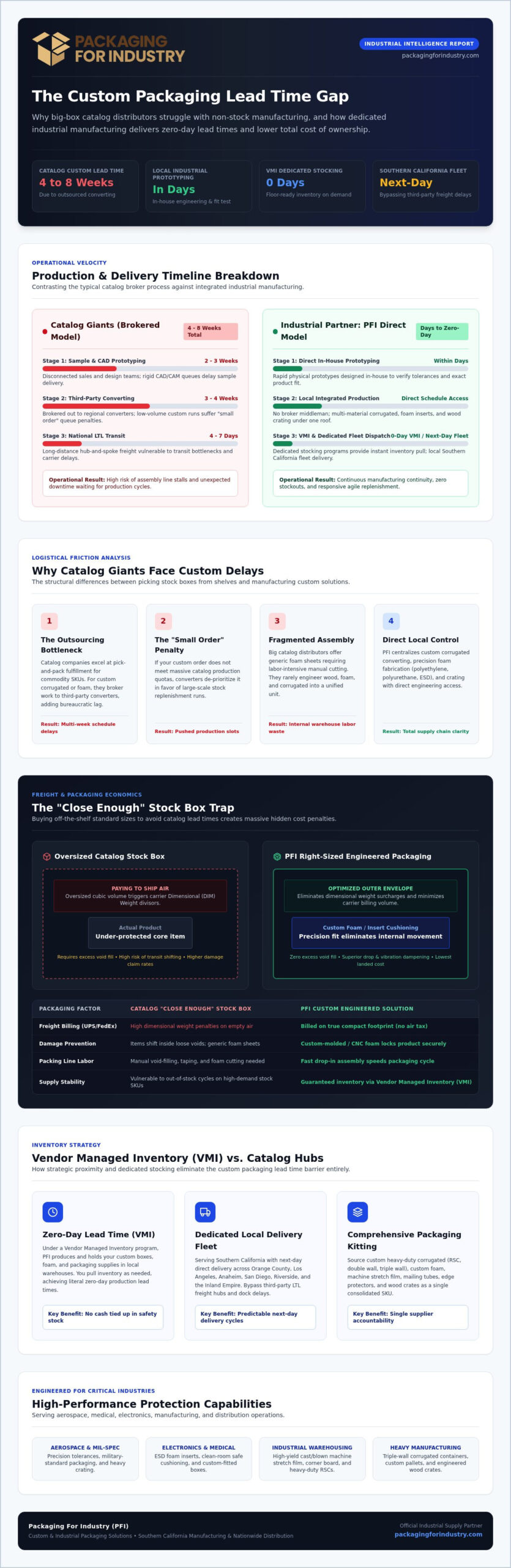
Many procurement officers rely on catalog distributors for daily supplies like tape or stretch film because they offer same-day shipping. However, this speed disappears when you need a box that isn’t in the catalog. This is the “Uline Trap.” Getting better lead times than Uline for custom packaging requires moving away from the hub-and-spoke model and toward an integrated industrial partner. While a catalog company prioritizes moving millions of stock SKUs, an industrial packaging supplier focuses on the engineering required for your specific product. Prototyping is another common bottleneck; while catalog giants may take weeks to send a sample, a local partner can provide a physical prototype in days to ensure a perfect fit.
A major factor in these delays is the manufacturing lead time associated with custom production. Catalog companies often broker these orders to third-party converters. This adds layers of communication and transit time that can stretch a project to six or eight weeks. Local manufacturing responsiveness eliminates these gaps by keeping design, prototyping, and production under one roof. By cutting out the middleman, you gain direct access to the production schedule.
The Lead Time Comparison: Custom Orders
Standard catalog providers typically quote 4 to 8 weeks for custom-printed or non-stock configurations. This is because their systems are built for picking and packing, not manufacturing. PFI reduces this design-to-delivery window by handling prototyping and production locally. When your supplier is in Southern California rather than a distant regional hub, you eliminate days of transit and the risk of LTL freight delays. This proximity allows for a more agile response to sudden production spikes or design changes.
Why Stock Boxes Are Not the Solution
It’s tempting to buy a “close enough” stock size to avoid lead times. This decision often leads to higher costs and operational inefficiency. Carriers like UPS and FedEx use dimensional (DIM) weight divisors to bill based on box volume rather than actual weight. Using oversized stock boxes means you’re paying to ship air. Additionally, excess space inside a box increases the likelihood of shipping damage because the product can shift during transit. Utilizing custom corrugated boxes tailored to your product dimensions ensures maximum protection and lower freight surcharges. Right-sizing your packaging is a direct path to lowering your total cost of ownership.
The Custom Packaging Bottleneck: Why Big-Box Suppliers Struggle
Big-box catalog companies are masters of the warehouse shelf, but their efficiency stops at the edge of customization. Most of these giants don’t actually manufacture their custom lines. Instead, they broker the work to third-party converters. This outsourcing creates a major bottleneck, as your order must wait for the broker to clear their own schedule before production even begins. For industrial buyers, this often results in a “Small Order” penalty. If your custom request doesn’t meet massive volume thresholds, it’s de-prioritized in favor of stock replenishment. This is why getting better lead times than Uline for custom packaging is difficult when working through a middleman.
Rigid CAD/CAM queues at large organizations further delay the process. Initial prototyping might take weeks because the design team is disconnected from the sales department. This lack of specialized expertise is especially problematic for aerospace and aviation packaging solutions, where precision and mil-spec compliance are mandatory. Relying on a generalist for high-stakes engineering is a risk most manufacturers can’t afford. Strategic domestic sourcing and total cost of ownership analysis shows that moving away from these bloated supply chains is the key to securing reliable delivery schedules.
The Complexity of Custom Engineering
High-performance protection requires more than just a box. Many industrial products need custom foam inserts to prevent vibration damage or ESD issues. Catalog suppliers usually offer generic foam sheets that require manual cutting, which is labor-intensive and inconsistent. PFI integrates multiple materials, including wood, foam, and corrugated, into a single protective assembly. By managing these materials under one roof, we eliminate the need to coordinate with three different vendors, significantly shortening your overall procurement cycle.
Communication Barriers in Large Organizations
Working with a big-box supplier often means speaking to a “catalog-only” sales representative who lacks technical training. They can’t answer questions about load-bearing capacity or material density without checking with the factory. This back-and-forth adds days to the custom design packaging workflow. Direct access to a packaging engineer allows for real-time adjustments and faster approvals. If you’re tired of waiting for a call back from a call center, you can request a packaging quote from a team that understands your technical requirements immediately.
Accelerating Production via Local Southern California Manufacturing
Proximity is the most effective tool for getting better lead times than Uline for custom packaging. When your supplier is located hundreds of miles away, your schedule is at the mercy of common carriers and regional hub delays. PFI operates its own delivery fleet, providing a “Next-Day” advantage for manufacturers in Anaheim, Irvine, and Santa Ana. This direct control eliminates the unpredictability of LTL freight, where custom orders often sit in transit for days. If a production line requires a last-minute design adjustment, being local allows our engineers to visit your facility, prototype a solution, and start production immediately. This localized approach turns weeks of waiting into days of action.
Serving the SoCal Industrial Corridor
PFI provides dedicated support to the manufacturing hubs of Orange County and LA County. Our strategic proximity to major logistics gateways like Carson and the Port of Long Beach ensures we can move materials efficiently. Local warehousing is a critical component of this strategy. By staging supplies near your facility, we reduce the “emergency order” panic that occurs when stock runs low. This regional focus allows us to provide a level of responsiveness that national catalog distributors simply cannot match. We understand the specific needs of the local industrial base, from aerospace compliance to high-speed fulfillment requirements.
Environmental and Financial Benefits of Local Sourcing
Choosing a local partner offers significant financial advantages beyond simple unit pricing. Shipping bulky items like wooden crates and heavy-duty skids across the country is cost-prohibitive due to high freight rates. Local sourcing lowers these costs and reduces the carbon footprint of your supply chain by shortening transit distances. To further optimize these benefits, many of our clients implement vendor-managed inventory programs. This collaborative approach eliminates the “bullwhip effect” of order batching, ensuring your custom packaging arrives exactly when it’s needed. By aligning production with local demand, you improve your supply reliability while keeping your warehouse floors clear of excess clutter. It’s a pragmatic solution that prioritizes fiscal responsibility and operational flow.
Zero Lead Time: Utilizing VMI and Just-In-Time Stocking
Reactive buying is the primary cause of production delays. If you wait until your stock is depleted to place an order, you’re already behind. Getting better lead times than Uline for custom packaging isn’t about finding a faster truck; it’s about having the product already on your shelf before you need it. By implementing Vendor Managed Inventory (VMI), you transition from spot ordering to a strategic replenishment model. This approach eliminates lead times entirely for recurring custom items, as safety stock is staged and ready for immediate use.
Scheduled inventory reviews prevent the “line-down” emergencies that plague high-volume manufacturing environments. Our team monitors your usage patterns and manages the replenishment cycle automatically. This Just-In-Time (JIT) methodology keeps your production lines moving without the warehouse clutter associated with bulk catalog buying. You maintain a lean operation while ensuring supply reliability. It’s a proactive way to manage your supply chain that prioritizes operational flow over catalog convenience.
The VMI Implementation Process
Successful VMI starts with a comprehensive usage analysis. We identify which custom items are production-critical and determine their historical consumption rates. Next, we establish “Min/Max” levels; these are specific triggers that signal when new stock should be manufactured and delivered. This system automates the procurement process and frees up valuable warehouse space. Instead of storing months of “just in case” inventory, you can use that square footage for additional manufacturing operations. It’s a methodical way to ensure you never run out of the packaging that protects your finished goods.
Managed Stocking for Custom Foam and Boxes
VMI is especially critical for items with complex production cycles, such as custom foam inserts for shipping. These products require precision die-cutting and multi-material assembly, which can lead to long lead times in a reactive model. PFI streamlines this by offering kitting and assembly services. We can deliver fully assembled protective packaging units directly to your packing stations. This improves your cash flow because you only pay for the materials as they are pulled into production, rather than tying up capital in bulk stock sitting in a warehouse.
Lowering Total Costs While Improving Delivery Reliability
Unit price is often a deceptive metric in industrial procurement. While a catalog giant might show a lower price for a stock box, the true Total Cost of Ownership (TCO) includes freight, storage, and the risk of production stops. Getting better lead times than Uline for custom packaging isn’t just about speed; it’s about eliminating the hidden costs of supply chain volatility. When you factor in the expense of factory downtime, the value of a reliable local partner becomes clear. Cheap, off-the-shelf packaging often leads to increased shipping damage and expensive returns because it lacks the precision of an engineered solution. Shipping damage is a silent profit killer. When a standard box fails to protect a sensitive component, you lose the product, the shipping cost, and the customer’s trust.
A strategic partner does more than sell supplies; they optimize your logistical flow. By right-sizing your corrugated boxes and using custom foam, you reduce the dimensional weight surcharges that inflate carrier invoices. This transition from a transactional vendor to a consultative expert is the most effective way to lower packaging costs over the long term. Custom-engineered solutions pay for themselves by reducing failure rates to near zero and improving the efficiency of your packing stations.
Evaluating Your Next Packaging Supplier
Choosing a supplier requires looking beyond the catalog. You should ask potential partners about their direct manufacturing capabilities and whether they own their delivery fleet. This ensures they aren’t brokering your order to a third party, which is a common cause of delays. If your operation involves aerospace or defense contracts, verify their ability to handle military packaging and high-spec industrial requirements. A local warehouse and distribution partner in Southern California provides a safety net that distant suppliers cannot offer. Their proximity allows for same-day troubleshooting and immediate replenishment when demand spikes unexpectedly.
Requesting a Custom Packaging Quote
To get an accurate lead time estimate, provide your supplier with detailed product dimensions, weight, and expected order frequency. This data allows for precise engineering and better production scheduling. Don’t settle for a guess; ask for a physical prototype. PFI offers free prototyping to ensure your product fits perfectly before the first production run begins. This step eliminates the trial-and-error phase that often slows down speed-to-market. Prototyping ensures that every fold and cushion is optimized for your specific assembly process, allowing your team to test the packaging on the production floor before committing to a full run.
When you’re ready to eliminate supply chain uncertainty and reduce your total costs, the next step is simple. Request a packaging quote from PFI to start optimizing your industrial supply chain today.
Secure Your Supply Chain with Local Industrial Expertise
Relying on catalog giants for bespoke industrial needs often leads to operational friction and extended production delays. By shifting your focus from simple unit price to total cost of ownership, you can build a more resilient and cost-effective supply chain. Implementing local manufacturing and vendor managed inventory programs is the most direct path to getting better lead times than Uline for custom packaging. These strategies ensure your production lines never stall due to a shortage of custom corrugated boxes or precision foam inserts.
PFI specializes in custom industrial engineering designed to reduce shipping damage and lower freight costs through right-sized protection. Our local next-day delivery across Southern California and dedicated VMI programs eliminate the uncertainty of third-party logistics and hub-and-spoke delays. You gain a steady, dependable partner focused on tangible outcomes rather than just catalog volume. We understand the specific demands of aerospace, medical, and industrial manufacturing environments and provide the technical expertise needed to secure your products.
We’re ready to help you optimize your logistics and secure your inventory against future shortages. Take control of your packaging schedule today and experience the peace of mind that comes with a well-oiled, reliable supply chain.
Frequently Asked Questions
How can I get faster lead times for custom-sized corrugated boxes?
You can achieve faster lead times by working directly with a local custom packaging supplier that manufactures on-site. Unlike catalog distributors that broker custom orders to third-party converters, a direct manufacturer controls the entire production schedule. This eliminates the communication lag and transit delays inherent in large distribution networks. By bypassing these middlemen, you often reduce the turnaround for custom cardboard boxes from several weeks to just a few business days.
Is it possible to get custom foam inserts faster than 4 weeks?
Yes, it’s possible to secure custom foam inserts in significantly less than four weeks by partnering with a local industrial converter. PFI utilizes in-house CAD/CAM technology to design and prototype protective foam packaging rapidly. Because we manufacture locally in Southern California, we don’t face the logistical bottlenecks that force national catalog companies to quote month-long lead times for non-stock configurations. This speed is essential for protecting high-value industrial components.
What is the benefit of a local Southern California packaging supplier over Uline?
The primary benefit is the elimination of regional hub delays and high LTL freight costs. A local Southern California packaging supplier like PFI uses a dedicated delivery fleet to serve Anaheim, Irvine, and Santa Ana. This proximity allows for next-day delivery and immediate response to design changes. You gain direct access to packaging engineers who understand your specific operational challenges, providing a level of consultative support that a transactional catalog vendor cannot provide.
How does Vendor Managed Inventory (VMI) help with lead times?
Vendor Managed Inventory (VMI) eliminates lead times for recurring items by maintaining a pre-determined safety stock at your facility or our local warehouse. Instead of reactive ordering, we monitor your usage and replenish stock automatically. This strategic approach ensures you have zero lead time for critical custom items. It’s the most effective method for getting better lead times than Uline for custom packaging, as the materials are ready before your production line needs them.
Can I get same-day delivery for industrial packaging supplies in Anaheim?
PFI is headquartered in Anaheim and provides local next-day delivery across Southern California for most stock and managed inventory items. While same-day service depends on current route schedules and order timing, our local fleet is much more agile than national carriers. For businesses in the Anaheim industrial corridor, this proximity means we can resolve packaging shortages and deliver critical supplies faster than any supplier shipping from a distant regional distribution center.
Why are custom packaging lead times so long with large catalog companies?
Large catalog companies are optimized for high-volume stock SKUs and hub-and-spoke logistics. When a customer requests a custom size, the catalog vendor usually outsources the production to a separate converter. This creates a fragmented supply chain where your order is de-prioritized behind larger stock runs. These layers of outsourcing, combined with long-distance freight, are why getting better lead times than Uline for custom packaging requires a direct relationship with a local manufacturer.
Does PFI offer free prototypes for custom box designs?
Yes, PFI provides free prototyping for custom box designs to ensure a perfect product fit before full production begins. Our engineering team uses CAD technology to create precise samples that you can test on your production floor. This proactive step reduces the risk of shipping damage and prevents costly design errors. It also accelerates the overall development cycle, allowing your business to move from the design phase to final delivery much faster.
What industries benefit most from faster custom packaging turnaround?
Industries with high-value products or complex supply chains, such as aerospace, medical device manufacturing, and electronics, benefit most from rapid turnaround. These sectors often require specialized protection like ESD foam or heavy-duty triple-wall boxes that aren’t available in standard catalogs. Faster lead times prevent expensive production stops and allow these companies to meet strict delivery deadlines for their own customers. Reliable supply is critical for maintaining the operational flow in these high-stakes environments.