
What protects a cabinet box may leave a door or drawer front exposed to edge and corner damage. Cabinet components vary in size, shape, and finish, so a standard package can leave too much room or miss a vulnerable contact point. Custom packaging for cabinet makers starts with the product configuration and the way it moves through your operation.
Damage can mean rework, replacement, and added customer-service demands. Choosing packaging around each component’s dimensions, handling risks, and shipping method can help protect products while keeping freight costs and repeat purchasing needs in view.
This guide compares stock and custom options for cabinets, doors, drawer fronts, and related parts, including corrugated boxes, foam, and edge protection. You’ll learn which design details to review, how to assess packaging against your shipping workflow, and what information to gather for a useful quote request. The goal is a repeatable packaging approach that balances protection, fit, and cost.
Key Takeaways
- Custom packaging for cabinet makers can combine an outer box with interior and edge protection suited to the shipment.
- Compare corrugated, foam, and corner or edge protection based on the role each plays in the package.
- Assess stock and custom options against package dimensions, storage space, and repeat-order patterns.
- Gather product configuration, order quantity, shipping method, and damage concerns to make a quote request more useful.
- PFI supports cabinet packaging projects with corrugated options, protective foam, crates, and packaging design services.
Custom packaging for cabinet makers starts with the shipment, not just the box
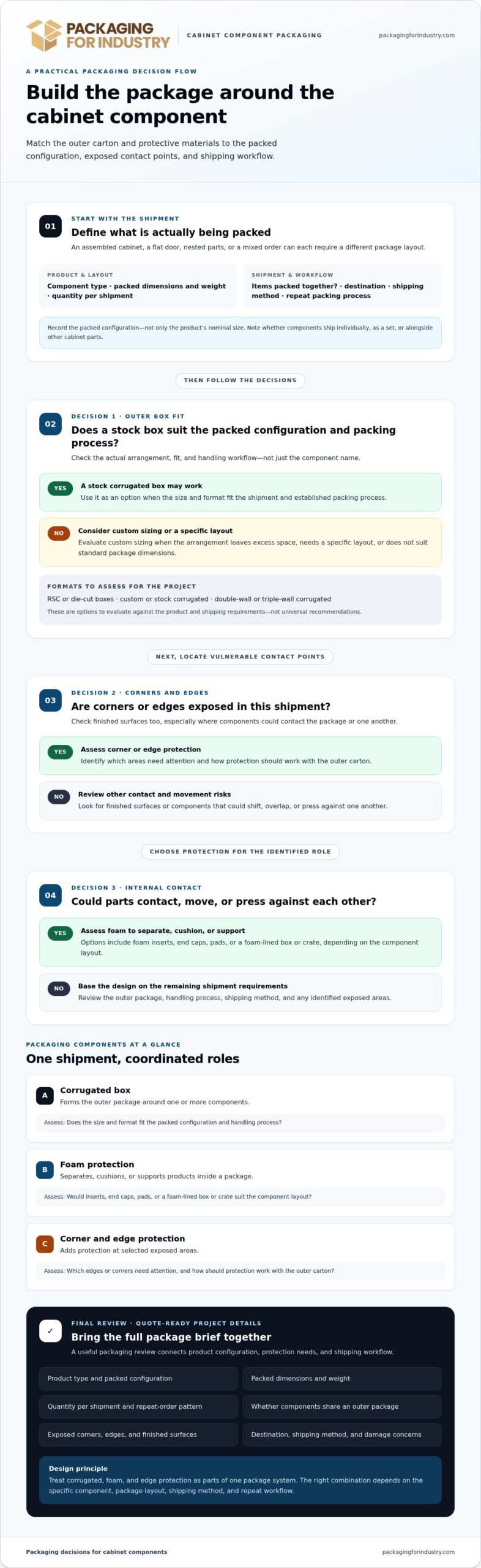
Custom packaging for cabinet makers combines outer packaging and protective materials to suit a particular product and shipment. A useful packaging brief explains what is being shipped, how the items are arranged, and how they will move. A package designed for an assembled cabinet may not suit a flat door, a stack of drawer fronts, or an order combining several component types. Using the same box for every item can leave a poor fit, use unnecessary material, or expose contact points.
Start with the actual packed configuration and the areas that need protection. Corrugated packaging can form the outer structure, while foam and edge protection can separate or cover vulnerable areas. For background on the material, see this overview of Corrugated Fiberboard.
Which cabinet products and shipment formats change the packaging brief?
Separate assembled units from flat, nested, or individually packed components. An assembled cabinet has a different shape and footprint from a bundle of doors. Drawer fronts may ship individually, grouped together, or with other cabinet parts. Each configuration changes how the products sit in the package and which surfaces, corners, and edges remain exposed.
Record the dimensions and weight of the packed configuration, not just the product’s nominal size. Include the quantity per shipment, whether different components share an outer package, and the destination and shipping method. A single-product shipment may need a different layout from an order combining doors, drawer fronts, and smaller parts. These details help the packaging design address fit, handling, and repeat orders. PFI’s custom packaging design support considers the product and shipping method as part of the same project.
What should cabinet packaging protect during transit?
Check exposed corners and edges first, then identify finished surfaces that could contact the package or another component. Consider movement inside the package too: note where parts could shift, overlap, or press against one another during handling. These are potential contact points to evaluate, not proof that damage will occur. The aim is to select packaging components that address the risks for the specific shipment.
Corrugated boxes provide an outer packaging option, while foam and other cushioning materials can separate or support components. Corner and edge protection may be useful where those areas are exposed. The right combination depends on the product configuration and shipment requirements. No single material or package format suits every cabinet component.
- Identify exposed corners, edges, and finished surfaces.
- Describe how components are grouped and where they could contact one another.
- Share the shipping method and destination when reviewing packaging options.
Match corrugated boxes, foam, and edge protection to cabinet components
A cabinet shipment may need more than an outer carton. Corrugated packaging forms the enclosure, while foam and corner or edge protection can address specific contact points inside or around it. For custom packaging for cabinet makers, assess these materials as parts of one system. The right combination depends on the component, package layout, shipping method, and repeat workflow.
| Packaging component | Primary role to assess | Questions for cabinet shipments |
|---|---|---|
| Corrugated box | Forms the outer package around one or more components. | Does the size and format fit the packed configuration and handling process? |
| Foam protection | Separates, cushions, or supports products inside a package. | Would inserts, end caps, pads, or a foam-lined box or crate suit the component layout? |
| Corner and edge protection | Adds protection at selected exposed areas. | Which edges or corners need attention, and how should protection work with the outer carton? |
When should cabinet makers consider custom corrugated boxes?
Compare stock and custom sizing based on fit, shipment configuration, and packing workflow. A stock box may work for a regular component and an established packing process. Consider custom sizing when the product arrangement leaves excess space, needs a specific layout, or does not suit standard package dimensions. Also consider whether components ship individually, as a set, or with other cabinet parts.
RSC and die-cut box formats are options to evaluate for the project, not universal recommendations. Buyers can also compare custom, double-wall, or triple-wall corrugated based on the product and shipping requirements. PFI supplies custom corrugated boxes and stock corrugated options for reviewing fit and repeat packaging needs.
How can foam and edge protection complement the outer box?
Foam inserts can be designed around a product layout; end caps and pads offer other ways to separate or cushion components. Foam-lined boxes or crates may suit a package design that integrates cushioning with the enclosure. These options help create a layout for the specific project rather than relying on one configuration for every part.
Corner and edge protection can supplement an outer carton where those areas are exposed. A door shipment, for example, may need attention to its perimeter, while a mixed order may need separation between different components. The design should account for how the protective materials fit with the carton and how workers will pack the order.
PFI’s custom packaging design support brings corrugated, foam, and edge protection into a coordinated review, with CAD/CAM support, prototypes, and samples available as part of the design process. Share the component layout and shipping method to request a cabinet packaging quote based on your project requirements.
Compare packaging approaches by fit, freight, and production workflow
Packaging affects more than the product’s fit inside a box. Buyers also need to consider how protective materials affect packed dimensions, where supplies will be stored, and how consistently workers can assemble the package. Stock packaging, custom packaging, and right-sized production each offer a different way to manage these needs. None is automatically the best choice for every cabinet product or order pattern.
The best-fit approach balances protection, shipping dimensions, and repeatability on the production floor. Compare options using the same shipment details: packed size, component arrangement, protective materials, shipping method, storage capacity, and order frequency. A package that fits well may still be awkward to store, while a familiar stock box may leave unused space or require additional packing material.
When can stock packaging work, and when does custom sizing merit review?
Stock packaging can be practical when an available size suits the product, protective components, and packing process. Review custom sizing when standard options do not fit the product or protection layout well. Right-sized production is another approach to assess when package dimensions vary across shipments. Compare the full configuration and workflow rather than assuming custom packaging will always cost less or reduce freight charges.
- Stock packaging: Consider it when products fit available sizes without compromising protection or disrupting the packing process.
- Custom packaging: Evaluate it when the product or protective layout calls for a different package configuration.
- Right-sized production: Assess it when package dimensions need to correspond more closely to specific shipments.
How should buyers assess one-off shipments versus recurring orders?
A one-off shipment may need a solution for an immediate project. Recurring production benefits from packaging that staff can use consistently across runs. Consider order frequency, storage space, and whether the lead time for a custom item fits the production schedule. These operational details matter alongside package fit and shipment dimensions.
For recurring requirements, PFI’s vendor-managed inventory and just-in-time packaging programs can support supply planning. Buyers can review usage and replenishment needs, especially when several products or packaging components serve the same workflow.
Review freight costs using actual shipment profiles. Package dimensions and weight may affect carrier billing, including dimensional-weight calculations or surcharge exposure, depending on carrier rules and the shipment. Compare applicable charges rather than assuming a smaller package will produce a particular saving. An undersized or poorly configured package may also compromise product protection.
For a useful comparison, record packed dimensions and weight, protective components, order cadence, storage constraints, and shipping method for each option. This gives a packaging supplier a practical basis for reviewing fit and repeatability together. If you’re assessing custom packaging for cabinet makers, these details can help shape a project-specific quote. Request a packaging quote with your shipment and workflow information.
Prepare a cabinet packaging quote with the right project details
A useful packaging quote starts with a clear picture of the product, how it will be packed, and how it will ship. For custom packaging for cabinet makers, practical details help PFI assess the configuration, materials, and repeat-order needs. Gather what you have before submitting a request. Drawings, photographs, and examples of current packaging can help explain the project, but a concise written description is a good starting point.
What dimensions and shipment details should buyers gather?
Measure the product and describe its packed configuration separately. Explain whether components are assembled, nested, grouped, or packed individually. Include the order quantity and destination, and note whether the package moves by parcel or freight. If one shipment combines different parts, identify the components and how they are grouped. This gives the quote discussion a practical basis.
- Product dimensions: Share the length, width, and height of each relevant component, plus its weight when available. Distinguish unboxed measurements from the dimensions of the current packed shipment.
- Configuration: Explain whether the shipment contains an assembled cabinet, doors, drawer fronts, smaller components, or a mixed order. Note how items are arranged together.
- Quantity and order pattern: Provide the quantity needed for the current order and indicate whether the packaging is for a one-time project or recurring production.
- Shipping method and destination: Identify parcel or freight movement, the destination, and any known carrier or freight constraints that affect package dimensions or handling.
- Existing materials and concerns: Describe current packaging, known damage concerns, and areas that need attention. Attach product drawings, photos, or packaging examples when available.
How can a prototype or packaging review support the decision?
A prototype or sample lets your team assess how the proposed package fits the product and how its components come together before a broader rollout. It can surface practical questions about packing steps, product contact, and the arrangement of protective materials. It does not replace evaluation in the actual shipping workflow, but it can make the design review more specific.
A packaging review brings product details, current materials, damage concerns, freight considerations, and purchasing patterns into one discussion. It may also identify opportunities to refine material use or the packing workflow, without assuming a particular cost reduction or shipping result. PFI’s design support includes CAD/CAM, prototypes and samples, and packaging reviews. The custom packaging design process connects those project details to a proposal tailored to the product and shipping method.
Once you’ve gathered product measurements, configuration, quantities, and shipment details, send them with any relevant examples or concerns. This gives the quote request a clear starting point for evaluating packaging options.
Work with PFI on custom packaging and dependable cabinet supply
Cabinet shipments can involve several packaging items and purchasing needs. Packaging For Industry (PFI) works with industrial buyers to align packaging choices with their product and workflow requirements. That makes it easier to discuss the project as a coordinated supply need rather than a collection of unrelated purchases, giving purchasing and operations teams a shared starting point.
What can an industrial packaging supplier coordinate for cabinet shipments?
PFI can review cabinet shipments alongside the buyer’s purchasing and packing workflow. Sharing which product lines ship regularly, which packaging items are used together, and where supplies are needed clarifies the project’s operational context. This is useful for businesses managing several cabinet configurations or coordinating packaging requirements across production and shipping teams.
For businesses in Orange County, Los Angeles, San Diego, and Riverside, PFI provides local next-day delivery throughout Southern California. Nationwide shipping is also available for companies with packaging needs beyond the region. Include delivery locations and purchasing requirements in your quote request so the proposed supply approach reflects how your operation is organized.
How can repeat packaging needs stay easier to manage?
Recurring packaging needs are easier to plan when purchasing decisions account for actual usage, storage capacity, and production schedules. PFI’s vendor-managed inventory and just-in-time programs support businesses that regularly use packaging supplies. These programs can be considered alongside the packaging items and replenishment needs specific to the operation.
For cabinet makers purchasing for ongoing production, identify which requirements stay consistent and which change with product runs. That gives the supplier and purchasing team a practical basis for organizing replenishment without treating every order as identical.
Share your packaging requirements, purchasing pattern, and delivery locations to discuss custom packaging for cabinet makers with PFI.
Build a packaging plan that can adapt with production
Packaging decisions are easier to manage when they’re part of production planning, not a last-minute shipping task. Use the quote process to establish a clear starting point for purchasing, then revisit the plan when product configurations, order patterns, or shipping requirements change. This keeps packaging decisions connected to current operations and gives your team a consistent basis for future orders.
For cabinet makers, custom packaging should support both the shipment in front of you and the way your business expects to fulfill orders over time. A defined approach helps purchasing and operations teams coordinate around practical requirements, compare options clearly, and make informed adjustments as needs evolve.
Start with the details you have and request a quote for packaging that fits your next shipment and ongoing needs.
Frequently Asked Questions
Can custom packaging accommodate different cabinet sizes in one production run?
Yes. A production run can use distinct packaging specifications for different cabinet sizes or product families. Give each variation a clear part number or identifier, and link the packing instructions to that item. This helps purchasing and production teams distinguish package versions as the product mix changes. If designs change frequently, note which items are stable and which may need updates.
How much does custom packaging for cabinet makers cost?
Pricing depends on project complexity, material choices, and production volume, so a quote is needed for a reliable estimate. The volume planned for each packaging configuration can affect the comparison between options. For a useful cost review, consider packaging used per item and how regularly it is ordered. PFI can assess the project details and provide pricing for the specified requirements.
Can cabinet packaging be designed for both parcel and freight shipments?
Yes. A cabinet maker can define separate packaging specifications for products shipped by parcel and those moving by freight. Keeping the configurations distinct helps teams use the right packing instructions for each order type instead of relying on one default. If products move between channels, document the approved configuration for each and update internal work instructions when the shipping plan changes.
What information should I provide for a cabinet packaging quote?
Along with the project specifications, explain how the packaging fits into your purchasing process. Note whether you buy by production run, replenish on a recurring schedule, or manage packaging across multiple facilities. Identifying who reviews packaging changes and how revised specifications are communicated also helps clarify the business requirements for the quote.
Can packaging combine corrugated boxes and foam protection?
Yes. A project can specify corrugated and foam together, with the package contents and pack-out method defined for each configuration. This helps purchasing teams manage the materials as a coordinated packaging requirement, while production staff follow consistent packing instructions. Include the intended configuration in the project scope so the quote reflects the combined system rather than treating each item in isolation.
Does PFI support cabinet makers outside Southern California?
Yes. PFI supports nationwide packaging needs through distribution and manufacturing partners. Cabinet makers with locations outside Southern California can describe which facilities need support and whether each site uses the same packaging specifications. This helps frame the project around the company’s locations and purchasing structure, particularly when teams coordinate packaging across multiple sites.
What industries does PFI serve beyond cabinet making?
PFI serves manufacturers, warehouses, and distribution operations, as well as businesses in aerospace and defense, electronics, medical devices, automotive, food and beverage, and industrial equipment. The company focuses on industrial packaging needs, including recurring supply and packaging designed around products or shipping methods. Buyers in these sectors can share their requirements to discuss a suitable packaging approach.