
A single drop during a shipment can cost your business far more than just a repair fee. It can derail an entire field service schedule and force your technicians into hours of unproductive downtime. You’ve likely dealt with the frustration of a precision tool arriving at a job site out of tolerance because of standard shipping materials that failed to dampen transit vibrations. This is why investing in custom packaging for calibrated instruments Southern California companies trust is a requirement for maintaining operational reliability and protecting your sensitive equipment.
This guide will show you how to engineer durable solutions that eliminate shipping damage and optimize your field service operations. We’ll explain how to integrate precision-cut foam inserts with heavy-duty corrugated boxes or durable crates to create a reusable system that lowers your long-term costs. You’ll learn how to design organized kits that keep your team productive and discover how local, engineered solutions help you avoid the damage risks common with generic suppliers. We’re covering everything from material selection to Southern California delivery logistics to ensure your gear stays in spec from the warehouse to the field.
Key Takeaways
- Learn how custom packaging for calibrated instruments Southern California engineers use precision foam to prevent vibration-induced calibration loss during transit.
- Compare the technical benefits of Polyethylene and Polyurethane foam to select the right cushioning material for your specific field kit drop-height requirements.
- Discover how integrating heavy-duty double-wall corrugated shells with CAD-designed foam nests improves technician efficiency and reduces long-term repair costs.
- Lower your operational overhead by leveraging local next-day delivery and Vendor Managed Inventory (VMI) programs across Orange County, Los Angeles, and the Inland Empire.
The Role of Custom Packaging for Calibrated Instruments
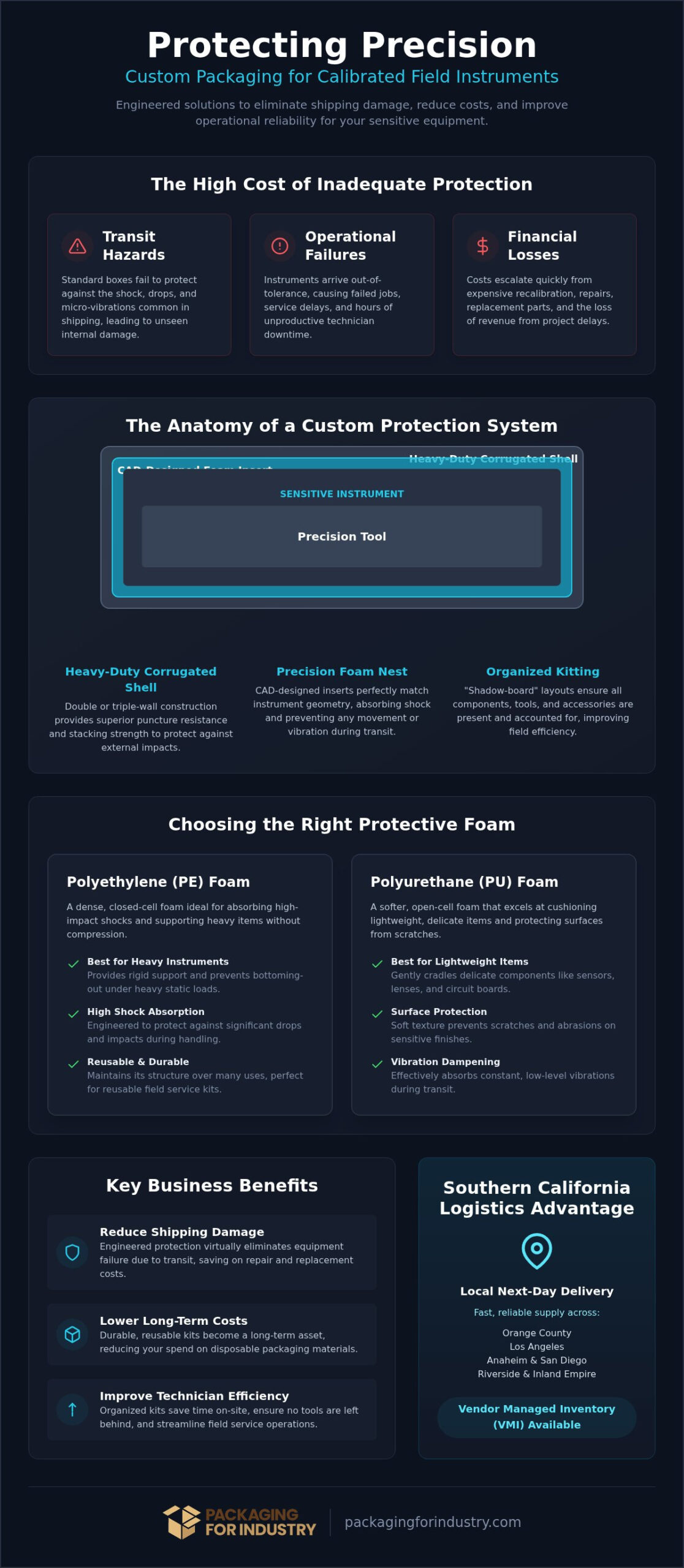
Custom packaging for calibrated instruments Southern California manufacturers rely on is more than just a shipping container; it’s a precision-engineered protection system. These systems are specifically designed to mitigate the destructive effects of shock and vibration that occur during transit. While off-the-shelf catalog boxes are sufficient for durable consumer goods, they often fail to meet the strict requirements of sensitive field service tools. Standard boxes lack the structural integrity and tailored cushioning needed to keep specialized components from shifting. This movement is the primary cause of equipment failure and accuracy loss.
When you invest in engineered solutions, you get custom sizes available for any instrument geometry, no matter how complex. This eliminates the need for excessive void fill and ensures the tool’s center of gravity is properly supported. Professional packaging kitting further streamlines logistics by consolidating multiple tools, manuals, and accessories into a single, organized unit. This approach helps businesses reduce shipping damage and lower packaging costs by creating a reusable, long-term asset rather than a disposable expense.
Protecting Sensitive Calibration in Transit
Maintaining the precise calibration of a field instrument is the most critical factor in field service success. During shipping, packages are subjected to high G-forces and constant micro-vibrations from truck engines and sorting belts. These forces can cause internal damage that isn’t visible on the box’s exterior, such as shifted lenses, loosened circuit boards, or misaligned sensors. Custom foam inserts are engineered to absorb these specific frequencies, acting as a shock absorber for the tool’s internal mechanisms. When you compare the high cost of laboratory recalibration and technician downtime against the cost of durable packaging, the return on investment for custom protection is immediate.
Benefits for Southern California Manufacturers
For manufacturers in Anaheim, Orange County, and Los Angeles, localized packaging solutions offer a significant competitive edge. By using “shadow-board” style kit layouts, your field technicians can identify missing tools instantly, which improves service speed and prevents expensive gear from being left behind at job sites. This level of organization is standard in our aerospace packaging solutions, where SoCal defense contractors require absolute precision and reliability. Working with a local packaging supplier near me ensures you have access to fast prototyping and reliable supply chains. This proximity allows Southern California businesses to optimize their warehouse space and improve their overall supply reliability while maintaining the highest standards of instrument protection.
Engineering Durable Field Service and Repair Kits
Developing high-performance field kits requires a symbiotic relationship between internal cushioning and external structural integrity. For custom packaging for calibrated instruments Southern California field teams use daily, a standard single-wall box won’t provide the necessary puncture resistance or stack strength. We recommend custom corrugated boxes utilizing double-wall or triple-wall construction for kits exceeding 30 pounds. These heavy-duty specifications ensure the kit maintains its shape under the weight of metal tools while protecting sensitive internal components from external impacts. Using higher-grade fluting prevents the box from sagging or bulging when technicians carry the kit by a handle or strap.
To ensure these kits survive the rigors of the supply chain, we design according to International Safe Transit Association (ISTA) standards. This testing data helps us determine where to place internal partitions and dividers. These dividers are essential for preventing high-value components, like replacement sensors or delicate probes, from colliding with heavier tools during transit. By isolating each component, you reduce the risk of surface scratches and mechanical shock that can knock a tool out of tolerance.
Custom Foam Inserts for Instrument Protection
Selecting the right foam packaging is the next step in the engineering process. We evaluate the static loading of the instrument to choose between Polyethylene (PE) for heavier items or Polyurethane (PU) for lighter, more delicate gear. If you’re shipping electronic calibrated tools, we utilize pink anti-static (ESD) foam to prevent electrostatic discharge damage. Multi-layer foam nests allow us to create a tiered organization system. The most frequently used tools sit on top, while delicate sensors remain protected in a recessed lower layer. This layout isn’t just about safety; it’s about making your team more efficient in the field.
Outer Shell Durability: Beyond the Standard RSC
While corrugated is versatile, some high-value field gear requires the extreme durability of custom wooden crates. This is especially true for heavy diagnostic machinery or equipment used in Southern California’s coastal or desert outdoor environments. We often apply weather-resistant coatings to protect against moisture and UV exposure that can degrade standard materials. To prevent structural box failure during rough handling by freight carriers, we integrate heavy-duty corner and edge protection into the design. These reinforcements allow the kit to withstand significant vertical pressure during palletized shipping. If you need a more resilient solution for your field gear, you can request a packaging quote to see how our engineering team can optimize your kit.
Material Comparison: Choosing the Right Protection
Selecting the correct materials for custom packaging for calibrated instruments Southern California businesses use is a balance of engineering requirements and fiscal responsibility. The choice between different foam types and corrugated grades determines if your equipment survives the “last mile” of delivery. While bubble wrap and loose-fill peanuts are common in consumer shipping, they are insufficient for industrial instruments that must maintain tight tolerances. Professional-grade protection requires a technical understanding of material density and load-bearing capacity to ensure the safety of your high-value assets.
If you are unsure which material profile fits your specific tool kit, you can request a packaging quote for a full material consultation. Our team analyzes your instrument’s fragility and weight to recommend a solution that balances durability with cost-effectiveness. We focus on creating reusable kits that provide a much higher return on investment than single-use shipping containers, especially for field service teams who transport gear daily between job sites in Anaheim and Los Angeles.
Polyethylene vs. Polyurethane Foam
The two primary materials used in precision kitting are Polyethylene (PE) and Polyurethane (PU) foam. PE foam is a closed-cell material that is rigid and resilient, making it ideal for heavy instruments that require firm support and protection against multiple impacts. In contrast, PU foam is an open-cell, softer material designed for lightweight, highly sensitive instruments that need gentle cushioning to prevent internal component shifting. Foam density represents the mass per unit volume of the material and serves as the primary metric for calculating how much shock energy the packaging can dissipate during a fall. We calculate the required foam thickness based on the “drop height” variable, which accounts for the standard 30 to 36-inch fall a package might experience in a sorting facility.
Corrugated Strength: Double-Wall vs. Triple-Wall
The outer shell must be strong enough to contain the internal foam nest and the weight of the tools without buckling. For most industrial field kits, we move beyond standard single-wall boxes to double-wall or triple-wall corrugated. Double-wall provides the necessary burst strength for kits up to 60 pounds, while triple-wall is reserved for the heaviest diagnostic machinery. Beyond protection, rightsizing your box is a critical cost-saving strategy. UPS and FedEx have implemented significant dimensional weight surcharges for oversized packages; by using custom-sized boxes, you eliminate wasted space and lower your shipping costs. For equipment that exceeds the limits of corrugated, refer to our Engineering Custom Crates guide to explore timber-based solutions for extreme protection needs.
The Design-to-Rollout Process for Custom Kits
Engineering effective custom packaging for calibrated instruments Southern California manufacturers use requires a methodical, five-step approach. We don’t rely on guesswork; our process is rooted in industrial engineering to ensure every kit performs under pressure. This journey moves from initial fragility analysis to long-term inventory management, providing a total protection system for your field operations.
- Step 1: Fragility Assessment. We begin by evaluating the G-force tolerance of your instruments and identifying every component that needs to be included in the kit, from sensors to cables.
- Step 2: CAD/CAM Design. Our engineers create digital models of the foam nests and corrugated shells to ensure a zero-tolerance fit.
- Step 3: Anaheim Prototyping. We produce a physical sample at our Anaheim facility for your team to inspect and test.
- Step 4: Performance Testing. The prototype undergoes drop and vibration simulations to verify it meets transit safety requirements.
- Step 5: Production and VMI. Once approved, we move to full-scale production and can implement a Vendor Managed Inventory (VMI) program to ensure you never run out of kits.
Precision CAD/CAM Engineering
Odd-shaped calibrated tools present unique challenges that standard packaging cannot solve. We use advanced CAD/CAM software to design custom design packaging that matches the exact contours of your gear. This precision ensures that 100% of the instrument’s surface is supported where necessary, which prevents parts from shifting or colliding during rough handling. By locking the equipment into a custom-cut foam nest, we eliminate the internal movement that often leads to calibration drift or mechanical failure during long-distance shipping.
Prototyping and Performance Testing
A digital design is only the starting point. We provide free prototyping because we believe you should hold a physical kit before committing to a bulk order. This phase allows us to gather feedback from your field technicians. If a technician finds a specific tool is difficult to remove while wearing gloves, we adjust the finger-pull dimensions in the CAD file. This iterative process ensures the final product meets the practical needs of your team and adheres to strict aerospace or medical industry standards. Testing for real-world transit conditions means your gear is ready for the road the moment it leaves our warehouse.
Southern California Logistics: The PFI Advantage
While many suppliers offer nationwide shipping, they lack the agility and accountability of a local partner. For businesses requiring custom packaging for calibrated instruments Southern California, proximity is a strategic asset that directly impacts your bottom line. PFI operates from our Anaheim headquarters, allowing us to provide face-to-face engineering support and on-site packaging reviews that remote vendors simply can’t match. This local presence ensures that your feedback is integrated immediately into the design process, which is critical when protecting high-value, sensitive equipment.
We position ourselves as a proactive partner rather than a passive vendor. Our local next-day delivery across Orange County, Los Angeles, and the Inland Empire means your operations aren’t stalled by shipping delays or carrier backlogs. Beyond just delivering boxes, our Vendor Managed Inventory (VMI) programs prevent kit component shortages by tracking your usage and restocking automatically. This level of oversight ensures you have a reliable supply of kits ready for every field service call.
Serving Anaheim, Irvine, and Orange County Hubs
Medical device and technology companies in Irvine and Anaheim operate on tight production schedules that don’t allow for long lead times. Local proximity significantly reduces the time from design to rollout, ensuring your field kits are ready the moment your instruments are calibrated. We offer custom boxes in Anaheim for immediate needs, helping you avoid the high freight costs associated with transporting heavy, bulky kits from out-of-state suppliers. Reducing the physical distance between the manufacturer and the packaging supplier is a proven way to lower packaging costs and improve overall supply reliability.
Reliable Supply for Los Angeles and the Inland Empire
Manufacturing centers in Carson and Torrance benefit from our dedicated local delivery routes. By utilizing PFI’s VMI programs, you can eliminate the need for large on-site warehouse storage, freeing up valuable floor space for production. We act as your off-site warehouse, delivering exactly what you need when you need it. This just-in-time approach also helps reduce shipping damage by ensuring kits aren’t sitting in cramped storage areas where they can be crushed or soiled. To see how our local logistics can streamline your operations, request a packaging quote to lower industrial packaging costs and secure your supply chain today.
Secure Your Field Operations with Engineered Protection
Protecting precision gear requires more than standard off-the-shelf boxes. By integrating CAD-designed foam inserts with heavy-duty corrugated shells, you ensure your tools arrive in tolerance and ready for service. This specialized approach to custom packaging for calibrated instruments Southern California businesses rely on eliminates the high costs of transit damage and technician downtime.
PFI provides free CAD design and prototyping support to ensure your kit is perfect before full-scale production. We specialize in aerospace and medical device packaging, meeting the strict standards these industries demand. Our Anaheim facility offers local next-day delivery across Orange County, San Diego, and Los Angeles. It’s the most reliable way to keep your supply chain moving without the delays or high freight costs of out-of-state vendors.
Let’s optimize your field kits to improve reliability and lower your total operational costs. Our team is ready to help you build a more durable and efficient logistical system today.
Frequently Asked Questions
Why do calibrated instruments require custom packaging instead of standard boxes?
Standard boxes don’t account for the sensitive tolerances of precision tools. Custom packaging for calibrated instruments Southern California manufacturers use is engineered to mitigate specific shock and vibration frequencies. Off-the-shelf options often lack the structural integrity to prevent internal component shifting. Precision engineering ensures the tool’s center of gravity is supported, which prevents calibration drift and mechanical failure during the rigors of industrial transit. This approach helps lower packaging costs by reducing expensive repairs.
How can custom kitting reduce shipping damage for field service kits?
Custom kitting organizes every component into a dedicated, precision-cut foam nest. This prevents high-value sensors and delicate probes from colliding with heavier tools like wrenches or diagnostic units. By isolating each part, you eliminate surface scratches and mechanical shock. Organized layouts also help technicians identify missing items immediately. This reduces the risk of leaving gear behind and prevents damage caused by loose items rattling inside a box during the return trip to your warehouse.
What is the best foam material for protecting sensitive instruments in Southern California?
The choice depends on the instrument’s weight and fragility. Polyethylene (PE) foam is best for heavier tools requiring rigid support and multiple-impact protection. For lightweight, highly sensitive instruments, Polyurethane (PU) foam provides softer cushioning to absorb micro-vibrations. If you’re shipping electronic tools, anti-static (ESD) foam is essential to prevent electrostatic discharge damage. We help you compare material performance to ensure your gear survives Southern California’s varied transit environments, from coastal humidity to desert heat.
Does PFI offer local next-day delivery for custom kits in Orange County?
Yes, PFI provides local next-day delivery across Orange County, including cities like Anaheim, Irvine, and Huntington Beach. Our headquarters is located in Anaheim, which allows us to serve Southern California manufacturers with much faster lead times than out-of-state catalog suppliers. This local proximity reduces your shipping costs and ensures your production lines aren’t stalled while waiting for essential packaging materials or custom-engineered field kits to arrive at your loading dock.
Can I get a free prototype of my custom instrument kit before ordering?
We offer free prototyping and CAD/CAM design support for all custom packaging projects. This allows your team to inspect a physical sample and verify the fit before committing to a bulk packaging pricing agreement. Testing a prototype is a critical step for aerospace and medical device companies to ensure the design meets strict industry standards. We can adjust the foam nests or corrugated shells based on your technicians’ feedback during the review process in our Anaheim facility.
How does a Vendor Managed Inventory (VMI) program benefit kitting operations?
A VMI program eliminates the risk of packaging shortages by automating the replenishment process. PFI conducts scheduled inventory reviews at your facility and restocks items based on your actual usage. This frees up warehouse floor space since you only store what you need for immediate production. It also improves your cash flow by preventing over-ordering and eliminating the need for expensive emergency rush orders when a specific kit component runs low during a busy shipping cycle.
What industries in SoCal benefit most from custom instrument packaging?
Aerospace, defense, medical device manufacturing, and electronics are the primary industries served in Southern California. These sectors require absolute precision and cannot afford the downtime caused by instruments losing calibration during shipping. Our expertise in mil-spec packaging and ESD-safe materials makes us a preferred partner for contractors in Los Angeles and the Inland Empire. We also support industrial equipment manufacturers who need heavy-duty double-wall or triple-wall corrugated solutions for their field service and repair operations.
How do I request a quote for custom packaging for calibrated instruments Southern California?
You can request a packaging quote directly through our website or by contacting our Anaheim office. We’ll perform an initial assessment of your instrument’s fragility and shipping requirements. Our team then provides a custom packaging quote for calibrated instruments Southern California companies use to protect their high-value assets. Whether you need custom boxes in Anaheim or bulk packaging pricing for a nationwide rollout, we provide the technical data needed to make an informed purchasing decision.