
Packaging that fits a stamped part isn’t automatically ready for the trip to a customer. Sharp edges, delicate surfaces, and part-to-part contact can lead to scratches, bends, or other damage. Oversized cartons can also add avoidable freight expense. Choosing custom packaging for metal stamping parts means balancing protection with the way parts are packed, handled, shipped, and replenished for the next order.
Standard packaging can miss the mark when part geometry or batch quantities vary. To compare options, start with the part shape, surface finish, weight, pack quantity, shipment method, and packing workflow. The goal is packaging that helps reduce shipping damage without making packing slower or less efficient.
This guide explains how corrugated boxes, protective foam, and crates can work together to protect stamped components through handling and transit. It also covers how design support, prototypes, and samples can help refine a solution before repeat production, and how stocking programs can support reliable supply. Packaging For Industry helps manufacturers match packaging design to operating needs, with local next-day delivery across Southern California and fast nationwide shipping.
Key Takeaways
- Use part dimensions, shape, finish, weight, and batch quantity to define packaging requirements before comparing materials.
- Custom packaging for metal stamping parts should contain and separate components while supporting the way they’re handled and shipped.
- Compare corrugated boxes, foam, and crates based on protection, shipment format, storage, and packing workflow.
- Review prototypes and samples for part fit, separation, and ease of packing before setting repeat-order requirements.
- Coordinate boxes, foam, and crates as one packaging system to support production and shipping.
Custom Packaging for Metal Stamping Parts Starts with the Part and Its Journey
A finished stamped component can leave production in good condition and still arrive scratched, bent, or difficult to use. The challenge is protecting parts without slowing packing, taking up unnecessary storage space, or choosing an outer pack that doesn’t suit the shipment. Effective custom packaging for metal stamping parts starts with the component, then accounts for how it will be packed, handled, and delivered.
Dimensions, weight, shape, edges, and surface finish all affect the design. A flat part that nests may need a different arrangement from a formed bracket with exposed edges. Understanding the metal stamping process can help buyers describe how a component is formed, but packaging decisions also depend on its handling and shipping needs, not simply the type of metal.
Which part details should inform a packaging specification?
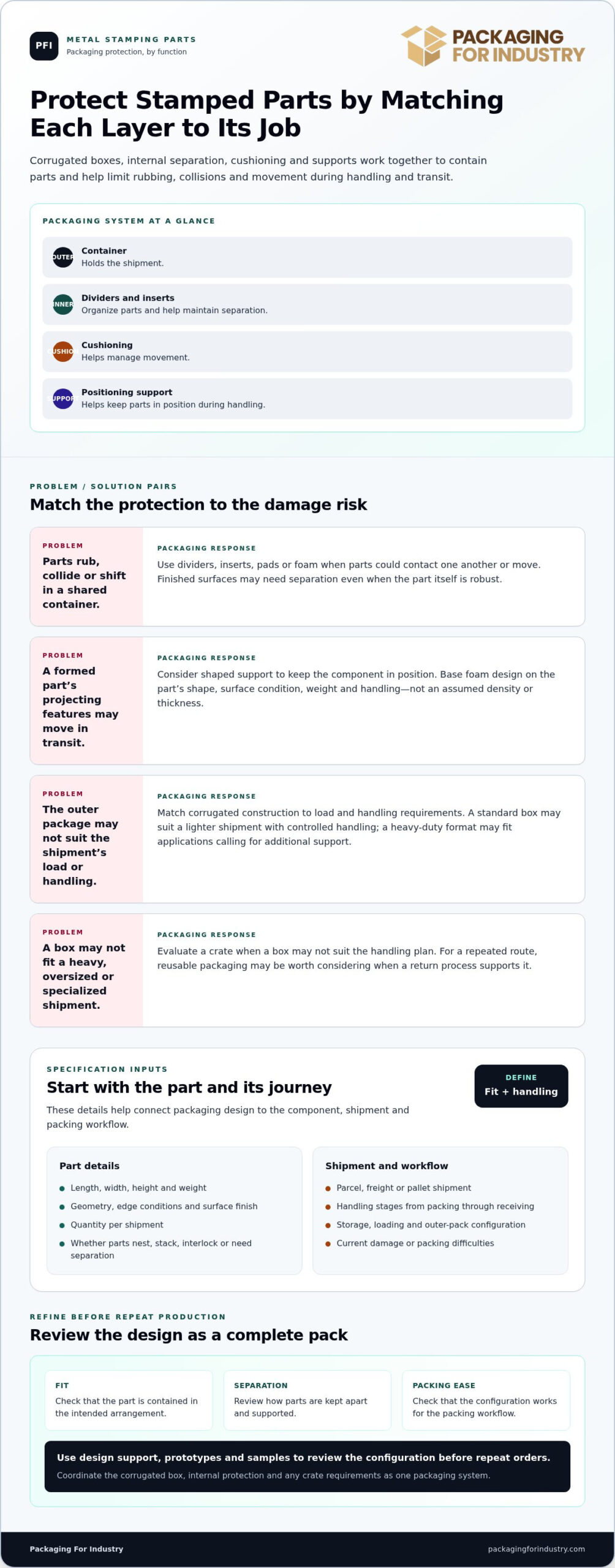
Start with the part’s length, width, height, weight, geometry, edge conditions, surface finish, and quantity per shipment. Then consider how components behave together: do they nest, stack, or interlock, or must they stay separated to prevent contact? Note concerns such as abrasion, impact, contamination, or movement. These details help determine whether parts should be packaged individually, grouped in batches, or arranged in production-ready kits.
How does the shipping and handling journey change the design?
Map the route from the packing station through internal handling, storage, carrier pickup, transit, and receiving. A part moved between work cells before shipment may need a different pack configuration from one packed for direct delivery. Identify whether the shipment travels by parcel, freight, or pallet, and note any additional handling stages. Review outer-pack dimensions and configuration alongside protection needs because they can affect storage, loading, and freight planning.
What information helps a packaging supplier quote accurately?
Provide part drawings or physical samples, shipment quantities, order patterns, and a clear description of current damage or packing difficulties. Include photos or examples of the existing package and explain what needs to change, such as improving separation or making packing easier for operators. Share expected repeat-order needs and production schedules, too. This gives a packaging supplier the context to quote a design and its ongoing supply requirements.
For manufacturers in Los Angeles, Orange County, San Diego, and Riverside, it also helps to describe the packing workflow: who packs the parts, how they handle each unit, and whether components need to be ready for a defined production or shipping step. Packaging For Industry provides custom packaging design support, including CAD/CAM, prototypes, and samples. This process helps translate part and shipment details into a practical specification before repeat orders begin.
How Custom Packaging Protects Stamped Parts Through Transit
Protective packaging works as a system. The outer container holds the shipment, internal components organize and separate parts, cushioning helps manage movement, and supports help keep parts in position during handling. If one element is missing, stamped components may shift, strike each other, or press against the package in transit. The result can be surface damage, bent features, or extra inspection and repacking at the receiving end.
Good packaging connects each part’s geometry, finish, and weight to the movement and handling it will face before delivery. That principle guides custom packaging for metal stamping parts: choose each component for its role rather than expecting one material to meet every protection need.
When should parts be separated or cushioned?
Use dividers, inserts, pads, or foam when parts could rub, collide, or shift inside a shared container. A finished surface may need separation even when the part itself is robust. A formed component with projecting features may need shaped support to stay in position. Choose cushioning based on part shape, surface condition, weight, and handling. Foam design should reflect the specific project rather than rely on an assumed density or thickness.
How can corrugated boxes support a metal-parts packaging system?
Match corrugated construction to the shipment’s load and handling requirements. A standard box may suit a lighter shipment with controlled handling, while a heavy-duty format may be appropriate when the application calls for additional support. Die-cut boxes, partitions, pads, and inserts can organize parts and help maintain separation. PFI’s custom corrugated boxes can be designed alongside foam so the outer container and internal protection work together.
When might a crate be more suitable than a box?
Evaluate a crate for heavy, oversized, or specialized shipments where a box may not suit the handling plan. If parts travel repeatedly along a defined route, reusable packaging may also be worth considering when a return process supports it. Crate selection still depends on the shipment and handling requirements. For context on this decision, the related topic “Engineering Custom Crates for International Transit” considers how crate requirements can vary by shipment.
Keep the scope of any regulatory reference clear. The Legal Information Institute’s text of federal standards for metal packaging addresses metal intermediate bulk containers, not general corrugated or foam packaging for stamped parts. Buyers should distinguish that specific category from ordinary component-protection decisions.
To reduce shipping damage, assess the complete pack: part placement, separation, cushioning, outer container, and handling method. If you’re comparing a box-and-foam design with a crate-based approach, you can request a packaging quote based on the parts and shipment requirements.
Compare Box, Foam, and Crate Options for Stamped Metal Components
No single packaging material suits every stamped part or shipment. Compare each option against the actual job: protecting parts, making them practical to handle, fitting the shipment format, using storage efficiently, and supporting repeat orders. A box may organize a batch, foam may locate delicate parts, and a crate may suit a specialized shipment. The right custom packaging for metal stamping parts depends on how these needs work together.
| Packaging option | Best-fit purpose | Handling and shipment considerations | Storage and repeatability trade-offs |
|---|---|---|---|
| Corrugated box | Organizes suitable parts for shipping or storage; partitions can keep batches apart. | Choose the format to suit the shipment and load. Internal pads or inserts can help control placement. | Can support consistent packing, but the box and internal layout must suit the parts and available storage space. |
| Foam components | Locates or separates parts that need cushioning or a defined position. | Insert shape and material depend on the part, finish, and handling needs. Foam often works inside an outer package. | Custom inserts can make placement repeatable, but they need storage space when not in use. |
| Crate | May suit heavy, oversized, or specialized shipments. | Consider the shipment route, handling, and receiving process. A crate can be combined with cushioning where needed. | Reusable packaging may fit a recurring route if an effective return process is in place. |
When are custom corrugated boxes the practical choice?
Corrugated boxes are useful when parts can be packed in an organized, manageable format for shipping or storage. Partitions separate groups, while pads or inserts can help keep components positioned. These features can make batch packing more consistent without requiring a separate pocket for every part. Review corrugated box options alongside the intended pack quantity and shipment format.
When should buyers consider foam packaging or inserts?
Consider custom foam inserts when parts need defined locations or added separation within a package. A shaped insert can help prevent components from shifting together, particularly when surface condition or geometry makes contact a concern. Polyethylene, polyurethane, or ESD foam may be suitable depending on project requirements. Select the material and design for the application rather than assuming one foam type fits every stamped component.
When do crates or combined packaging systems merit consideration?
Evaluate crates against the actual shipment conditions and part requirements, not simply because a component is metal. For some applications, a crate with foam lining can pair a supportive outer structure with cushioning and separation inside. A box-and-foam design may address the same needs in a different shipment format. Compare the complete system, including packing steps, storage, and repeatability, before settling on a configuration.
There’s no universal ranking. A box with partitions may be practical for an organized batch; foam may add useful positioning and separation; and a crate may better fit a specialized shipment. Compare how each option supports the parts and the workflow, then consider whether combining materials solves a protection or handling issue that one material alone cannot.
Build a Custom Packaging Specification That Fits Production and Shipping
A useful specification turns packaging needs into clear design and purchasing decisions. It should cover the component, shipment, packing process, and replenishment plan. This gives your team a practical basis for reviewing samples, comparing operating impact, and setting up repeat orders.
What should a buyer include in the packaging brief?
Bring together part drawings or samples, dimensions, weight, surface concerns, and the quantity packed per shipment. Add the shipping route, handling steps, storage limits, and palletization needs. Describe current damage issues and packaging constraints, such as a pack that takes too long to assemble or occupies too much warehouse space. Include recurring order patterns so the specification reflects production demand, not just the first shipment.
How should teams evaluate prototypes and samples?
Review samples with the people who will use them. Confirm that parts fit, stay separated, and can be accessed without awkward handling. Follow the proposed packing sequence at the work area, then inspect the parts and package after handling trials that reflect the normal workflow. Collect feedback from production, warehouse, shipping, and receiving teams before approving a configuration.
Use this sequence to move from project inputs to a repeatable specification:
- Gather the part information. Record drawings or sample details, dimensions, weight, finish concerns, and shipment quantity.
- Map the workflow. Document packing steps, internal moves, storage, shipment format, and receiving conditions.
- Describe current problems. Note damage, excess handling, difficult packing steps, or limitations in the existing package.
- Develop and review a prototype. Check fit, separation, access, and whether the package works with the actual packing process.
- Assess the full operating impact. Consider material use, package dimensions, packing labor, storage footprint, freight implications, and damage-related rework together.
- Record the approved setup. Document the configuration, pack quantity, and reorder pattern so future orders follow the reviewed specification.
How can packaging choices account for freight and operating costs?
Compare more than material use. Package dimensions and shipment configuration can affect parcel or freight planning, while a bulky design can consume warehouse and production-floor space. Include packing time and the potential cost of damage-related rework in the review. A design that uses less material may not be the better operational choice if it slows packing or leaves parts vulnerable. PFI’s custom packaging design services include design support and cost-reduction analysis to help assess these trade-offs.
For recurring shipments, align the approved specification with expected order patterns and replenishment needs. This makes custom packaging for metal stamping parts practical beyond the prototype, supporting consistent packing and dependable supply as production continues.
Source Custom Packaging for Metal Stamping Parts with PFI
Packaging For Industry (PFI) supplies custom and stock corrugated boxes, protective foam, crates, and related industrial packaging materials to manufacturers. These products can be planned as a coordinated packaging program, helping teams source materials around their parts and operations rather than managing disconnected purchases.
How can PFI support a custom packaging project?
PFI works with manufacturers on packaging design, from initial requirements through CAD/CAM support, prototypes, samples, and packaging reviews. Corrugated boxes, foam inserts, and crates can be considered together for metal stamping applications. Packaging kitting and assembly services can prepare organized packaging components for the production floor, supporting consistent packing and simpler handling for teams.
How can repeat supply support production continuity?
For manufacturers with ongoing demand, stocking programs and planned replenishment help align packaging supply with production needs. This can reduce purchasing interruptions and make routine supply easier to manage. PFI’s vendor managed inventory packaging supports businesses that need a coordinated approach to recurring packaging materials.
PFI serves industrial buyers across sectors including automotive, aerospace and aviation, electronics, medical device manufacturing, industrial equipment, and contract manufacturing. Its packaging support is designed for operations where product protection, purchasing efficiency, and dependable supply all matter.
What should buyers provide when requesting a packaging quote?
Share the stamped-part application, current packaging approach, order pattern, and the operational outcome you want to improve. Mention whether the project involves new packaging, a packaging review, or ongoing replenishment. This context helps PFI assess how its products and design support can fit the work, whether the priority is protecting parts, simplifying packing, or coordinating repeat supply.
For a practical next step, submit your project details and request a packaging quote.
Make Packaging Part of Your Production Plan
Packaging performs best when it stays aligned with the component and the operation around it. Treat the approved specification as a working production document, not a one-time purchasing decision. If a part drawing, shipment pattern, or packing process changes, review whether the packaging still fits the job. That practice can help keep protection and packing expectations consistent as requirements evolve.
For custom packaging for metal stamping parts, turn your requirements into a project brief that your packaging team can evaluate. Clear details about the component, shipment, and recurring demand give the design process a practical starting point and keep the discussion focused on your operation’s priorities.
A well-planned packaging specification can support a smoother handoff from production to shipment. Request a quote from PFI to develop a solution around how your parts move.
Frequently Asked Questions
Can custom packaging accommodate several metal stamping part sizes?
Yes. A packaging program can account for a family of parts by assigning each size a defined package configuration and clear identification. This helps purchasing and warehouse teams match the right packaging to each production item instead of treating every part as interchangeable. Custom sizes can support accurate picking and packing while keeping the packaging plan manageable across the product range.
What information should I provide for a custom packaging quote?
Identify the packaging items and quantities you want priced, along with expected order frequency and delivery needs. If you’re comparing packaging pricing, use the same pack quantity and shipment assumptions for each option. For repeat or higher-volume demand, include bulk packaging pricing in the review. A consistent comparison helps your purchasing team evaluate options without relying on unit price alone.
Can packaging be designed for recurring production orders?
Yes. Recurring packaging can be managed against an agreed item list and replenishment plan. Keep a record of approved packaging configurations and flag product or process changes that could affect material requirements. This gives purchasing and operations teams a shared reference when demand shifts, helping prevent unplanned substitutions and making routine replenishment easier to coordinate with production.
Does PFI supply both custom and stock packaging materials?
Yes. PFI supplies custom and stock packaging materials, giving buyers options for specialized applications and routine supply needs. A manufacturer might use engineered packaging for a particular component while standardizing common shipping supplies across its facility. This approach supports packaging for manufacturers, warehouses, and distribution centers, with procurement organized around how each location uses and replenishes its materials.
Can a packaging program combine boxes, foam, and crates?
Yes. PFI can consider these materials within one packaging program, helping buyers coordinate sourcing and purchasing rather than manage unrelated packaging specifications. A shared plan can also help align material ordering with the teams that pack, store, and ship components. The appropriate mix depends on the application, but the program can be organized around the operation’s packaging requirements.
Does PFI provide packaging delivery in Southern California?
Yes. PFI provides local next-day delivery across Southern California. Buyers looking for an Orange County packaging supplier or packaging delivery in Los Angeles can plan local supply around their facility’s needs. PFI also serves customers in San Diego and Riverside, in addition to supporting nationwide shipping.
Can custom packaging help reduce parcel or freight surcharges?
It can help address package dimensions that may affect parcel or freight charges, but it can’t guarantee a surcharge will be avoided. Review carrier invoices and shipment records to identify packages that regularly trigger added charges, then compare the current configuration with alternatives. Consider dimensional impact alongside protection and packing needs. This gives your team a practical basis for evaluating whether a packaging change could improve shipping efficiency.