
What if the most expensive part of your logistics chain isn’t the freight rate, but the foam you chose to save a few dollars on? When you’re moving high-value industrial machinery, the margin for error is non-existent. You’ve likely experienced the stress of transit damage or the confusion of trying to decipher technical density specs. Selecting the wrong shock absorbing foam for heavy equipment transport often leads to “bottoming out,” where the material fails to dissipate energy and transfers the full force of an impact directly into your equipment.
We understand that protecting your bottom line means protecting your cargo. This guide provides a pragmatic look at how to select high-density materials and custom-engineered inserts that actually perform under pressure. You’ll learn how to navigate current standards like MIL-STD-2073-1 and A-A-59136 to ensure your packaging meets rigorous industrial requirements. We’ll also explore how optimized packaging geometry can help you lower packaging costs by reducing dimensional weight. By the end, you’ll have a clear roadmap for achieving zero-damage shipping through precision engineering and reliable material selection.
Key Takeaways
- Learn why closed-cell polyethylene foam is the preferred material for supporting heavy industrial loads without the risk of bottoming out.
- Discover how precision-engineered shock absorbing foam for heavy equipment transport manages G-force impact to ensure zero-damage delivery.
- Master the technical process for calculating static load and identifying equipment fragility levels to avoid the high costs of over-packaging.
- Explore the logistical advantages of integrating custom foam inserts with heavy-duty corrugated or wood crates for comprehensive machinery protection.
- Understand how Southern California manufacturers can leverage local next-day delivery and VMI programs to lower packaging costs and improve supply reliability.
Understanding Shock Absorbing Foam for Heavy Equipment Transport
Shock absorbing foam isn’t just a packing filler; it’s a high-density engineered material designed to manage the kinetic energy of heavy machinery. During transit, equipment faces two distinct threats: steady vibration and sudden impact. Industrial-grade foam acts as a decelerator. It creates a controlled “crush zone” that lengthens the time of an impact, which directly reduces the peak force exerted on the machinery. This is essential for Package cushioning where the goal is to keep internal components within their specific fragility limits. Unlike consumer materials, these foams are tested for repeatable performance under extreme pressure.
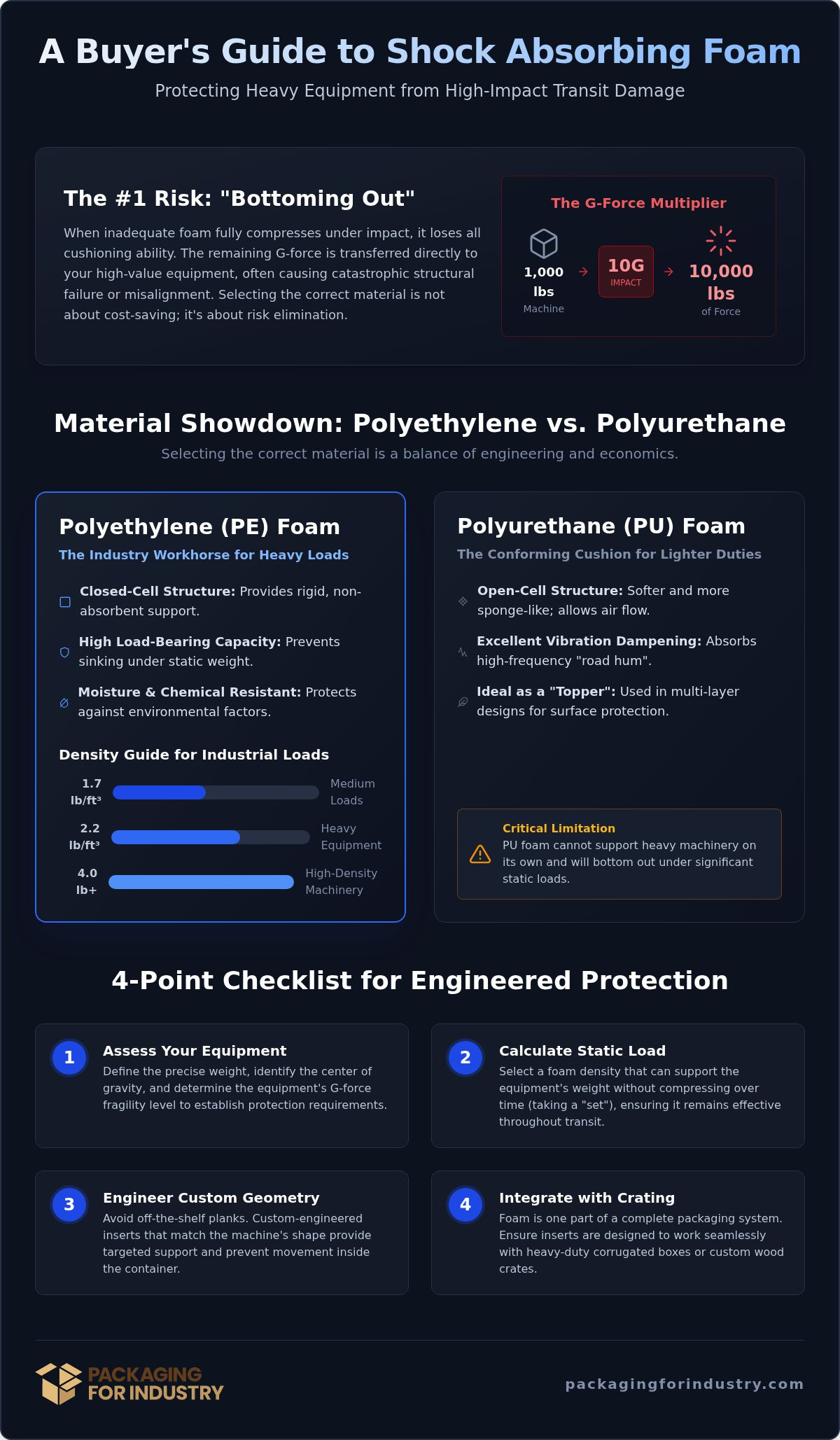
Think of G-force as the multiplier of weight during a sudden event. If a 1,000-pound machine experiences a 10G impact due to a hard brake or a drop, it momentarily exerts 10,000 pounds of force. Without the right shock absorbing foam for heavy equipment transport, the material will “bottom out.” This occurs when the foam compresses to its limit, losing its ability to absorb energy. At that point, the remaining force travels through the packaging directly into the equipment’s frame, often causing catastrophic structural failure or misalignment. A well-engineered foam insert ensures the equipment comes to a stop slowly enough to prevent this energy transfer.
The Role of Dampening in Industrial Logistics
Dampening and shock absorption serve different functions in a logistics plan. Dampening addresses the high-frequency “road hum” or vibration that occurs during a thousand-mile truck haul. Constant vibration can loosen fasteners, fatigue metal components, or damage calibrated optics and sensors. Industrial foam must have enough density to maintain its shape under a static load while still providing enough “give” to neutralize these vibrations. For heavy equipment, we prioritize materials that don’t take a “set” or lose their resilience over long durations, ensuring the protection remains effective from the loading dock to the final destination.
Why Off-the-Shelf Solutions Fail for Heavy Loads
Standard, one-size-fits-all foam planks found in retail catalogs often lack the specific density required for heavy machinery. If the foam is too soft, the equipment sinks and bottoms out before it even leaves the warehouse. If it’s too rigid, it can actually amplify vibrations, acting like a tuning fork rather than a cushion. This mismatch is why many manufacturers require custom foam packaging. Engineering a solution based on the equipment’s center of gravity and weight distribution ensures the protection is functional rather than just decorative. Using the wrong material often leads to expensive rework or total product loss, making professional material selection a critical part of the procurement process.
Comparing Material Performance: Polyethylene vs. Polyurethane
Selecting the correct material for industrial protection is a balance of engineering and economics. For high-value machinery, polyethylene (PE) is the industry workhorse. It’s a closed-cell material, meaning the cells are sealed off from each other. This structure provides high load-bearing capacity and resistance to moisture. When we specify shock absorbing foam for heavy equipment transport, PE is usually the primary component because it doesn’t lose its shape under the weight of massive machinery. It provides the rigid support necessary to prevent the equipment from sinking into the packaging during long hauls.
Density ratings are a critical technical specification for buyers to understand. These are typically expressed in pounds per cubic foot. A 1.7 lb density foam is a common baseline for medium loads, but for heavier industrial machinery, a 2.2 lb or even a 4.0 lb density is often required. Higher density means more material per square inch, which translates to better support for high-static loads. As you compare packaging pricing, you’ll find that selecting the correct density upfront prevents the massive costs of transit damage. Choosing a density that is too low is the most common cause of packaging failure, as the material will eventually compress fully and fail to provide any cushioning.
Polyurethane (PU) foam serves a different purpose. It’s an open-cell material that is much softer and more flexible than PE. While it cannot support a heavy machine on its own, it’s frequently used as a “topper” in multi-layer designs. This allows the packaging to protect fragile surface finishes or lightweight protruding parts while the heavier base foam handles the main weight. For specialized sectors like aerospace, cross-linked polyethylene (XLPE) is the premium choice. It offers a “Class-A” surface protection and zero off-gassing, which is essential for sensitive equipment that cannot risk chemical contamination or scratches.
Closed-Cell vs. Open-Cell Mechanics
Closed-cell foams like PE are impervious to water and most chemicals, making them ideal for international shipping or long-term storage in varied environments. They provide the rigid support that maintains structural integrity under pressure. Open-cell PU, conversely, acts more like a sponge. It’s excellent for vibration dampening on lighter components but will compress fully under heavy weight. Following Defense Logistics Agency packaging standards ensures that your material choice aligns with the necessary preservation and cushioning requirements for high-value assets. This technical alignment is what prevents costly transit damage.
Anti-Static and ESD Foam Requirements
Electronic heavy equipment requires more than just physical protection. Pink anti-static foam is treated to prevent the buildup of static electricity during transit, which is vital for medical imaging machines or server racks. For highly sensitive semiconductor or aerospace components, black conductive foam might be necessary. We leverage PFI’s expertise in ESD packaging to ensure your sensitive electronics are protected from both physical shock and electrostatic discharge. Integrating the right shock absorbing foam for heavy equipment transport with ESD properties ensures a comprehensive protection system. If you aren’t sure which density or treatment your equipment requires, you can request a packaging quote to get an engineered recommendation based on your specific load requirements.
Engineering Custom Foam Inserts for Industrial Machinery
Engineering custom inserts requires more than just cutting material to size; it involves precision CAD/CAM modeling to mirror the equipment’s exact footprint. This ensures load distribution is even across all contact points, preventing pressure spikes that could damage delicate housings. Modern research on shock-absorbing material design emphasizes that the geometry of the insert is as important as the material density discussed earlier. With custom sizes available for any machinery profile, we can utilize multi-layer assemblies to place rigid polyethylene at the base for support and softer polyurethane on top for delicate surfaces. This approach provides a comprehensive solution for shock absorbing foam for heavy equipment transport without the excessive cost of full-block encapsulation.
Production methods vary based on your specific volume and complexity. While some competitors focus exclusively on molded parts, CNC routing and die-cutting offer greater flexibility for most industrial runs. CNC routing is ideal for complex, deep-cavity inserts required for specialized machinery with irregular shapes. Die-cutting provides a faster, more cost-effective path for high-volume orders. To further streamline your operations in the Inland Empire or Orange County, we offer “kitting” services. This involves pre-assembling the foam into its final box or crate before it reaches your facility. It eliminates staging time and allows your warehouse team to focus on the equipment rather than the packaging logistics.
Prototyping and Fit Testing
Precision is non-negotiable when moving high-value assets. We provide free prototyping to ensure every insert fits the equipment exactly, preventing any internal shifting that could lead to damage. Our custom design packaging services involve rigorous testing phases to refine the design before full production begins. A “drop test” serves as the primary validation standard, measuring how the foam manages g-force impacts from specific heights to ensure the safety of sensitive internal components. These steps guarantee that the final product meets your specific reliability requirements and matches the shock absorbing foam for heavy equipment transport specs you need.
End Caps and Corner Protection
You don’t always need to wrap an entire machine in foam to protect it effectively. The “star” or “end cap” method uses localized foam blocks to suspend the equipment in the center of a crate. This creates a protective air buffer on all sides while significantly lowering packaging costs by reducing material use. Integrating corner and edge protection with these foam caps provides additional structural stability for heavy equipment. This hybrid strategy ensures the highest level of protection while maintaining a lean packaging budget, which is a pragmatic way to improve your logistical flow.
Specifying Your Protective Packaging: A Buyer’s Checklist
Procuring the right shock absorbing foam for heavy equipment transport requires a methodical approach to balance protection and cost. A vague request for “heavy-duty foam” often leads to quotes for generic materials that don’t meet your specific technical needs. Using a structured checklist ensures that your packaging supplier understands the physics of your cargo before they begin the design phase.
To ensure your equipment arrives intact, follow these specific steps during the specification process:
- Determine the static load: Calculate the weight of the equipment divided by the total surface area touching the foam.
- Identify fragility: Determine the maximum G-force your machinery can withstand before internal components or calibrations fail.
- Define the shipping environment: Specify if the cargo will face the turbulence of LTL freight, the humidity of ocean export, or short-haul local delivery.
- Assess secondary needs: Identify if you need anti-static properties for electronics or specialized liners to prevent surface scratching.
- Request a prototype: Always validate the engineering with a physical sample to ensure the fit is precise before full production.
Calculating Static Load and Fragility
Determining the static load is the most critical calculation in the procurement process. The formula is simple: divide the total weight of the machinery by the square inches of foam that will support it. This number tells us exactly which density of polyethylene or polyurethane is required to keep the equipment suspended. Matching the density to the load ensures the foam remains in its functional compression range during an impact rather than bottoming out.
Matching the material too aggressively can be counterproductive. If you choose a foam that’s too dense for the weight, it won’t compress enough to absorb energy. This is known as over-packaging. The foam acts like a solid block, transferring every shock directly to the machine. For high-value aerospace or medical equipment, consulting with an engineer is the only way to guarantee the density provides the necessary deceleration to keep the equipment within its G-force limits.
Optimizing for Freight and Storage
Beyond physical protection, engineered foam helps control your total cost of ownership. Custom inserts allow for “right-sizing,” which reduces the overall footprint of your shipping container. This is a direct way to lower packaging costs by avoiding dimensional weight surcharges from carriers. Smaller, more efficient packaging also means you can fit more units on a single pallet or in a shipping container, maximizing your logistical efficiency.
We offer Vendor Managed Inventory (VMI) to help you maintain a lean operation. This program ensures your custom shock absorbing foam for heavy equipment transport is always available for just-in-time (JIT) production without cluttering your warehouse floor. It moves the storage burden to us while providing you with local next-day delivery options in Southern California. This logistical flow supports lean manufacturing lines and prevents production delays caused by packaging shortages.
PFI Custom Solutions: Integrated Foam and Crate Engineering
Effective protection isn’t just about the foam; it’s about the interaction between the cushioning and the outer container. We specialize in designing integrated systems where custom foam inserts are precision-fitted into heavy-duty corrugated or wood crates. This holistic approach ensures that the shock absorbing foam for heavy equipment transport remains perfectly aligned with the machinery’s center of gravity, preventing the load from shifting or tilting. By acting as a single partner for your corrugated boxes, foam, crates, and stretch film, we help you streamline procurement and lower packaging costs through optimized material use. You won’t have to manage multiple vendors or worry about material compatibility when every component is engineered in-house to work as a unified unit.
Our engineering team focuses on the intersection of economics and protection. We don’t just provide a material; we provide a system designed to survive the specific rigors of your supply chain. Whether you are shipping a single high-value prototype or managing bulk quantities for a manufacturing run, our integrated solutions eliminate the guesswork. This one-stop-shop model reduces logistical friction and ensures that your internal teams spend less time coordinating between different suppliers and more time on their core operations.
Foam-Lined Crates for International Export
Global logistics introduce environmental variables that foam alone cannot solve. For international transit, we provide ISPM-15 compliant wood crates paired with engineered foam to meet strict customs regulations for heat-treated wood. We often incorporate vapor barrier bags to protect sensitive metal surfaces from salt air and moisture during long-duration ocean freight. This combination of physical shock protection and environmental barrier ensures your equipment arrives in factory condition regardless of the route. We understand the complexities of mil-spec and aerospace standards, ensuring your export packaging is fully compliant and ready for the rigors of global handling. For more details on our structural capabilities, read our sibling article on Engineering Custom Crates.
Partnering with PFI in Southern California
Our footprint across Southern California, including the Anaheim and Orange County service areas, allows us to provide a level of responsiveness that catalog distributors can’t match. Unlike larger distributors who sell generic products, PFI takes a consultative approach to solve specific operational pains for manufacturers in San Diego, Los Angeles, and the Inland Empire. Our sales team acts as seasoned industrial consultants, working directly with your engineers to identify the most cost-effective density and crate design. We don’t just ship products; we engineer outcomes that reduce transit damage and lower your total cost of ownership. Our local presence enables next-day delivery for recurring needs, keeping your production lines moving without the overhead of massive on-site inventory. We’re committed to being a dependable partner that values long-term reliability over flashy, one-size-fits-all options.
Ready to secure your high-value machinery for its next journey? Request a packaging quote today to see how our integrated engineering can protect your bottom line.
Securing Your Industrial Logistics Chain
Effective machinery protection requires a technical alignment between material density and static load. Precision-engineered inserts prevent the catastrophic failure of bottoming out while optimizing your freight footprint. By selecting the right shock absorbing foam for heavy equipment transport, you’ll eliminate transit damage and lower packaging costs. Professional engineering ensures that your high-value assets remain within their specific G-force limits throughout the entire supply chain.
Packaging For Industry specializes in these complex aerospace and industrial requirements. We provide free prototyping and samples to guarantee a perfect fit before full production begins. Our Anaheim-based team offers local next-day delivery across Southern California to keep your operations running smoothly. Whether you need mil-spec compliance or VMI programs for recurring needs, we’re ready to serve as your dependable packaging partner.
We look forward to helping you achieve zero-damage shipping and improved supply reliability for your most critical equipment.
Frequently Asked Questions
What is the best foam density for heavy machinery transport?
The ideal density depends on the static load of your equipment. For most heavy machinery, we recommend polyethylene foam with a 2.2 lb or 4.0 lb density. These higher densities provide the structural integrity needed to support significant weight without collapsing. Utilizing the correct shock absorbing foam for heavy equipment transport ensures that your cargo remains suspended and protected throughout the entire shipping cycle.
Can I reuse custom foam inserts for multiple shipments?
Reusability depends on the material and the intensity of the transit environment. Polyethylene is a durable, closed-cell material that resists compression set, making it suitable for multiple trips in a closed-loop logistical system. If the foam hasn’t been crushed beyond its elastic limit during an impact, it will maintain its protective properties. We design custom inserts with longevity in mind for recurring industrial needs.
How do I know if I need polyethylene or polyurethane foam?
Weight and moisture resistance are the primary deciding factors. Polyethylene is a rigid, closed-cell foam that is best for supporting the heavy base of industrial equipment. It also resists water and chemicals. Polyurethane is a softer, open-cell material used for lighter components or as a topper to protect delicate finishes. We often combine both in multi-layer assemblies to provide comprehensive support and cushioning.
Does PFI offer anti-static foam for heavy electronics?
Yes, we provide both pink anti-static and black conductive foam options. These materials are critical for transporting heavy medical devices, server racks, or semiconductor equipment. They prevent the buildup of static electricity that can damage sensitive internal circuitry. Integrating these properties into your shock absorbing foam for heavy equipment transport provides a dual layer of physical and electrical protection for high-value electronic assets.
What information do I need to provide for a custom foam quote?
To provide an accurate quote, we need the equipment’s dimensions, total weight, and fragility level. Providing a CAD file or a physical sample allows our engineers to design precision cutouts that mirror your equipment’s footprint. We also consider the shipping environment and any secondary needs like ESD protection. This data helps us optimize material use to help you lower packaging costs effectively.
How long does it take to get a custom foam prototype?
We prioritize fast turnaround times for our Southern California partners. Our Anaheim-based engineering team uses CAD/CAM technology to produce prototypes quickly, ensuring a perfect fit before full production. While complexity influences the schedule, we offer free prototyping to help manufacturers move from design to delivery without delays. You should contact our sales team directly to verify current lead times for your specific project.
Do you provide foam-lined crates for international shipping?
We specialize in building ISPM-15 compliant wood crates that feature integrated foam cushioning. These crates are specifically engineered for international export and long-term ocean freight. By combining heat-treated wood with high-density shock-absorbing materials, we ensure your machinery meets global customs regulations. This integrated approach provides a superior level of protection compared to using separate suppliers for crates and internal foam cushioning.
Is custom foam more cost-effective than standard foam planks?
Custom foam is typically more cost-effective because it enables “right-sizing.” While standard planks are easy to source, they often lead to excessive material waste and larger shipping boxes. Custom-engineered inserts reduce the overall package dimensions, which helps you avoid expensive carrier surcharges based on dimensional weight. Precision engineering also prevents the significant financial losses associated with transit damage and the subsequent need for product rework.