
Shipping damage is rarely a carrier error; it is almost always an engineering failure. When you rely on generic catalog boxes and excessive dunnage, you aren’t just risking a broken part. You’re accepting the high cost of replacement freight and the long-term erosion of your brand reputation. Implementing custom packaging to reduce shipping damage transforms your logistics from a source of professional stress into a predictable, high-performance system. For manufacturers in Los Angeles and Orange County, this shift is the difference between a profitable quarter and one drained by operational inefficiencies.
We understand that your warehouse team is likely struggling with slow, manual packing processes that still result in scuffed or broken arrivals. This guide will show you how to eliminate transit losses and lower your total operational costs by replacing one-size-fits-all containers with engineered, custom-fit solutions. You’ll learn the specific industrial engineering principles that create zero-damage shipping cycles and reduce labor time in the warehouse. From precision foam inserts to heavy-duty corrugated designs, we will preview the strategies that help Southern California distributors achieve total supply chain reliability and predictable packaging budgets.
Key Takeaways
- Identify the Total Cost of Loss (TCOL) by calculating how freight, product value, and labor impact your bottom line beyond simple insurance claims.
- Learn how to leverage custom packaging to reduce shipping damage through structural engineering and precise shock absorption ratings.
- Avoid the “Catalog Trap” by using custom-fit containers that eliminate expensive dimensional weight (DIM) surcharges and carrier penalties.
- Master a systematic design approach that uses damage audits and CAD digital blueprints to create high-performance protection for industrial components.
- Optimize your Southern California operations by utilizing local next-day delivery and Vendor Managed Inventory to ensure consistent supply reliability.
The Financial Impact: Why Shipping Damage is More Than a Freight Claim
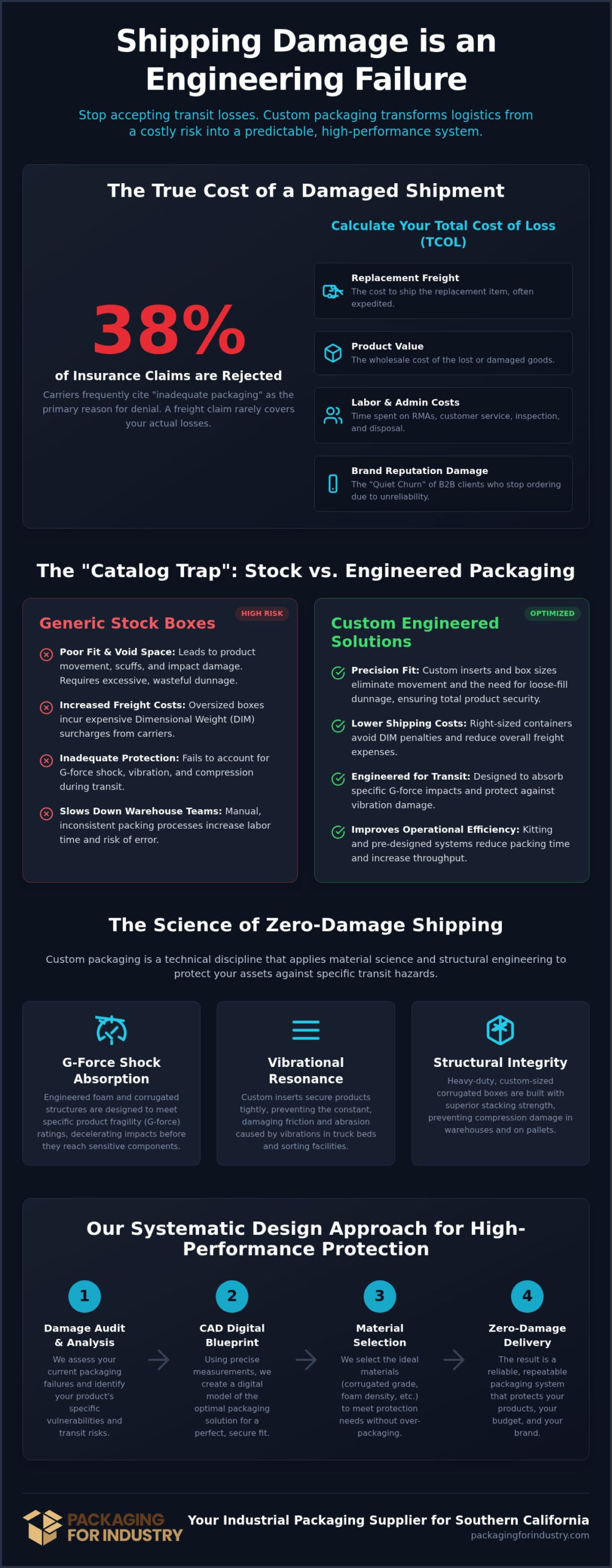
Many operations managers view shipping damage through the narrow lens of a carrier claim. This perspective is a costly mistake. Industry data from early 2026 shows that carriers like the USPS reject over 38% of insurance claims, frequently citing “inadequate packaging” as the primary reason for denial. When a package arrives damaged, the freight claim typically only covers a fraction of the actual financial hit. To understand the true drain on your bottom line, you must calculate the Total Cost of Loss (TCOL). This metric accounts for the original freight, the replacement shipping costs, the wholesale value of the product, and the administrative labor required to process the failure.
In high-stakes sectors like aerospace and medical device manufacturing, the definition of “damage” is much stricter than in general consumer goods. A minor scuff on a precision-machined housing might seem cosmetic, but it often leads to a total part rejection during quality control. These industries demand perfection because a compromised exterior can signal internal structural issues. This is where the principles of Packaging engineering become a financial necessity. By applying material science to the shipping cycle, businesses move away from a reactive mindset and toward a proactive protection strategy. Utilizing custom packaging to reduce shipping damage ensures that your high-value assets survive the rigors of transit without technical failures.
Beyond the immediate invoice, the “Quiet Churn” effect presents a different risk. In B2B relationships, reliability is the primary currency. If a distributor or warehouse consistently receives compromised pallets, they won’t always file a formal complaint. Instead, they simply stop placing orders and look for a partner who can guarantee a zero-damage delivery cycle. Implementing custom packaging to reduce shipping damage isn’t just about the box; it’s about protecting your reputation and securing your long-term contracts.
The Hidden Costs of Product Returns
Processing an RMA is an administrative burden that drains your most valuable resources. Your customer service team spends hours on documentation, while your warehouse staff must stop productive work to inspect and reprioritize returned goods. Disposal costs add another layer of expense. Damaged industrial materials often require specialized waste management, turning a failed transaction into a long-term liability. These costs are often invisible on a balance sheet, but they significantly impact your overall operational efficiency.
Brand Equity and Industrial Reliability
Tier 1 suppliers cannot afford failures caused by “realistic handling” in the freight network. Your packaging is a physical representation of your engineering standards. If you ship in generic, oversized boxes with loose dunnage, it suggests a lack of precision. Using engineered foam packaging or custom-sized corrugated boxes demonstrates that you value product integrity. This level of professional presentation reduces customer service friction and reinforces your position as a reliable partner in the supply chain.
The Science of Protection: Engineering Custom Packaging Solutions
Custom packaging engineering is the deliberate integration of material science and structural design. It is a technical discipline that moves beyond simply placing an item in a box; it involves analyzing the specific vulnerabilities of a product and building a defensive system around it. According to research and curriculum standards from Michigan State University’s School of Packaging, effective protection requires a deep understanding of the physical hazards present in the distribution environment, from vibrational resonance in a truck bed to high-impact drops during sorting.
Industrial components often have specific G-force ratings that define their fragility. Engineering custom packaging to reduce shipping damage requires calculating these thresholds to ensure that the cushioning system decelerates shocks before they reach the product’s sensitive internal structures. This principle of precision support is mirrored in other fields; for example, Gurum Pillow applies similar ergonomic material science to provide optimal neck support and spinal alignment. When you rely on one-size-fits-all catalog boxes, you inevitably create dangerous void spaces. These gaps are often filled with inadequate dunnage like air pillows or loose fill, which can settle during transit. This settling allows the product to move, gaining momentum within the box and significantly increasing the force of any impact. A custom-fit solution eliminates this movement entirely, locking the component in place.
True industrial protection rarely relies on a single material. It requires multi-material integration, combining the structural rigidity of corrugated outer walls with the shock absorption of foam and the crush resistance of edge protection. If you’re struggling with recurring transit failures, you can request a custom packaging quote to see how an integrated material strategy can stabilize your shipments.
Material Selection: Polyethylene vs. Polyurethane Foam
Choosing the correct foam density is critical for operational success. Polyethylene is a closed-cell foam that offers high load-bearing capacity, making it the standard choice for heavy aerospace or automotive parts. Polyurethane is an open-cell, softer foam designed to protect lighter, more sensitive electronics. Utilizing custom foam inserts provides a level of precision that generic void fill cannot match, especially when shipping semiconductors that require anti-static or ESD-safe materials to prevent latent electrical damage.
Structural Integrity in Corrugated Design
The outer container must act as a rigid exoskeleton. For heavy industrial goods, it’s often necessary to move from standard single-wall construction to heavy-duty double-wall or triple-wall boxes. While the Regular Slotted Carton (RSC) is the most common box style, die-cut designs offer superior stability for products with irregular centers of gravity. Additionally, integrating corner and edge protection into palletized loads prevents the vertical compression and strap damage that frequently occurs during long-haul trucking and warehouse stacking.
Custom vs. Stock: Why Catalog Solutions Often Fail Industrial Goods
Many purchasing departments fall into the “Catalog Trap.” They rely on large, generic suppliers for their shipping supplies because the initial ordering process feels convenient. However, stock boxes are designed for a broad range of lightweight consumer goods, not specialized industrial components. These generic containers often lack the specific burst strength or Edge Crush Test (ECT) ratings required for stable industrial stacking in a warehouse environment. When you implement custom packaging to reduce shipping damage, you aren’t just buying a container; you’re securing a system engineered for the specific weight and center of gravity of your product.
Freight costs are another major factor that makes stock solutions expensive. With the 2026 General Rate Increase (GRI) from FedEx and UPS reaching an effective average of 8-12% for many industrial shippers, dimensional weight (DIM) pricing is more aggressive than ever. Stock boxes are almost always oversized for your specific part, forcing you to pay to ship empty space. Custom sizing allows you to optimize the cubic volume of every shipment. This precision lowers your freight spend while simultaneously improving protection by eliminating the internal movement that leads to transit breakage.
Labor efficiency in the warehouse also suffers when using catalog solutions. Manual wrapping with bubble wrap or kraft paper is a slow, inconsistent process that relies entirely on a packer’s individual judgment. This inconsistency leads to variable protection levels across different shifts. Engineered drop-in inserts create a standardized workflow. Transitioning from manual dunnage to custom-fit protection reduces packing time and eliminates the risk of human error in your shipping department.
To achieve this level of consistency and professionalism, many organizations utilize the expertise of specialists like micro-printing.com for their custom packaging solutions and commercial printing needs, ensuring that every shipment is both secure and brand-aligned.
The Problem with Excessive Void Fill
Loose-fill peanuts, air pillows, and bubble wrap are fundamentally unreliable for heavy industrial goods. During the vibrations of a long-haul truck journey, these materials shift and compress. This creates “product migration,” where the component moves toward the box wall. Once the part touches the side of the container, it loses its cushioning protection. Engineering the box to fit the product reduces material waste and ensures the item remains centered and secure from the moment it leaves your facility until it reaches the end user.
Cost-Benefit Analysis of Engineered Packaging
While a stock box might have a lower unit price, it often represents a higher total cost of ownership. You must weigh that price against the expense of replacement parts, freight for returns, and the labor required to process damage claims. Utilizing custom design packaging simplifies the warehouse workflow and provides a measurable return on investment. For example, manufacturers in Orange County often find that switching from generic boxes to foam-lined containers virtually eliminates the high-value scrap rates that occur with catalog solutions.
How to Design Custom Packaging to Reduce Shipping Damage
Designing a solution starts with a forensic look at your current failures. A proper damage audit involves more than glancing at return photos; you must analyze carrier handling patterns and pinpoint exactly where the structural failure occurs. Is the box collapsing under vertical compression during warehouse stacking, or is the internal dunnage failing during side-impact events in the LTL network? By identifying these specific pain points, you can develop custom packaging to reduce shipping damage that addresses the root cause rather than just adding more layers of generic wrap.
Once the failure points are identified, the process moves to engineering and CAD design. This digital blueprinting phase allows for the precision protection of complex geometries. Whether you need heavy-duty crates for industrial machinery or intricate foam inserts for sensitive electronics, CAD ensures a snug fit that eliminates the product migration discussed in previous sections. Prototyping is the bridge between theory and reality. We provide free prototyping to ensure the fit and function are perfect before you commit to mass production.
The final stages involve rigorous transit testing and a full rollout. We simulate the harsh realities of the supply chain, including drops, vibrations, and compression, to validate the design. Once the design is proven, we help you integrate the new packaging into your production line. This often includes setting up Vendor Managed Inventory (VMI) to ensure your warehouse always has the necessary materials for a zero-damage shipping cycle.
The Role of CAD/CAM in Precision Protection
Digital modeling is the only way to ensure a snug fit for parts with irregular centers of gravity. By using CAD/CAM technology, we create digital blueprints that account for every protrusion and fragile point on your product. This iterative design process allows PFI to refine the packaging based on real-world feedback and technical requirements. It’s a level of detail that generic catalog suppliers simply can’t provide, ensuring that your custom packaging to reduce shipping damage is as precise as the components it protects.
Simulating the Shipping Environment
Industrial packaging must meet recognized benchmarks to guarantee performance. We utilize ASTM and ISTA testing standards to simulate the distribution environment. For example, the ISTA 3E-2026 standard update includes revised compression formulas that are critical for unitized truckload shipments. Testing also extends to load stabilization, where we evaluate the performance of high-performance stretch film to prevent pallet shifting. Free prototyping is essential for high-stake aerospace shipments where the cost of a single failure is catastrophic.
Optimizing Your Southern California Supply Chain for Zero Damage
Having an engineered design is only the first step toward logistical efficiency. The most common cause of shipping failures in high-volume environments is actually a supply chain breakdown. When your warehouse team runs out of the specific container designed for a part, they don’t stop the line. Instead, they grab the nearest “close enough” stock box. This is what we call the “Substitute Damage” risk. By using a generic box without the proper structural integrity or fit, you negate all previous engineering efforts. Utilizing Vendor Managed Inventory (VMI) ensures that the correct custom packaging to reduce shipping damage is always available, eliminating the temptation to use inadequate substitutes.
For manufacturers in Anaheim and Orange County, proximity is a strategic asset. Partnering with a local industrial packaging supplier allows for on-site packaging reviews where we can walk your floor and identify bottlenecks in real-time. This hands-on approach is how we function as a “fixer” for complex logistical challenges. Local next-day delivery in Los Angeles and the surrounding areas means you can maintain leaner inventory levels without the anxiety of long lead times from distant catalog suppliers. When your supplier is just a few miles away, your supply chain becomes significantly more resilient.
The VMI and JIT Advantage
A managed inventory system does more than just prevent stockouts. It improves your warehouse space efficiency by allowing for Just-In-Time (JIT) delivery of heavy-duty boxes and foam inserts. Instead of dedicating valuable square footage to months of packaging supplies, you can use that space for production. This model lowers your total procurement costs through managed replenishment, as we monitor your usage rates and trigger deliveries before you hit a critical low. It turns packaging from a constant purchasing headache into a seamless, automated utility.
Local Support for Local Manufacturers
Serving the industrial hubs of San Diego, the Inland Empire, and the greater Los Angeles area requires a partner who understands the specific pressures of Southern California logistics. Whether you need rapid prototyping for a new aerospace component or a bulk packaging supplier for a distribution rollout, local support ensures faster turnaround times. We don’t just ship products; we provide a system of protection that evolves with your manufacturing needs. Proximity matters when you need a custom-fit solution delivered to your dock tomorrow morning.
Let’s work together to eliminate transit failures and improve your warehouse efficiency starting today.
Frequently Asked Questions
How do I calculate the real cost of shipping damage for my business?
The real cost is measured through the Total Cost of Loss (TCOL). This formula includes the wholesale value of the damaged item, the original freight cost, and the cost of the replacement shipment. You must also factor in the administrative labor required to process the RMA and the warehouse time spent inspecting returned goods. In high-value sectors, the “Quiet Churn” of losing a B2B customer often outweighs the physical cost of the part.
Is custom packaging actually more expensive than stock catalog boxes?
Custom solutions often have a higher unit price but a lower total cost of ownership. Stock boxes require excessive manual void fill and frequently lead to higher freight spend due to dimensional weight (DIM) pricing. Implementing custom packaging to reduce shipping damage eliminates the expense of replacement parts and replacement freight. Over a full production cycle, the reduction in damage and labor typically results in significant operational savings.
What is the best foam material for protecting sensitive electronics?
Polyurethane is the preferred choice for sensitive electronics due to its soft, open-cell structure that provides superior shock absorption for light items. For components like semiconductors or circuit boards, we use Electrostatic Dissipative (ESD) or anti-static foam to prevent latent electrical damage. If the electronic assembly is heavy, a closed-cell polyethylene foam may be necessary to provide the load-bearing support required during long-haul transit.
How does custom-sizing my boxes reduce shipping costs?
Custom sizing optimizes the cubic volume of your shipment, which directly lowers your billable weight. Carriers use dimensional weight (DIM) formulas that penalize shippers for using oversized boxes. By engineering a container that fits your product precisely, you stop paying to ship empty space. This also reduces the amount of secondary cushioning material your team has to purchase and store in the warehouse.
What is the difference between VMI and standard packaging procurement?
Standard procurement is a reactive process where you manually monitor stock and place orders. Vendor Managed Inventory (VMI) is a proactive system where we monitor your usage and replenish supplies automatically. This ensures you always have the correct custom packaging to reduce shipping damage on hand. VMI prevents the “Substitute Damage” risk that occurs when warehouse teams use improper boxes because the correct ones are out of stock.
Can custom packaging help me avoid UPS and FedEx oversized surcharges?
Yes, precision sizing can keep your packages below the thresholds that trigger Additional Handling Surcharges (AHS). As of January 12, 2026, FedEx applies these surcharges to packages exceeding 10,368 cubic inches. Fees can range from $29.50 to over $40.00 depending on the zone. Custom engineering ensures your container is only as large as necessary, protecting your product while avoiding these aggressive carrier penalties.
How long does the custom packaging design and prototyping process take?
The initial design and prototyping phase typically takes between two and five business days depending on the complexity of your part. We use CAD/CAM technology to create digital blueprints and offer free prototyping for custom crates and foam inserts. This allows your team to test the fit and function before mass production begins, ensuring the design meets industrial standards like ISTA 3E-2026 for unitized loads.
Does PFI offer local delivery for custom boxes in Orange County?
Yes, we provide local next-day delivery throughout Orange County, including Anaheim, Irvine, and Santa Ana. Our fleet also serves industrial hubs in Los Angeles and San Diego. This local presence allows Southern California manufacturers to maintain leaner inventory levels and receive rapid support for prototyping. Being a local supplier means we can conduct on-site packaging reviews to solve your most complex logistical challenges quickly.