
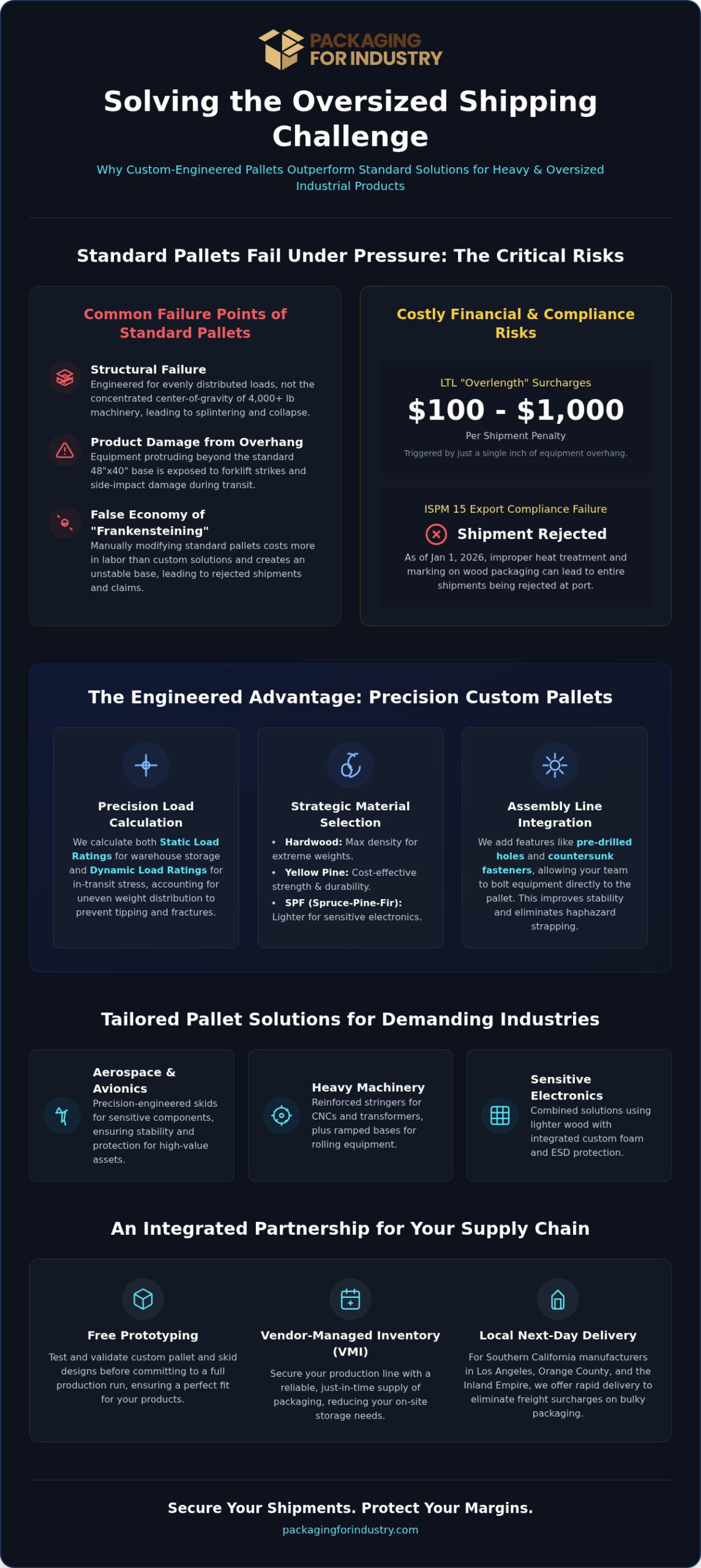
Did you know that a single inch of overhanging equipment can trigger LTL “overlength” fees ranging from $100 to $1,000 per shipment in 2026? Shipping heavy machinery isn’t just about finding a bigger platform; it’s about engineering a foundation that protects your assets while satisfying strict carrier density requirements. You’ve likely felt the frustration of seeing your margins eaten by these surcharges or, worse, dealing with transit damage because a standard skid couldn’t stabilize a complex load. It’s a logistical headache that many manufacturers in Los Angeles and Orange County face daily when handling custom pallets for oversized industrial products.
We understand that your operational efficiency depends on reliable, damage-free delivery and fiscal responsibility. This guide provides the technical and economic framework you need to specify and procure custom wood packaging that reduces shipping risks and lowers total freight spend. You’ll learn how to balance material strength with weight optimization to avoid the steep penalties associated with modern density-based pricing models.
We’ll preview the latest 2026 ISPM 15 hyphen marking regulations for export compliance, explore the benefits of local vendor-managed inventory, and show you how custom-engineered skids can transform your warehouse flow. By the end of this guide, you’ll have a clear path to achieving zero transit damage and a more predictable Southern California supply chain.
Key Takeaways
- Learn to calculate static and dynamic load ratings to prevent the structural failures common when using standard GMA pallets for heavy machinery.
- Discover how to specify custom pallets for oversized industrial products by matching wood species like yellow pine or hardwood to your specific weight and durability requirements.
- Explore specialized designs for the aerospace and machinery sectors, including ramped bases for rolling equipment and precision skids for sensitive avionics.
- Reduce logistical overhead by leveraging local next-day delivery in Orange County and Los Angeles to eliminate excessive freight surcharges on bulky packaging.
- Secure your production line with free prototyping and integrated material solutions that combine heavy-duty wood bases with custom foam and corrugated protection.
Why Standard Pallets Fail Oversized Industrial Products
In the world of freight logistics, oversized industrial products are defined by dimensions that exceed the standard 48×40 footprint or weights that surpass the 2,500-pound threshold. These items often include CNC machinery, aerospace components, and heavy-duty transformers. While many warehouses attempt to utilize standard pallet designs for these loads, the structural physics simply don’t align. Standard GMA pallets are engineered for evenly distributed, static loads. When you place a 4,000-pound piece of equipment with a concentrated center of gravity on a standard skid, the wood fibers often reach their breaking point before the cargo even leaves the dock.
Structural failure isn’t the only concern. Improperly sized pallets create “overhang,” where expensive machinery parts protrude beyond the edges of the wood base. This exposure makes your equipment a target for forklift strikes and side-impact damage during transit. For manufacturers in Los Angeles and Orange County, using custom pallets for oversized industrial products is a tactical necessity to ensure that the base acts as a protective perimeter, not just a lifting platform. Engineered skids account for load distribution by utilizing thicker deck boards and reinforced stringers that prevent the “bowing” effect common in center-heavy machinery shipping.
The Hidden Costs of Modified Standard Pallets
Many operations try to save money by “frankensteining” multiple standard pallets together to accommodate larger footprints. This approach is a false economy. The labor costs required for warehouse teams to manually modify and reinforce these structures often exceed the price of a professionally built solution. More importantly, these modified bases lack the engineered lateral stability required to prevent heavy equipment from shifting during rapid deceleration or sharp turns. This instability often leads to rejected shipments and costly insurance claims that far outweigh any initial savings on packaging materials.
Regulatory and Compliance Risks for Industrial Shipping
Compliance is another critical failure point for non-engineered packaging. As of January 1, 2026, U.S. Customs and Border Protection has resumed full enforcement of the ISPM 15 hyphen requirement. All wood packaging for international export must feature a permanent mark where the country and facility codes are separated by a hyphen, such as “US-1234.” If your oversized pallets aren’t properly heat-treated and marked by a certified supplier, your entire shipment can be rejected at the port. Utilizing custom design packaging ensures that your skids meet both structural requirements and the latest international shipping regulations, protecting you from liability and logistical delays.
Engineering Criteria for Custom Oversized Pallets
Engineering custom pallets for oversized industrial products requires a shift from general-purpose thinking to precision load management. You must calculate both static load ratings for warehouse storage and dynamic load ratings for the stresses of transit. Heavy machinery often has uneven weight distribution. This requires specific stringer placement to prevent the base from fracturing during forklift maneuvers. If the weight isn’t centered, an unengineered pallet can tip or splinter when lifted, leading to catastrophic equipment loss.
Material selection dictates the longevity and safety of your skid. Hardwood offers maximum density for multi-trip use or extreme weights. Southern Yellow Pine provides a cost-effective balance of strength and nail-holding power. If you’re shipping sensitive electronics, SPF (Spruce-Pine-Fir) offers a lighter footprint but requires thicker deck boards to maintain structural integrity. For assembly line integration, we often incorporate pre-drilled holes and countersunk fasteners. This allows your team to bolt equipment directly to the pallet, which eliminates the need for haphazard strapping and improves stability on the production floor.
Load Bearing and Structural Design
Modern engineering utilizes the Pallet Design System (PDS) to simulate how different wood species and configurations handle specific industrial loads. For heavy-duty applications, block pallets are often preferred because they provide true four-way forklift entry. This is essential in tight Southern California warehouse environments. Stringer pallets remain the standard for heavy skids, yet they require precise deck board thickness to prevent equipment from “sinking” into the gaps between supports. We ensure every design accounts for the specific footprint of your machinery to prevent deck deflection.
Cost-Reduction Analysis: Dimensions and Surcharges
Freight economics in 2026 are increasingly driven by density and dimensions. LTL carriers frequently apply “overlength” accessorial fees for any piece exceeding 8 feet, with costs ranging from $100 to $1,000 depending on the carrier. By engineering your pallet to stay just under these thresholds or maximizing the width of a standard 102-inch trailer, you can significantly lower packaging costs and freight expenses. Proper sizing also helps you avoid UPS or FedEx “Additional Handling” surcharges that trigger when dimensions are even slightly off. If you’re unsure how to optimize your footprint, you can request a packaging quote to see how an engineered solution compares to your current spend.
Industry-Specific Pallet Solutions: Aerospace to Machinery
The application of custom pallets for oversized industrial products is rarely a one-size-fits-all scenario because each sector brings unique regulatory and physical challenges. Medical device manufacturers often require skids that integrate specialized cushioning materials to protect delicate optical sensors and imaging hardware. These solutions frequently utilize clean-room compatible materials to maintain sterility during the final stages of delivery. Similarly, defense contractors must adhere to strict mil-spec requirements that dictate everything from fastener types to wood moisture content. By following federal standards for wooden large packaging, we ensure that critical hardware remains secure during the rigors of global military transport.
Precision Support for Aerospace and Defense
High-precision components in the aerospace sector, such as turbine blades and avionics racks, require advanced protection against micro-vibrations. Standard wood finishes can be too abrasive for flight-ready surfaces. Our Aerospace & Aviation Packaging Solutions often incorporate non-abrasive linings and custom-contoured dunnage to mitigate these risks. We design these skids to cradle oddly shaped parts, distributing pressure away from sensitive connection points. This precision is essential. It ensures that flight-critical parts remain within their required tolerances throughout the entire shipping cycle.
Heavy Equipment and Machinery Skids
When engineering custom pallets for oversized industrial products in the machinery sector, the design focus shifts to extreme weight capacity and ease of loading. Skids designed for units exceeding 10,000 pounds require heavy-duty stringers and integrated tie-down points to prevent shifting during transit. We often include ramped bases and edge stops for equipment with wheels or casters, allowing for safer loading in warehouse environments. These heavy-duty pallets are frequently designed for durability, enabling reusable, closed-loop cycles between manufacturing plants in Orange County and assembly sites in San Diego. This approach doesn’t just protect the equipment. It streamlines your logistical flow by providing a reliable, standardized base for every stage of the production line.
Procurement Strategies for Southern California Manufacturers
Sourcing custom pallets for oversized industrial products from a distant supplier often leads to “shipping on shipping” costs. You’re essentially paying to move bulky, empty wood across state lines before it even begins protecting your high-value machinery. By choosing a local Southern California partner, you eliminate these inflated freight charges and regain control over your logistical timeline. Proximity isn’t just about cost; it’s about operational agility. When a production schedule shifts or a rush order arrives, you can’t afford a week-long lead time from a distant catalog supplier. Local sourcing ensures your packaging arrives exactly when your equipment is ready to move.
Local Logistics and Next-Day Support
Manufacturing hubs in the Inland Empire and Orange County operate on tight margins and even tighter schedules. We provide local next-day delivery to Anaheim, Irvine, and Los Angeles to ensure your shipping dock never becomes a bottleneck. As a dedicated Orange County packaging supplier, we prioritize rapid response for emergency custom pallet orders. This local presence allows us to offer free prototyping for product fit. We can physically verify dimensions at your facility, ensuring your oversized equipment matches its base perfectly before full-scale production begins. This eliminates the risk of receiving unusable wood packaging that stalls your shipments.
Vendor Managed Inventory (VMI) for Wood Packaging
Southern California warehouse space is among the most expensive in the nation. Devoting hundreds of square feet to stacks of custom pallets for oversized industrial products is an inefficient use of capital. Our Vendor Managed Inventory services solve this by taking full responsibility for your pallet stock levels. We monitor your usage history and schedule replenishment based on your actual production output. This Just-In-Time (JIT) approach keeps your inventory lean while guaranteeing you’re never caught without the specific skids your operations require. It shifts the burden of inventory management from your team to ours, allowing your warehouse staff to focus on higher-value tasks like quality control and kitting.
The PFI Advantage: Integrated Custom Engineering
Effective protection for heavy machinery requires more than just a large footprint. It demands a holistic approach where every component of the packaging system works in unison. While some suppliers specialize only in timber, we provide an integrated engineering service that combines custom pallets for oversized industrial products with advanced cushioning and outer containment. This single-source model eliminates the logistical friction of managing multiple vendors. You gain a partner who understands how the wood base interacts with the internal foam and the external corrugated walls to create a unified protective barrier.
Our team provides full CAD/CAM support to map out complex industrial footprints. We don’t guess at dimensions. We use your equipment’s exact specifications to determine the precise placement of stringers, blocks, and tie-down points. This level of oversight ensures that your most valuable assets have a foundation engineered for the specific stresses of your supply chain. We ensure that the custom sizes available for your unique machinery are structurally sound and freight-optimized before the first board is cut.
Prototyping and Custom Design Process
We believe in verifying performance before full-scale manufacturing begins. Through our Custom Design Packaging Services, we provide free prototyping to ensure a perfect physical fit. This phase allows our engineers to test load stabilization across various material densities and wood species. We can identify potential failure points in a controlled environment, adjusting the design to prevent shifting or sinking during long-haul transit. It’s a proactive step that protects your bottom line and guarantees that the final product meets your exact operational requirements without the need for costly field adjustments.
Integrated Material Solutions
A heavy-duty skid is often only as effective as the secondary protection surrounding the product. We specialize in Custom Foam Packaging, utilizing polyethylene or ESD foam end caps to isolate sensitive components from impact energy. This protection is often paired with heavy-duty double-wall or triple-wall corrugated boxes to create a secure, palletized load. Our integrated approach includes several critical components:
- Corner and edge protection to prevent strapping damage to sensitive finishes.
- Custom-cut foam dunnage for internal component stabilization and vibration dampening.
- Triple-wall corrugated RSC boxes for maximum stacking strength in high-density warehouses.
By consolidating these materials into one engineered solution, you lower your total packaging costs and simplify your procurement process. You don’t need to coordinate between a wood shop and a foam fabricator. PFI handles the entire assembly, delivering a ready-to-use system that secures your equipment from the factory floor to the final destination. This comprehensive oversight ensures total accountability and peace of mind for your most challenging logistical projects.
Optimize Your Industrial Shipping Strategy
Managing the transport of heavy machinery or high-precision aerospace components requires an engineered approach that standard skids cannot provide. You’ve learned how precise weight distribution and material selection eliminate structural risks while helping you avoid the steep overlength surcharges common in 2026 freight logistics. Procuring custom pallets for oversized industrial products through a local partner allows you to balance protection with fiscal responsibility. It’s about creating a foundation that satisfies both carrier density requirements and internal quality standards.
Our team at PFI is ready to help you streamline your operations. We offer free prototyping and design reviews to ensure your equipment fits perfectly before any wood is cut. With ISPM-15 heat-treated materials and local next-day delivery across Anaheim, Los Angeles, and the Inland Empire, we provide the reliability your production schedule demands. We’re here to help you eliminate professional stress by providing a steady, dependable supply chain.
We look forward to helping you lower your packaging costs and securing your next shipment with confidence.
Frequently Asked Questions
What defines a pallet as “custom” for oversized products?
A custom pallet is defined by its engineering to accommodate dimensions exceeding the standard 48×40 GMA footprint or weight capacities beyond 2,500 pounds. Unlike stock options, these skids feature reinforced stringers and deck boards placed specifically to support a machine’s center of gravity. They are often built as custom pallets for oversized industrial products to ensure the base acts as a protective perimeter, preventing forklift strikes on protruding parts.
Do custom pallets for oversized equipment need to be heat-treated?
Yes, all wood packaging used for international export must be heat-treated to meet ISPM-15 standards. This process involves heating the wood core to 56°C for at least 30 continuous minutes to eliminate pests. As of January 2026, U.S. Customs also strictly enforces the hyphenated marking requirement, such as US-1234. Even if you aren’t exporting, heat-treated wood is often preferred for its reduced moisture content and improved structural stability during long-term storage.
Can custom pallets be designed for high-weight industrial loads?
We engineer skids to support extreme industrial loads, including units weighing 10,000 pounds or more. These designs utilize dense hardwoods or reinforced Southern Yellow Pine and thicker deck boards to prevent deflection. By calculating static and dynamic load ratings, we ensure the pallet doesn’t fracture during lifting or transport. This precision engineering is what separates a professional industrial base from a standard pallet that might fail under concentrated machinery weight.
How does a custom pallet help reduce freight costs?
Custom pallets lower packaging costs by optimizing the footprint to fit standard trailer widths and avoiding “overlength” accessorial fees. LTL carriers in 2026 apply steep surcharges for shipments exceeding 8 feet or those with poor density. An engineered pallet minimizes wasted space while ensuring your equipment doesn’t overhang. This avoids “Additional Handling” fees from carriers like UPS or FedEx and ensures you’re only paying for the floor space your cargo actually requires.
What industries benefit most from custom wood skids?
Aerospace, defense, and heavy machinery manufacturing are the primary sectors that rely on custom pallets for oversized industrial products. These industries handle sensitive, high-value components that require precision support and vibration dampening. Medical device manufacturers also benefit from specialized skids that integrate clean-room compatible materials. Any sector shipping non-standard, heavy, or fragile equipment needs an engineered foundation to maintain product integrity and comply with strict transportation safety regulations.
How long does it take to get a prototype for a custom pallet?
We offer free prototyping to ensure a perfect fit for your specific equipment dimensions. The timeline for a prototype typically depends on the complexity of the engineering requirements and material availability. Because we are a local Southern California supplier, we can often conduct a design review and deliver a prototype quickly to keep your production line moving. This proactive step identifies potential stabilization issues before you commit to a full-scale manufacturing run.
Does PFI offer local delivery for pallets in Southern California?
Yes, we provide local next-day delivery for manufacturers and warehouses throughout Southern California. Our service areas include Anaheim, Irvine, and Costa Mesa in Orange County, as well as Los Angeles, Torrance, and Santa Fe Springs. This local presence eliminates the “shipping on shipping” costs associated with ordering bulky wood packaging from out-of-state vendors. Our proximity allows us to respond rapidly to emergency orders or sudden shifts in your shipping schedule.
Can I combine custom pallets with foam inserts for extra protection?
Integrated material solutions are a core part of our engineering process. We can combine heavy-duty wood skids with custom foam packaging, such as polyethylene end caps or ESD foam, to protect sensitive electronics from vibration and impact. This holistic approach often includes corner boards and heavy-duty triple-wall corrugated boxes. Consolidating these materials into a single protective system simplifies your procurement and ensures every component of your packaging works together to prevent damage.