
If your solar module damage rates are climbing toward that critical 3% threshold, your current crate design isn’t just failing your product. It’s eroding your bottom line through hidden micro-cracks and rising freight surcharges. You’ve likely seen how a panel engineered to withstand 5,400 Pa of snow can still succumb to the simple vibrations of a flatbed trailer. It’s a frustrating reality for manufacturers who prioritize quality but find themselves held hostage by inefficient box sizing and supply chain stockouts.
We understand that effective protective packaging for solar panels isn’t about using thicker materials. It’s about an integrated engineering system that manages vibration at the unit load level. In this guide, you’ll learn how to engineer solutions that eliminate transit damage and optimize your module supply chain. We’ll cover the technical shifts in the updated ISTA 3E-2026 testing standards and the logistical pressures of the new Section 232 trade rules taking effect this December. From custom heavy-duty corrugated to precision foam cushioning, this is your roadmap to achieving zero-damage delivery and a lower total cost of ownership.
Key Takeaways
- Understand why it’s critical to identify the hidden causes of micro-cracks to prevent long-term module power degradation and costly warranty claims.
- Discover how to combine heavy-duty double-wall boxes with custom foam inserts to absorb harmonic vibrations and eliminate transit damage.
- Compare the long-term ROI of custom protective packaging for solar panels against the risks and hidden costs of using standard stock shipping containers.
- Explore how Vendor Managed Inventory (VMI) and local Southern California logistics can streamline your supply chain and eliminate production stockouts.
- Learn how the updated ISTA 3E-2026 testing standards impact your current packaging design and help you avoid unnecessary freight surcharges.
The High Cost of Damage: Why Solar Panel Packaging Requires Precision
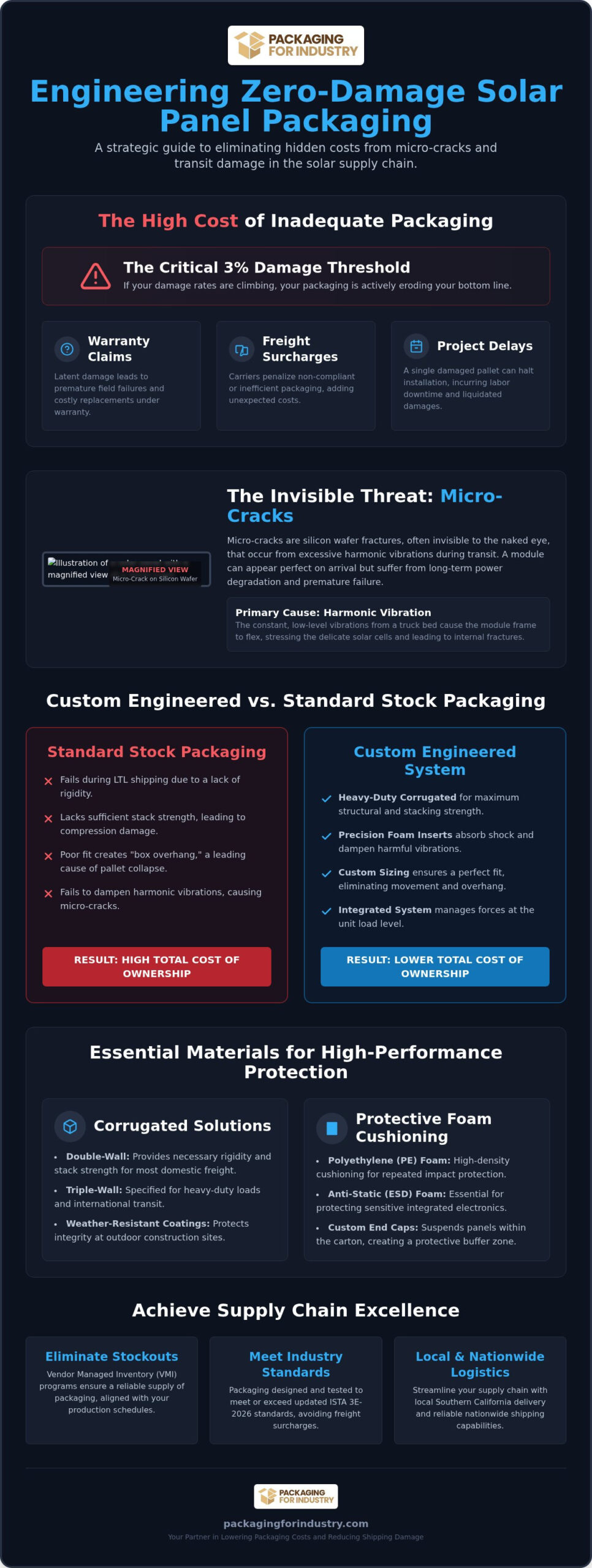
Protective packaging for solar panels is a multi-layered engineering system designed to mitigate the destructive forces of vibration, shock, and compression. It’s more than just a container; it’s a shield for high-value technology. Standard RSC boxes frequently fail during LTL (Less-Than-Truckload) shipping because they lack the double or triple-wall rigidity required for heavy stacking. When a box buckles under compression, the module absorbs the force, leading to immediate glass failure or latent electrical issues.
The financial consequences of poor packaging extend far beyond product replacement costs. You must account for site delays, labor downtime for installation crews, and the high expense of specialized freight re-shipments. A single damaged pallet can derail a project timeline, resulting in liquidated damages or strained client relationships. Investing in precision packaging is a strategy to lower your total cost of ownership and protect your brand reputation.
Understanding the Solar Handling Chain
From the manufacturing floor to the final job site, modules face numerous high-risk touchpoints. Each time a forklift moves a pallet, the risk of impact increases. Vertical stacking is the industry standard for preventing glass breakage, but it requires precise engineering to maintain stability during transit. For manufacturers producing non-standard module sizes, custom design packaging is necessary to ensure the load remains unitized and secure throughout the journey. Identifying these risks early allows you to engineer out the vulnerabilities in your supply chain.
Micro-Cracks: The Invisible Damage
Micro-cracks are silicon wafer fractures that are often invisible to the naked eye. They occur when a solar panel is subjected to excessive harmonic vibrations during transit. While the module appears perfect upon arrival, these internal breaks lead to long-term power degradation and premature warranty claims. A rigid packaging system reduces the flex of the module frame, which is the primary cause of cell damage. Many manufacturers now integrate impact indicators into their shipments to track handling quality. This data helps you hold carriers accountable and refine your protective packaging for solar panels to withstand real-world shipping conditions.
Essential Materials for High-Performance Solar Packaging
High-performance protective packaging for solar panels requires a systems-based approach where each material serves a specific functional purpose. Relying on a single layer of protection often leads to failure during the rigors of long-haul freight. A robust solution for protective packaging for solar panels integrates structural strength, vibration dampening, and unit load stability to ensure modules arrive in factory condition. By combining these elements, manufacturers can significantly reduce the risk of glass breakage and latent cell damage.
Corrugated Solutions for Solar Modules
The foundation of any solar shipping system is the outer carton. While standard boxes might suffice for lightweight goods, solar modules require heavy-duty double-wall or triple-wall corrugated to provide necessary stack strength. Triple-wall corrugated is often specified for international transit or heavy-duty loads where pallets are stacked multiple levels high in a warehouse. Using custom corrugated boxes tailored to your specific pallet footprint prevents “box overhang,” which is a leading cause of pallet collapse. We also offer weather-resistant coatings for panels destined for outdoor construction sites where moisture can compromise corrugated integrity.
Protective Foam and Cushioning
Inside the box, the focus shifts to vibration management. Harmonic vibrations during truck transit can be just as damaging as a single large impact. Engineering custom foam packaging allows for a high degree of shock absorption without the bulk of traditional materials. We specialize in designing foam systems such as:
- Polyethylene (PE) Foam: Ideal for high-density cushioning and protecting against repeated impacts.
- Anti-Static Foam: Necessary for components with integrated electronics that are sensitive to ESD.
These foam end caps suspend the panels within the carton, creating a “buffer zone” that prevents the modules from hitting the sides of the box. For high-value prototypes or oversized components, foam-lined crates provide an even higher level of protection against mechanical stress.
Stabilization with Stretch Film and Edge Boards
A pallet is only as strong as its weakest point. Even the best boxes can shift if the load isn’t properly stabilized. Adhering to international transportation standards involves more than just cushioning; it requires total load integrity. We use cardboard edge protectors to distribute strap tension evenly across the module frames, preventing deformation. This is followed by high-performance, machine-grade stretch film with high-cling properties. This wrap secures the entire unit load, preventing the individual modules from shifting during transit. If you’re looking to optimize your current material usage, you can request a packaging quote to compare high-performance alternatives.
Custom Engineering vs. Stock Packaging: A Comparison Guide
Choosing between off-the-shelf options and custom-engineered solutions is a decision that directly impacts your operational margins. Stock packaging is often the fastest route to procurement. However, it presents a significant risk for the specialized dimensions of solar modules. When a box is too large, you’re paying for “air shipping” through dimensional weight surcharges. Even worse, the lack of a precision fit allows panels to shift. This movement increases the likelihood of the micro-cracks that lead to long-term power degradation.
Custom protective packaging for solar panels requires a higher initial investment in design, but it delivers a significantly lower total cost of ownership. By engineering the box and internal cushioning to the exact specifications of your module, you maximize pallet density and eliminate the transit damage that stock containers can’t prevent. Custom sizing also removes the need for excessive void fill, which helps you lower packaging costs while improving the reliability of your shipments.
The Prototyping Process at PFI
Our engineering team uses CAD/CAM technology to ensure your protective packaging for solar panels fits perfectly from the first shipment. We follow a methodical three-step approach to perfect your design:
- Step 1: We analyze your specific panel dimensions and identify fragile points, such as the glass-to-frame seals and corner junctions.
- Step 2: Our designers create CAD models for integrated systems that combine heavy-duty corrugated with precision foam inserts.
- Step 3: We provide free prototyping. This allows you to test the real-world fit and protection in your own facility before mass production begins.
When to Invest in Custom Wood Crates
There are instances where even the strongest triple-wall corrugated isn’t enough. Oversized commercial solar arrays and specialized mounting hardware often require the structural rigidity of custom wood crates. These crates provide the necessary compression strength for heavy stacking and the durability needed for rough handling in the field. If you’re shipping globally, we use heat-treated wood that meets ISPM 15 standards for international export compliance. You can learn more about engineering custom crates for international transit to ensure your high-value components bypass customs delays and arrive intact.
Optimizing Procurement: VMI and Local Logistics in Southern California
Managing the intake of protective packaging for solar panels is often as complex as the manufacturing of the modules themselves. Heavy-duty corrugated boxes and custom foam inserts are voluminous. They take up significant floor space that should be dedicated to production. This creates a warehouse space crisis that can stall your operations. By optimizing your procurement strategy, you shift the burden of storage and inventory management to your supplier. This ensures your production line never stops due to a packaging stockout.
Vendor Managed Inventory (VMI) for Solar Manufacturers
Our Vendor Managed Inventory (VMI) program is designed to eliminate lead-time surprises. We take full responsibility for managing your packaging inventory, performing scheduled weekly or biweekly review cycles based on your actual usage. This proactive approach is critical as we approach the December 4, 2026, effective date for new Section 232 trade rules. These regulations are already creating urgency in solar supply chains. With VMI, you improve your cash flow by stocking only what you need for the current production run. We hold the safety stock of your protective packaging for solar panels at our facility, freeing up your warehouse floor for additional manufacturing equipment.
Local Delivery and Nationwide Shipping
Operating from our Anaheim headquarters gives us a distinct logistical advantage in Southern California. We provide local next-day delivery for manufacturers in Irvine, Los Angeles, and across the Inland Empire. This proximity allows for a just-in-time supply chain that large catalog suppliers cannot match. Localized supply also reduces the carbon footprint of your packaging, aligning your logistics with the sustainability goals of the solar industry. For operations with multiple facilities, we leverage an extensive distribution network to provide reliable nationwide shipping. Whether you’re in Orange County or across the country, you receive the same engineering-minded support and consistent material quality.
Why Packaging For Industry is the Choice for Solar Logistics
Packaging For Industry (PFI) operates as a strategic partner rather than a simple material vendor. We understand that procurement managers and operations leads aren’t just buying boxes; they’re securing their supply chain reliability. Unlike large catalog suppliers that prioritize high-volume, generic stock, we focus on the specific engineering requirements of industrial manufacturing. Our approach to protective packaging for solar panels prioritizes technical precision and fiscal responsibility. By moving away from one-size-fits-all options, you eliminate the over-packaging and “air shipping” that inflates your total freight spend.
Lowering Your Total Packaging Costs
We help you identify hidden waste through a comprehensive packaging review. This process examines your entire handling chain to find where materials are failing or where you’re over-spending on unnecessary bulk. Proactive inventory management through our VMI programs eliminates the need for expensive rush orders that disrupt your budget and production schedule. By ensuring a perfect fit and utilizing the right density of cushioning materials, you improve your ROI through a measurable reduction in product returns and warranty claims. Achieving zero-damage delivery is the most effective way to lower packaging costs over the long term.
Integrated Solutions and Dependable Supply
Managing multiple vendors for corrugated boxes, foam inserts, crates, and stretch film creates administrative friction and logistical delays. PFI offers an integrated solution where all components are designed to work together as a single, engineered system. This holistic oversight ensures that your foam end caps fit perfectly inside your double-wall or triple-wall cartons, and your pallets are stabilized with the correct grade of high-cling film. Our just-in-time delivery model keeps your shipping dock clear and your production moving without interruption. We provide the stability of a seasoned industrial consultant with the agility of a local partner.
Request a Custom Solar Packaging Quote
When you partner with PFI, you gain direct access to Anaheim-based packaging experts who understand the unique challenges of the Southern California manufacturing corridor. We provide fast turnarounds on custom quotes for bulk and repeat orders, ensuring your procurement timeline remains on track even as trade regulations shift. Our team is ready to help you engineer a system that balances durability with economic efficiency. We speak the language of operations and are committed to solving your most complex logistical challenges.
We look forward to helping you optimize your logistics and protect your brand’s reputation for quality. Let’s build a more resilient and cost-effective shipping strategy together.
Frequently Asked Questions
What is the best way to prevent micro-cracks in solar panels during shipping?
The most effective way to prevent micro-cracks is to implement an integrated engineering system that manages harmonic vibrations. Standard boxes allow too much flex during transit. By using protective packaging for solar panels that features custom foam end caps and rigid triple-wall corrugated, you suspend the module and absorb road shock. This prevents the silicon wafers from fracturing during long-haul freight, which is the primary cause of latent electrical failures.
Does PFI provide custom foam inserts for specific solar module dimensions?
Yes, we design and manufacture custom foam inserts tailored to your specific solar module dimensions. Our engineers utilize polyethylene (PE) and polyurethane (PU) foams to create precision end caps and edge buffers. These inserts are designed using CAD/CAM technology to ensure a perfect fit that suspends the panel within the outer carton. This custom approach provides superior shock absorption compared to using generic void fill or stock foam pieces.
Can you provide heat-treated crates for international solar panel exports?
We provide custom wood crates that are fully heat-treated and compliant with ISPM 15 standards for international solar panel exports. These crates offer the maximum structural rigidity required for oversized commercial arrays or heavy-duty sea freight. By using certified heat-treated lumber, we ensure your shipments bypass customs delays related to pest control regulations. This is a critical requirement for manufacturers shipping modules to international job sites or distribution centers.
How does Vendor Managed Inventory (VMI) work for high-volume solar packaging?
Vendor Managed Inventory (VMI) allows PFI to take full responsibility for your packaging stock levels based on your production schedule. We perform regular onsite reviews of your inventory and replenish materials before a stockout occurs. This system is ideal for high-volume solar production because it frees up your warehouse floor space for manufacturing equipment. You only pay for the materials you need for your current production run, which improves cash flow.
Do you offer local next-day delivery in Orange County and Los Angeles?
We offer local next-day delivery for manufacturers and distributors located in Orange County, Los Angeles, and the Inland Empire. Because our headquarters is based in Anaheim, we can support just-in-time production schedules that large national catalog suppliers can’t match. This local proximity reduces your lead times for custom protective packaging for solar panels and helps lower the carbon footprint of your logistical operations through shorter transit distances.
What is the difference between double-wall and triple-wall corrugated for solar panels?
The primary difference lies in the compression strength and the intended shipping environment. Double-wall corrugated is standard for domestic LTL shipments where stacking is moderate. Triple-wall corrugated provides the extreme rigidity needed for international export, heavy-duty stacking, or protecting oversized modules. Specifying triple-wall ensures that the bottom pallets in a stack don’t buckle under the weight of several thousand pounds, protecting the modules from structural failure or glass breakage.
Do you provide free prototyping for custom solar packaging designs?
Yes, we provide free CAD/CAM prototyping for custom solar packaging designs. This allows you to verify the real-world fit and protection levels of our integrated box and foam systems before committing to a bulk production run. Our engineers work directly with your team to refine the design, ensuring that every fragile point of the module is protected. This consultative process eliminates the risk of ordering thousands of units that don’t perform.
How can I lower my shipping costs for oversized solar arrays?
You can lower shipping costs for oversized solar arrays by utilizing custom-sized packaging that eliminates “air shipping.” Standard stock boxes often trigger expensive dimensional weight surcharges from carriers because they are unnecessarily large. By engineering a custom fit, we reduce the overall cubic volume of the package. This allows for higher pallet density and ensures you aren’t paying to ship empty space or excessive amounts of expensive void fill materials.