
The corner isn’t always the only place a load needs protection. Packaging tubes and edge protectors for manufacturers serve different packaging needs, while edge and angle protection can support products during manufacturing, storage, warehousing, and shipping.
That protection matters when palletized goods need reinforcement against handling pressure or shifting. Edge protectors are rigid paperboard or cardboard angles placed along load corners and edges. Angle boards protect package corners, while longer edge protectors run along the edges. The right fit depends on the load, not just the carton.
This guide explains who uses edge protection, what protectors are made from, and how angle boards compare with edge protectors. It also covers how load weight, stack height, pallet dimensions, and banding method inform protector length and thickness, plus where packaging tubes fit into a manufacturer’s packaging plan. With those details in view, buyers can define custom sizes and quantities more clearly, compare packaging pricing, and choose protection suited to their products and shipping process.
Key Takeaways
- Match paperboard or cardboard edge protection to the load’s exposure during handling, storage, and transit.
- Choose between angle boards and edge protectors based on whether corners or longer edges need reinforcement.
- Use pallet dimensions, stack height, product weight, and banding method to guide protector sizing.
- Identify where tubes fit alongside edge protection in your packaging plan for manufacturers and shipping operations.
- Share load and packaging requirements when requesting a quote to compare suitable options and packaging pricing.
Packaging Tubes and Edge Protectors for Manufacturers
Manufacturers use tubes to contain or protect long, narrow products, and edge protectors to reinforce palletized loads. The right choice depends on product shape, load configuration, and handling conditions.
Packaging edge protectors are rigid angles placed along shipment corners or edges. Cardboard and paperboard versions reinforce pallet-load corners and help distribute banding pressure. They can help keep cartons aligned and improve load stability during storage and transit. Recycled paperboard is one material option, with construction and dimensions selected for the load.
Plastic and paper edge guards can reinforce product edges and corners, helping protect goods from contact and shifting during handling. Paper products use paper and glue, while plastic guards have a different material construction. Neither material alone determines performance: shape, thickness, length, and load arrangement all matter.
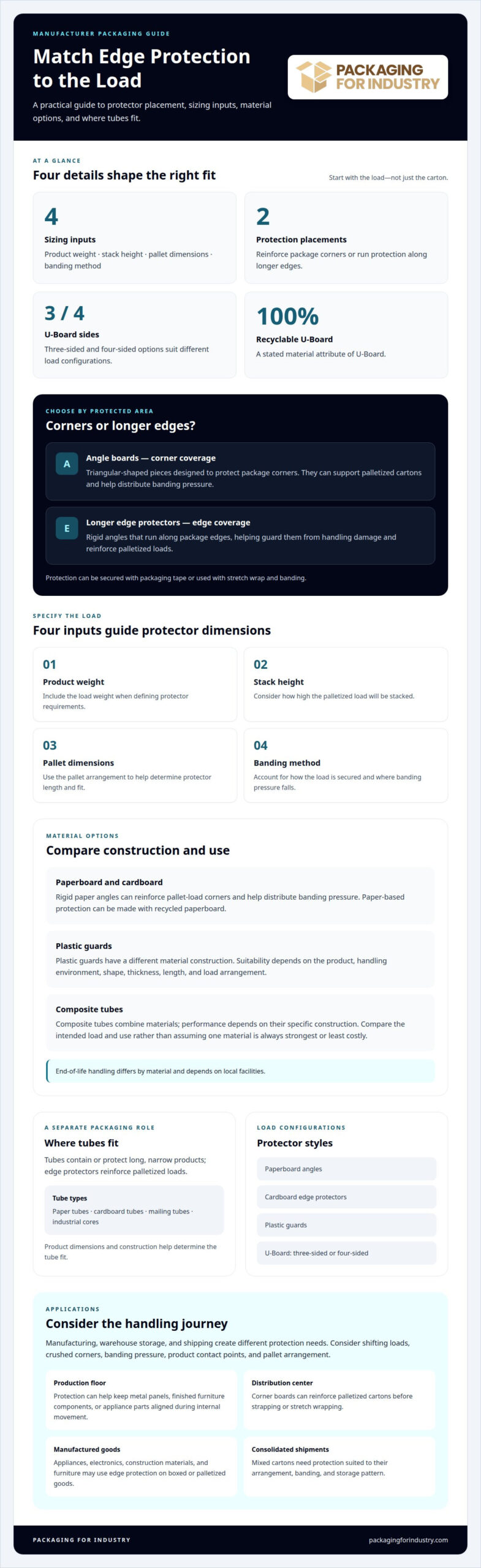
Angle boards and edge protectors overlap in purpose but differ in placement. An angle board is a triangular-shaped piece designed to protect package corners. A longer edge protector runs along a package edge, helping guard it from handling damage. Both can support cartons on a pallet. Edge protection can be secured with packaging tape or used with stretch wrap and banding.
Available Tube and Protector Types
Manufacturers can select paper tubes, cardboard tubes, mailing tubes, or industrial cores for cylindrical packaging needs. Edge protection options include paperboard angles, cardboard edge protectors, plastic guards, and U-Board. U-Board comes in three-sided and four-sided options for different load configurations. Product shape, protected area, and pallet arrangement guide the selection.
Some loads need protection on corners; others need reinforcement along several edges. Printed edge protectors can also carry handling messages such as “Do Not Double Stack.” The message supports warehouse and shipping communication, while the protector adds physical support. Tubes serve a separate role, containing or protecting long products such as rolled materials, depending on their dimensions and construction.
Material Strength, Cost, and Sustainability
Paperboard, plastic, and composite tubes differ in construction, strength, cost, and end-of-life handling. Paperboard is a common choice for many tube applications; plastic may suit applications where its material properties fit the product and handling environment. Composite tubes combine materials, so performance depends on their specific construction. Compare the intended load and use rather than assuming one material is always strongest or least costly.
For sustainability, paper-based protection can be made with recycled paperboard. U-Board is 100% recyclable. Plastic and composite options have different disposal and recycling considerations, which depend on their materials and local facilities. In the United States, product pricing is case-specific and is provided after a quote request; material, dimensions, construction, quantity, and customization affect the quote.
Industries Served
Edge and angle protection supports loads through manufacturing, warehouse storage, and shipping. In the United States, packaging requirements depend on product needs, customer specifications, and shipment handling. Manufacturers should also consider shifting loads, crushed corners, banding pressure, and supply interruptions when selecting protection.
Manufacturing and Shipping Applications
On a production floor, edge protection can help keep metal panels, finished furniture components, or appliance parts aligned during internal movement. At a distribution center, corner boards can reinforce palletized cartons before strapping or stretch wrapping. These applications differ: parts moving between workstations need protection suited to repeated handling, while outbound pallets face storage and transit conditions.
Shipping teams use protection where exposed corners could buckle or loads could shift. For example, a pallet of boxed components can use corner protection to support stacked cartons and distribute banding pressure. A tube serves a different packaging task, such as containing rolled material or protecting a long product. The load’s shape and route help determine which packaging components fit.
Industries Using Edge Protection
Manufacturers of appliances, electronics, construction materials, and furniture may use edge protection on boxed or palletized goods. A construction supplier shipping panels faces different exposed edges than an electronics manufacturer shipping cartons of assembled components. In each case, product contact points and pallet arrangement help identify where reinforcement is useful.
Aerospace suppliers and medical-product manufacturers also manage packaged components through storage and distribution. Their packaging plans can account for product fragility, handling instructions, and shipping configuration. Food producers may use edge protection on stable pallet loads of packaged goods, while distributors use it to support consolidated shipments. Packaging choices should reflect each shipment’s product and handling requirements.
- Metal and building products: Long panels or bundled materials can need protection along exposed edges during pallet handling.
- Furniture and appliances: Cartons with vulnerable corners may benefit from reinforcement during stacking and warehouse movement.
- Electronics and aerospace: Palletized cartons can use edge support to help limit load movement in transit.
- Distribution and fulfillment: Mixed cartons need protection suited to their arrangement, banding, and storage pattern.
Damage risks begin when cartons shift, corners compress, or straps bear directly against an unreinforced edge. A distributor handling mixed cartons may face a different load pattern from a manufacturer shipping identical cases. These differences affect which edges need support and how protection works with stretch wrap or banding.
Safety and supply continuity also matter. A poorly supported pallet can be harder to handle, while inconsistent protector dimensions can complicate packing operations or replenishment. Packaging teams can reduce these risks by documenting the product, pallet layout, stack arrangement, banding method, and handling instructions. Those details help align packaging with the shipment rather than treating every load alike.
For manufacturers reviewing their manufacturing packaging operations, the useful starting point is the shipment itself: identify vulnerable edges, how the load is secured, and where it travels. This makes comparisons between protection options more relevant and helps keep packaging aligned with production and distribution workflows.
Benefits of Choosing the Right Edge Protector Dimensions
Edge protection works best when its dimensions match the shipment, not just the carton. Select a configuration based on pallet dimensions, stack height, product weight, and banding method.
Dimensions, Wall Thickness, and Load Ratings
Industrial packaging tubes have no single size, wall thickness, or load rating for every application. Specifications depend on the product’s length and diameter, tube construction, and the load it must support. A tube for rolled material has different requirements from one used as a protective sleeve for a long component.
Use product dimensions and handling conditions to select a tube that contains or protects the item appropriately. Also consider how the packaged product will be stored and shipped. For edge protectors, the relevant dimensions include length and thickness, matched to load weight and stack height.
Proper sizing helps the protector reach the area needing support without interfering with handling or securing the shipment. A protector that is too short may leave vulnerable edges exposed. Suitable length covers the load edge, while sufficient thickness supports the intended application. Pallet layout and banding method help determine how protection fits.
How a packaging supplier calculates protector quantity and placement
Start with pallet dimensions, stack height, product weight, and banding method. Use these details to identify exposed corners and edges, then position protection where straps or handling pressure could damage cartons. The required count follows the load configuration, not a universal rule for every pallet.
For example, a shipment with several stacked cartons may need protection along the vertical corners and at band contact points. A wide load with vulnerable outer edges may require a different arrangement. The supplier considers how protectors work with stretch wrap, steel or plastic banding, and manual or automated packaging lines.
Correct placement can help limit carton compression and reduce movement that destabilizes pallet loads. It also helps avoid adding protection where the shipment does not need it. This balance matters to packaging budgets: undersized or poorly placed material can leave damage points exposed, while unnecessary coverage adds material and handling to each packed load.
Dimension selection also affects packing consistency. If a warehouse handles recurring pallet configurations, defined protector lengths and placement patterns can make packing easier to repeat. Review the specification when product weight, stack height, pallet dimensions, or banding method changes, since each factor can alter the support the load needs.
Teams can provide a packaging supplier with the shipment details that drive selection:
- Pallet dimensions: Show the footprint and the edges requiring coverage.
- Stack height: Establish how far corner protection must extend.
- Product weight: Helps determine the support required for the load.
- Banding method: Identifies where pressure contacts the cartons or product.
For tubes, share product length and diameter, along with how the packaged item will be handled and shipped. These details help match tube dimensions and wall construction to the application rather than relying on an assumed load rating. For edge protectors, use shipment specifications to determine length, thickness, quantity, and placement together.
This assessment supports practical decisions about protection and packaging use. A well-matched design can help reduce shipping damage while keeping material choices aligned with the load. It also gives purchasing and warehouse teams a consistent specification for comparing packaging options across recurring shipments.
Why Choose Packaging For Industry (PFI)
Packaging For Industry (PFI) helps manufacturers connect packaging decisions with practical needs across production, storage, and shipping. When product dimensions, load arrangements, or handling processes change, reviewing the packaging system can reveal where protection or supply planning needs adjustment. A coordinated approach helps purchasing and operations teams consider how packaging components work together rather than assessing each item in isolation.
Packaging tubes and edge protectors for manufacturers need to fit the products and shipment conditions they serve. PFI provides industrial packaging solutions for manufacturers, including custom packaging design and protective foam packaging. A long component and a palletized load have different packaging needs, so the application matters. Describe product dimensions, packaging workflow, and shipment configuration to make the discussion specific to your operation.
Some products also need cushioning inside their packaging. PFI offers foam packaging for applications where cushioning helps protect products during handling and shipment. Product shape, contact points, and the existing packaging configuration inform the role foam may play. For a fragile component, internal cushioning addresses a different packaging concern than protection around a pallet load.
Stretch film can be part of a broader plan for securing palletized shipments during storage or transit. PFI offers stretch film that manufacturers can consider alongside their load-protection requirements. Align each packaging component with a practical job. Reviewing the shipment as a system helps teams avoid treating materials as interchangeable when they address different needs.
Packaging supply consistency also matters to manufacturers with recurring production and shipping demands. PFI offers Vendor Managed Inventory (VMI) and Just-In-Time (JIT) inventory programs for packaging. These services support planning and replenishment, helping operations teams coordinate packaging availability with usage patterns. They are relevant when supply interruptions, emergency purchasing, or excess on-site inventory complicate the packaging workflow.
A packaging review can be useful when a manufacturer faces changes or recurring operational pressure, such as:
- Product revisions: Updated dimensions or packaging methods may change protection requirements.
- Damage patterns: Repeated issues can indicate that the current packaging arrangement needs attention.
- Supply planning challenges: Packaging demand may need closer coordination with production schedules.
- Multiple packaging materials: Foam and stretch film should each address a clear function in the shipment.
For example, a manufacturer shipping long products on palletized loads may need to consider product containment, exposed edges, and how the load is secured. Packaging tubes and edge protectors for manufacturers can be considered within that broader plan, alongside suitable options such as foam packaging or stretch film. PFI helps connect the packaging question with the product and operational details that shape the decision.
PFI’s vendor managed inventory service is relevant when recurring packaging usage makes replenishment part of production planning. It can support an organized approach to packaging supply while the manufacturer considers the separate requirements of product protection. This distinction helps purchasing teams address supply continuity without confusing inventory planning with the physical purpose of packaging materials.
Manufacturers can turn to PFI when a packaging change affects product protection, recurring supply, or both. Useful details for a discussion include product dimensions, load configuration, handling conditions, and packaging usage patterns. Those inputs help clarify the operational need and the packaging support that may fit.
Frequently Asked Questions
How can a packaging supplier help manufacturers choose edge protectors for palletized loads and different products?
A packaging supplier can help turn damage history and packing requirements into a consistent specification. For example, if cartons arrive with crushed corners, reviewing damage photos and the packing sequence can help identify where reinforcement is needed. A Los Angeles packaging supplier or Orange County packaging supplier can also consider how protection fits existing warehouse procedures, keeping the approach practical for the team packing and handling each shipment.
Which U.S. suppliers offer custom packaging tubes and edge protectors, and what are their minimum order quantities?
Packaging For Industry (PFI) serves industrial packaging buyers in Orange County, Los Angeles, and San Diego, with local packaging delivery across Southern California. Minimum order quantities depend on the product and whether the order uses stock packaging or custom production, so one quantity does not apply to every tube or protector. Define the quantity needed and whether purchases will recur, then request a packaging quote and compare packaging pricing against actual usage and purchasing schedules.
How are packaging tubes and edge protectors custom-sized, printed, and manufactured?
Custom orders typically begin with a written specification that records the product, required dimensions, material, and any print artwork or handling message. The supplier uses that information to prepare the order details for production. Buyers can reduce avoidable revisions by keeping approved artwork and packaging specifications together, especially when replenishing an established item. This makes repeat purchasing more consistent across purchasing, production, and warehouse teams.
What are the environmental and recycling options for packaging tubes and edge protectors?
For recycling, separate packaging components by material where local collection programs require it, and keep paper-based items free from incompatible waste. Manufacturers can also review packaging use across recurring shipments to identify avoidable excess without compromising product protection. For a sustainability comparison, consider material composition, available recycling routes, and the amount of packaging needed for the application. Disposal options vary by material and local recycling facilities.
What do packaging tubes and edge protectors typically cost in the United States?
Pricing is case-specific and depends on material, dimensions, construction, quantity, and customization. Request a packaging quote to compare bulk packaging pricing for your requirements.