
A single overlooked IPPC stamp can lead to the immediate quarantine or destruction of your entire international shipment at the importer’s expense. For manufacturers and distributors in Los Angeles and Orange County, the stakes of non-compliance are exceptionally high, particularly in the aerospace and medical sectors where delivery timing is critical. You likely feel the pressure to ensure every piece of timber meets the rigorous ISPM 15 standard of 56°C heat treatment for 30 minutes. It’s a complex process, but securing custom wood crates for international shipping SoCal shouldn’t be a source of professional stress or operational risk.
This guide provides the technical clarity you need to move cargo through the Port of Los Angeles or Long Beach with complete confidence. We’ll outline the essential documentation checklist, explain the nuances of IPPC marking, and demonstrate how custom-engineered protection prevents both physical damage and regulatory delays. You’ll learn how to identify compliant materials and select a partner that understands the intersection of engineering and economics. By the end of this article, you’ll have a clear roadmap for streamlining your export logistics while maintaining total fiscal responsibility and peace of mind.
Key Takeaways
- Master the mandatory ISPM 15 heat treatment standards required to prevent costly shipment quarantines and delays at international ports.
- Identify the essential documentation required for both ocean and air freight to ensure your cargo clears customs without administrative friction.
- Learn how custom-engineered internal protection and integrated foam packaging safeguard high-value aerospace and medical equipment during transit.
- Discover the logistical advantages of sourcing custom wood crates for international shipping SoCal from a local Anaheim partner to reduce lead times.
- Optimize your warehouse operations and lower overhead by utilizing Vendor Managed Inventory (VMI) programs for recurring export requirements.
Navigating International Shipping Standards for SoCal Exporters
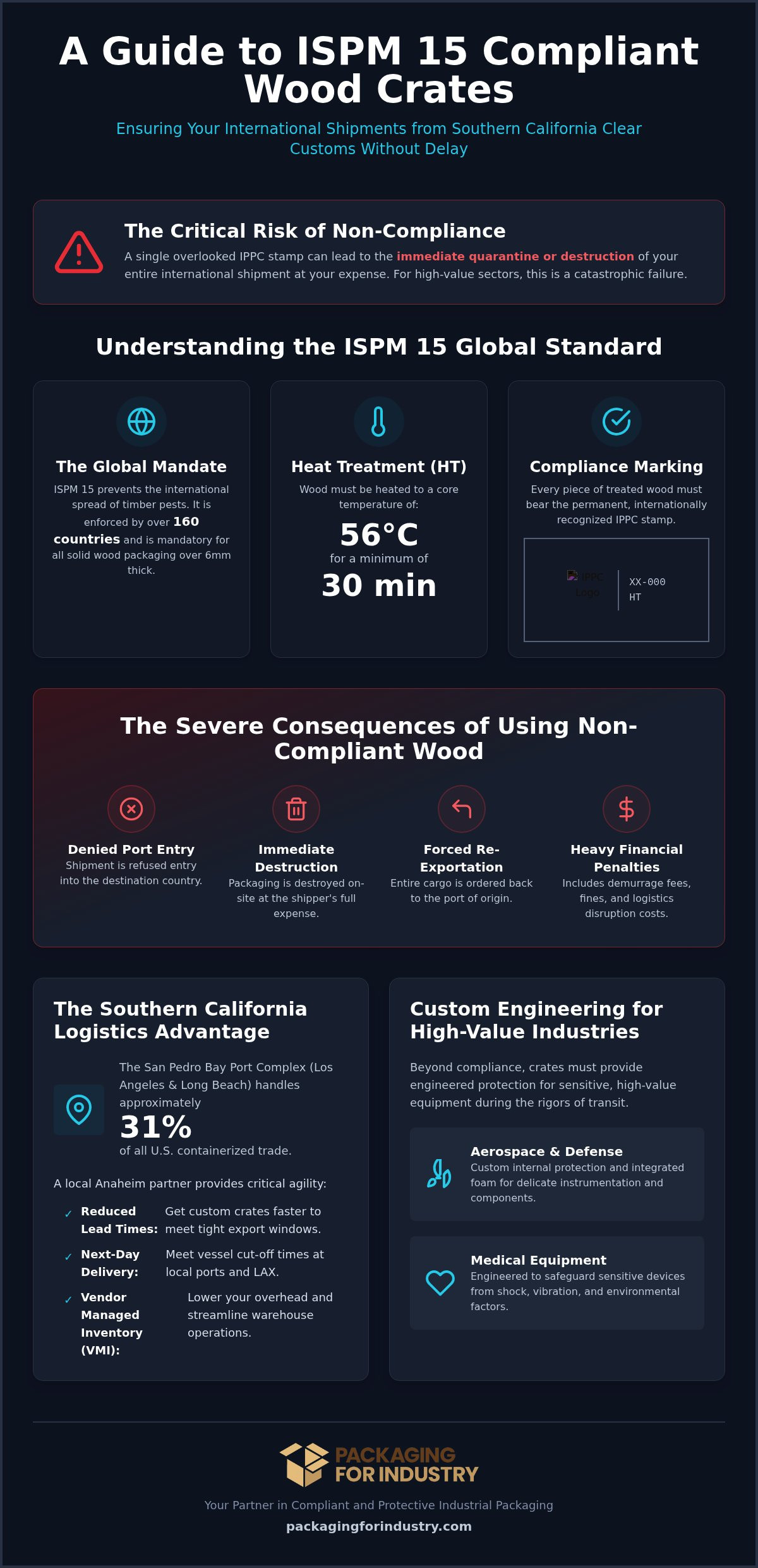
The San Pedro Bay Port Complex, comprising the ports of Los Angeles and Long Beach, handled approximately 31% of all containerized international waterborne trade in the United States in 2025. In June 2026 alone, the Port of Los Angeles processed 1 million TEUs, marking a significant 12.4% increase year-over-year. For companies exporting from this massive logistical hub, the choice of packaging material is a critical business decision. While wood remains the gold standard for protecting heavy industrial equipment, its organic nature makes it a primary focus for international biosecurity. Using “standard” untreated lumber isn’t just a mistake; it’s a liability that can halt your supply chain before it leaves the dock.
To mitigate the spread of timber pests, the International Plant Protection Convention developed the International Standards For Phytosanitary Measures No. 15 (ISPM 15). This global framework requires all solid wood packaging thicker than 6mm to be heat-treated to a minimum core temperature of 56°C for at least 30 continuous minutes. When you invest in custom wood crates for international shipping SoCal, you’re ensuring that every piece of timber in your shipment is certified and marked with the permanent IPPC stamp. Without this verification, your cargo cannot legally enter any of the 160-plus participating countries.
The Risks of Non-Compliant Wood Packaging
U.S. Customs and Border Protection (CBP) and the USDA’s Animal and Plant Health Inspection Service (APHIS) strictly enforce these regulations. The legal and financial consequences of using non-compliant wood are immediate and severe. If a shipment is flagged for lacking the proper HT (Heat Treatment) mark, authorities may deny entry, order the immediate destruction of the packaging, or mandate the re-exportation of the cargo at the shipper’s expense. For the aerospace and medical sectors, these delays are catastrophic. A single quarantine can trigger thousands of dollars in demurrage fees and disrupt critical manufacturing timelines across the globe.
SoCal Logistics: From Anaheim to Global Markets
Navigating the surges in port volume requires a packaging partner with deep regional expertise. From our strategic location in Anaheim, PFI supports manufacturers across Orange County, Los Angeles, and San Diego with custom design packaging tailored for the rigors of ocean and air transit. We understand that export windows are often tight. By offering local next-day delivery for custom wood crates for international shipping SoCal, we provide the agility needed to meet vessel cut-off times at the Port of Long Beach or flight schedules at LAX. This local presence ensures your protective solutions are engineered for both physical durability and total regulatory compliance.
The ISPM 15 Requirement: Heat Treatment and Compliance Marking
ISPM 15 stands for the International Standards for Phytosanitary Measures No. 15. It’s a global regulation designed to prevent the international spread of timber pests. As of mid-2026, over 160 countries actively enforce this standard. For your cargo to clear customs, every piece of solid wood packaging thicker than 6 mm must undergo a specific heat treatment (HT) process. This requires the wood’s core temperature to reach at least 56°C for a minimum of 30 continuous minutes. This process ensures that larvae and insects are eliminated before the wood is used to build custom wood crates for international shipping SoCal.
While chemical fumigation using Methyl Bromide (MB) was once common, it’s increasingly restricted due to environmental concerns and strict safety protocols at international ports. Heat treatment has become the preferred, more sustainable industry standard. The USDA’s APHIS oversees this program in the United States, and staying current with their guidelines is essential for any exporter. You can find detailed technical specifications for USDA-compliant wood packaging on their official portal, which remains the definitive source for biosecurity protocols.
Heat-Treated vs. Kiln-Dried Wood
It’s a common misconception that kiln-dried (KD) lumber is automatically export-ready. Kiln-drying is a process used to reduce the wood’s moisture content for structural stability and to prevent warping. While HT and KD processes both involve heat, only the HT certification specifically targets pest elimination to meet international law. PFI maintains a strict commitment to using only certified HT lumber for all export crates and heavy-duty packaging solutions. Using the wrong wood grade can lead to immediate shipment rejection, so we ensure every component of your crate is fully compliant before it leaves our Anaheim facility.
The Anatomy of the IPPC Stamp
Every compliant crate must bear the International Plant Protection Convention (IPPC) mark. This stamp acts as a “passport” for your wood packaging. It must be permanent, legible, and placed on at least two opposite sides of the crate. The mark includes the IPPC symbol, the ISO two-letter country code (US for the United States), a unique identification number for the treatment provider, and the HT treatment code. Red and orange inks are strictly prohibited because they’re reserved for hazardous materials labeling. We take total accountability for this marking process, ensuring that your custom wood crates for international shipping SoCal are ready for inspection the moment they arrive at the port. If you’re unsure if your current packaging meets these visual standards, you can request a packaging quote to review compliant options for your next shipment.
Essential Documentation Checklist for Wood Crate Shipments
Physical compliance is only half the battle when exporting industrial goods. A permanent IPPC stamp is vital, but it’s useless if your digital documentation fails to reflect the same standards. Customs agents at international ports cross-reference your digital manifest with the physical cargo. For high-value exports using custom wood crates for international shipping SoCal, ensuring absolute consistency between your paperwork and your packaging is the only way to avoid administrative holds. A pro-tip for local exporters: always include a digital copy of the ISPM 15 heat treatment certification in your master shipping file. This provides immediate proof of compliance if an inspector at a foreign border requests verification beyond the physical mark.
Core Export Paperwork
The standard suite of export documents must include specific language regarding your wood packaging to prevent red flags. Accuracy here is non-negotiable for maintaining a reliable supply chain.
- Commercial Invoice: This document details the value and nature of your industrial goods. It serves as the primary record for customs valuation and must be clear and professional.
- Packing List: You must explicitly note the use of ISPM 15 compliant wood packaging here. Don’t use vague descriptions. Be precise about the number of crates and their treatment status.
- Bill of Lading or Air Waybill: This is your contract of carriage. While the physical crate remains the same, air cargo documentation often requires more stringent weight and dimension reporting to account for aircraft fuel and balance.
Specialized Certificates for Wood Packaging
While the IPPC stamp is the standard “passport” for wood, certain destination countries or specific customs agents may require additional, specialized verification. Missing one of these can lead to the quarantine of your entire shipment.
A Certificate of Heat Treatment is the most common request. It verifies that the lumber used in your custom wood crates for international shipping SoCal was processed at a certified facility, providing a documented paper trail for the HT mark. Some nations also require a Phytosanitary Certificate, which is an official government-issued document proving the wood is free of pests. This is particularly common in agricultural-heavy economies. Additionally, if your crates are constructed from hardwoods, you may need a Declaration of Non-Coniferous Wood. This document helps you bypass specific restrictions some countries place on coniferous (softwood) bark. If you’re looking to streamline this process and ensure your shipments move without friction, you can request a packaging quote to review our fully compliant crating solutions.
Custom Crate Engineering for High-Value SoCal Industries
International transit is a physical gauntlet. Beyond regulatory compliance, your packaging must withstand high-frequency vibrations, extreme humidity shifts, and aggressive handling at major logistics hubs. Engineering custom wood crates for international shipping SoCal requires a precise understanding of these environmental stressors. A one-size-fits-all box often fails to protect specialized cargo during long-haul ocean voyages. Instead, we match the crate’s structural integrity to the specific weight and fragility of your product. This includes the use of heavy-duty skids and integrated pallets for large-scale industrial machinery, ensuring the load remains stable during crane transfers and forklift maneuvers.
Internal protection is just as critical as the exterior shell. We often integrate custom foam packaging to suspend sensitive electronics and precision instruments, isolating them from impact. To ensure a perfect fit and total compliance before a full rollout, we provide free prototyping and CAD/CAM design support. This allows Southern California manufacturers to verify the engineering of their crates before committing to a high-volume order, reducing the risk of transit damage and helping lower packaging costs over the long term.
Aerospace and Defense Crating
Southern California’s aerospace sector demands packaging that meets rigorous mil-spec standards. When handling precision flight components, shock-absorption engineering is a necessity, not an option. We design aerospace packaging solutions that feature reinforced bracing and multi-density foam inserts to maintain part orientation during turbulence or rough handling. For recurring defense contracts, we provide reusable crate designs that offer long-term durability. These provide a cost-effective alternative to single-use containers while maintaining the highest level of protection for sensitive mission-critical hardware.
Medical Device and Semiconductor Protection
Delicate medical equipment and semiconductors require specialized anti-static environments. We integrate ESD (electrostatic discharge) foam to protect sensitive circuitry from latent damage during transit. For items that must remain free of debris, we offer cleanroom-compatible wood alternatives or barrier packaging solutions. We also utilize corner and edge protection to reinforce the most vulnerable points of the crate, preventing structural failure during high-density stacking in cargo holds. This methodical approach ensures that your high-value cargo arrives at its international destination in the same condition it left your facility.
Securing Your Export Logistics with PFI Custom Crates
Managing the procurement of custom wood crates for international shipping SoCal shouldn’t be a logistical burden for your operations team. While the technical requirements of ISPM 15 and documentation are complex, our role is to simplify the purchasing process through total accountability. We bridge the gap between design engineering and warehouse logistics. By handling the compliance marking and structural validation in-house, we allow your team to focus on production rather than packaging regulations. This integrated approach ensures that every crate arriving at your dock is export-ready and engineered for fiscal responsibility.
High-volume exporters often face the challenge of balancing stock availability with warehouse space constraints. Our Vendor Managed Inventory (VMI) program addresses this by allowing us to monitor your usage and replenish compliant crates as needed. This eliminates the risk of stockouts during peak shipping seasons while keeping your overhead low. When you compare packaging pricing, PFI serves as a cost-saving alternative to national catalog suppliers. Large catalog companies often charge a premium for standard sizes that don’t fit your specific industrial equipment. We focus on custom-tailored responses that reduce material waste and optimize shipping volume, directly impacting your bottom line.
Local Service, National Capabilities
From our primary hub in Anaheim, we provide direct support to industrial centers in Irvine, Los Angeles, and across the Inland Empire. Our local presence allows for next-day delivery on many stock items and rapid turnaround times for custom orders. PFI’s free prototyping reduces the risk of international shipping damage by validating the structural integrity and internal fit of the crate against real-world transit stresses before you commit to bulk production. While we are a Southern California leader, we maintain nationwide shipping capabilities to support customers with multi-state manufacturing operations, ensuring consistency across your entire supply chain.
Request a Packaging Quote Today
Securing a compliant, custom-engineered solution for your next international shipment is a straightforward process. To provide an accurate crate quote, our engineering team needs to understand the physical dimensions, total weight, and final destination of your cargo. We also consider the fragility of the item to determine if specialized foam lining or internal bracing is required. Leveraging our expertise in custom wood crates for international shipping SoCal allows you to navigate complex logistical challenges without the fear of customs delays or transit damage. Our team is ready to help you lower packaging costs and improve supply reliability immediately.
Optimizing Your Global Export Strategy
Managing the technical complexities of international trade requires a meticulous approach to both engineering and documentation. By utilizing certified heat-treated lumber and maintaining precise records, you eliminate the risk of customs rejections and costly port delays. PFI’s established expertise in mil-spec and aerospace packaging ensures that your most sensitive equipment remains secure throughout the entire logistical journey. It’s about moving beyond standard boxes to a system of total accountability and protection.
Securing custom wood crates for international shipping SoCal is a strategic investment in both physical protection and regulatory peace of mind. Our Anaheim-based team supports your local operations with free CAD/CAM prototyping and local Southern California delivery to keep your supply chain moving efficiently. Whether you’re shipping from Los Angeles, Orange County, or the Inland Empire, we provide the industrial-grade solutions needed to lower packaging costs and improve reliability. We’re ready to engineer a solution that fits your specific cargo and destination requirements perfectly.
Take the first step toward a more efficient and compliant export process today. We’re here to help you solve your toughest logistical challenges with precision and speed.
Frequently Asked Questions
What documentation is needed for international shipping crates?
The primary documents include a Commercial Invoice, a detailed Packing List explicitly noting ISPM 15 compliance, and a Bill of Lading or Air Waybill. For certain destinations, you may also need a Certificate of Heat Treatment or a Phytosanitary Certificate. Consistency is vital; your physical IPPC stamp must match the digital records to avoid administrative holds. Keeping these records in your master shipping file ensures a smoother clearance process at foreign borders.
Do all countries require ISPM 15 compliant wood crates?
Over 160 countries currently participate in the ISPM 15 program, including all major U.S. trading partners. While a few nations may have different local rules, the vast majority of global trade routes strictly enforce these standards to prevent pest migration. Using custom wood crates for international shipping SoCal that are fully compliant is the safest way to ensure your cargo reaches its destination without being rejected or quarantined at the port of entry.
Is a heat treatment certificate always required for customs?
A heat treatment certificate isn’t always mandatory if the IPPC stamp is legible, but foreign customs agents frequently request it for secondary verification. This document provides a paper trail that links the specific lumber used in your crate to a certified heat treatment facility. We recommend including a digital copy of this certificate in your export documentation package. It acts as an insurance policy against inspectors who may question the validity of a physical mark.
Can I use plastic pallets instead of wood crates for international shipping?
You can use plastic pallets for international shipping because they’re exempt from ISPM 15 regulations as non-wood materials. However, plastic pallets don’t provide the same structural protection or load bearing capacity as custom engineered wood crates. For high value aerospace components or heavy medical machinery, a wood crate offers superior impact resistance and internal bracing options. Plastic is a viable alternative for lighter, uniform loads, but it lacks the customization required for complex industrial cargo.
How do I know if my wood crate is ISPM 15 certified?
A certified crate must feature a permanent, legible IPPC stamp on at least two opposite sides. This mark includes the IPPC symbol, the ISO “US” country code, a unique manufacturer ID, and the “HT” code for heat treatment. If the mark is missing or illegible, the crate is not considered compliant regardless of its actual treatment status. We ensure every custom crate we manufacture is clearly branded with these mandatory identifiers before it leaves our facility.
What happens if my shipment arrives with a non-compliant wood crate?
If a shipment arrives with non-compliant wood packaging, U.S. Customs or foreign authorities will likely deny entry. The shipment may be quarantined, the packaging destroyed at your expense, or the entire cargo re-exported to the point of origin. These actions often lead to thousands of dollars in demurrage fees and significant supply chain disruptions. Avoiding these risks is the primary reason why manufacturers prioritize sourcing custom wood crates for international shipping SoCal from experienced suppliers.
Does PFI provide on-site crating services in Southern California?
We provide direct delivery of fully assembled or knock-down crates to industrial hubs across Anaheim, Irvine, and Los Angeles. While we specialize in the design and manufacturing of custom engineered crates at our facility, our local presence allows us to support your team with rapid delivery and technical consultations. This ensures your packaging is perfectly matched to your warehouse logistics. We focus on providing the physical protection you need to move cargo safely from your dock to the port.
How much can I save by switching from a catalog supplier to PFI for custom crates?
Switching from a national catalog supplier to PFI often leads to a reduction in total packaging costs through better engineering and reduced material waste. Catalog suppliers typically sell standard sizes that require excessive void fill or result in higher dimensional weight fees. Our custom engineered approach ensures you only pay for the materials your specific cargo requires. Additionally, our VMI programs help lower overhead by optimizing your inventory levels and reducing the need for large on-site storage.