
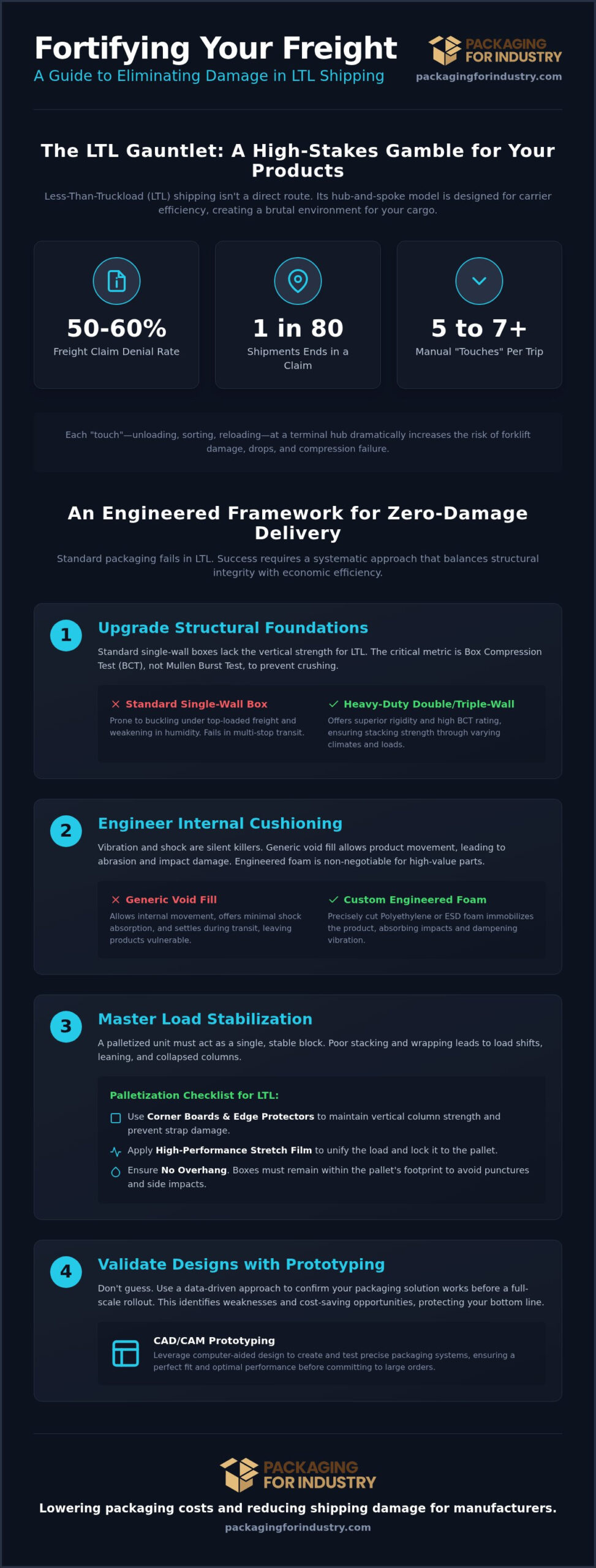
With a freight claim denial rate consistently hitting between 50% and 60% in 2026, the LTL environment is less of a shipping lane and more of a financial gamble for industrial manufacturers. When one in every 80 shipments ends in a damage or loss claim, reducing product damage in less-than-truckload shipping becomes a critical operational priority rather than a secondary concern. You understand that the hub-and-spoke model is inherently brutal on cargo. Between five or more manual “touches” and the constant risk of compression failure in a crowded trailer, your high-value components are often just one forklift move away from a total loss and a frustrated customer.
We recognize that protecting your freight requires more than just a thicker box; it demands an engineered system that balances structural integrity with economic efficiency. This guide provides the technical strategies you need to eliminate freight claims and protect your bottom line in a high-risk logistics landscape. We will examine how to optimize board grades, integrate custom foam cushioning, and implement load stabilization techniques that ensure zero-damage delivery. By the end of this article, you’ll have a repeatable framework to lower your total cost of ownership and improve supply chain reliability.
Key Takeaways
- Understand the high-touch nature of the hub-and-spoke model to better prepare for the 5-7 handling events typical of LTL transit.
- Upgrade from standard single-wall boxes to heavy-duty double-wall or triple-wall corrugated to provide a robust first line of defense.
- Prioritize engineered foam inserts over generic void fill as a primary strategy for reducing product damage in less-than-truckload shipping.
- Follow a rigorous palletization checklist including corner boards and edge protection to maintain vertical stack strength and prevent compression failure.
- Leverage custom CAD/CAM prototyping to validate your packaging designs and identify cost-saving opportunities before a full-scale rollout.
The LTL Hub-and-Spoke Environment: Why Standard Packaging Fails
Less-than-truckload shipping operates on a hub-and-spoke model designed for carrier efficiency, not necessarily product safety. Unlike Full Truckload (FTL) transit where a trailer is sealed at your dock and opened at the destination, LTL involves constant consolidation. Your freight is mixed with diverse commodities, ranging from industrial machinery to palletized liquids. This environment subjects your goods to 5-7 handling events per trip. Successfully reducing product damage in less-than-truckload shipping requires acknowledging that standard RSC boxes designed for stable warehouse stacks often fail here. They simply aren’t engineered for the lateral shifts and vertical pressures of a multi-stop route.
The Reality of Multi-Terminal Handling
A shipment originating in Anaheim or Irvine rarely takes a straight path. It likely travels to a regional consolidation hub in Carson or Los Angeles before moving toward its final destination. Each stop requires a forklift operator to unload, sort, and reload the pallet. These frequent interactions significantly increase the statistical probability of forklift incursions and accidental drops. Handling events are the primary variable in LTL damage rates; the more times a pallet is moved, the higher the risk of structural compromise.
Compression and Vibration: The Silent Killers
Beyond physical impacts, constant trailer vibration acts as a silent destroyer. High-frequency road hum can loosen internal fasteners or mar delicate finishes if your internal cushioning isn’t precisely fitted. Carriers also maximize trailer space by top-loading, often placing heavy freight directly onto your pallets. If your outer containers lack the stacking strength to handle this unexpected weight, the bottom layers will buckle under compression. In Southern California’s coastal regions, fluctuating humidity levels can weaken corrugated fibers, leading to a marked decrease in the load-bearing capacity of standard boxes. Success in reducing product damage in less-than-truckload shipping requires moving beyond off-the-shelf supplies toward custom design packaging that accounts for these specific environmental stresses.
Structural Foundations: Selecting Corrugated and Wood for Maximum Strength
The outer container is your primary defense against the high-touch LTL environment. While many procurement teams focus on the Mullen Burst Test, which measures puncture resistance, the Box Compression Test (BCT) is the more critical metric for reducing product damage in less-than-truckload shipping. BCT measures a box’s ability to withstand vertical pressure. Since LTL carriers frequently top-load freight to maximize trailer density, your packaging must support thousands of pounds of overhead weight without buckling. Standard single-wall RSC boxes often lack the structural integrity required for these vertical loads; they might survive a warehouse stack but fail in a vibrating trailer. Choosing the right material grade ensures your bottom layer doesn’t collapse under the weight of a neighbor’s pallet.
Heavy-Duty Corrugated Solutions
For high-value industrial components, upgrading to double-wall or triple-wall corrugated is often the most cost-effective way to lower replacement costs. Double-wall construction provides significantly more rigidity for mid-weight parts, while triple-wall corrugated serves as a lightweight alternative to wood for heavy machinery. These materials also offer better resistance to the humidity fluctuations encountered during cross-country transit. If you’re shipping from Anaheim to the East Coast, weather-resistant adhesives in heavy-duty board help maintain structural strength through varying climates. You can Explore our heavy-duty corrugated box options to find the right grade for your specific application.
Custom Crating for Extreme Loads
Sometimes corrugated material isn’t enough. For sensitive aerospace gear or heavy manufacturing equipment exceeding 500 pounds, a custom-engineered wood crate is the only way to ensure safe delivery. These crates provide total structural enclosure and can be kitted with custom foam inserts to isolate the product from external shocks. At PFI, we design crates that comply with ISPM-15 international standards, ensuring your export shipments pass through customs without delay. We also offer hybrid solutions that combine wood bases with triple-wall corrugated sleeves to balance protection and weight. Designing these specialized enclosures is a proactive step in reducing product damage in less-than-truckload shipping for your most valuable assets. If you’re shipping irregular or high-density loads, it’s wise to request a packaging quote for a custom wood solution designed for your specific dimensions.
Internal Cushioning: Engineering Protection with Custom Foam
In the high-risk LTL environment, “void fill” is often confused with “engineered cushioning.” Using packing peanuts or crumpled paper only prevents an item from shifting within the box. It does nothing to absorb the energy from a three-foot drop or the sustained vibration of a cross-country haul. For effective reducing product damage in less-than-truckload shipping, you need foam inserts designed to manage shock. Engineered cushioning decelerates the product during an impact, spreading the force over a longer period to prevent structural failure.
Choosing between Polyethylene (PE) and Polyurethane (PU) depends on your product’s fragility and weight. PE is a closed-cell foam that excels at protecting heavy industrial components because it maintains its shape after multiple impacts. PU is an open-cell, softer foam ideal for lighter, highly sensitive items requiring delicate surface protection. For electronics or semiconductor parts, we integrate ESD (Electrostatic Discharge) foams to prevent static damage. Die-cut foam inserts ensure every component is held in a fixed orientation, which eliminates the risk of internal collisions during transit.
Material Density and Shock Absorption
Calculating the correct foam density is a precise science. If the foam is too soft, the product will “bottom out” and strike the outer container during a drop. If it’s too firm, the shock will pass directly through the foam into the product. We often utilize foam end caps to create a “floating” environment, suspending the item in the center of the box to maximize the crush zone. Learn about custom foam packaging inserts to see how different densities protect specialized gear from the G-forces typical of LTL handling.
Kitting and Assembly for Operational Efficiency
Operational efficiency is just as important as protection. By kitting multiple components into a single, multi-cavity foam insert, you reduce the time spent on the packing line while ensuring every part is accounted for. This method prevents parts from rubbing against each other, which is a common cause of finish damage in vibrating LTL trailers. PFI uses advanced CAD/CAM support to design complex foam geometries that fit your products perfectly. This engineering-led approach is a cornerstone of reducing product damage in less-than-truckload shipping, particularly for recurring production lines in the aerospace and medical sectors. Custom foam assemblies don’t just protect; they streamline your entire warehouse workflow.
Load Stabilization: Mastering Palletization and Stretch Film
Even the most robust triple-wall box will fail if the pallet foundation is structurally unsound. A critical factor in reducing product damage in less-than-truckload shipping is ensuring your load is properly unitized to withstand lateral shifts and vertical pressure. One of the most common errors in warehouse operations is pallet overhang. When a corrugated box extends even an inch over the edge of a pallet, it loses approximately 30% of its compression strength. This misalignment causes the vertical walls of the box to buckle under the weight of top-loaded freight, leading to internal product crushing and potential load collapse.
The 5 Steps to an LTL-Proof Pallet
To ensure your freight survives the multi-terminal journey through Southern California hubs, follow this rigorous unitization process:
- Step 1: Select the right pallet. Use heavy-duty, heat-treated skids with no broken deck boards. A weak pallet is a liability that can splinter under the weight of industrial components.
- Step 2: Prioritize column stacking. Align your boxes directly on top of each other. While interlocking patterns might feel more stable, they significantly reduce the vertical stacking strength of the corrugated material.
- Step 3: Apply cardboard edge protectors. Use these to stabilize the load and distribute the vertical pressure from top-loaded freight.
- Step 4: Optimize stretch film application. Use the correct gauge for your load weight. Machine film is preferable for high volumes because it provides a consistent containment force that hand-wrapping cannot match.
- Step 5: Implement clear documentation. Place labels on all four sides of the pallet to ensure visibility for forklift operators in high-traffic terminals like Santa Fe Springs or Carson.
Edge Protection and Containment
Cardboard corner protectors are essential for maintaining the integrity of your load. They prevent heavy-duty strapping from cutting into your boxes and provide a rigid frame that resists the “twisting” forces encountered during transit. You can reduce damage with corner and edge protection by ensuring your pallets maintain their shape even when stacked three high in a trailer. There is a fundamental difference between simply wrapping a pallet and securing a load. Securing requires enough containment force to keep the freight from shifting on the skid during a sudden stop or sharp turn. Proper film gauge and wrap count are the final barriers between a successful delivery and a costly freight claim.
Request a custom palletization quote
The PFI Strategy: Prototyping and VMI for Damage Reduction
Effective reducing product damage in less-than-truckload shipping isn’t just about buying heavier materials. It requires a methodical engineering process that validates packaging performance before you commit to a full-scale rollout. Many manufacturers over-spend on generic, bulky supplies that fail to address the specific vibration and impact risks of the LTL hub-and-spoke system. At PFI, we move beyond the catalog model by acting as a technical partner. We focus on the intersection of structural integrity and economic efficiency to ensure your high-value goods arrive intact without inflating your total cost of ownership.
Free Prototyping and Design Support
Prototyping is the only reliable way to guarantee LTL survival. Using advanced CAD/CAM technology, our team creates physical samples for fit and function testing. This allows you to verify that custom foam inserts and heavy-duty corrugated containers work together as a single, integrated system. Our “packaging review” service identifies opportunities to eliminate redundant materials while simultaneously strengthening weak points in your current design. For manufacturers in Irvine, Anaheim, and across the Inland Empire, this local custom design packaging support means fast turnaround times for samples and immediate adjustments based on your feedback.
Vendor Managed Inventory (VMI) and JIT
A damage-reduction strategy is only effective if you have the right materials on hand when the truck arrives. Our Vendor Managed Inventory (VMI) program prevents the stockouts that often lead to warehouse teams using “substitute” packaging that isn’t rated for LTL stresses. By managing your inventory levels for you, we ensure a consistent supply of custom corner boards, stretch film, and specialized crates. This proactive approach supports Just-in-Time (JIT) manufacturing cycles, which is critical for the fast-paced aerospace and medical sectors in Southern California.
- Maintain zero-damage delivery standards with engineered, pre-tested designs.
- Lower packaging costs by identifying and removing over-engineered components.
- Improve warehouse flow with local next-day delivery and integrated inventory management.
- Access specialized expertise in mil-spec and aerospace-grade protection.
We invite you to request a custom packaging quote to start your damage reduction audit and see how our engineered solutions can protect your bottom line. Whether you are shipping from a single facility in Orange County or managing a nationwide distribution network, PFI provides the stability and technical oversight required for zero-damage logistics.
Take Control of Your Industrial Shipping Outcomes
Transitioning from reactive freight claims to a proactive packaging strategy is essential for protecting your bottom line. Success depends on engineering. Effective reducing product damage in less-than-truckload shipping relies on an integrated approach that combines heavy-duty corrugated board with engineered foam inserts and stabilized palletization. By moving beyond off-the-shelf supplies, you eliminate the structural failures that lead to costly replacements and customer dissatisfaction.
Packaging For Industry (PFI) provides the technical oversight and specialized aerospace expertise required for zero-damage delivery. Our team uses free CAD/CAM prototyping to validate every design; this ensures it withstands the specific stresses of the Southern California hub-and-spoke system. With local next-day delivery in Orange County and Los Angeles, we help you maintain operational flow while lowering your total cost of ownership. We focus on the intersection of engineering and economics to give you peace of mind.
We’re ready to help you build a more resilient and cost-effective supply chain today.
Frequently Asked Questions
What is the primary cause of product damage in LTL shipping?
The primary cause is the high-touch nature of the hub-and-spoke model where freight is handled multiple times. Unlike full truckloads, LTL pallets are loaded and unloaded at least 5-7 times before reaching their destination. Each “touch” by a forklift or manual sorter increases the statistical probability of impact damage. Reducing product damage in less-than-truckload shipping requires packaging that can survive these frequent movements and the associated risks of trailer vibration and top-loading.
Is double-wall corrugated enough for LTL shipments?
Double-wall corrugated is often sufficient for mid-weight parts, but high-value or heavy industrial components often require triple-wall board. The choice depends on the Box Compression Test (BCT) requirements of your specific load. While double-wall provides good puncture resistance, triple-wall offers the vertical stacking strength needed to resist buckling when carriers place heavy freight on top of your pallet. We analyze your product’s weight and fragility to determine the most cost-effective grade.
How do I calculate the right foam density for my product?
Calculating the correct foam density involves balancing your product’s weight with its fragility rating or G-force limit. If the foam is too dense, the shock from a drop passes directly to the product; if it’s too soft, the product “bottoms out” against the outer box. We use engineering data to select between closed-cell polyethylene for heavy items or open-cell polyurethane for sensitive equipment. This precision is a cornerstone of reducing product damage in less-than-truckload shipping.
Why is pallet overhang so damaging to LTL freight?
Pallet overhang leads to a 30% loss in the compression strength of your corrugated boxes. When a box extends beyond the edge of the pallet, the vertical walls lack the support of the deck boards. This misalignment causes the bottom layer to buckle under the weight of top-loaded freight. To maintain structural integrity, your load must be centered and flush with the pallet edges, supported by corner boards to distribute vertical pressure evenly.
Does PFI provide free prototypes for custom packaging designs?
Yes, we provide free CAD/CAM prototyping and design support for our industrial clients. This service allows you to test the fit and function of custom foam inserts and heavy-duty corrugated boxes before moving to a full-scale production run. Prototyping is essential for validating that your engineered packaging can survive the multi-terminal LTL environment. Local manufacturers in Orange County and Los Angeles benefit from our fast turnaround times on these custom samples.
Can custom packaging actually lower my overall shipping costs?
Custom packaging lowers your total cost of ownership by eliminating freight claims and preventing over-packaging. While standard boxes might seem cheaper initially, the cost of replacements, denied claims, and customer dissatisfaction quickly adds up. Engineered solutions allow you to use the exact amount of material needed for protection, which often reduces the overall dimensions and weight of the shipment. This efficiency helps you avoid the high costs associated with density-based LTL pricing reforms.
How does stretch film gauge affect load stabilization?
Stretch film gauge determines the containment force required to keep your load from shifting during transit. Lighter loads may only require a 60-gauge film, while heavy industrial components often need 80-gauge or 100-gauge machine film to ensure stability. It’s not just about the number of wraps; it’s about the tension applied to the load. Proper gauge selection prevents the twisting and sliding that frequently occurs when LTL trailers navigate sharp turns or sudden stops.
What industries benefit most from custom LTL packaging solutions?
Industries shipping high-value, sensitive, or heavy items benefit most, particularly aerospace, medical device manufacturing, and electronics. These sectors require specialized protection like ESD foam or mil-spec packaging to ensure compliance and safety. Custom solutions are also vital for manufacturing firms in Southern California that manage recurring production lines. By using kitted foam inserts and heavy-duty crates, these businesses improve warehouse efficiency while maintaining a zero-damage delivery standard across their distribution networks.