
A standard pallet isn’t always the right foundation for a heavy electrical shipment. Custom wooden shock skids for heavy electrical equipment in Torrance can be designed around the load to support machinery during storage and transport. Unlike pallets, wooden skids typically have a top deck without a bottom deck and rest directly on their stringers, which can make them easier to slide when the handling plan calls for it.
For large machinery, OEM equipment, and oversized industrial loads, the base should fit the equipment and its shipping requirements. This guide explains how custom skids support heavy shipments, how they differ from pallets, and what to consider when planning a skid. It also covers how Packaging For Industry’s custom packaging design, foam packaging, and stretch film can fit into a broader equipment-protection plan.
Key Takeaways
- Match skid dimensions and support points to the equipment’s footprint, weight distribution, and handling plan.
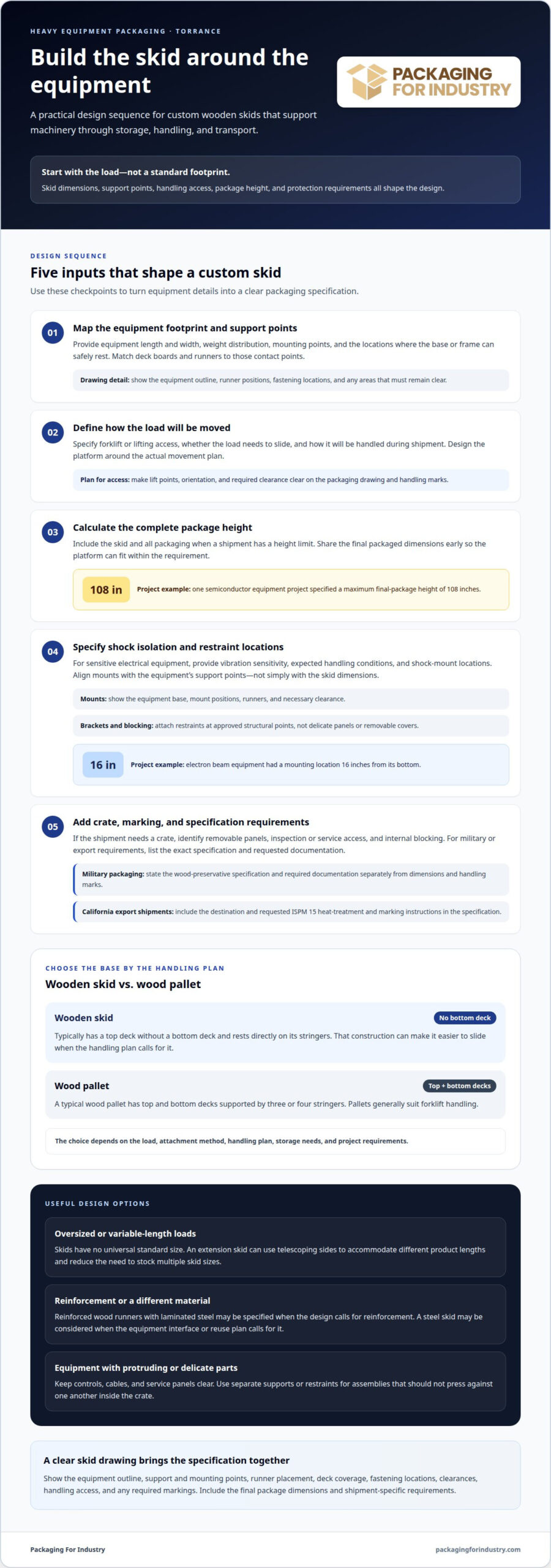
- Account for package height limits early; one semiconductor equipment project specified a maximum final-package height of 108 inches.
- Choose between a skid and a pallet based on how the load will be handled, stored, and moved.
- Use custom platforms, runners, brackets, and crates to support machinery and oversized industrial loads.
- Coordinate skid design with cushioning, stretch film, and packaging inventory planning to build a more dependable shipping process.
Custom Wooden Shock Skids and Heavy-Duty Packaging Products
Wooden skids support heavy shipments by distributing equipment across deck boards and runners. For a Torrance project, start with the load’s footprint, support points, handling method, and final package height.
Skid and Pallet Construction
A wooden skid typically has a top deck without a bottom deck and rests directly on its stringers. A typical wood pallet has top and bottom decks supported by three or four stringers. This difference affects clearance, handling, and how the load sits on the floor.
For machinery, the design should match how the shipment will move. Pallets generally suit forklift handling, while a skid can be easier to slide because it has no bottom deck. Companies in Torrance planning custom wooden machinery skids and crates can specify equipment dimensions, support locations, and the intended transport method. A custom skid can also serve as the base for crating.
Skids have no universal standard size, so an oversized load can be matched to its own footprint. For example, an extension skid uses telescoping sides to accommodate different product lengths and reduce the need to stock multiple skid sizes. For a Torrance shipment, local packaging support in Torrance can be part of broader shipping coordination.
Quotes and Fabrication Capabilities
A useful skid quote begins with the equipment’s length, width, weight distribution, mounting points, and handling plan. Include the final packaged dimensions when height is restricted. One semiconductor equipment project specified a maximum final-package height of 108 inches, showing why skid height must be included in the package calculation.
For oversized equipment, the drawing can show runner placement, deck coverage, fastening points, and clearance for lifting or sliding. Reinforced wood runners with laminated steel may be specified when the design calls for reinforcement; the quote should describe their placement and purpose. Include required skid markings and handling instructions, such as lift points or orientation, so they remain clear during shipment.
If military specifications call for wood preservatives, state the exact specification and required documentation in the quote. Preservative requirements are separate from skid dimensions and handling marks, so list each separately in the specification.
Shock-Isolating Support for Electrical Equipment
For transformers and other electrical equipment, shock-isolating skid design starts with the load’s weight distribution, mounting points, vibration sensitivity, and expected handling conditions. Specify shock mounts by their intended location and relation to the equipment base. Their position should align with the equipment’s support points, not be chosen based on skid dimensions alone.
For example, electron beam equipment in one project had a mounting location 16 inches from its bottom. That kind of measurement can affect skid geometry and mount placement. A clear drawing should show the equipment base, mounting locations, skid runners, and any required clearance.
Wooden shock skids versus steel skids for electrical equipment is a design choice shaped by the load, attachment method, handling plan, and project requirements. Wood can be configured as a product-specific base; a steel design may be considered when the equipment interface or reuse plan calls for it. For California export shipments, include the destination and requested ISPM 15 heat-treatment and marking instructions in the specification rather than assuming the origin alone settles the requirement. A buyer seeking custom wooden shock skids for heavy electrical equipment in Torrance should provide the equipment drawing, shock-mount locations, package-height limit, and handling instructions together.
Skids for Machinery, OEM Equipment, and Industrial Shipments
Large machinery needs a base designed around its support points, not a generic footprint. A custom wooden skid can keep equipment steady during storage and transport while leaving access for handling. For an OEM assembly, begin with its base drawing, weight distribution, protruding components, and required fork or lifting access. These details guide the platform and crating plan.
A heavy-duty platform distributes the load across structural members and supports the equipment at designated contact points. Consider a production machine with a narrow frame and projecting control cabinet. The platform can support the frame while keeping the cabinet clear of the deck. The skid drawing should show the equipment outline, runner positions, fastening locations, and areas that must remain accessible for inspection or service.
Top-heavy machinery needs restraint that accounts for its center of gravity and movement during shipment. Custom brackets can secure the upper frame or designated attachment points to the platform, limiting unwanted movement inside a crate. For example, a tall robotic cell may need lower supports for its base and separate restraints for its raised assembly. Bracket placement must match the machine’s approved attachment locations, not delicate panels or removable covers.
Crates enclose and restrain a load mounted on a skid. A machinery crate can protect exposed components and keep loose accessories organized with the main unit. A practical design identifies removable panels, access points, and internal blocking. For an OEM shipment containing a machine and control cabinet, separate internal restraints can prevent the components from pressing against each other during transport.
- Base support: Match platform contact points to the machine frame or mounting feet.
- Restraint: Locate brackets and blocking at approved structural attachment areas.
- Crate layout: Preserve clearance around controls, cables, and service panels.
- Handling: Show forklift or lifting access on the packaging drawing.
These steps also help manufacturing teams repeat a packaging configuration across OEM shipments. A drawing that records the skid outline, bracket locations, and crate access points gives production and packing staff a consistent reference. For a modular process skid, the platform can follow the module’s support footprint while the crate protects equipment extending beyond the base. Coordinating these elements can reduce repacking and prevent obstructed access at receiving.
For Torrance shipments, delivery planning and equipment installation are separate parts of the project. The shipment plan should identify the delivery point and unloading approach; final positioning, connection, and commissioning belong to the equipment installation and rigging scope. The skid supports transport and handling, but it does not replace the receiving team’s installation plan.
Packaging requirements often extend beyond the wooden base. Foam packaging can cushion vulnerable surfaces, while packaging kitting can group packing components for a repeatable line-side process. A packaging design should coordinate those materials with the machine’s shape, shipping route, and packing workflow. To scope packaging needs for a machinery shipment, request a packaging quote with the equipment drawing and packing requirements.
How Heavy-Duty Skids Support Industrial Equipment
A heavy-duty skid serves as the equipment’s structural base during movement and storage. Its design should follow the machine’s load path, or where its weight transfers into the supporting frame. For a pump assembly with a dense motor on one side, runner placement should account for the uneven distribution rather than assume the load is centered.
Start with the equipment drawing and identify its structural feet, frame rails, and unsupported projections. These contact points show where the deck transfers force to the runners. If a machine has a broad frame but only a few mounting feet, the skid must support those feet without blocking access needed for lifting or service. The drawing also helps coordinate the base with protective materials and any outer enclosure.
Handling conditions matter as much as the equipment outline. A shipment may move by forklift, crane, or sliding, and each method requires different access and clearance. For example, a maintenance team receiving a compact press may need fork access from a particular side because nearby equipment limits maneuvering. Recording that constraint in the packaging plan helps prevent a skid that supports the load but obstructs handling.
Consider the equipment’s full journey, not just its first lift. A skid may support a machine during warehouse staging before it moves to a truck or installation area. If the package will be stored, the design should keep sensitive components clear of the floor and provide stable support. For a modular process skid, projecting pipes or fittings may need clearance so they do not bear the platform’s load or touch nearby packing materials.
Load restraint must work with the base. Blocking can limit movement at sturdy frame locations, while cushioning can protect surfaces that should not touch hard restraints. A control cabinet mounted beside a machine frame is one example: the packing plan should restrain the equipment without making the cabinet bear the load. Coordinating these elements can help reduce shipping damage and avoid packaging that does not address a specific risk.
- Map support: Identify the machine’s frame rails, feet, and weight-bearing areas.
- Plan handling: Record forklift, crane, or sliding access needed at receiving.
- Protect projections: Allow clearance around pipes, controls, and exposed components.
- Coordinate restraint: Keep blocking and cushioning aligned with the equipment structure.
These details distinguish a fit-for-purpose skid from a platform designed only around overall dimensions. A tall electrical cabinet, for example, may have a compact base and a higher center of gravity. Its restraint plan should account for approved attachment points and handling conditions. For Torrance buyers planning custom wooden shock skids for heavy electrical equipment, the equipment drawing and handling route are useful starting points.
Repeat shipments benefit from a consistent packaging record. Keep the approved skid drawing, equipment orientation, restraint locations, and handling notes together so future packing runs follow the same configuration. If the equipment changes, revise the drawing to reflect its new footprint or support points. This gives purchasing and operations teams a clear reference when ordering packaging for recurring industrial shipments.
The buyer’s key takeaway is to specify the load path, handling method, and protection needs together. A skid that matches all three can support a more orderly movement from packing through receiving. Custom packaging design can help translate equipment requirements into a coordinated packaging plan.
Why Choose Packaging For Industry (PFI)
Packaging For Industry (PFI) helps manufacturers coordinate equipment packaging around the load, handling plan, and shipping workflow. Its custom packaging design services are useful when standard packaging leaves gaps, a machine has sensitive components, or several materials need to work together. For a Torrance shipment, start the design discussion with the equipment drawing, contact points, and receiving requirements.
Custom packaging design connects equipment requirements to a practical packing plan. A heavy electrical assembly, for example, may need a support base, cushioning around vulnerable surfaces, and a clear packing and unloading sequence. PFI can develop the packaging design around those needs rather than treating each material as a separate decision. This is especially useful when equipment dimensions or packing procedures change between shipments.
Foam packaging can fill gaps between equipment and its protective packaging. It can provide cushioning or separation where the design calls for it, such as around a control enclosure or a component that should not touch the crate structure. The material and placement should match the equipment’s shape and packing requirements. This coordinated approach can help reduce shipping damage without adding protection where it is unnecessary.
Stretch film helps unitize and stabilize packaged loads. Depending on the shipment configuration, it can hold outer packaging or grouped components together during handling. For example, a warehouse dispatching related equipment components can add film to its packing sequence after the individual protective packaging is in place. Stretch film complements the package; it does not replace structural support or equipment-specific cushioning.
For operations with recurring packaging needs, Packaging For Industry’s Vendor Managed Inventory (VMI) program can support supply planning. It is relevant when a manufacturer wants packaging inventory managed through a repeatable purchasing and replenishment process. VMI can align packaging supply with operating needs and reduce the burden of managing routine materials internally. It addresses inventory coordination, while custom design addresses how the equipment is packaged.
When discussing a project, start with the equipment drawing, shipment destination, handling method, and any package-size or access constraints. Include the packing workflow and whether the equipment ships repeatedly or as a one-time load. These details help match design choices to the materials and inventory process the job requires. Buyers can then discuss a packaging quote based on the project scope rather than a generic configuration.
- Custom design: Coordinate the equipment’s shape, protection needs, and packing workflow.
- Foam Packaging: Address cushioning and separation for vulnerable areas.
- Stretch Film: Secure outer packaging or grouped components as part of dispatch preparation.
- VMI: Plan packaging inventory for recurring operational requirements.
Contact Packaging For Industry (PFI) to discuss packaging needs for your equipment shipment.
Plan Your Next Equipment Shipment
A skid specification can serve as a useful reference for future orders, especially when equipment dimensions or handling needs change. For custom wooden shock skids for heavy electrical equipment in Torrance, bring the equipment drawing and shipment requirements to the planning conversation. This gives the packaging design a clear starting point and helps align the package with your receiving workflow.
Packaging For Industry (PFI) can discuss the packaging scope and how it fits your operation. In a quote request, outline the equipment, shipment destination, recurring demand, and any constraints that matter to your team. This provides a practical basis for planning the next step without relying on a generic configuration.
A well-planned shipment starts with clear requirements. Use that foundation to plan your equipment packaging project.
Frequently Asked Questions
What load capacity, dimensions, and engineering details should a wood skid meet for heavy electrical equipment?
A skid’s required capacity and dimensions depend on the equipment’s weight, weight distribution, base geometry, and handling conditions. Share the equipment drawing and identify its support feet, center of gravity, and lifting points. For example, a transformer with offset components may need support positioned around its actual load path, not simply centered beneath the enclosure. The design should match the equipment manufacturer’s handling instructions and shipment plan.
What affects custom shock skid pricing and lead time in Torrance and Los Angeles County?
Pricing depends on the project and is provided after a quote request. Key factors include skid dimensions, materials, reinforcement, shock-isolation requirements, crate integration, and order quantity. Lead time depends on design details, material requirements, and production scheduling. A complete equipment drawing and shipment specification help define the scope efficiently. For a quote, include the Torrance delivery location, required package dimensions, and any target shipping date.
What shipping and rigging details matter for heavy electrical equipment on wooden skids?
Coordinate the skid’s handling features with the carrier and rigging plan before shipment. Document the packaged dimensions, total shipping weight, designated lift points, fork access, and orientation instructions. For example, a receiving site with limited clearance may need an unloading approach planned around the equipment’s footprint and access route. Keep rigging instructions with the shipment documents, and follow the equipment manufacturer’s requirements for lifting and movement.
Torrance companies that build custom wooden machinery skids and crates
Packaging For Industry (PFI) provides custom packaging design for machinery skids and crates. Share the equipment dimensions, support locations, weight distribution, and handling plan to guide the design.