
Packaging delays and poorly fitted protection can disrupt electronics assembly as surely as component shortages. A dependable approach to packaging for electronics assembly in Irvine aligns replenishment with production needs and matches protective materials to the parts being handled and shipped.
Assembly teams need packaging that arrives when needed, protects sensitive components through handling, and fits the workflow without adding unnecessary steps. Just-in-time supply can align packaging with demand, while custom design can account for product dimensions, packing methods, and shipping requirements.
This article explains how just-in-time packaging supply works, what to consider when selecting protective packaging, and how custom design can support an efficient assembly operation. These decisions can help reduce shipping damage, manage packaging costs, and keep supplies moving reliably for Irvine manufacturing operations.
Key Takeaways
- Match protective packaging to the size, shape, and handling needs of circuit boards and other delicate electronics.
- Consider how Irvine manufacturers and technology companies can align packaging supply with their production workflows.
- Use just-in-time replenishment to coordinate packaging availability with inventory and assembly needs.
- Assess packaging vendors for custom design capabilities and solutions suited to electronics protection requirements.
- Explore how packaging kitting, inventory management, and custom packaging services can support a more reliable supply process.
Packaging Products for Electronics Assembly
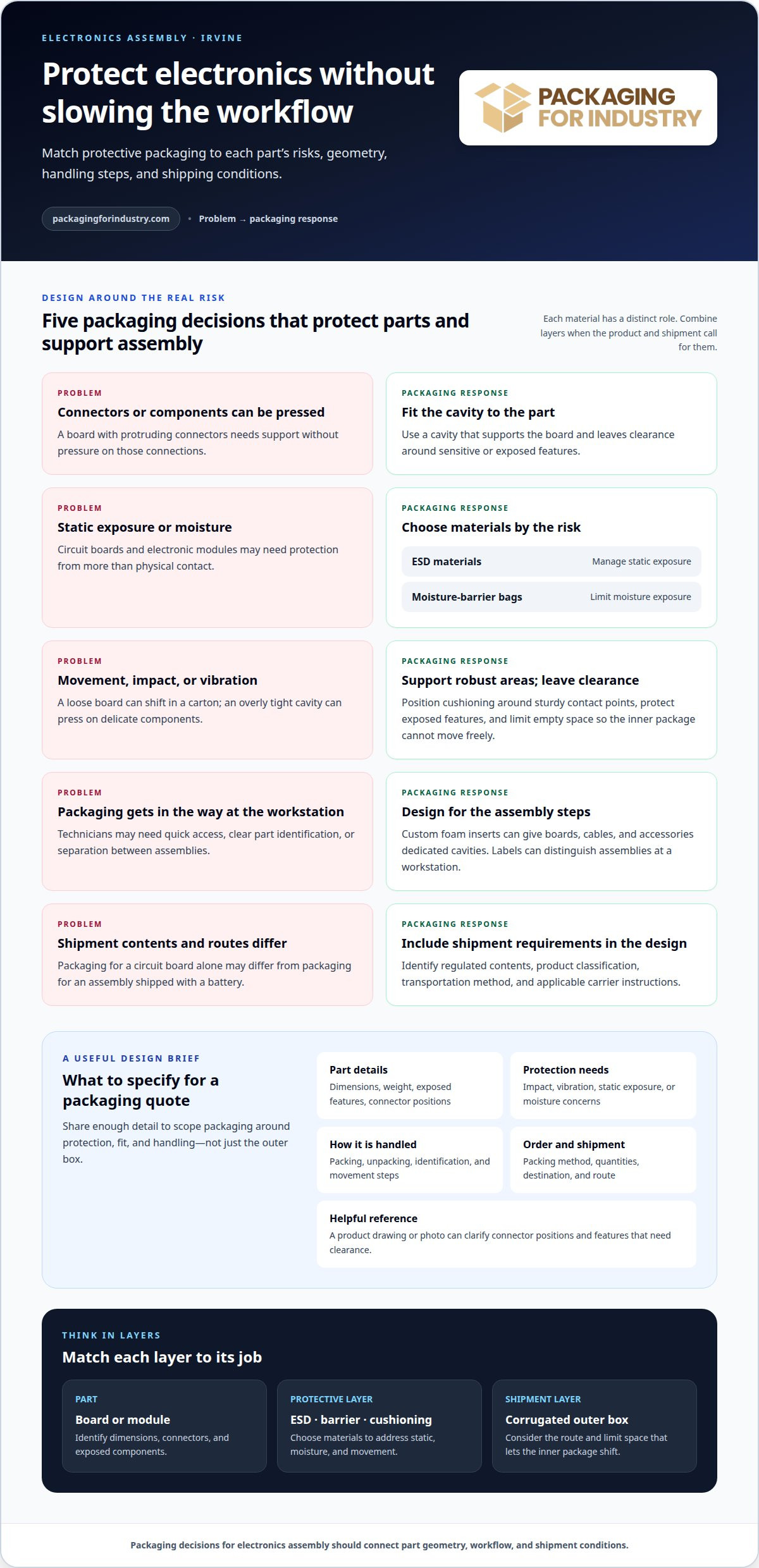
Packaging for circuit boards and electronic modules should control movement, static exposure, moisture, and contact with hard surfaces. Start with the part’s dimensions, weight, connector locations, exposed components, and handling method. For example, a board with protruding connectors needs a cavity that supports the board without pressing on the connections. A compact module may need separate compartments to prevent contact with neighboring parts.
Options for managing static, moisture, and shock include ESD packaging, moisture-barrier bags, and cushioning such as foam inserts. Each addresses a different risk: ESD materials help manage static exposure, barrier bags limit moisture exposure, and fitted cushioning helps absorb impacts and restrict movement. A layered design can combine these materials around a circuit board, with a corrugated outer box for shipment.
Impact and vibration protection depend on supporting the product through handling and transit. A loose board can shift inside a carton, while a tight cavity can press on sensitive components. Map contact points first, then position cushioning around robust areas rather than delicate parts. For a module with a heat sink and exposed connector, for instance, the insert can support the housing while leaving clearance around the connector. The outer carton should also limit empty space that lets the inner package move.
Packaging design should reflect the assembly workflow, not only the final shipment. Consider whether technicians need to remove components quickly, identify part numbers, or keep multiple assemblies separated. A custom foam insert can provide dedicated cavities for boards, cables, and accessories, while labels can distinguish assemblies at a workstation. Packaging for electronics assembly in Irvine can also account for the route from receiving to production and onward to the customer. The Irvine packaging service area supports local businesses evaluating packaging needs around those workflows.
For U.S. electronics shipments, packaging requirements depend on the contents and transportation method. Batteries or other regulated contents may bring additional handling and documentation requirements, so account for the product classification and applicable carrier instructions. Packaging for a circuit board alone may differ from packaging for an assembly shipped with a battery. Include the shipment’s contents and route in the design brief rather than treating every electronic item alike.
A packaging quote is easier to scope when assembly details are clear. Include product dimensions, weight, fragile or exposed features, and any static or moisture concerns. Add the destination, packing method, expected order quantities, and whether packaging is used at the workstation or for outbound shipping. A drawing or product photo can clarify connector positions and other features that need clearance. These details help shape a design around protection, fit, and handling rather than relying on a generic carton.
- List each component that needs its own cavity, such as a board, cable, or connector cover.
- Describe the main risks, including vibration, impact, static exposure, or moisture.
- Explain how employees pack, unpack, identify, and move the assembly.
- Share dimensions, weight, shipping route, and expected order quantities for quote planning.
Good packaging balances protection with practical use. If an insert slows access at an Irvine assembly station, its layout may need adjustment. If a board shifts during transit, its support points may need revision. Connecting product geometry, handling steps, and shipment conditions gives the design a clear purpose. It also helps purchasing teams compare options by fit and function, not just by the outer box.
Industries Served
Irvine manufacturers and technology companies need packaging supplies suited to their production flow, product mix, and shipping routes. A supplier’s local service and custom-design capabilities can affect how smoothly those needs are met.
Irvine-Area Vendor Options
Manufacturers in Irvine may need packaging for receiving, work-in-process storage, assembly stations, and outbound shipments. A technology company shipping circuit boards has different priorities from a facility packing cables or electronic modules. Review how a supplier handles these use cases, including order quantities, packaging specifications, and replenishment coordination.
Local proximity alone doesn’t show whether a supplier fits an operation. Consider the range of available packaging materials, support for recurring demand, and how clearly an order is scoped. For example, a team using separate packaging at receiving and final assembly may value a supplier that can coordinate both requirements.
Delivery planning matters, too. Confirm how orders are delivered to an Irvine facility, how order changes are communicated, and how shipments fit receiving procedures. A warehouse with limited storage may need smaller, coordinated replenishment, while a production line may depend on packaging arriving in time for a scheduled run. Clear ordering details help prevent packaging from becoming a bottleneck.
Compare vendors against the same operational needs rather than selecting on location alone. An Irvine packaging supplier should be evaluated on whether it can support the mix of stock and tailored packaging the facility uses. The packaging quote request can start a discussion using product details, quantities, and delivery requirements.
- List packaging used at receiving, assembly, storage, and shipping points.
- Separate recurring supply needs from one-time or project-based orders.
- Describe delivery access, receiving hours, and any storage constraints.
- Compare how each supplier handles changes to quantities or packaging specifications.
Custom Packaging Availability
Custom packaging is useful when standard sizes leave electronic parts exposed, allow excess movement, or complicate assembly handling. A technology manufacturer may need a tray or insert to keep several components organized, while a contract manufacturer may pack different module configurations. Explain the product mix and packing sequence so the design reflects actual use.
Start custom design discussions with measurable product information. Provide dimensions, weight, fragile areas, connector locations, and the number of components packed together. For example, if one assembly has an exposed connector and another does not, the design may need different support or clearance for each configuration.
Review how packaging moves through the facility. An insert for a workstation should make components easy to identify and remove; a shipping pack needs to keep them arranged during handling. If both uses matter, describe each step, from packing to unpacking. This lets the design address production needs alongside distribution requirements.
Packaging suppliers can differ in how they handle revisions. A new board layout, added cable, or changed assembly configuration can affect fit. Discuss how drawings, product samples, and revision details will define the packaging. A clear record of the approved configuration helps purchasing and production teams order the intended materials.
- Provide drawings or product photos that show connectors and other vulnerable features.
- Identify which parts need separate compartments or clear identification.
- Describe how employees pack and remove each assembly.
- Note planned product or configuration changes that could affect fit.
For Irvine manufacturers, the right supplier relationship connects packaging choices to purchasing, production, and delivery routines. A structured quote request that includes product mix, order quantities, and workflow details gives suppliers a practical basis for discussing suitable options.
Benefits of Just-in-Time Packaging
Packaging replenished in step with electronics production can help limit excess stock and keep assembly stations supplied. For example, a team building several module configurations can schedule replenishment around its production plan instead of storing every package type in bulk.
Compare providers by asking for lead-time details by item and order quantity, and whether packaging is stock or custom. Minimum order quantities and included services also vary, so compare those terms with delivery timing, inventory coordination, and kitting support.
Reliable replenishment starts with understanding how packaging moves through the operation. Identify the materials used at receiving, assembly, and shipping, then note how often each item is consumed. A circuit-board line may use protective inserts at a different pace from cartons for completed assemblies. Separating these requirements creates a clearer picture of demand.
Order timing should account for production schedules and changes in component availability. If an assembly run shifts, packaging demand may shift, too. Use order histories, current inventory, and upcoming production requirements to guide delivery timing. This helps purchasing avoid tying up warehouse space in packaging that will sit unused.
- Group packaging by workstation, product family, or shipping purpose.
- Track usage and on-hand inventory for each frequently used item.
- Share schedule changes that could affect packaging demand.
- Set reorder points that reflect supplier lead times and storage capacity.
For Irvine electronics manufacturers, coordinated deliveries can support a steady flow from receiving to assembly. A facility with limited storage might prefer smaller, planned deliveries, while a larger production run may require packaging staged in advance. The right approach depends on consumption patterns, available space, and how quickly schedules change.
Just-in-time supply can also clarify purchasing decisions. Instead of treating every packaging item as an isolated order, teams can align packaging orders with production phases. For example, purchasing can coordinate cartons for finished modules with the assembly schedule, while workstation packaging follows the build plan. That visibility can help reduce unnecessary storage and urgent replenishment.
Packaging kitting can support this flow when a workstation needs several materials together. A kit might group an insert, carton, and cushioning material for a specific assembly task. Coordinated preparation can reduce repeated picking and make supplies easier to stage. The contents should reflect the actual packing sequence, not a generic bundle.
Supplier communication is central to a workable replenishment routine. Share expected usage, order changes, delivery constraints, and packaging revisions through a consistent process. When a product configuration changes, updated packaging requirements should reach purchasing and production before the next order. Clear details help prevent outdated materials from disrupting a build.
Use a packaging quote discussion to define item specifications, order quantities, delivery cadence, and inventory responsibilities. Comparing these details gives Irvine purchasing teams a practical basis for evaluating supply fit and avoiding assumptions about lead times or minimum orders.
Why Choose Packaging For Industry (PFI)
Packaging For Industry (PFI) supports Irvine electronics operations with packaging kitting, foam packaging, stretch film, and inventory management. These services can help production teams coordinate supplies, organize packing materials, and align replenishment with usage.
When assessing Irvine-area vendors for custom or ESD-safe packaging, match their capabilities to the product and workflow. Discuss part dimensions, assembly configurations, handling steps, and order patterns. For ESD requirements, define the components involved and the protection expected, then evaluate whether the proposed materials and documentation address those needs.
Custom packaging evaluation should consider more than a box’s outside dimensions. Check whether the solution keeps each component organized, supports employees’ packing process, and suits its route through the facility. For example, a kit for a board assembly may need separate spaces for the board, cables, and related parts. A supplier should understand how those pieces are packed and used.
- Provide product dimensions, weights, and details about exposed or fragile features.
- Explain whether packaging is used at a workstation, for storage, or for shipment.
- Describe any ESD requirements and request information about how proposed materials address them.
- Compare ordering terms, delivery coordination, and support for packaging revisions.
PFI’s foam packaging can address cushioning needs for electronics handled or shipped in protective packaging. Its packaging kitting can bring related materials together for a defined packing task. For example, a team may need packaging components grouped by assembly type to simplify staging and picking.
Supply coordination matters alongside material selection. PFI offers just-in-time inventory management for packaging and vendor managed inventory. These services can support operations that want replenishment aligned with usage and production planning. Discuss how frequently materials are consumed, which items are critical, and how deliveries should fit the receiving process.
Stretch film can secure packaged goods for warehouse movement or shipment. Its role differs from protective cushioning around an individual circuit board, so identify where each material fits in the packaging process. A clear plan distinguishes workstation supplies, inner protection, and materials used to secure grouped shipments.
For a practical evaluation, outline the packaging flow from incoming materials to finished assemblies. Note which items need cushioning, which supplies are used repeatedly, and where kits could simplify packing. Then compare the proposed service with those needs, including inventory coordination and how changing assembly schedules are handled. This keeps the discussion focused on production fit rather than a general product list.
PFI supports electronics assembly in Irvine with foam packaging, kitting, stretch film, and inventory management. Share the product types, packaging workflow, recurring supply needs, and any ESD considerations to frame a relevant discussion about packaging and replenishment options.
Contact Packaging For Industry (PFI) to discuss packaging needs for your Irvine operation.
Build a Packaging Plan That Can Adapt
A dependable approach to packaging for electronics assembly in Irvine starts with a shared plan between purchasing, production, and shipping. Give each team a clear way to flag changes to assembly requirements, packaging usage, or delivery priorities. This creates a practical basis for reviewing the supply process as operations evolve.
Use the next purchasing discussion to set a review routine. Identify who owns packaging specifications, how updates reach the people placing orders, and which production changes should trigger a review. A consistent process helps teams respond to product revisions without relying on last-minute decisions or outdated ordering details.
When you’re ready to discuss packaging requirements, include the assemblies involved, how materials move through your facility, and the supply challenges you want to address. Packaging For Industry (PFI) can use that context to discuss an approach suited to your operation.
A clear plan gives your team a deliberate path toward dependable packaging supply. Take the next step when it fits your production priorities.
Frequently Asked Questions
What electronics assembly packaging suppliers serve Irvine, California?
Packaging For Industry (PFI) serves Irvine-area manufacturers and technology companies. For supplier discussions, clarify whether your purchasing team needs repeat orders, mixed packaging components, or support for changing assembly configurations. Identify who approves specifications and who places replenishment orders. These details help align procurement, production, and receiving around a consistent supply process, especially when several teams use or reorder packaging materials.
What packaging materials are suitable for protecting assembled electronics?
Material selection should reflect the assembly’s handling process and the requirements set by its engineering or quality team. For example, an assembly specification can identify whether conductive or antistatic foam is appropriate and whether moisture-barrier packaging is needed for storage or shipment conditions. Avoid treating every product in an electronics operation as having identical packaging needs. Document approved materials by part or assembly configuration.
What are the steps for designing and ordering custom electronics packaging?
Begin by defining the purchase specification: assembly or part number, drawing revision, pack quantity, and any required labels or identification. Then have relevant production and quality stakeholders review a prototype or sample for fit and packing workflow. Record the approved configuration and revision before ordering. For recurring supply, establish who owns reorders and how specification changes reach purchasing, so obsolete packaging doesn’t remain in the ordering process.
What packaging risks can cause damage or shipping delays for electronic assemblies?
Incorrect labels, outdated packaging specifications, and incomplete kits can create avoidable errors even when the package is intact. A carton labeled for one assembly revision may send the wrong materials to production, while a missing kit component can delay packing or dispatch. Use clear part identification, controlled revision records, and a final contents check before shipment. These process controls help prevent mix-ups and incomplete orders.
How do packaging providers compare on lead times, minimum order quantities, and services?
Compare vendors by the order quantities they support, recurring-demand and replenishment coordination, delivery planning, and custom-design capabilities. Discuss how they handle delivery timing and changes to quantities or packaging specifications.