
What if the heavy-duty corrugated box you’ve relied on for years is actually the primary reason your shipping margins are disappearing? Many manufacturers in Orange County and Los Angeles accept high shipping damage rates or rising UPS and FedEx dimensional weight surcharges as an unavoidable cost of doing business. If you are struggling with inconsistent material quality or long lead times, getting a second opinion on packaging design is the most effective way to stop the bleed and reclaim your operational efficiency.
A professional design audit is not about a visual refresh; it’s a technical evaluation of your entire logistical flow. This review helps you identify hidden costs in your supply chain, from oversized boxes that waste warehouse space to insufficient cushioning that leads to costly returns. You’ll learn how a strategic approach to custom engineering can lower your per-unit costs and significantly reduce transit damage without sacrificing protection.
This guide outlines how an industrial audit optimizes your Southern California supply chain. We will examine the specific ways tailored protective foam and right-sized corrugated solutions can improve your reliability, reduce your shipping spend, and speed up your lead times.
Key Takeaways
- Identify hidden costs like dimensional weight surcharges and labor inefficiencies that often go unnoticed when using standard catalog packaging.
- Learn how getting a second opinion on packaging design helps you transition from generic materials to custom-engineered protection that reduces transit damage.
- Discover the technical audit process for evaluating corrugated strength and foam density to ensure your sensitive equipment is properly secured.
- Understand the shift from aesthetic design to logistical performance, focusing on how your packaging impacts warehouse space and shipping spend.
- Explore the benefits of partnering with a local Southern California supplier for CAD prototyping and next-day delivery of industrial packaging supplies.
Why Professionals Seek a Second Opinion on Packaging Design
Getting a second opinion on packaging design is a rigorous technical review of your current materials, dimensions, and engineering. While consumer brands focus on “shelf appeal” and aesthetics, industrial sectors prioritize logistical performance and protection. This audit ensures your packaging is engineered for the realities of the modern supply chain, rather than just being “good enough” to leave the warehouse. If you haven’t reviewed your specifications in the last year, you’re likely operating with outdated designs that don’t account for current carrier requirements or transit stresses.
Professionals typically seek this review when they encounter specific operational triggers. Rising damage claims, unexpected freight surcharges, or bottlenecks in the packing line are clear signs that your current system is failing. The process of getting a second opinion on packaging design helps identify these bottlenecks before they impact your bottom line. It’s about moving from a reactive “fix it when it breaks” mindset to a proactive strategy focused on fiscal responsibility and engineering precision.
Identifying the ‘Damage Tipping Point’
Every product has a “damage tipping point” where the cost of protection meets the cost of failure. If your transit damage rates are creeping up, your current design is likely under-engineered for the modern shipping environment. These failures go beyond the cost of a replacement part. You have to account for the labor of processing returns, the freight costs of the reverse logistics, and the invisible damage to your brand reputation. For specialized sectors like aerospace, medical devices, and high-end electronics, protection requires a zero-tolerance strategy. A technical audit analyzes whether your corrugated strength and foam density are actually sufficient for the G-force impacts and vibrations your products face in the back of a truck.
The Catalog Supplier Trap
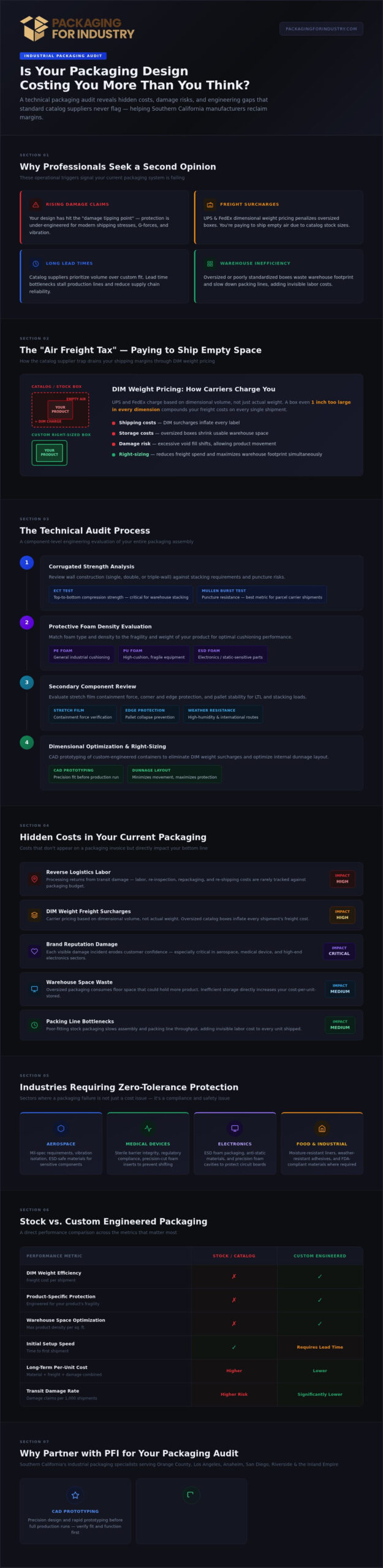
Many manufacturers fall into the trap of using large catalog suppliers for their stock sizes. While these suppliers offer convenience, they rarely provide efficiency. Using a box that’s even an inch too large in every dimension results in what we call the “Air Freight Tax.” You’re paying to ship and store empty space. This has a massive impact on your dimensional weight (DIM) pricing, as carriers like UPS and FedEx charge based on volume rather than just actual weight. Transitioning to custom design packaging allows you to reclaim these lost margins. By right-sizing your containers and optimizing your internal dunnage, you reduce your shipping spend and maximize your warehouse footprint simultaneously.
The Technical Audit: Evaluating Protection and Material Efficiency
A technical audit moves beyond visual inspection to evaluate the engineering metrics of your current materials. When getting a second opinion on packaging design, the focus shifts to whether your material specifications actually match the physical hazards of your distribution channel. Many companies over-specify materials in one area while leaving critical vulnerabilities in another. A thorough audit identifies these imbalances to ensure you aren’t paying for performance you don’t need or risking failure where it matters most.
This evaluation includes a component-level review of your entire assembly. We look at everything from the containment force of your stretch film to the integration of corner and edge protection. These secondary components are often the difference between a pallet that arrives intact and one that collapses under the stress of vertical stacking or sudden shifts during LTL transit.
Corrugated Engineering: More Than Just a Box
The choice between single-wall and heavy-duty double or triple-wall corrugated depends on your stacking requirements and puncture risks. We analyze whether your design should prioritize the Edge Crush Test (ECT) or the Mullen Burst Test. ECT measures top-to-bottom compression strength, which is vital for warehouse stacking. In contrast, the Mullen test measures the force required to puncture the box wall, which is a better metric for individual shipments handled by parcel carriers. If you ship internationally or through high-humidity environments, we also evaluate the need for weather-resistant adhesives and liners to prevent structural softening. If you’re unsure if your current corrugated specs are holding up, it may be time to compare packaging pricing and material grades with a specialist.
Protective Foam and Cushioning Analysis
Engineering effective foam packaging requires matching the material’s density to the product’s fragility, often expressed in G-force ratings. Polyethylene (PE) foam provides excellent vibration dampening for heavier industrial parts, while Polyurethane (PU) foam offers a softer “ride” for lighter, highly sensitive instruments. For manufacturers in the medical and semiconductor sectors, we specifically audit for anti-static (ESD) compliance to prevent latent electrical damage. Getting a second opinion on packaging design often reveals that die-cut foam inserts are more cost-effective for recurring shipments than labor-intensive manual wrapping, as they ensure consistent protection regardless of who is working the packing line.
By reviewing these technical benchmarks, you can eliminate the guesswork from your operations. This data-driven approach ensures your packaging is a functional asset that protects your margins rather than a recurring overhead drain.
Identifying Hidden Costs in Your Current Packaging Engineering
Beyond the immediate expense of damaged goods, inefficient packaging engineering creates a cascade of hidden costs that erode your bottom line. These fiscal leaks often go unnoticed because they are buried in freight invoices, labor hours, and warehouse overhead. By getting a second opinion on packaging design, you can uncover these inefficiencies that standard catalog suppliers often ignore. A technical audit quantifies the total cost of ownership for your packaging, moving the conversation from the price per box to the total cost per delivered unit.
One of the most significant yet overlooked expenses is the cost of inventory management. Over-ordering stock supplies to avoid lead time issues ties up critical capital and consumes valuable floor space. Achieving true packaging cost savings requires a shift toward engineered solutions that prioritize both material performance and operational flow. When your packaging is designed specifically for your product, you eliminate the need for excessive tape, redundant void fill, and oversized containers.
Freight and Dimensional Weight Optimization
The “Air Freight Tax” is a reality for any company shipping via parcel or LTL carriers. Carriers like UPS and FedEx use dimensional weight (DIM) formulas to charge for the space a package occupies, not just what it weighs. Getting a second opinion on packaging design often reveals that a mere 1-inch reduction in a box’s length or width can save thousands in annual freight costs by moving the package into a lower pricing tier. Furthermore, optimizing your primary container size allows for higher pallet density. Increasing the number of units per pallet reduces the total number of shipments required, helping you avoid “Additional Handling” surcharges and reducing your overall carbon footprint.
Warehouse and Labor Flow
Labor is frequently the most expensive component of the packing process. If your current design is too complex, your warehouse team spends excessive time on assembly, kitting, and taping. We analyze the number of “touches” required to prepare a product for shipment. A well-engineered design should facilitate fast assembly, allowing your team to move more volume with less effort. To further streamline procurement, many Southern California manufacturers in the Inland Empire or San Diego utilize Vendor Managed Inventory (VMI). This service ensures you always have the exact custom boxes and foam inserts you need without the burden of managing the stock yourself, effectively turning your packaging from a logistical hurdle into a streamlined asset.
How to Transition from Stock to Custom Engineered Solutions
Transitioning from off-the-shelf stock boxes to custom-engineered solutions requires a methodical approach. It isn’t a matter of guesswork; it’s a transition rooted in empirical evidence and technical validation. Getting a second opinion on packaging design provides the framework for this shift, ensuring that every design change is justified by either a reduction in damage or an improvement in shipping economics. This structured process moves your operation away from the “one-size-fits-all” limitations of large catalog suppliers toward a system that’s built for your specific product dimensions and transit risks.
The transition begins with thorough data collection. We analyze your current shipping spend and actual damage rates to establish a baseline for improvement. From there, the process moves through a series of technical milestones:
- Step 1: Data Analysis – Reviewing freight invoices and return logs to identify specific failure points in your current system.
- Step 2: Prototyping – Developing CAD designs that utilize the precise amount of material needed for protection without wasted volume.
- Step 3: Technical Validation – Subjecting prototypes to drop testing and vibration analysis to simulate the stresses of LTL and parcel transit.
- Step 4: Pilot Rollout – Testing the new design on a small production run to ensure it integrates seamlessly with your warehouse kitting and assembly flow.
- Step 5: Full Implementation – Integrating the final design into your standard procurement cycle for long-term reliability.
The Role of Free Prototyping
Physical samples are the only way to verify that a design works in the field before you commit to bulk production. We use CAD/CAM support to create a “glove-like” fit for complex industrial parts, ensuring that sensitive components don’t shift during transit. This precision eliminates the need for excess tape or manual void fill, which speeds up your packing line. When you’re getting a second opinion on packaging design, look for a partner that offers this prototyping as a standard part of the engineering process to avoid costly mistakes in the final production run.
Validating Designs for Specific Industries
Different sectors require different levels of validation. In the high-stakes world of aerospace packaging, designs must often meet strict Mil-Spec compliance and handle extreme G-forces. Medical device manufacturers require packaging that maintains structural integrity despite rough handling to protect delicate instruments. For heavy machinery, the transition might involve custom crate engineering that accounts for weight distribution and international export regulations. Each industry has unique technical benchmarks that a custom-engineered solution must address to ensure total supply chain reliability.
Partnering with PFI: Data-Driven Packaging Reviews in Southern California
Manufacturers across Southern California trust Packaging For Industry (PFI) as a technical partner rather than a simple commodity vendor. We operate as “fixers” for complex logistical challenges, moving beyond the standard sales pitch to provide deep engineering analysis. Our approach combines specialized design expertise with the competitive pricing of a wholesale supplier. When you’re getting a second opinion on packaging design from our team, you’re receiving a comprehensive audit that prioritizes both the protection of your physical assets and the health of your bottom line.
Operational reliability is built on consistent supply, yet many companies struggle with the long lead times associated with national catalog distributors. We solve these bottlenecks through just-in-time inventory management. By aligning our delivery schedules with your production cycles, we ensure you never run out of critical custom corrugated boxes or foam inserts. This proactive oversight allows your procurement team to focus on high-level strategy while we handle the granular details of your packaging supply chain.
Local Expertise in Anaheim and Beyond
Geography plays a critical role in your logistical efficiency. PFI provides local, next-day delivery to industrial hubs throughout Orange County, Los Angeles, and the Inland Empire. Because we’re local, we can implement stocking programs that effectively reduce your on-site warehouse footprint. Instead of dedicating valuable square footage to bulky pallets of empty boxes, you can use that space for manufacturing or finished goods. If you’re ready to move away from generic solutions, contacting an Anaheim packaging supplier for an on-site technical review is the most direct path to optimization. Our engineers visit your facility to see your packing line in action, identifying inefficiencies that remote consultants often miss.
Your Next Steps for a Packaging Audit
Getting a second opinion on packaging design is a straightforward process that starts with your current data. To prepare for a professional review, we recommend gathering samples of your existing packaging along with a list of your most frequent shipping “pain points.” Whether you’re dealing with high rates of transit damage, excessive UPS/FedEx surcharges, or slow kitting speeds, our team needs these benchmarks to engineer a better alternative. Once we’ve identified the technical gaps in your current design, we provide a custom-engineered audit and redesign proposal. This isn’t just a quote for materials; it’s a blueprint for a more durable, cost-effective, and reliable supply chain.
Optimize Your Industrial Logistics Strategy
Accepting high damage rates or inflated freight bills as an unavoidable cost of doing business is no longer necessary. By getting a second opinion on packaging design, you move beyond the limitations of stock catalog sizes and into a system optimized for your specific supply chain. This technical audit identifies exactly where custom engineering can replace generic materials to lower your total cost per unit and reclaim lost warehouse space. It’s about ensuring your packaging is a functional asset rather than a recurring overhead drain.
PFI provides the specialized engineering expertise required for aerospace and industrial sectors, backed by free prototyping and CAD support to ensure a perfect fit. Our local next-day delivery across Southern California ensures your operations remain agile and responsive to market demands without the burden of long lead times. We focus on the intersection of engineering and economics to deliver results that directly impact your bottom line.
Your packaging should be a steady, dependable part of your logistical flow. We’re ready to help you engineer a more reliable and cost-effective future for your business.
Frequently Asked Questions
What are the signs that I need a second opinion on my packaging design?
The most common signs include a sudden spike in transit damage claims, inconsistent material quality from your current supplier, or unexpected freight surcharges. If your warehouse team is struggling with complex assembly or you’re using excessive tape and void fill, your current design is inefficient. Getting a second opinion on packaging design helps you identify these operational leaks and implement technical corrections that protect your margins and improve overall reliability.
How can a redesign help me reduce shipping damage?
A redesign reduces damage by matching material specifications to the specific G-force sensitivity of your product. We analyze the transit environment to determine if you need heavy-duty double-wall corrugated or specialized PE and PU foam inserts. By engineering a “glove-like” fit, we eliminate internal movement. This technical precision ensures your sensitive aerospace or medical components remain secured against the vibrations and impacts common in LTL and parcel shipping.
Will custom packaging design cost more than buying stock boxes?
Custom packaging often results in a lower total cost of ownership compared to stock boxes. While the per-unit price of a custom corrugated box might be slightly higher, you save significantly on freight by reducing dimensional weight (DIM) and eliminating the need for expensive secondary void fill. Additionally, the reduction in product damage and returns provides a high return on investment that stock catalog sizes simply cannot match.
What technical specifications should I look for in an industrial packaging review?
Look for a review that evaluates Edge Crush Test (ECT) ratings for stacking strength and Mullen Burst Test results for puncture resistance. A comprehensive audit should also assess foam density requirements, anti-static (ESD) compliance for electronics, and dimensional weight optimization. Ensure the review includes a technical analysis of your pallet density and containment force to confirm your entire load is stabilized for the rigors of long-haul transit.
How long does the prototyping process take for custom foam or boxes?
Our prototyping process is designed for industrial speed, typically taking only a few business days once we have your product dimensions. We use advanced CAD/CAM support to create physical samples for your team to test in-house. This rapid turnaround allows you to validate the engineering and fit before committing to a bulk production run, ensuring that the final solution meets your exact operational requirements without unnecessary delays.
Can a second opinion help me avoid FedEx and UPS surcharges?
Yes, getting a second opinion on packaging design is the most effective way to avoid UPS and FedEx “Additional Handling” or oversized surcharges. Carriers charge based on the volume your package occupies. By right-sizing your corrugated boxes and optimizing your internal cushioning, we move your shipments into lower pricing tiers. This technical adjustment reduces your freight spend and prevents the “Air Freight Tax” associated with inefficient catalog packaging.
Do you provide on-site packaging audits for Southern California manufacturers?
We provide on-site packaging audits for manufacturers and distributors throughout Southern California, including Orange County, Los Angeles, and the Inland Empire. Our team visits your facility to observe your packing line and warehouse flow in person. This “fixer” approach allows us to identify labor inefficiencies and material waste that a remote review might miss, ensuring your custom-engineered solution integrates perfectly with your existing operations.
What industries benefit most from custom engineered packaging?
Specialized sectors like aerospace, medical devices, and high-end electronics benefit most from custom-engineered solutions due to their zero-tolerance for damage. These industries require precise protection strategies, including Mil-Spec compliance and ESD-safe materials. Additionally, manufacturers of heavy machinery or delicate automotive parts see significant improvements in supply chain reliability and freight efficiency by switching from generic stock crates to tailored, high-performance packaging systems.