
If your high-value electronics or aerospace components arrive at their destination damaged, the problem usually isn’t the carrier; it’s your packaging design. Relying on stock catalog boxes for sensitive equipment often leads to failed ISTA tests and skyrocketing replacement costs. When you invest in engineered packaging solutions California manufacturers trust, you move beyond guesswork and into precision protection. We understand the pressure to lower packaging costs while maintaining absolute product integrity during transit.
You need a local partner who knows that a box is more than just cardboard. It’s a calculated system of custom corrugated and foam inserts designed to survive the revised 2026 ISTA 3E compression standards and California SB 54 requirements. This article outlines how to select a Southern California supplier that provides fast prototyping and CAD/CAM support. You’ll learn how to reduce shipping damage, avoid freight surcharges through optimized sizing, and secure a reliable supply chain with local delivery from San Diego and Orange County to Los Angeles and the Inland Empire.
Key Takeaways
- Understand how ISTA compliance protects high-value industrial goods and ensures your shipments meet the updated 2026 transit standards.
- Identify the critical role of CAD/CAM prototyping in identifying structural weaknesses and reducing product damage before bulk orders are placed.
- Learn how integrating custom foam and heavy-duty corrugated materials provides the precision protection required for aerospace and medical devices.
- Discover how engineered packaging solutions California companies rely on can lower total shipping costs by optimizing dimensions to avoid carrier surcharges.
- See why a local Southern California partner in Anaheim offers faster lead times and more reliable supply through next-day delivery and VMI programs.
Understanding ISTA Testing Requirements for California Manufacturers
The International Safe Transit Association (ISTA) serves as the primary governing body for transit packaging performance. For logistics managers, a comprehensive understanding of package testing is essential to ensure that goods arrive intact. ISTA doesn’t just provide guidelines; it sets the rigorous benchmarks used by carriers like UPS and FedEx to determine if a package is fit for the supply chain. When you seek engineered packaging solutions California manufacturers rely on, you’re looking for designs that anticipate these stresses before they reach the lab or the loading dock.
In high-stakes sectors like aerospace and medical device manufacturing, ISTA compliance isn’t optional. These industries deal with sensitive, high-value components where even minor vibrations or drops can lead to catastrophic failure. Using “ISTA Ready” designs means your packaging is engineered to meet specific performance levels based on known transit hazards. This is distinct from “ISTA Certified,” which refers to the final validation performed by a certified lab. By engineering for the test from the start, you avoid the expensive cycle of failing lab tests and redesigning from scratch.
Passing these transit protocols also provides a critical legal and financial shield. Carriers often deny damage claims if they can prove the packaging was insufficient for the journey. Having test-proven documentation ensures that your claims are backed by data, which can also help in negotiating lower insurance premiums for high-value freight.
Common ISTA Protocols: 1A, 2A, and 3A
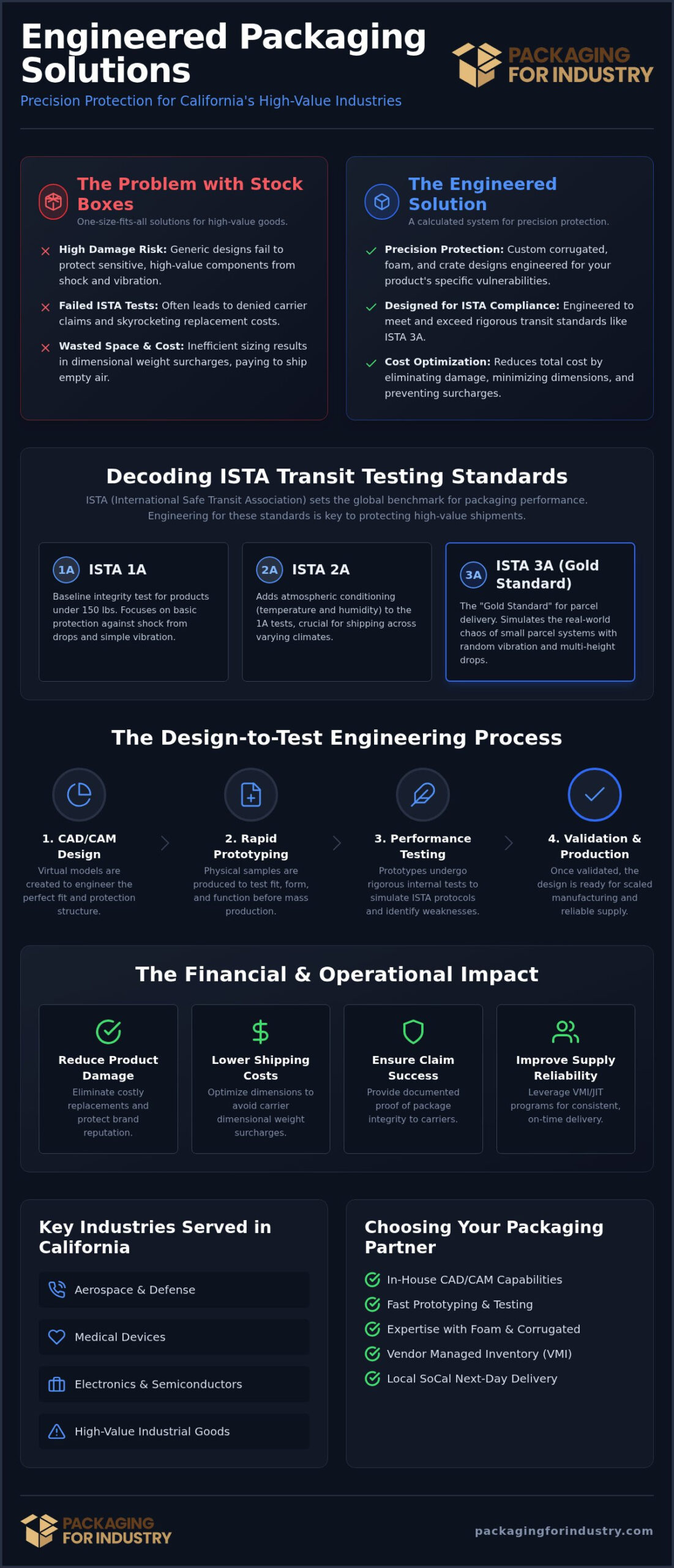
Selecting the right protocol depends on your shipping method and product weight. ISTA 1A is the baseline integrity test for individual products under 150 lbs, focusing on basic vibration and drop resistance. ISTA 2A goes a step further by adding atmospheric conditioning, which is vital for California companies shipping through varying climates. ISTA 3A is considered the “Gold Standard” for small parcel delivery. It simulates the actual rigors of the parcel environment, including random vibration and multi-height drops, ensuring your engineered packaging solutions California are built for real-world chaos.
The Financial Impact of Engineered Packaging
Precision engineering directly improves your bottom line by addressing the hidden costs of shipping damage. Beyond the loss of the product, you face the administrative burden of returns, customer dissatisfaction, and the cost of replacement shipping. You can lower packaging costs by optimizing the dimensions of your boxes. Engineered designs often allow for slimmer profiles without sacrificing protection. This helps you avoid dimensional weight surcharges, which are often the largest hidden expense in modern logistics. Validating a high-protection, low-volume design ensures you aren’t paying to ship empty air.
Criteria for Selecting an Engineered Packaging Supplier in California
Selecting a partner for engineered packaging solutions California requires looking beyond the price per unit. You need a supplier that functions as an extension of your engineering team. This means prioritizing partners with in-house CAD/CAM capabilities and a proven track record in high-stakes sectors like semiconductors and aerospace. A supplier’s ability to integrate diverse materials, such as precision-cut foam packaging inserts with heavy-duty corrugated outer shells, is what separates a standard box from a transit-ready system. It’s also vital to verify that your supplier offers Vendor Managed Inventory (VMI) to ensure your production line never halts due to a lack of custom materials.
Custom Engineering vs. Catalog Solutions
Off-the-shelf catalog solutions are designed for generic retail items, not calibrated industrial components. They often fail ISTA’s official process standards because they don’t account for specific G-force thresholds or the unique center of gravity of heavy machinery. Custom foam inserts are engineered to absorb specific impact energy. Heavy-duty wooden crates provide the structural rigidity needed for equipment that catalog boxes simply can’t support. Engineering the solution to the product’s fragile points is the only way to eliminate recurring shipping damage.
The Southern California Prototyping Advantage
Speed is a critical factor in your product launch timeline. Working with a local Anaheim packaging supplier allows for face-to-face design reviews that can shave weeks off the certification process. Local access to engineered packaging solutions California businesses depend on means your team can physically inspect a prototype within 24 to 48 hours. At PFI, we offer free prototyping to ensure your product fits perfectly before you commit to a full production run. This regional presence across Los Angeles, Orange County, and the Inland Empire provides faster design iterations and local packaging delivery for your critical supplies. If you’re ready to optimize your transit protection and reduce costs, you can request a packaging quote to compare packaging pricing against your current stock boxes.
A local partner also understands the specific regulatory landscape of the region, including the 2026 updates to California SB 54 regarding single-use plastics. By engineering your packaging with a focus on both protection and compliance, you avoid the risk of future fines or forced redesigns. Choosing a supplier that offers multi-material integration under one roof simplifies your supply chain. It ensures that the foam, corrugated, and pallets all work together as a single, high-performance unit.
The Design-to-Test Process: Engineering for ISTA Success
Passing a transit test isn’t a matter of luck; it’s a result of precise structural analysis. Our process for engineered packaging solutions California begins with a forensic review of your current configuration to identify structural weaknesses. We look for crush zones where the box might buckle under load and migration risks where the product might shift during vibration. Identifying these failure points early allows us to engineer the solution before you spend money on official lab fees. The goal is to create a “Gold Sample”; this is the finalized, test-ready unit that goes to the International Safe Transit Association (ISTA) for official certification.
Custom engineering involves more than just picking a bigger box. We calculate the exact G-force protection required for your specific product. This data drives our selection of foam density and corrugated wall strength. We then move into prototyping and iterative testing. If a preliminary drop test shows a weakness in the bottom-corner impact zone, we adjust the design immediately. This iterative cycle ensures that by the time your packaging reaches the lab, it’s already been proven to survive the rigors of the supply chain. We also provide bulk packaging pricing for these custom configurations, ensuring your high-volume production lines remain cost-effective while you lower packaging costs.
Material Selection for Transit Performance
Designing for the 2026 ISTA 3E standards requires calculating compression based on maximum stacking height. We use this data to determine if double-wall or triple-wall corrugated boxes are necessary for your specific pallet load. For cushioning, the choice between polyethylene and polyurethane foam is critical. Polyethylene provides the rigid support needed for heavy industrial parts. Polyurethane offers the soft deceleration required for delicate electronics. We also integrate corner and edge protection to reinforce high-stress points that often fail during the rotational edge drop tests required for unitized loads. With custom sizes available for any industrial application, our engineering team focuses on maximizing protection while minimizing material waste.
Integrating Multiple Protective Materials
The most effective engineered packaging solutions California manufacturers use are those that function as a single, unified protective unit. We design foam-lined boxes where the foam is precision-cut to the product’s geometry, ensuring zero movement during transit. For high-value aerospace gear, we often combine custom wooden crates with multi-layer foam systems to meet Mil-Spec requirements. Security is the final step. We ensure the unit stays intact by using industrial-grade adhesive tapes and heavy-duty strapping. This holistic approach prevents the packaging fatigue that occurs during long-haul multimodal transportation, keeping your products secure from the factory floor to the end user. Our goal is to reduce shipping damage and improve your supply reliability through better design.
Engineered Solutions for High-Value California Industries
California is home to some of the world’s most demanding manufacturing sectors. From the satellite labs in El Segundo to the medical device hubs in Irvine, generic shipping supplies don’t provide the necessary protection. We provide engineered packaging solutions California businesses use to maintain compliance with both ISTA standards and strict industry-specific regulations. Whether you’re moving heavy industrial gear or microscopic semiconductor components, the design must account for the specific physics of your supply chain.
In the aerospace sector, packaging must often meet both ISTA transit protocols and Mil-Spec requirements. These components are frequently oversized and heavy, yet they possess internal sensitivities that can’t tolerate even minor vibrations. We engineer multi-material systems that combine structural rigidity with high-performance cushioning to ensure these assets arrive ready for deployment. Medical device manufacturers rely on rigorous vibration testing to ensure that sterile packaging integrity remains intact from the cleanroom to the hospital. Similarly, industrial equipment manufacturers require specialized logistics support for oversized freight. This often involves heavy-duty, double-wall corrugated boxes or custom-designed pallets that can support thousands of pounds without compromising the safety of the handlers or the product.
Aerospace Packaging Challenges in SoCal
Southern California’s aerospace corridor presents unique logistical hurdles. You’re often dealing with parts that are simultaneously oversized, extremely heavy, and incredibly fragile. Standard boxes aren’t an option here. Custom foam-lined crates have become the industry standard because they offer the structural integrity of wood combined with the precision impact absorption of engineered foam. This level of protection is especially critical when shipping across borders. You can learn more about how we approach Engineering Custom Crates for International Transit to see how we handle these complex requirements.
Electronics and Sensitive Equipment
For the electronics and semiconductor industries, transit durability must be paired with anti-static (ESD) protection. We design engineered packaging solutions California tech firms rely on by integrating ESD-safe foam packaging with high-strength corrugated outer shells. This protects against both physical impact and electrostatic discharge during the “last mile” of delivery, where handling is often most aggressive. Our designs ensure that sensitive equipment remains functional upon arrival, reducing the high cost of field failures and technical returns.
Partner with PFI for ISTA-Ready Packaging in Southern California
Choosing a partner for industrial logistics requires more than just a vendor; you need a proactive problem solver. At Packaging For Industry (PFI), we operate out of our Anaheim facility to provide engineered packaging solutions California manufacturers depend on for reliability and fiscal responsibility. Our team doesn’t just sell boxes; we design comprehensive protection systems that combine custom corrugated structures with precision-cut foam. By handling both design and manufacturing locally, we eliminate the communication gaps that often lead to failed transit tests and damaged freight.
Our local presence allows us to offer services that national catalog suppliers simply can’t match. We provide expert CAD/CAM support and free prototyping to our local manufacturing partners. This means you can hold a physical sample of your custom design within 24 to 48 hours, allowing for immediate feedback and faster design iterations. Whether you’re in the aerospace, medical, or electronics sector, having a partner who can perform a face-to-face packaging review is invaluable for meeting tight production deadlines.
Local Support for Orange County and Los Angeles
Reliability in your supply chain depends on proximity. PFI provides local next-day delivery across the Inland Empire, San Diego, and Riverside. We specifically focus on serving Anaheim, Irvine, and Santa Ana with a steady supply of industrial materials. This regional focus ensures that your warehouse operations never stall. Our engineers are available for on-site visits to evaluate your current shipping protocols and identify where structural weaknesses are driving up your hidden costs. We act as a local extension of your operations team, providing the peace of mind that comes with total accountability.
Request a Custom Packaging Quote Today
If you’re currently struggling with high product damage rates or failing ISTA tests with stock catalog boxes, it’s time for a professional review. Many of our clients find that they can lower packaging costs by switching from generic off-the-shelf options to engineered designs. When you compare packaging pricing against large catalog suppliers, you’ll see the value of a partner who optimizes dimensions to reduce dimensional weight surcharges. Our cost-reduction analysis looks at the entire lifecycle of your package, from the factory floor to the final destination.
To start protecting your high-value assets and streamlining your logistics, you can request a custom packaging quote today. We’ll help you validate your designs and ensure your products are ready for the rigors of the modern supply chain.
Secure Your Supply Chain with ISTA-Ready Design
Eliminating shipping damage requires moving beyond standard catalog boxes and investing in precision-engineered protection. By integrating custom foam inserts with heavy-duty corrugated materials, you ensure your products survive the rigorous ISTA 3A and 3E protocols. This methodical approach doesn’t just protect your goods; it lowers packaging costs by eliminating dimensional weight surcharges and reducing the financial burden of returns.
Working with a local partner provides the fast iterations needed for high-stakes industries like aerospace and medical device manufacturing. We offer free prototyping for local Southern California businesses to validate designs before full production begins. With our facility in Anaheim, you benefit from next-day delivery across Orange County and Los Angeles; this ensures your warehouse stays stocked and your shipments remain on schedule. Implementing engineered packaging solutions California manufacturers trust is the most effective way to stabilize your logistics and protect your bottom line.
We’re ready to help you optimize your transit protection and improve your supply reliability today.
Frequently Asked Questions
How much does ISTA testing cost for California manufacturers?
Lab fees vary based on the specific protocol and sample volume required for validation. While we don’t set these third-party prices, we help you avoid multiple testing rounds by engineering the solution correctly the first time. If you need a corrugated box quote for high-volume production, we provide bulk packaging pricing that factors in these engineering steps. This ensures your unit price remains competitive while meeting the rigorous demands of your distribution network.
Can a packaging supplier help me find an ISTA-certified lab?
Yes, we maintain a network of third-party labs to assist our clients with final validation. If you’re searching for a packaging supplier near me in Southern California, PFI provides the structural engineering and prototypes needed for lab submission. We guide you through the process. This ensures your custom foam and corrugated assemblies are ready for the specific tests required by your industry, whether you’re shipping aerospace parts or medical devices.
What is the difference between ISTA 1A and ISTA 3A testing?
ISTA 1A is a baseline integrity test for products under 150 lbs, focusing on vibration and drop resistance. ISTA 3A is a more complex simulation for small parcel environments like UPS or FedEx. It includes random vibration and varying drop heights to mimic carrier hub stress. Our engineered packaging solutions California team focuses on 3A compliance to ensure your high-value gear survives aggressive handling, providing custom sizes available to fit these specific test parameters.
How long does it take to design and prototype ISTA-ready packaging?
Initial prototypes are typically ready within 24 to 48 hours at our Anaheim facility. The full engineering process, from review to a final “Gold Sample,” generally takes one to two weeks. Because we offer local packaging delivery across Los Angeles and Orange County, we can speed up the design cycle through face-to-face reviews. This rapid turnaround helps local manufacturers meet tight production deadlines without risking shipping damage during critical product launches.
Which ISTA protocol do I need for UPS or FedEx shipping?
Most parcel carriers require ISTA 3A to validate that a package can survive their automated sorting systems. If you’re shipping unitized pallet loads, you might need the updated ISTA 3E standard instead. We evaluate your shipping methods to recommend the right protocol. Whether you need a stretch film quote for pallet stability or a custom box design, we ensure every component is engineered to pass the specific tests required by your carriers.
Does PFI offer ISTA-ready custom foam inserts in Southern California?
Yes, we design and manufacture custom foam inserts in Anaheim using polyethylene, polyurethane, and ESD-safe materials. These inserts are precision-cut to your product’s geometry to ensure it passes vibration and drop tests. We integrate these inserts into a unified system with our corrugated products. This holistic approach provides the precision protection required for aerospace and electronics, with local packaging delivery available to keep your production lines moving without interruption.
Can custom corrugated boxes help reduce my freight costs?
Custom boxes lower packaging costs by removing excess volume that triggers expensive carrier surcharges. Stock boxes often force you to pay for empty space. By providing custom sizes available for your specific products, we reduce the total footprint of your shipments. This optimization helps you reduce shipping damage while lowering your freight bills. It’s a more cost-effective alternative to generic catalog boxes for high-volume manufacturers and distribution centers.
What industries in California most commonly require ISTA testing?
Aerospace, medical device, and electronics manufacturers are the primary users of ISTA validation in Southern California. These industries ship high-value, sensitive components that cannot tolerate transit failure. If you need a corrugated box quote or a stretch film quote for these applications, we provide the engineering data to support your compliance needs. Our solutions are built to withstand the rigors of multimodal transport, ensuring your high-stakes shipments arrive fully functional.