
How much of your bottom line is currently being eroded by transit vibration and “minor” shipping damage that forces expensive product replacements? You already know that standard packaging often fails to meet the rigorous demands of the Southern California logistics corridor. When you’re shipping high-end electronics or aerospace components, a generic solution isn’t just a risk; it’s a liability. Finding the right custom foam inserts Los Angeles and orange county manufacturers trust means balancing material science with local logistical speed.
We understand that you need a zero-damage shipping cycle and a professional presentation for your equipment. By mastering the technical and economic factors of custom foam selection, you can eliminate transit failures and streamline your supply chain. This article will show you how local engineering and just-in-time delivery from an Anaheim or LA partner can transform your packaging from an expense into a strategic asset. We’ll also clarify how 2025 California regulations regarding EPS foam impact industrial packaging differently than food service, ensuring your operations remain compliant and efficient.
Key Takeaways
- Learn how to evaluate polyethylene and polyurethane foam densities to ensure your specific SKUs are protected against transit vibration without overspending on excess material.
- Discover how our local CAD design and prototyping process for custom foam inserts Los Angeles and orange county provides a precision fit that eliminates product movement and damage.
- Identify the specialized requirements for aerospace and medical device packaging, including how to maintain material cleanliness and meet strict technical part specifications.
- Explore how integrating custom foam with heavy-duty corrugated boxes and utilizing Vendor Managed Inventory (VMI) can reduce your lead times and lower facility storage costs.
- Understand the economic advantages of sourcing from a local Anaheim supplier to achieve just-in-time delivery and a professional presentation for your high-end equipment.
Optimizing Industrial Protection with Custom Foam Inserts in Los Angeles and Orange County
Southern California’s manufacturing landscape is one of the most dense and demanding in the nation. From the satellite clusters in the South Bay to the medical device hubs in Irvine, the need for precision is absolute. Standard bubble wrap or loose-fill peanuts aren’t sufficient when you’re moving high-value components through the busiest logistics corridors in the country. Utilizing custom foam inserts Los Angeles and orange county businesses rely on ensures that your specific part geometry is secured against the unique stresses of industrial transit. It’s a pragmatic investment that prioritizes the safety of your equipment over generic, one-size-fits-all cushioning.
Off-the-shelf solutions often fail because they don’t account for the weight distribution or fragility of specialized aerospace and medical hardware. When a part shifts inside a box, the risk of impact damage increases exponentially. Precision-engineered foam packaging eliminates this “box walking” effect by creating a literal lock on the product. This leads to a direct reduction in Return Merchandise Authorization (RMA) rates, which protects your bottom line and your brand’s reputation for quality.
The High Cost of Transit Damage in Southern California
Local freight routes, particularly those surrounding the Port of Los Angeles and Long Beach, present significant vibration challenges. Heavy-duty trucking and rail transfer create constant micro-vibrations that can loosen internal fasteners or mar delicate surfaces. By applying established Package cushioning principles, we engineer inserts that absorb these shocks before they reach your product. Consider the following factors that impact local shipping:
- Vibration Profiles: Stop-and-go traffic on the 405 and 5 freeways creates a cycle of jarring movements.
- Internal Shifting: Loose components can rattle against the walls of a carton, causing cosmetic and functional failure.
- Customer Perception: High-end equipment arriving in messy, makeshift packaging suggests a lack of professional oversight.
Why Local Procurement Matters for LA and OC Manufacturers
Sourcing from an Anaheim-based supplier offers more than just lower freight costs. It provides a level of agility that non-local vendors can’t match. When you work with a regional partner, you can conduct on-site design consultations and physical fit-tests with your actual hardware. This eliminates the guesswork that often comes with remote technical drawings. You don’t have to wait weeks for a prototype to arrive from across the country; we can iterate designs quickly to meet your production deadlines.
A local supply chain also supports just-in-time (JIT) production. Instead of dedicating valuable warehouse space to months of inventory, you can leverage next-day delivery for both foam and custom corrugated boxes. This proximity reduces your carbon footprint and streamlines your operations. If your production schedule shifts, a local partner in Orange County can pivot quickly to keep your lines moving. It’s a proactive approach to logistics that prioritizes fiscal responsibility and operational flow.
Selecting the Right Foam Material: A Buyer’s Comparison
Choosing the correct material for your packaging isn’t just a matter of cushioning; it’s a financial decision that impacts your total cost of ownership. For procurement managers, the goal is to find the intersection where material performance meets the specific fragility of the product. Selecting the right custom foam inserts Los Angeles and orange county suppliers provide requires an understanding of density and cell structure. Using a material that is too dense can transmit shock directly to the part, while a material that is too soft may “bottom out” during a drop, leading to catastrophic failure.
We evaluate your SKU’s G-force rating to determine which polymer will provide the most efficient protection. This engineering-first approach prevents over-packaging, which saves on both material costs and shipping weights. Whether your operation is in Anaheim or a surrounding industrial hub, choosing a local partner allows you to compare packaging pricing based on actual prototypes rather than theoretical data.
Polyethylene (PE) vs. Polyurethane (PU) Foam
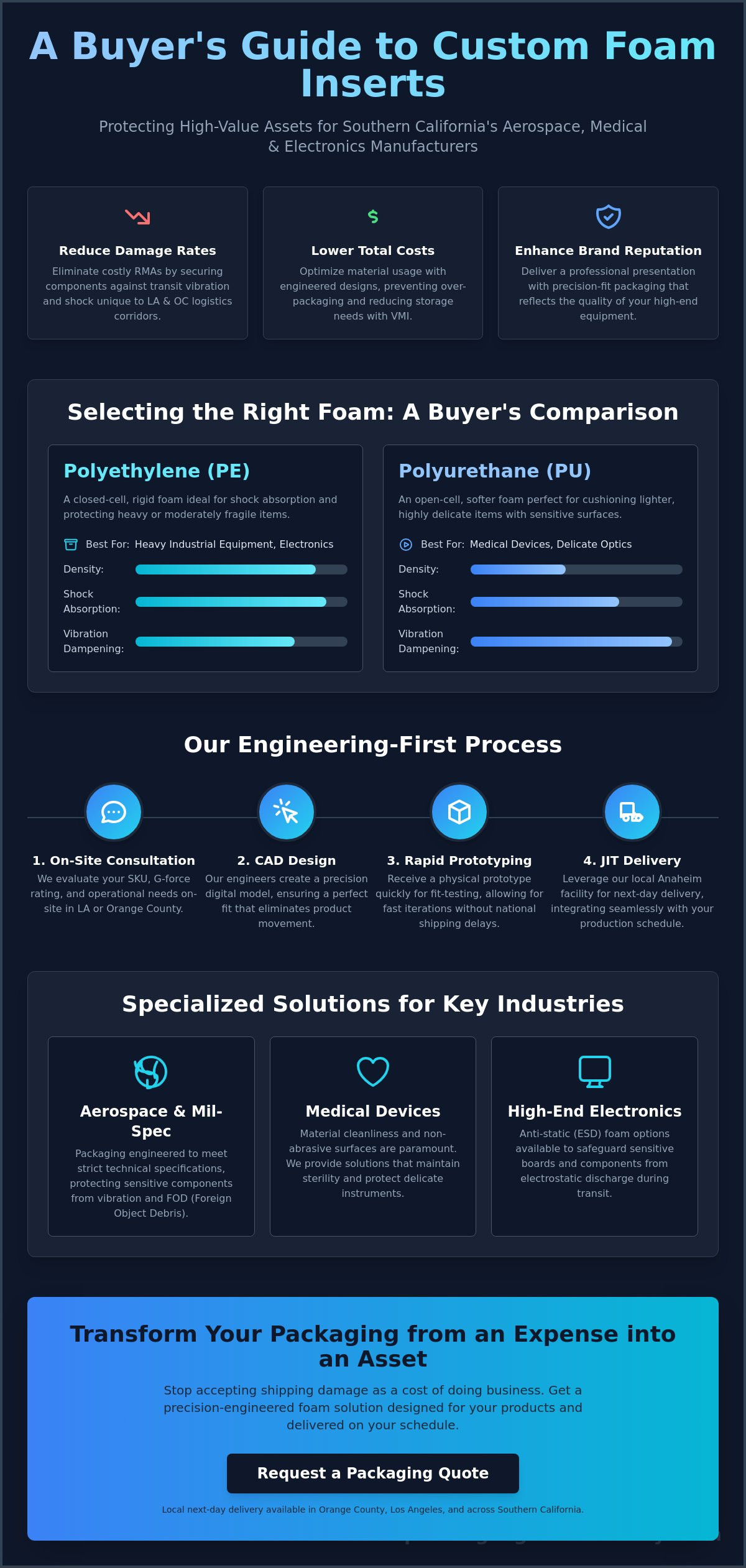
Polyethylene (PE) is a closed-cell foam known for its durability and rigidity. It’s the standard for heavy industrial parts and military-spec applications because it can withstand repeated impacts without losing its shape. PE foam is also naturally moisture-resistant, making it the superior choice for international shipping where humidity levels fluctuate. If your supply chain involves reusable “totes” or internal plant transfers, PE’s long-term resilience offers a better return on investment.
In contrast, Flexible polyurethane foam for packaging is an open-cell material designed for lightweight items with delicate finishes. Its soft, sponge-like texture makes it ideal for medical instruments or consumer electronics that require a non-abrasive surface. While PU foam is generally more cost-effective for single-trip shipments, it doesn’t offer the same structural support as PE for heavy loads. It’s a pragmatic choice when the primary concern is surface protection and light vibration dampening.
Specialized Materials: Cross-Linked PE and ESD Foam
For high-value aerospace components, standard foams aren’t always enough. Cross-linked polyethylene (XLPE) offers an extremely fine cell structure that is virtually non-abrasive, making it the gold standard for Class A surface protection. It’s often specified in Los Angeles defense contracts where particulate contamination must be kept to a minimum.
Electronics manufacturers must also consider Anti-Static (ESD) foam. This specialized material is treated to dissipate static electricity, preventing electrostatic discharge from damaging sensitive circuit boards or sensors. ESD foam is a pink or charcoal-colored material engineered to protect microelectronics by ensuring that static charges don’t build up during the friction of transit. Using the wrong material here can result in “dead on arrival” products that look perfect but fail to function. If you’re unsure which material fits your technical specs, we can help you identify the most cost-effective solution for your specific application.
The Engineering Process: From CAD Design to Free Prototyping
Precision in packaging is an engineering discipline, not an afterthought. Moving from material selection to a finished solution requires a methodical approach that translates your part’s physical dimensions into a secure protective environment. The process for developing custom foam inserts Los Angeles and orange county manufacturers require begins with high-fidelity CAD design. By utilizing 3D part modeling, we ensure every cavity and contour matches your equipment perfectly, preventing the subtle shifts that cause internal component failure.
We utilize two primary fabrication methods depending on your volume and complexity: CNC routing and die-cutting. CNC routing is an abrasive-free process ideal for intricate geometries and lower-volume runs where tool-up costs would be prohibitive. For high-volume production, die-cutting offers a faster, more cost-effective path. Unlike some competitors who hide prototyping fees or demand massive minimum order quantities (MOQs) before providing value, PFI prioritizes accessibility. We believe you shouldn’t have to commit to thousands of units just to see if a design works for your specific hardware.
Initial Design and Material Specification
Designers focus on G-force fragility ratings to determine how much energy the foam must absorb during a drop. We translate these technical blueprints into functional cavities that account for hand-holes and wire-management paths. This stage involves adhering to established military and industry foam packaging standards to ensure compliance and reliability. You can choose between kitted inserts, where multiple parts are organized in a single tray, or multi-layer laminated designs for deep-well protection. Our goal is to minimize the “dead space” in your box to reduce overall shipping dimensions and costs.
Prototyping and Fit-Testing
A digital drawing is a start. A physical prototype is essential for verifying real-world performance. We provide physical samples to allow for hands-on fit-testing at your facility. This step allows you to adjust tolerances, ensuring the part is easy for your team to pack while remaining immobile during transit. It’s much easier to refine a design in the prototyping phase than to deal with damaged goods later. To begin this engineering cycle, you can request a custom foam packaging quote. Our team will review your specs and provide a prototype for qualified orders, eliminating the financial risk often associated with custom engineering.
Industry-Specific Applications for Southern California Manufacturers
The industrial diversity of Southern California requires more than just general-purpose cushioning. From the aerospace hubs in the South Bay to the medical device corridors of Irvine, each sector operates under unique regulatory and operational constraints. Securing custom foam inserts Los Angeles and orange county manufacturers can rely on means understanding these specific environmental demands. Whether you’re shipping sensitive satellite components or heavy-duty construction hardware, your packaging must align with both the fragility of the part and the rigors of the supply chain.
Aerospace and Mil-Spec Foam Requirements
Aerospace and defense contractors face the most stringent requirements in the industry. Packaging must often meet specific Military Packaging Standards, which dictate everything from material density to chemical resistance. We specialize in providing high-performance polyethylene that resists degradation when exposed to jet fuels, lubricants, and solvents. Beyond transit protection, we also design shadow boards and tool control inserts. These custom foam solutions improve hangar efficiency by providing a precise, visual layout for high-value tools; this ensures that no equipment is left inside an airframe after maintenance.
Medical and Electronics Protection
The medical device sector in Orange County requires packaging that prioritizes cleanliness and precision. We offer clean-room compatible foam options that minimize particulate shedding, which is critical for sensitive diagnostic equipment and surgical instruments. Multi-component kitting is another essential service for this sector. By organizing complex medical kits into a single, precision-fit foam tray, you improve the end-user experience and reduce the risk of lost or misplaced components in the field. This level of organization is a hallmark of the custom foam inserts Los Angeles and orange county businesses use to maintain professional standards.
For electronics manufacturers, anti-static compliance is a non-negotiable requirement. High-density circuit boards and sensors are susceptible to damage from electrostatic discharge during transit. We provide ESD-safe foam that dissipates static charges, ensuring your components arrive in perfect working order. This level of technical oversight is why local tech startups and established manufacturers alike turn to us for integrated protection systems.
The rise of EV startups in Southern California has created a new demand for protective packaging for heavy, high-value battery components and drivetrain hardware. These parts require dense, structural foam that can support significant weight without compressing over time. Similarly, construction and heavy equipment manufacturers need rugged inserts for high-value tools and hydraulic components. If you’re managing complex assemblies or fragile hardware, you can request a packaging quote to see how an engineered foam solution can lower your total cost of damage.
Streamlining Your Supply Chain with a Local Anaheim Packaging Partner
Efficiency in industrial operations is about more than just the product. It’s about the logistics of the packaging that protects it. Many suppliers focus solely on the foam itself, which leaves you to source boxes and pallets from other vendors. This fragmented approach creates compatibility issues and often inflates your freight costs. By partnering with an Anaheim-based supplier, you gain a “one-stop-shop” advantage. We integrate custom foam inserts Los Angeles and orange county manufacturers rely on with custom corrugated boxes to ensure a seamless fit. This hybrid strategy of combining custom-engineered inserts with stock materials lowers your overall spend by optimizing every inch of the shipping container.
For high-volume users in Orange County, we offer Vendor Managed Inventory (VMI). This service eliminates the stress of stock-outs while reducing the amount of capital tied up in packaging materials. We monitor your usage and replenish stock automatically to support Just-In-Time (JIT) production lines. This allows you to reclaim valuable warehouse floor space for manufacturing instead of storage. Key benefits of this local partnership include:
- Reduced Carrying Costs: Pay for only what you need, when you need it.
- Minimized Warehouse Footprint: Free up square footage for revenue-generating operations.
- Agile Replenishment: Respond quickly to sudden spikes in production demand.
It’s a pragmatic solution for businesses looking to improve their logistical flow and fiscal responsibility.
Total Solution Engineering: Foam, Boxes, and Crates
Maximum efficiency is achieved when you design the outer container and the inner foam concurrently. This holistic engineering approach ensures that the protective qualities of the foam are balanced with the structural integrity of the box or crate. It also helps in reducing dimensional weight (DIM) charges. By optimizing the packaging footprint, you avoid paying to ship air. If your project requires heavy-duty transit protection, our team can design Custom Shipping Crates that integrate perfectly with your foam inserts. This ensures total accountability for the safety of your shipment from the design phase to final delivery.
Local Support and Nationwide Capability
Proximity is a strategic asset. Our location allows for next-day delivery logistics across Los Angeles, San Diego, and Riverside. This local speed is vital for meeting tight production deadlines or responding to sudden shifts in demand. While we provide the personal touch of a regional partner, we also have the infrastructure to scale with you. We can move from local prototyping to nationwide distribution without a drop in reliability or quality control. This end-to-end oversight is what sets a professional packaging partner apart from a simple material vendor. Ready to optimize your supply chain? Request a Quote for Custom Foam Inserts today and see how our engineering and logistical support can protect your bottom line.
Securing Your Southern California Supply Chain
Selecting the right protective packaging is a strategic choice that balances engineering precision with logistical agility. By prioritizing material science and leveraging CAD-driven design, you can eliminate the transit damage that often erodes industrial profitability. A local partnership in Anaheim provides the speed necessary for just-in-time production while ensuring your high-value equipment is secured in professional, custom-fit inserts. Our specialized expertise in Aerospace and Mil-Spec packaging ensures that your most sensitive components meet rigorous durability standards.
We provide the custom foam inserts Los Angeles and orange county businesses rely on to maintain a zero-damage shipping cycle. With local next-day delivery throughout Southern California and free prototyping for qualified industrial orders, we’re ready to help you optimize your supply chain and reduce carrying costs. It’s time to transition from generic cushioning to an engineered solution that protects your bottom line.
Request a Custom Foam Insert Quote for Your Next Project today. We’re eager to partner with you to solve your most complex packaging challenges.
Frequently Asked Questions
What is the minimum order quantity (MOQ) for custom foam inserts?
Minimum order quantities vary based on the complexity of the design and the specific material chosen. While we specialize in industrial volume, we work with you to find a threshold that makes custom tooling and setup cost-effective for your project. Typically, higher volumes allow for a lower per-unit price by amortizing the initial engineering and fabrication costs across a larger production run.
How much does it cost to have a custom foam insert designed?
Design costs are generally integrated into the overall project quote rather than billed as a standalone fee. Our engineering team focuses on creating a layout that minimizes material waste and optimizes protection, which helps lower the total unit price. When you move forward with a production order, the value of the design phase is reflected in the efficiency and reliability of the final packaging solution.
How long is the typical lead time for custom foam in Orange County?
Standard lead times for custom foam fabrication typically range from 5 to 10 business days following the final approval of your design. Because our facility is located in Anaheim, we can often expedite schedules for local manufacturers to prevent production line delays. This proximity allows us to respond quickly to urgent shifts in your supply chain requirements.
Can you provide ESD-safe or anti-static foam for electronics?
Yes, we offer specialized anti-static (ESD) foam in both polyethylene and polyurethane varieties to protect sensitive electronic components. This material is essential for Los Angeles electronics firms to prevent electrostatic discharge that can lead to internal component failure. We ensure your custom foam inserts Los Angeles and orange county orders meet the technical compliance standards required for high-density circuit board shipping.
Do you offer free prototypes for custom packaging designs?
We provide physical prototypes for qualified industrial orders to ensure a precision fit before you commit to bulk production. This fit-test allows your team to verify the security of the part and the ease of the packing process at your facility. By testing a physical sample, you eliminate the risk of design errors and ensure the final product meets your exact technical specifications.
What information do I need to provide for a custom foam quote?
To generate an accurate quote, we need the dimensions and weight of your part, its fragility or G-force rating, and your estimated order volume. Providing CAD files or physical blueprints allows our engineers to design a cavity that minimizes dimensional weight and reduces material usage. This detailed information ensures we can provide a competitive price that aligns with your specific protection requirements.
Can custom foam inserts be integrated into existing corrugated boxes?
Our foam inserts can be engineered to fit perfectly within your current inventory of corrugated boxes or shipping crates. We often help clients improve their existing packaging by designing internal foam structures that offer superior protection without the need to replace their outer containers. This approach helps you maintain a consistent footprint while significantly reducing the risk of transit damage.
Do you provide local delivery to Los Angeles and San Diego?
We provide local next-day delivery throughout Los Angeles, Orange County, San Diego, and Riverside. Our regional fleet is optimized to support just-in-time (JIT) manufacturing schedules, ensuring that your custom foam inserts Los Angeles and orange county shipments arrive exactly when your production line needs them. This local service reduces your lead times and eliminates the high freight costs associated with non-local suppliers.